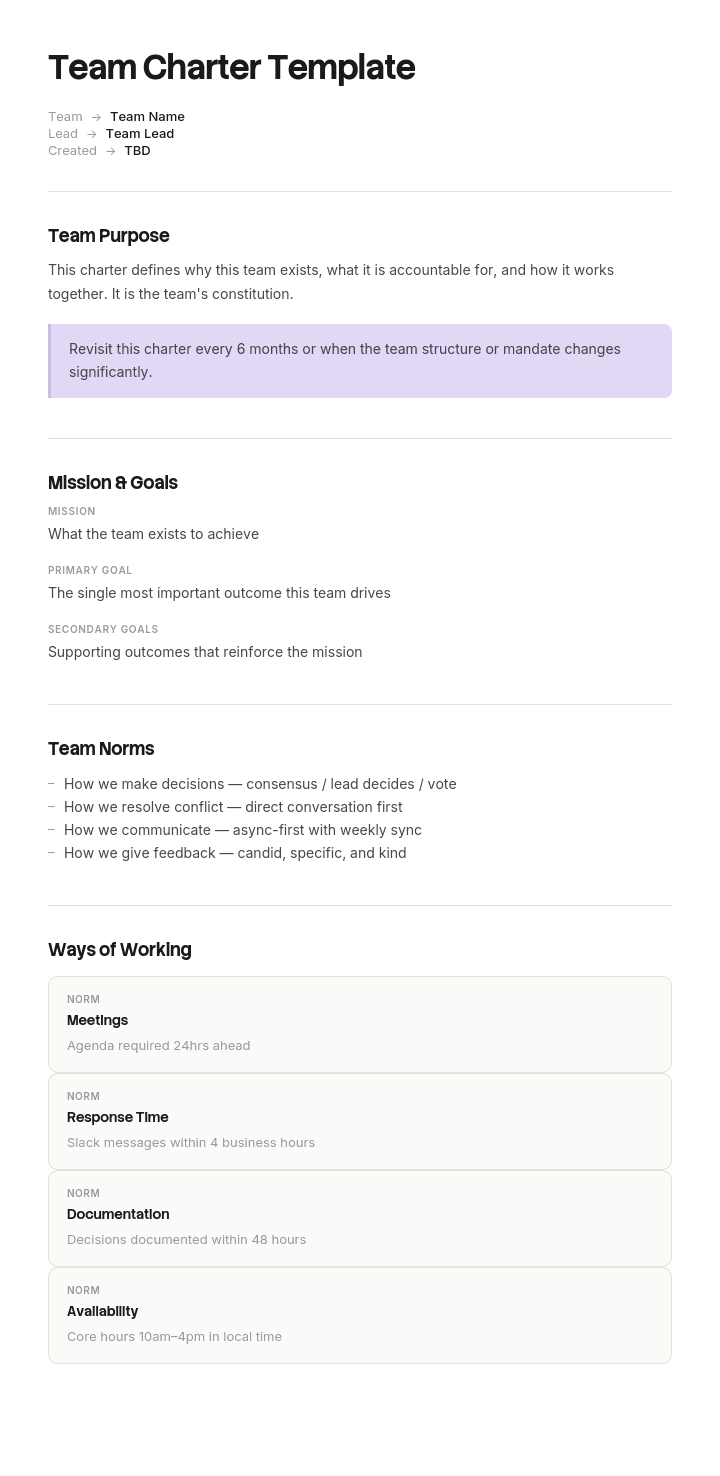
Use this template
A great team charter is what turns a group of people into a high-performing team. With Trupeer, you can save hours on team alignment by starting with a free team charter template, customizing it with your brand guidelines, and turning the charter into a video summary every team member can watch on day one.
What is a free team charter template?
A free team charter template is a reusable structure for a document a team writes together at the start, setting out what they are there to do and how they will work with each other.
The section list is stable across every published version: purpose, scope, roles, goals, ground rules, communication norms, decision making, conflict resolution and meeting rhythm. It is a sensible list and it takes twenty minutes to reproduce.
The document is not the point, though. A team charter is one of the few documents whose value lies almost entirely in the conversation that produces it. A charter written by the team leader and circulated for agreement is a set of instructions with a friendly title.
What the template needs to do, therefore, is provoke the right disagreements. Most of them do the opposite.
Format follows use. A free team charter template Word file suits the document itself, which gets edited during the session and referred to afterwards. A free team charter template PPT or free team charter template PowerPoint layout suits the version displayed during the workshop and pinned up afterwards. A free team charter template Excel file is worth having only for tracking whether each commitment has been tested, and a free team charter template PDF is the agreed and signed copy.
Ground rules everyone agrees to instantly are the ones that fail
Watch a charter session and notice how quickly the ground rules get agreed.
We communicate openly and honestly. We respect each other's expertise. We meet our deadlines. We support each other. We assume good intent.
Nobody objects to any of these, and that is precisely the problem. A statement that produces no discussion is either obvious, in which case writing it down changes nothing, or vague, in which case everybody is agreeing to their own interpretation of it.
Take "we communicate openly". Two people can both believe they are honouring it while one raises concerns immediately in the group and the other raises them privately with the manager a week later. Neither is breaking the rule, because the rule does not distinguish between them, and the disagreement that eventually surfaces is not about behaviour but about what was agreed.
The rules worth having are the ones somebody pushes back on. Pushback means the statement is specific enough to constrain somebody, which is the only property that matters. A charter that produced no argument during drafting has recorded a set of shared aspirations, and shared aspirations are not what a team needs written down.
So the diagnostic is uncomfortable and useful. If the session was easy and finished early, go back.
How to customize this template in Trupeer
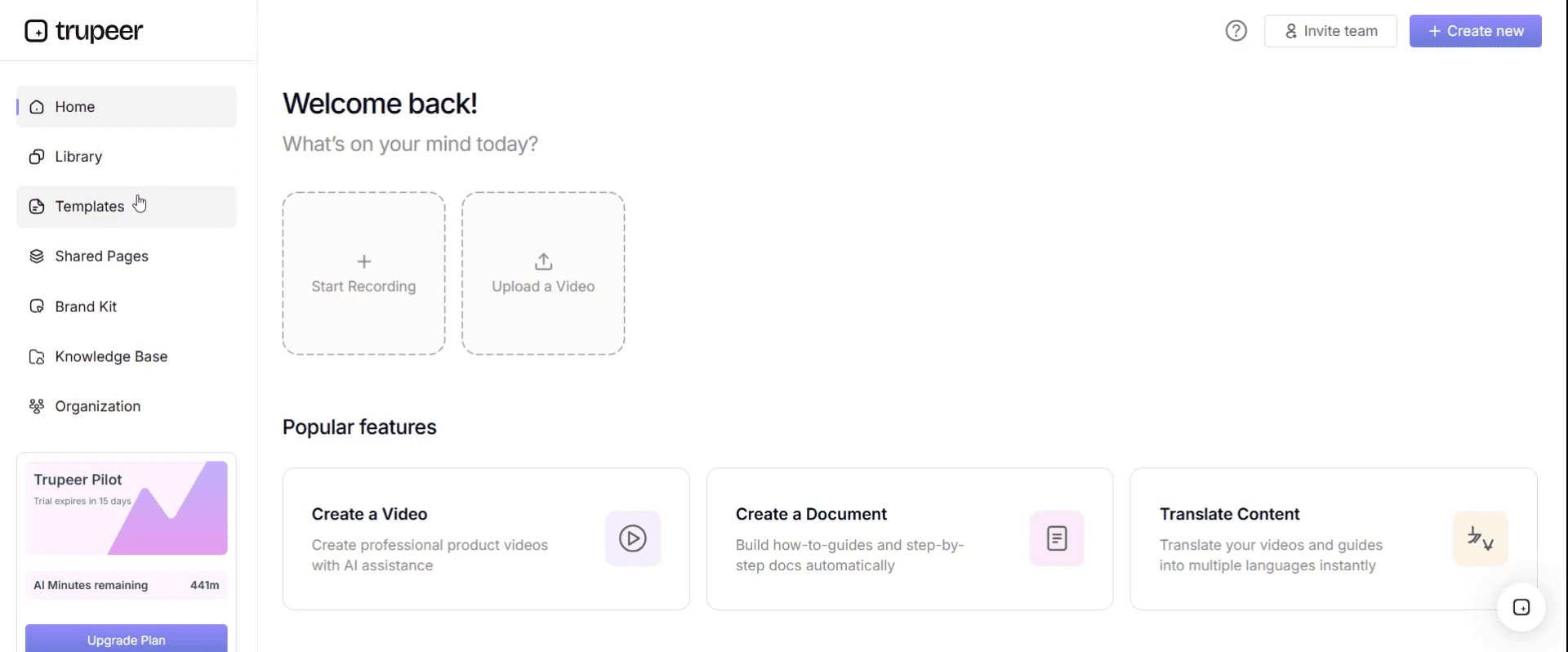
Step 1: Open the Templates Section
Go to the Templates section from the main navigation.
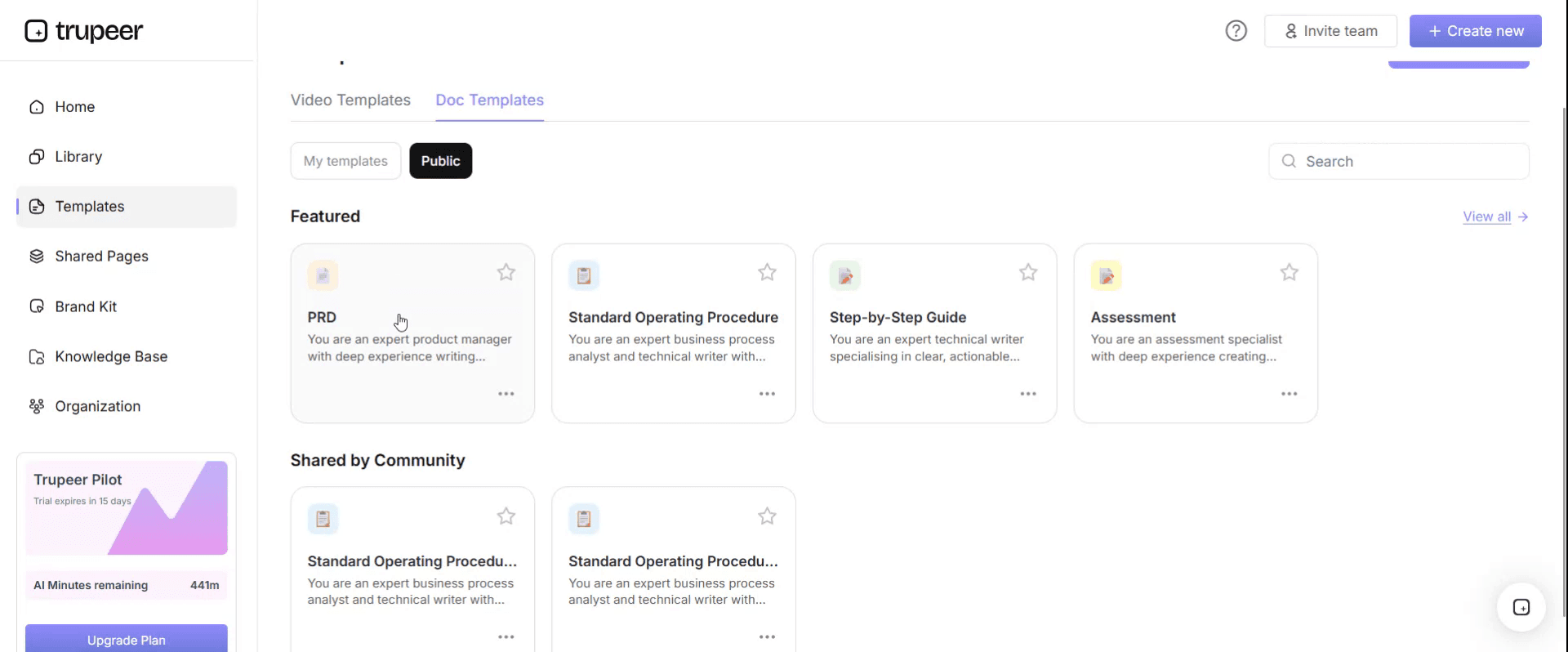
Step 2: Select and Open a Template
Click on any template you want to work with to open it.
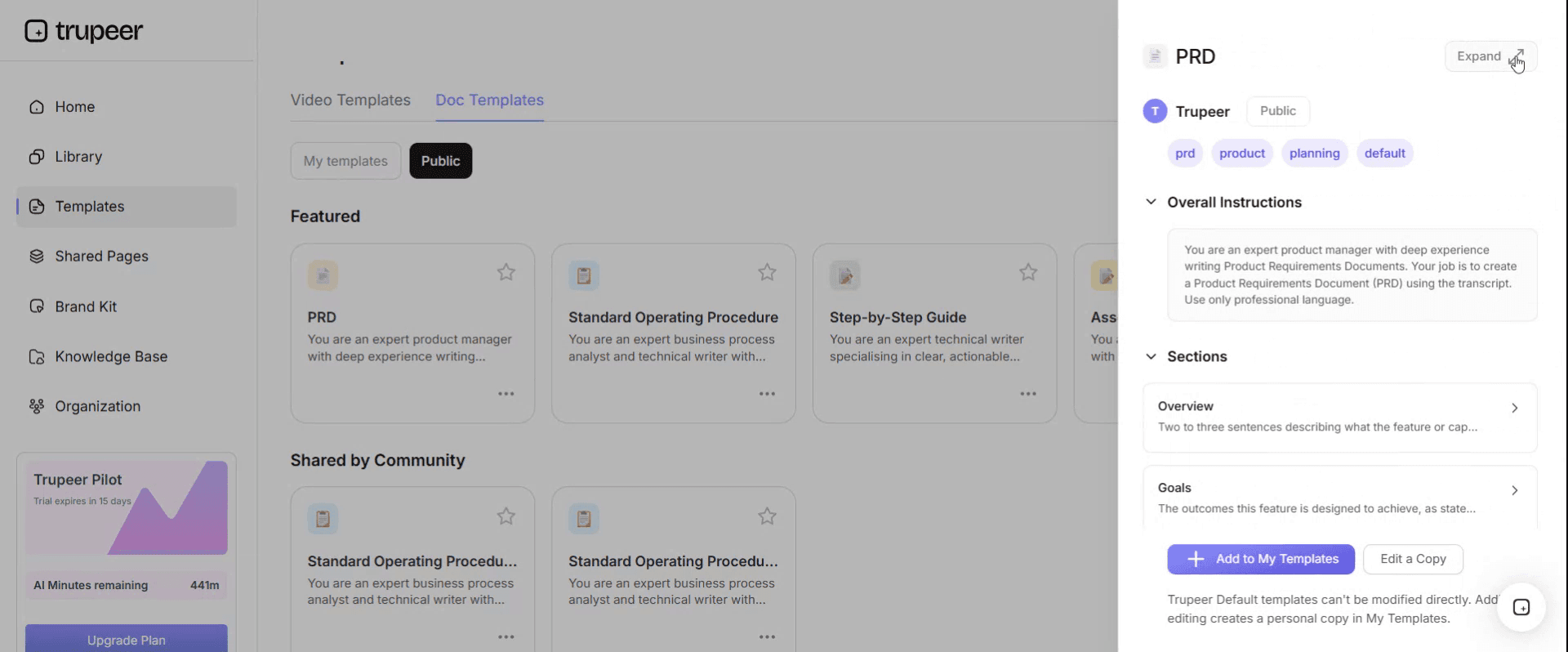
Step 3: Expand the Template View
If needed, expand the template view to see the full layout and details clearly.
Step 4: Edit the Template
Click on Edit to start modifying the selected template.
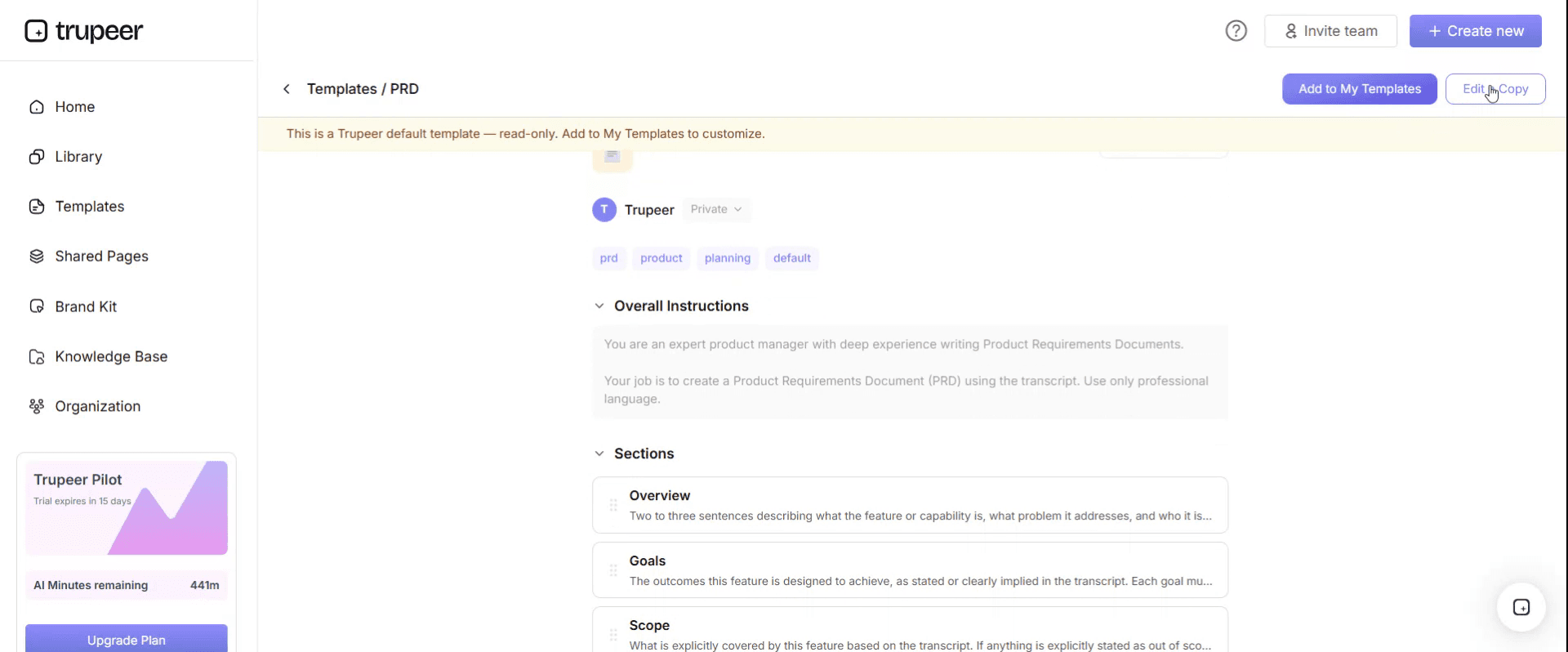
Within the editor, you can:
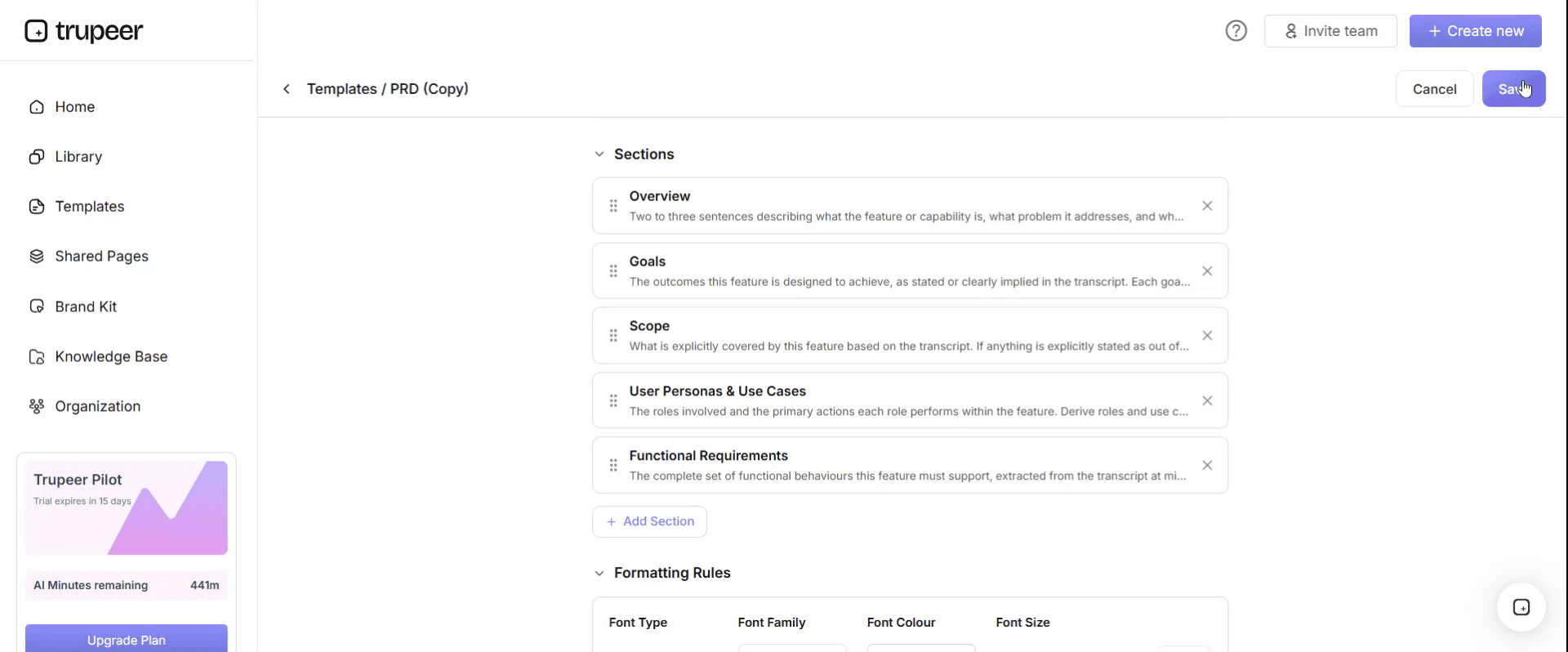
Add new sections
Define or update formatting rules
Add a logo and adjust its position and related settings
Step 5: Save Your Customized Template
After making all necessary changes, click Save to store the updated template as your own.
Step 6: Preview and Fine-Tune the Template
When you want to see how your customized template looks, open the Preview.
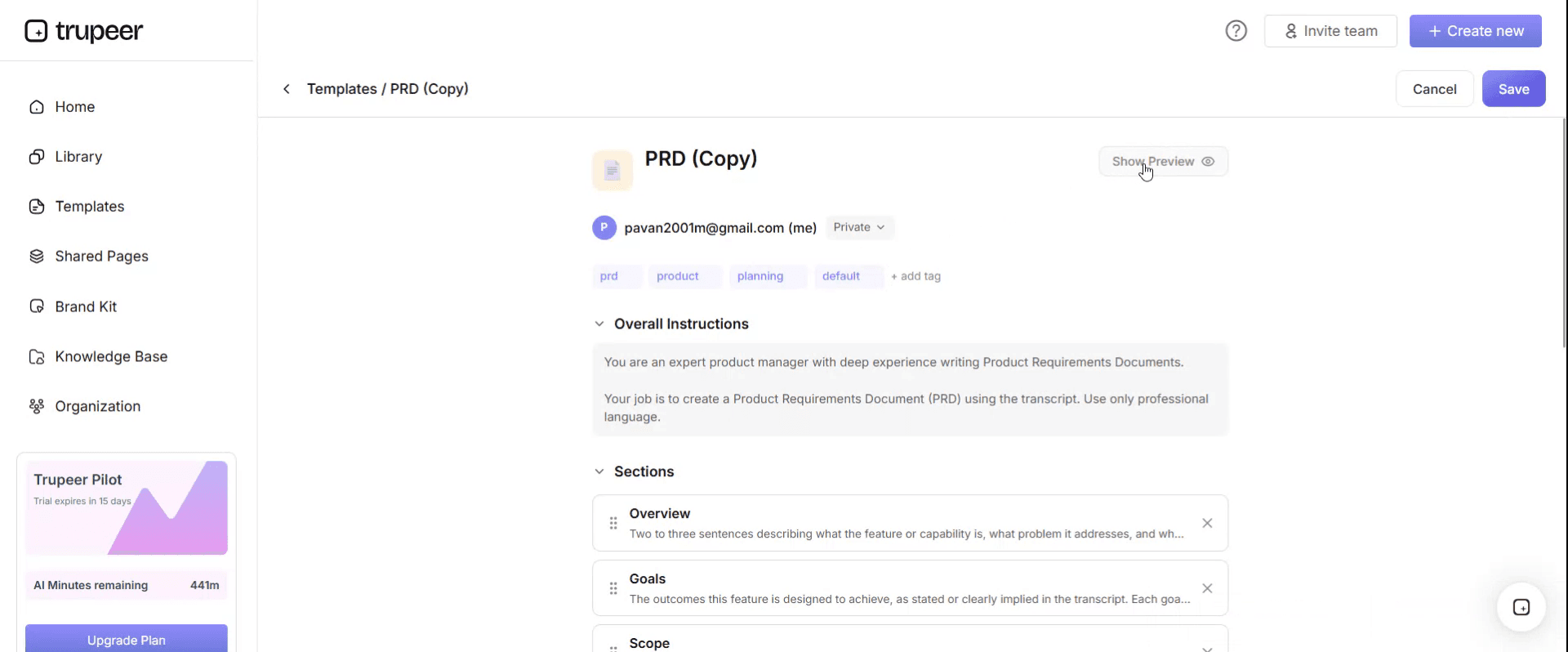
From the preview screen, you can continue to make adjustments directly if needed, ensuring the template appears exactly as you want.
With a team charter template you can:
Save hours on alignment: Skip the blank page with a proven team-charter structure.
Set clear expectations: Built-in sections for goals, roles and working agreements.
Stay on-brand: Apply your logo, fonts and colors using Trupeer's brand kit.
Onboard new members faster: Pair the charter with a video summary for instant context.
Standardize across teams: Use the same template for every team formation.
Reach global teams: Translate team charters into 65+ languages with one click.
Making a commitment testable
The correction is to apply one question to every proposed line: when will this be tested, and what happens then.
"We communicate openly" is never tested, because there is no moment at which anyone could say it had been breached.
"If you are going to miss a deadline you say so at least forty eight hours before, not after" is tested within a fortnight. Somebody will be late, and everybody will know whether the commitment was honoured.
Three properties make a commitment testable.
It names an observable behaviour rather than a value. Values are useful for hiring and useless for a charter.
It contains a threshold or a timeframe. Promptly, regularly and as soon as possible are the words that convert a commitment back into an aspiration.
It says what happens when it is not met. Not a punishment, usually just what the response is. If you miss the forty eight hours, you tell the group at the next stand up and say what you need.
Six testable commitments beat fourteen agreeable ones by a wide margin, and the sessions that produce six take longer than the sessions that produce fourteen.
What a team charter template must contain
Eight components. The testability column is the addition.
Component | What it does |
|---|---|
Purpose | What this team exists to achieve, in a sentence somebody outside the team would understand. |
Members and what each brings | Names, and what each person is here for. Not job titles. |
What success looks like | Two or three outcomes, specific enough to be assessed at the end. |
Commitments | The testable ones. Six or so, each with when it is tested and what happens. |
How decisions get made | Which decisions the team makes together, which individuals own, and what happens when the team is split. |
How disagreement gets escalated | After how long, to whom. The single most valuable section and the one most often absent. |
Meeting rhythm | What meetings exist, who attends, and what each is for. Include which ones people may decline. |
Review trigger | When the charter gets revisited, which should be membership change rather than a date. |
The escalation row is worth dwelling on. Most charters commit to resolving issues within the team, which sounds healthy and in practice produces long silences, because nobody wants to be the person who breached the commitment by raising something. A time limit turns escalation from a failure into a procedure.
Free team charter template: the structure to copy
Filled with a real example rather than placeholders. The team is a cross discipline group in an architecture practice working on a hospital scheme.
Copy from here.
Purpose. To deliver the technical design for the hospital scheme to RIBA stage four, coordinated across disciplines, by the agreed programme date.
Members and what each brings.
Project lead, accountable for programme and client relationship. Lead architect, design intent. Structural liaison, interface with the structural engineer. Sustainability lead, compliance and performance targets. BIM coordinator, model integrity and clash resolution. Plus six discipline architects.
What success looks like. Three outcomes.
Stage four issued by the programme date with no more than two weeks of float consumed. Zero unresolved clashes at issue. Client sign off achieved without a second round of major comments.
Commitments. Six, each testable.
# | Commitment | When it is tested | What happens |
|---|---|---|---|
1 | If you will miss a deadline, you say so at least 48 hours before it, not after | Within a fortnight, repeatedly | You raise it at the next stand up and say what you need. No further consequence. |
2 | A disagreement between two people that is not resolved within 5 working days goes to the project lead | Whenever there is a disagreement | The project lead decides or escalates. Raising it is not a failure and will not be treated as one. |
3 | The project lead does not overrule a discipline lead on a technical matter, but may require the decision to go to the practice board | Whenever disciplines and programme conflict | The decision goes up. Nobody is asked to sign something they consider technically wrong. |
4 | Model changes affecting another discipline are flagged in the daily model note on the day they are made | Daily | The BIM coordinator raises it. Repeated omissions go to the project lead. |
5 | Anyone may decline the Thursday coordination meeting if they have no item, provided they say so by Wednesday noon | Weekly | Nothing. This is a permission, not an obligation. |
6 | Nobody commits the team to a client date without the project lead present or informed the same day | At every client contact | The commitment is revisited with the client rather than absorbed silently. |
How decisions get made. Technical decisions within a discipline sit with the discipline lead. Decisions affecting two or more disciplines go to the project lead, who decides after hearing both, or escalates. Programme and commercial decisions sit with the project lead. Anything changing the agreed scope goes to the practice board.
Escalation. Five working days for a disagreement between individuals. Same day for anything affecting the client or the programme. To the project lead first, then the practice board.
Meeting rhythm. Daily fifteen minute model note review, BIM coordinator and anyone with a change. Weekly Thursday coordination, all disciplines, declinable per commitment five. Fortnightly programme review with the project lead and discipline leads.
Review trigger. Revisited whenever a member joins or leaves, and at each RIBA stage boundary. Not on a calendar.
Agreed by. All eleven members, with the date. Three commitments were argued about during the session and the version above is what was settled.
Copy to here.
That last line is worth including in a real charter. It tells a new joiner which parts were contested, which is the most useful thing they can know.
Team charter example: fourteen rules and three silent weeks
Marne and Faulds, an architecture practice of about ninety people, formed an eleven person cross discipline team for a large hospital scheme.
The team held a half day charter workshop at kickoff. It produced fourteen ground rules. We communicate openly and honestly. We respect each other's expertise. We meet our deadlines. We support one another. We resolve issues within the team.
All fourteen were agreed in about forty minutes. The document was signed by everyone and laminated.
In month five the client requested a structural change. The sustainability lead believed it should be absorbed within the current approach. The BIM coordinator believed it required the coordination model to be rebuilt.
Neither escalated for three weeks.
Both later gave the same reason. The charter said the team resolved issues within itself, and neither wanted to be the person who went to the project lead and broke that. Both kept trying to resolve it directly, and both continued working in the meantime on their own understanding of what had been decided.
By the time it reached the project lead, the coordination model had been developed on the wrong basis. Rework came to about a hundred and ninety hours and the programme slipped five weeks.
The review found that the charter contained fourteen commitments and none of them said how a disagreement gets decided, who decides when the team cannot, or by when.
The rewrite applied one question to every line: when will this be tested and what happens then. Nine of the fourteen could not be answered and were cut.
The replacement had six commitments. The session took two and a half hours rather than forty minutes, because three of the six were argued about properly.
The arguments were the useful part. How long somebody sits on a disagreement before escalating, settled at five working days. Whether the project lead can overrule a discipline lead on a technical matter, settled as no, but they may force the decision upward. And whether missing a deadline requires notice before or after, settled as forty eight hours before.
None of those three was resolvable by goodwill, and all three had been implicitly decided the wrong way by the original charter's silence.
On the next scheme, two disagreements escalated in month three and both were settled within a week.
The first charter had been agreed by everybody in forty minutes because it asked nothing of anybody.
How to run a charter session in six steps
Have the team write it, not the leader. A charter presented for agreement is a policy. The value is in the negotiation.
Start with purpose and success, not ground rules. People argue better about behaviour once they agree what they are trying to achieve.
Propose commitments and apply the test to each. When is this tested, what happens then. Cut anything that fails.
Push on anything agreed too quickly. Ask for a specific example of the commitment being honoured and one of it being breached. If nobody can describe the breach, the commitment is not real.
Settle the escalation rule explicitly. How long, to whom. Do not leave this to be worked out in the moment, because in the moment nobody wants to be the first to escalate.
Record what was contested. Not just the outcome. Future members need to know which lines were fought over.
Step four is the mechanism. Most charter sessions are pleasant because the facilitator accepts the first agreeable phrasing, and a pleasant charter session is a session that avoided the conversations worth having.
When to revisit the charter
The usual advice is to review the charter periodically, which produces a calendar reminder that gets deferred.
A better trigger is membership. Every time somebody joins or leaves, the charter becomes a document agreed by people who are partly no longer there and imposed on somebody who was not in the room.
That matters more than it sounds. A new member inherits commitments they did not negotiate, including the ones that were contested, without knowing which those were. In a team with normal turnover, within eighteen months the charter can be an agreement between people none of whom agreed to it.
Three practical triggers. Any member joining or leaving, which should prompt at minimum a walkthrough with the new person and an invitation to challenge anything. Any phase or stage boundary, where the work changes and the commitments may need to change with it. And any occasion where a commitment was breached and nothing happened, which is evidence the commitment is not real.
The last one is the most useful and the least used. A charter that has been quietly ignored twice without comment is no longer in force, whatever the laminated copy says.
Team charter, project charter or roles and responsibilities?
Three documents that overlap and answer different questions.
A team charter is about how a group of people work together. Purpose, commitments, decision making, escalation. Written by the team, for the team.
A project charter authorises a piece of work. It names the sponsor, the objective, the scope at a high level and the budget, and it is written for and approved by people outside the team. It is a mandate rather than an agreement.
A roles and responsibilities document allocates decisions and accountabilities across roles, and is covered in more depth on the roles and responsibilities template page. A team charter usually contains a light version of this and defers the detail.
The common confusion is between the first two, and the test is who agrees it. If the document exists so that a sponsor can authorise work, it is a project charter. If it exists so that a team can work together, it is a team charter. Producing one when the other is needed leaves either the team without an agreement or the work without a mandate.
Detailed scope boundaries belong in neither and sit in the project scope.
Team charter template variants
The structure holds and the emphasis moves with the kind of team.
Project team charter. Time bound, with a defined end. Success criteria and escalation matter most, since the team disbands before most cultural norms have time to develop.
Agile or scrum team charter. Overlaps heavily with the team's working agreement and definition of done. Keep them as one document rather than two, since two will diverge.
Six Sigma or improvement team charter. Conventionally includes the problem statement, scope and business case as well as the team agreement, because it doubles as the project mandate. This is the variant where team charter and project charter genuinely merge.
Leadership team charter. The hardest to write honestly, because the people writing it are the people who would enforce it, and the commitments that matter concern how they disagree in front of others.
Cross functional or matrix team charter. Escalation is the critical section, since members have two reporting lines and a disagreement can be escalated in two directions with different results.
Remote or distributed team charter. Add response time expectations, which meetings are synchronous, and what counts as being available. These are the commitments that cause friction when unstated and are easy to make testable.
What a free team charter template cannot fix
A charter written by one person. No template converts a circulated document into an agreement.
Commitments nobody enforces. A breached commitment that passes without comment teaches the team that the charter is decorative, and the second breach costs nothing.
A team with no real authority. If the team cannot decide anything, a decision making section is theatre and the charter will feel like one.
Sections inherited unchanged. A Team Charter example PDF from another organisation will hand you their ground rules, which are the least transferable part of any charter.
Aspirational language. No free team charter template free download will stop you writing that the team values transparency. Only somebody in the room asking when that gets tested will.
Show how the work is done, not just how the team works
A charter settles how people work with each other. It does not settle how the work itself is done, and new members need both.
That second half is where teams lose time repeatedly. Somebody joins, receives the charter, understands the meeting rhythm and the escalation rule within an hour, and then spends three weeks learning the actual mechanics of the job from whoever is nearest and least busy.
Trupeer AI covers that half. Somebody performs the task once while recording, and the output is a written walkthrough with screenshots already captured and placed, alongside a video, in your own branding. The charter tells a new member how the team behaves. The recordings tell them how the work is done.
Record it. Brand it. Translate it. Trupeer it.
That pairing is most useful at the moment the charter should be revisited anyway, which is when membership changes. Where teams span sites or languages, the same recording produces the same guidance in each, so a distributed team is working one way rather than several.
The material sits in your knowledge base and doubles as training. Task level procedure belongs in the work instructions. Consistency across your documents is a matter of setting the brand kit once, and setup is covered in the document template setup guide.
Frequently Asked Questions
Is there a free team charter template Word version?
Word suits the charter itself, because it gets edited live during the session and referred to afterwards. A team charter template Word file is the right working format, and editing it on a shared screen while the team argues is the correct way to use it.
Build the commitments as a three column table: the commitment, when it is tested, and what happens then. Those second and third columns are what stop the session settling for agreeable phrasing.
Is there a free team charter template PPT or free team charter template PowerPoint version?
Slides suit the workshop and the version that goes on a wall afterwards. A free team charter template PPT layout works for facilitating the session, and a free team charter template PowerPoint file is the same thing under its longer name.
Do not let the slide become the charter. A one slide version will hold the purpose and the commitments and will drop the escalation rule and the decision making section, which are the parts that get used.
Is there a free team charter template Excel version?
Excel is a poor fit for a charter, which is mostly prose and negotiated wording. A free team charter template Excel file makes sense only for the commitments table if you want to track whether each has been tested and what happened.
That tracking is genuinely useful for the first three months. A commitment that has never been tested may not be relevant, and one breached twice without comment is no longer in force.
Is there a free team charter template PDF?
PDF is the agreed version. Export a free team charter template PDF once the team has settled it, with the date and everyone's names on it, and circulate that.
Keep the editable source, because the charter should change when membership changes, and a document you can only revise by rebuilding will be quietly abandoned instead.
Where can I find a Team Charter example PDF?
Universities, public sector improvement teams and healthcare organisations publish these, and a Team Charter example PDF from one of those sources is more instructive than a commercial template because it was written by a real team for real work.
Read a Team Charter example PDF for the escalation and decision making sections rather than for the ground rules. Ground rules are broadly identical everywhere and transfer poorly. How a specific team decided to settle disagreements is the part worth borrowing.
Is there a free team charter template free download worth using?
The section list takes twenty minutes to build, so a free team charter template free download saves very little, and every one of them offers the same sections.
Judge any of them on one question. Is there a place to record when each commitment gets tested? None have it, and without that column a charter session will produce fourteen agreeable statements in forty minutes, which is the outcome to avoid.
Who should write the team charter?
The team, together, in one session, with the leader participating rather than presiding. A charter written by the manager and circulated for comment gets comments like fine by me, which is not agreement, it is compliance.
Where a team is large, a subgroup can draft and the whole team must be able to change it. The test is whether anybody who was in the room could name something they argued about. If nobody can, the document was accepted rather than agreed.
How long should a team charter be?
One to two pages. Six commitments, a decision making section, an escalation rule and a meeting rhythm will fit comfortably.
Length correlates negatively with usefulness here. The fourteen rule charter in the example above was longer than the six commitment version that replaced it, and it was longer precisely because nothing in it was specific enough to be contested.

