4.8/5
Free Automated Documentation Creation Update & Distribution Tool
Record a workflow once. Trupeer AI generates video and docs, updates them when the workflow changes, and distributes them through a single branded link in 65+ languages.
Automate Documentation Free
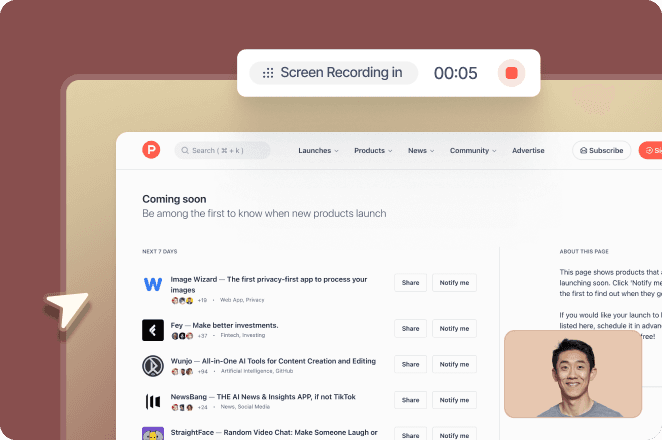
Trupeer AI's automated documentation tool handles the three stages where documentation usually breaks: creation, updates, and distribution. Record a workflow once. The AI generates a polished video plus a written document. Re-record the changed parts when the workflow shifts. Share the result through a single branded link that updates in place. Most documentation projects fail in stage two or three, not stage one, which is why traditional document automation software helps with creation but leaves teams to maintain and distribute everything manually.
End-to-end document workflow automation: record once, generate video plus written documentation together.
Update by re-recording just the changed section. The rest of the document stays put. No starting from scratch.
Distribute through a branded Shared Page link that embeds into Slack, intranet, LMS, or anywhere the company already shares content.
65+ languages for global teams. Translation applies to both the video and the document in the same job.
AI avatars and voiceovers available when the original recorder isn't available.
Creation: record once, get a polished video and a written document together
Documentation creation usually means someone writes a draft, someone else records a screencast separately, and a third person tries to keep them aligned. Trupeer AI compresses that into one job. Record a screen walkthrough, a webcam explainer, or upload existing footage. The AI removes filler words, smooths cursor jitter, adds zoom effects where they help the viewer, and generates a draft video plus a draft written document at the same time.
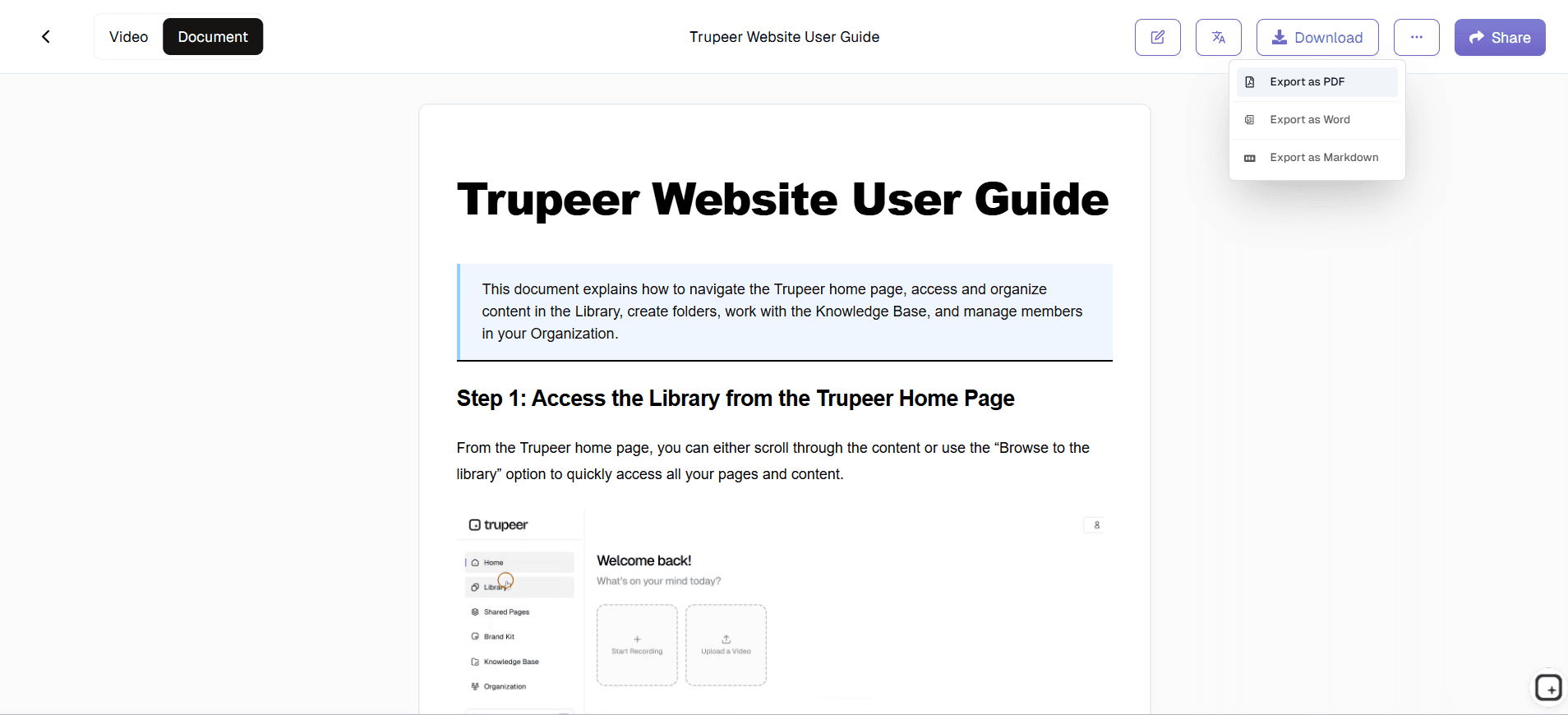
The video output is MP4. The document output is PDF or Word, ready for handing to a reviewer or dropping into the knowledge base. Brand kit applies automatically: corporate logo, colors, fonts, intro and outro slides all match the rest of the company's documentation library without a designer in the loop. Product names and brand terminology stay consistent through a custom glossary, so internal tool names don't get auto-corrected into something nonsense in either the video voiceover or the written guide. The AI screen recording layer handles cursor highlighting, region focus, and automatic zoom on UI interactions, which is what most document automation tools either skip or do badly.
Update: re-record the changed section, keep the rest
Most document automation software treats updates as a content rewrite. Trupeer AI treats them as a regeneration. When the underlying workflow changes, the original recorder records just the section that changed. The AI re-processes only that segment. The document updates in place. The video updates in place. The Shared Page link the team distributed last quarter now points to the current version, so anyone who bookmarked the original link or embedded it in their team's wiki gets the new content without any manual chase-down.
This is where ai document automation actually pays off in business document automation work. Workflow tweaks, UI changes, regulatory updates, and product feature releases all break documentation the same way: a step in the middle of a 10-step process changes, and the old documentation is now misleading rather than just incomplete. Misleading documentation is worse than no documentation. The re-record-just-the-changed-part flow keeps the documentation current without forcing the team to choose between "update everything" and "leave it wrong." That update model is what most enterprise document automation rollouts try to engineer and rarely manage to deliver.
Distribution: one branded link that updates in place
Trupeer AI ships every video and document as a Shared Page: a branded landing page with the company logo, an embedded video and document, and a call-to-action link the team can customize per audience. The link goes anywhere. Embedded in the knowledge base, posted in Slack, dropped into a help center article, sent directly to the team or customer who needs the documentation. One link instead of five places to host the same content.
For global teams, Trupeer AI's translation handles 65+ languages, applied to both the video and the document in the same job. The Madrid office gets the Spanish version. Tokyo gets it in Japanese. Berlin gets it in German. All from the same source recording, in the same week. Translation matters more for documentation than for most content types because misunderstood instructions create real downstream problems: a process step done wrong, a feature configured incorrectly, an audit finding that takes a week to chase down. Document automation solutions that skip the translation layer end up forcing global teams to either work in English or rebuild the documentation locally, both of which defeat the point of centralizing documentation work.
How automated documentation works in three steps
The full document workflow automation flow takes one recording and produces ship-ready content. No video editor, no separate documentation pass, no distribution scramble.
Step 1: Record the workflow on screen
Hit record in the browser, capture the workflow as it's actually done, or upload an existing video. The AI works on what's recorded. No separate scripting pass, no preparation overhead. The richer the recording (more context, more detail), the richer the documentation that comes out the other side.
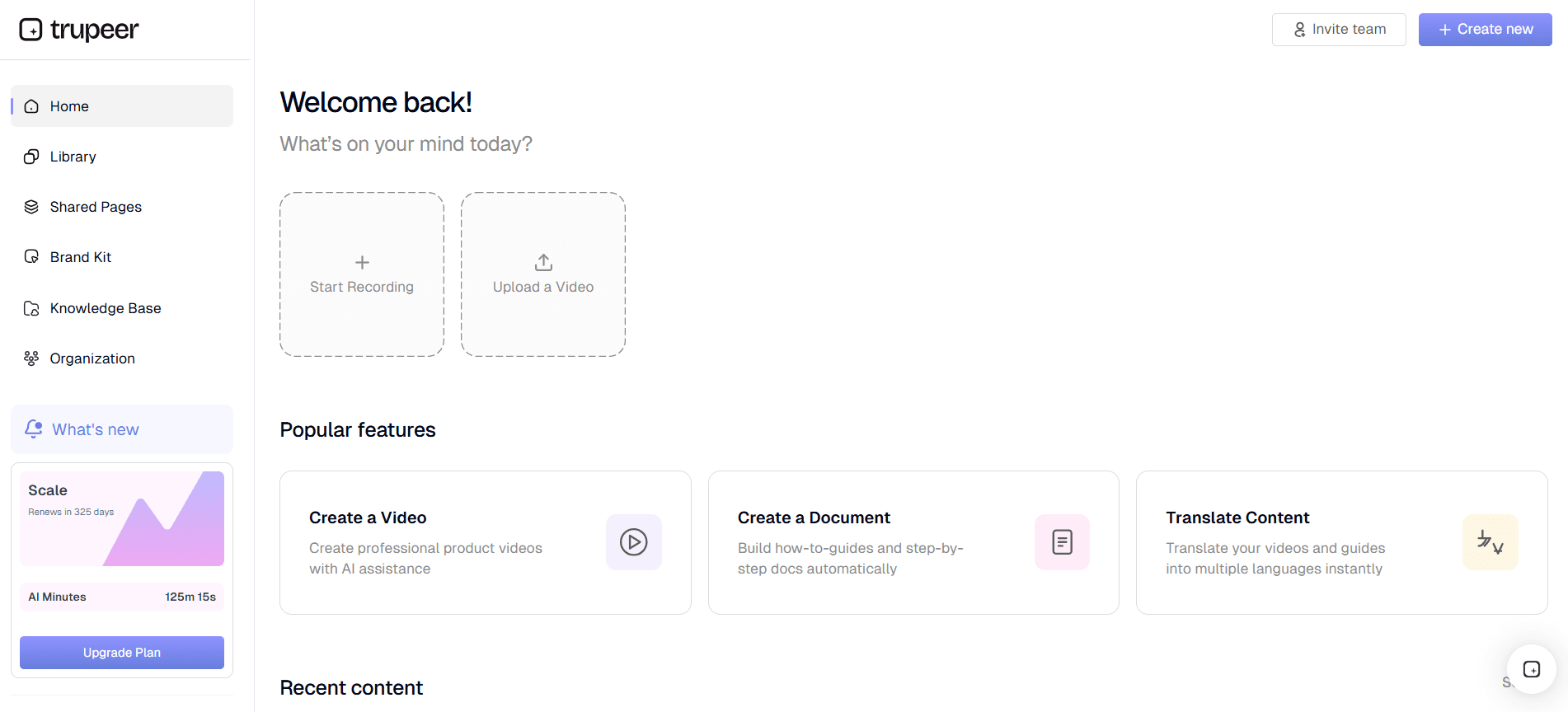
Step 2: Trupeer AI generates the video and document
Filler words get removed. Zoom and cursor effects get added where they help the viewer follow the workflow. A draft video and a draft written document show up in the editor together. The custom glossary applies, so internal product names get spelled and pronounced correctly in both outputs.
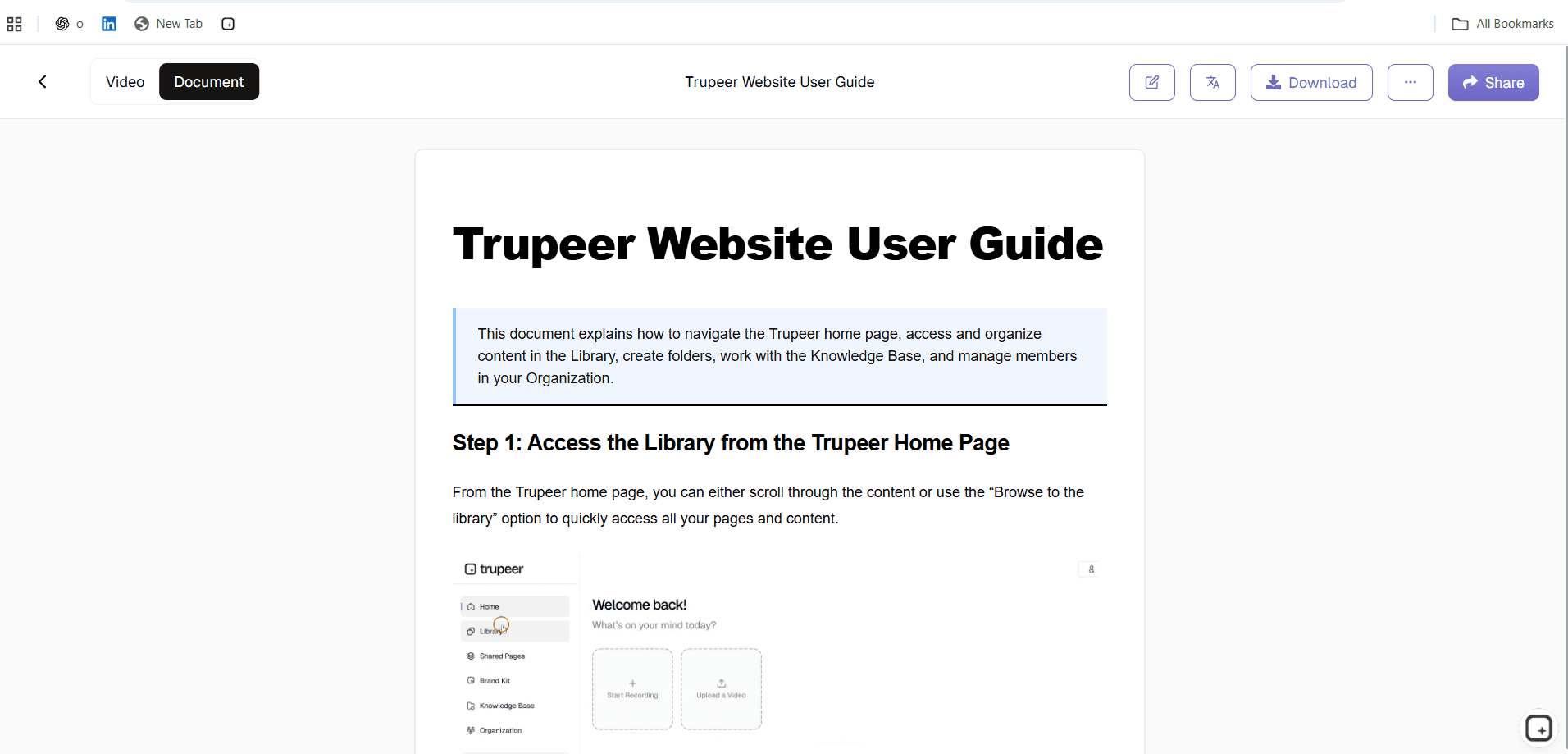
Step 3: Brand, translate, and distribute
Apply the brand kit so the corporate logo, colors, and intro/outro slides match the rest of the documentation library. Translate into Spanish, Mandarin, Hindi, Portuguese, or any of 65+ languages the company speaks. Then ship via a Shared Page link the team can embed in any knowledge base, intranet, LMS, or help center.
Who actually opens an automated documentation tool
The person who opens this tool is usually a documentation owner or operations lead at a company where documentation has been a recurring complaint for at least a year. The pattern is consistent: the company tried two or three different document automation platforms, settled on a wiki or a help center as the storage layer, and got stuck on the upstream problem of actually producing the documentation that's supposed to live in those systems. Trupeer AI fills the production gap.
The same pattern shows up across roles. IT teams reach for it as an IT documentation tool covering internal systems, software deployments, and incident runbooks. Sales operations leaders use it for CRM document automation work, covering how to use the CRM correctly across regions. Support managers use it to keep customer-facing help documentation current as the product changes. Engineering managers use it as a process documentation tool, capturing how the team's actual workflows function rather than how they were originally designed. Some teams treat it as their primary document automation platform; others use it alongside existing automated documentation tools they've already invested in.
Use cases for enterprise document automation
Enterprise document automation usually starts with the most repetitive content. Process documentation covers the workflows that get explained to new hires every quarter. Sales document automation covers the product knowledge content sales teams need updated after every release. CRM document automation covers how the company actually uses its CRM, which is always different from how the vendor's documentation says it should be used. For business document automation more broadly, the most common pattern is starting with documentation that's already proven to be valuable and is just stale. The team that owns the documentation knows what's broken. They don't need help prioritizing. They need help producing.
Document automation benefits compound once the team realizes they can update existing documentation by re-recording, instead of treating every update as a full rewrite. By the third or fourth re-record cycle, the team starts treating documentation as a living asset rather than a one-time deliverable. That shift is the actual structural change these tools are supposed to enable. Intelligent document automation earns its keep when the team can run the full flow without a training session. Trupeer AI's document automation workflow takes about fifteen minutes to learn end-to-end. The longest part is usually the first recording, because the team is still thinking about what to include. By the tenth, documentation has stopped being a project and started being a habit. That habit shift is what differentiates intuitive document automation software from a screen recorder with extra steps. Pairing the generator with the Trupeer AI SOP builder covers the procedural documentation that sits underneath the recorded workflows.
Why teams choose Trupeer AI for the documentation lifecycle
Creation in one job, not three
Record once, get video and documentation together. No separate screencast tool, no separate writing pass.
Updates by re-recording, not rewriting
When the workflow changes, re-record the section that changed. Document updates in place. Shared Page link stays the same.
Distribution through a single link
One branded Shared Page embeds in any knowledge base, LMS, or help center. Updates propagate to everyone who has the link.
Automate documentation in three steps
1단계
Record the workflow on screen or upload existing footage
2단계
Trupeer AI generates the video and written documentation together
3단계
Brand it, translate, and distribute via one Shared Page link
자주 묻는 질문
Is the automated documentation tool free to use?
Yes for the core flow. Record a workflow, generate the polished video and written document, and share via a Shared Page link without paying. Paid tiers add brand kits, AI avatars, custom voice cloning, team workspaces, translation across 65+ languages, and longer recording limits. Pricing details on the pricing page.
What is document automation software, and how is Trupeer AI different?
Document automation software is any tool that reduces the manual work of producing documentation, usually through templating, AI generation, or automated workflows. Trupeer AI focuses on the lifecycle: creation from screen recording, updates by re-recording the changed section, and distribution through a single branded link. The trade-off versus traditional document automation platforms is that Trupeer is built for workflow documentation (how something gets done) rather than form-based documents like contracts or compliance forms.
What inputs and outputs does the automated documentation tool support?
Inputs: screen recordings, webcam recordings, uploaded video files, audio files, and text scripts. Outputs: video as MP4 and document as PDF or Word (DOCX). Both also ship as a Shared Page, which is a branded link that embeds anywhere the company already shares content. Translation in 65+ languages applies to both video and document in the same job.
Can the automated documentation tool integrate with our existing knowledge base?
Yes. Trupeer AI doesn't replace the knowledge base. The Shared Page link embeds into any knowledge base, intranet, help center, or LMS that accepts embedded video or document. The knowledge base stays as the storage and discovery layer. Trupeer AI handles the upstream problem of where the documentation content actually comes from, and the downstream problem of keeping it current as workflows change.
What happens when the underlying workflow changes?
Re-record just the section that changed. Trupeer AI re-processes the affected segment. The video and document update in place. Anyone who has the original Shared Page link sees the new version automatically. The team doesn't have to chase down everyone who bookmarked the link, re-embed it in any wiki, or rebuild the documentation from scratch. That update model is what makes lifecycle automation more useful than creation-only automation.
도구 더 보기