
이 템플릿 사용
When the same process runs differently in every team, site or acquired business, everything gets harder. Results can't be compared, training has to be repeated for each variant, automation only works in one place, and every new system implementation turns into a negotiation. Process standardization fixes that by agreeing one best way of working and rolling it out everywhere it applies. A process standardization template gives that work a clear, repeatable structure.
This free process standardization template covers scope, a variation analysis across sites, the agreed standard process, allowed local variations, the rollout plan, training and the controls that keep the standard in place. It includes a filled-in example and guidance for multi-site, shared services and post-merger standardization. Copy the structure below, or open it in Trupeer and customize it.
What is a process standardization template?
A process standardization template is a structured document for designing and rolling out one standard way of performing a process across teams, sites, regions or business units. It records how each location does the process today, the differences between them, the agreed standard, any approved local variations and their reasons, the rollout and training plan, and how compliance with the standard will be measured and sustained.
Standardization sits between documenting the current process and running the new one. For documenting the agreed standard itself, use the standard work template.
Why standardize processes?
Consistent quality and customer experience, wherever the work is done.
Comparable performance, so you can see which teams need support.
Faster training, with one process and one set of materials.
Easier automation and system implementation, because there's one process to automate or configure.
Lower risk, with controls applied the same way everywhere.
Easier transitions and shared services, because work can move between teams.
Who uses a process standardization template?
Process excellence and operational excellence teams leading standardization.
Global process owners who own a process across the organisation.
Shared services and GBS leaders consolidating work from many sites.
Integration teams harmonizing processes after mergers and acquisitions.
ERP programme teams designing a global template.
Operations and site managers adopting the standard locally.
Preview the process standardization template
The template opens with a summary: process, owner, scope, sites and objectives. A variation analysis compares how each site performs each step today. The standard process section sets out the agreed steps, roles, systems and controls, with a table of allowed local variations and their justification. Rollout, training and communication plans follow, then measures of adherence and a governance section for keeping the standard current. Every section is editable, so you can add sites, steps or measures.
How to customize this template in Trupeer
Step 1: Open the Templates Section
Go to the Templates section from the main navigation.

Step 2: Select and Open a Template
Click on any template you want to work with to open it.
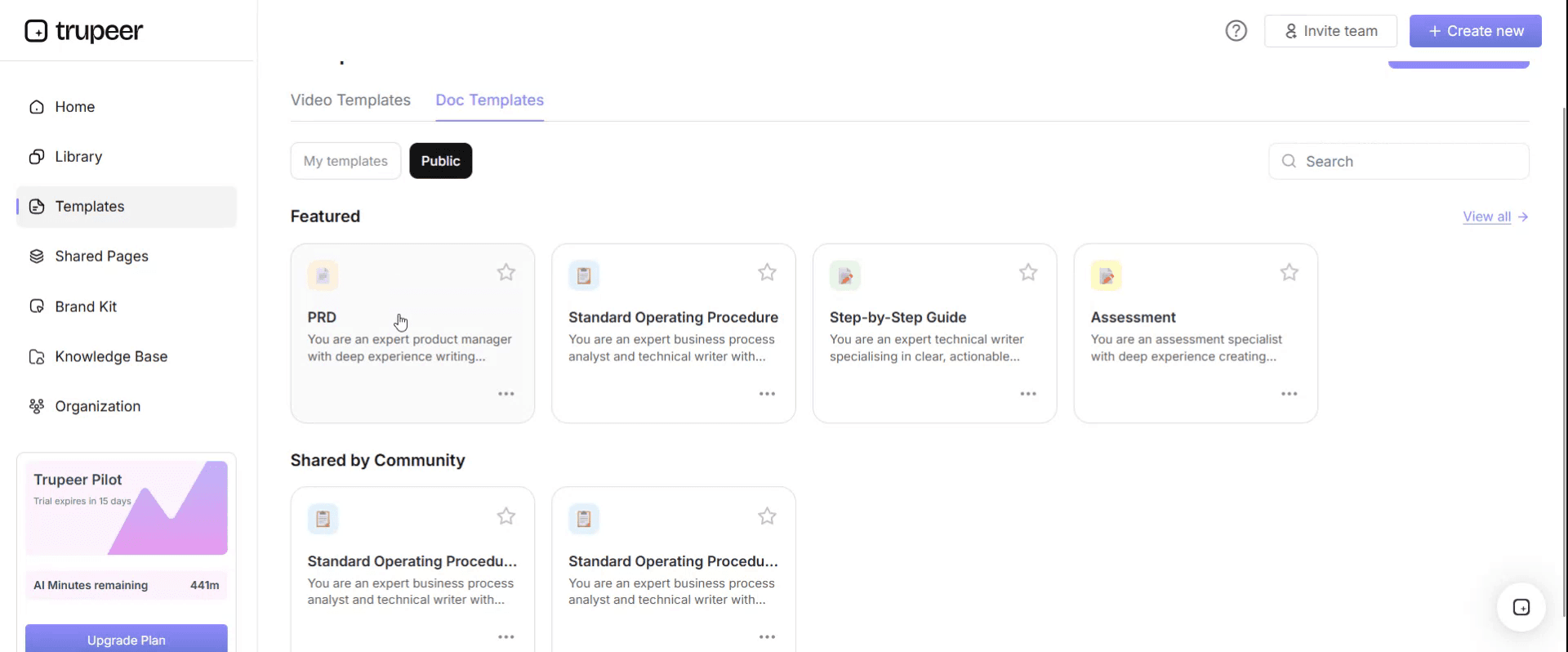
Step 3: Expand the Template View
If needed, expand the template view to see the full layout and details clearly.

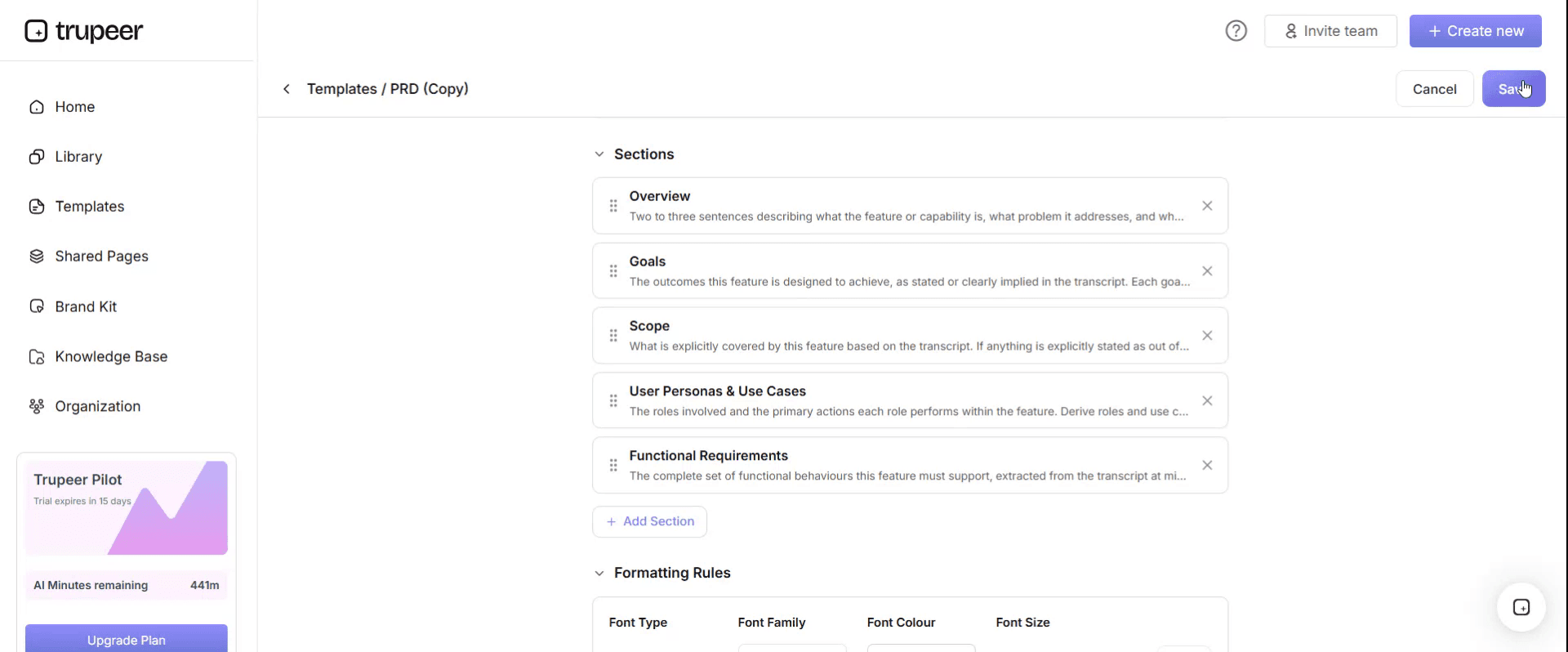
Step 4: Edit the Template
Click on Edit to start modifying the selected template.

Within the editor, you can:
Add new sections
Define or update formatting rules
Add a logo and adjust its position and related settings
Step 5: Save Your Customized Template
After making all necessary changes, click Save to store the updated template as your own.
Step 6: Preview and Fine-Tune the Template
When you want to see how your customized template looks, open the Preview.

From the preview screen, you can continue to make adjustments directly if needed, ensuring the template appears exactly as you want.
With a process standardization template you can:
See how each site really works before choosing the standard.
Choose the best way, not the loudest voice, using evidence and measures.
Allow only the variations you need, with recorded reasons.
Roll out the standard with training and support.
Keep the standard in place with adherence measures and governance.
What a process standardization template must contain
Section | What it covers |
|---|---|
Summary | Process, global owner, scope, sites, objectives and timeline |
Current state by site | How each site performs the process today, ideally from recordings |
Variation analysis | Differences in steps, roles, systems, controls and performance |
Standard process | The agreed steps, roles, systems, inputs, outputs and controls |
Allowed local variations | Approved differences, such as legal or language requirements, with reasons |
Measures | Performance and adherence measures for the standard |
Rollout plan | Sequence, dates and owners by site |
Training and communication | Materials, sessions and messages for each site |
Governance | Who owns the standard, how changes are requested and how often it's reviewed |
Sign-off | Global owner and site leads |
Free process standardization template: the structure to copy
Copy the structure below into your own document, or open it in Trupeer and customize it.
1. Summary. Process: [name]. Global process owner: [name]. Scope: [starts when … ends when …]. Sites: [list]. Objectives: [such as consistency, cycle time, quality]. Timeline: [dates].
2. Current state by site. For each site, link to the as-is documentation or recording and note volumes and key measures.
3. Variation analysis.
Step | Site A | Site B | Site C | Difference | Why it differs |
|---|---|---|---|---|---|
[Step] | [How it's done] | [How it's done] | [How it's done] | [Summary] | [Reason: legal, system, habit, customer] |
4. Standard process.
Step | Role | System | Action | Control | Output |
|---|---|---|---|---|---|
[Step] | [Role] | [System] | [Action] | [Control] | [Output] |
5. Allowed local variations.
Variation | Sites | Reason | Approved by | Review date |
|---|---|---|---|---|
[Variation] | [Sites] | [Legal, regulatory, language, customer contract] | [Global owner] | [Date] |
6. Measures. Performance: [cycle time, error rate, cost]. Adherence: [share of work following the standard, number of unapproved variations].
7. Rollout plan. Site, go-live date, site lead, readiness criteria and support.
8. Training and communication. Materials: [SOP, video, job aids]. Sessions: [by site]. Messages: [why, what changes, when, where to get help].
9. Governance. Owner: [global process owner]. Change requests: [how submitted and approved]. Review: [frequency].
10. Sign-off. Global process owner and site leads, with dates.
Process standardization example: invoice processing across three sites
Here's how part of the variation analysis and standard might look for invoice processing in a shared services consolidation. The details are illustrative.
Step | Site A | Site B | Site C | Agreed standard |
|---|---|---|---|---|
Receive invoices | Shared mailbox | Paper scanned locally | Supplier portal | Supplier portal and one shared mailbox |
Data entry | Manual in ERP | Manual in ERP | Automated capture | Automated capture for all sites |
Price variance | Email the buyer | Phone the buyer | ERP workflow | ERP workflow with defined tolerance |
Approval of non-PO invoices | Paper sign-off | ERP workflow | ERP workflow by approval limit | |
Filing | Local folder | Paper archive | ERP attachment | ERP attachment |
Allowed local variation. Site B keeps a local tax check required by its country's regulations, documented in the standard as a country step.
Rollout. Site C first, because it's already closest to the standard; then Site A; then Site B after its scanning is replaced.
How to standardize a process step by step
Choose the process with the most variation, volume or risk.
Appoint a global process owner with authority to decide the standard.
Capture how each site works today, ideally by recording the real work; see the process documentation template.
Analyse the variations and the reasons behind them: legal, system, customer or habit.
Design the standard from the best-performing practice, with input from every site.
Agree allowed variations only where there's a real reason, and record it.
Document the standard as an SOP and short videos for each role.
Roll out site by site, with training, support and readiness checks.
Measure adherence and performance, and fix the causes of drift.
Govern the standard, with one owner and a change process.
How to tell a necessary variation from a habit
Reason for the difference | Usually… |
|---|---|
Legal or regulatory requirement | A necessary variation; keep and document it |
Customer contract | Often necessary; review at contract renewal |
Language | Necessary for documents, not usually for the process itself |
System limitation | Temporary; plan to remove it when systems are aligned |
"We've always done it this way" | A habit; standardize |
Local workaround for an upstream problem | Fix the upstream problem, then standardize |
Keep the list of allowed variations short. Every variation adds training, documentation and control effort.
Process standardization after mergers and acquisitions
After an acquisition, the same processes often run in two or more ways, in different systems, with different controls and cultures. Standardization is part of integration, but it also asks people to give up familiar ways of working. Start with processes where differences create risk or block reporting, such as finance close, procure to pay and payroll. Capture both companies' current processes by recording them, so the debate is about evidence, not loyalty to the old way. For how video helps people accept the change, see process harmonization after M&A.
Process standardization for shared services and ERP
Shared services centres and global ERP templates both depend on standard processes. In a shared services consolidation, standardize before or during the transition, so the centre runs one process instead of inheriting every site's variant. In an ERP programme, the global template is a standardization exercise: the variation analysis feeds the fit-gap analysis, and allowed local variations become country localizations. For the gap decisions, use the fit-gap analysis template.
Who owns process standardization?
Role | Responsibility |
|---|---|
Global process owner | Decides the standard, approves variations and owns performance across sites |
Site process leads | Represent their site in design, lead local rollout and report adherence |
Process excellence or transformation team | Runs the variation analysis, facilitates design and tracks benefits |
Training and change leads | Produce materials and support people through the change |
IT and system owners | Align systems and configuration with the standard |
Executive sponsor | Resolves disputes between sites and removes blockers |
Without a global owner with real authority, standardization usually stalls at the design stage, because every site can argue for its own way.
Process standardization KPIs
Adherence: share of transactions following the standard process.
Approved variations: number in place, and any that have expired without review.
Cycle time and cost per transaction, compared across sites.
Error and rework rates, compared across sites.
Time to proficiency for people joining any site.
Training reuse: share of materials used across all sites rather than per site.
Measure before and after rollout, and compare sites against each other rather than only against the old process.
How to keep a standard in place
Measure adherence, not just performance, for example the share of transactions following the standard workflow.
Make the standard easy to follow, with short videos and job aids at the point of work.
Give one owner the authority to approve changes.
Review the standard regularly, and when systems, regulations or results change.
Investigate drift, because local workarounds often signal a real problem with the standard.
For the document that keeps everyone on the same version, see SOP version control.
Common mistakes to avoid
Picking the standard from the head office process without looking at what works best.
Allowing every site its own exceptions, so nothing is really standard.
Standardizing the document, not the practice, with no training or support.
No global owner, so the standard drifts.
Ignoring the people side, especially after mergers.
Process standardization checklist
A global process owner is appointed.
Each site's current process is captured with evidence.
Variations are analysed with their reasons.
The standard is designed from the best practice, with site input.
Allowed variations are short, justified and approved.
The standard is documented as an SOP and videos for each role.
Rollout, training and communication are planned by site.
Adherence and performance are measured.
Governance and review are in place.
How Trupeer helps you standardize processes
Standardization challenge | How Trupeer helps |
|---|---|
Nobody knows how each site really works | Record the process at every site, and Trupeer turns each recording into a step-by-step document for side-by-side comparison |
Debates are based on opinion | Recordings give every site's process as evidence |
The standard is hard to teach | Record the standard once and turn it into an SOP and short videos for each role with Trupeer's SOP creator |
Sites work in different languages | Translate the standard SOP and videos into 65+ languages from one source |
The standard changes over time | Update videos by editing the script, and replace a single step instead of re-recording |
Genpact used this recording-first approach for a company-wide Workday rollout, turning recorded process sessions and SME walkthroughs into more than 500 training collaterals across 20 workstreams in five languages, for 140,000 employees in 40 countries, in 3 months instead of 12. Read the Genpact customer story.
Download the free process standardization template
Open the template in Trupeer, add your sites, record each one's current process and design the standard together. Get the free process standardization template.
Related templates
As-is process documentation template
Frequently Asked Questions
What is a process standardization template?
It's a structured document for designing and rolling out one standard way of performing a process across teams, sites or business units, covering current-state comparison, variation analysis, the standard, allowed variations, rollout, training, measures and governance.
What are the steps in process standardization?
Choose the process, appoint a global owner, capture each site's current process, analyse variations, design the standard, agree allowed variations, document it, roll it out with training, measure adherence and govern changes.
How do you decide which process becomes the standard?
Compare each site's process using evidence such as recordings, volumes and performance measures, and build the standard from the best-performing practice with input from every site.
What's the difference between process standardization and harmonization?
The terms are often used together. Standardization usually means one identical process everywhere; harmonization often allows more local variation while aligning the core steps, controls and data.
Which local variations should be allowed?
Only those with a real reason, such as legal or regulatory requirements or customer contracts. Record each one with its reason, approver and review date.
How do you keep a process standard in place?
Measure adherence, make the standard easy to follow with videos and job aids, give one owner authority over changes, review it regularly and investigate any drift.
How does process standardization help ERP projects?
It reduces the number of process variants to configure and test, feeds the fit-gap analysis and global template design, and makes training and support simpler.
Is there a process standardization template in Word?
Yes. Word suits the summary, standard process and governance sections. Open the template in Trupeer, customize it and export it in the format you need.
Is there a process standardization template in Excel?
Yes. Excel suits the variation analysis and adherence measures across many sites. Customize the template in Trupeer and export it, or copy the structure into Excel.
Is there a process standardization template PDF?
Yes. Export the approved standard as a PDF for sign-off and sharing, and keep the editable version as the master.
Is the process standardization template free?
Yes. Sign up free to open the template in Trupeer, customize it and export it.
Can I compare site processes using screen recordings?
Yes. Record the process at each site, and Trupeer turns each recording into a step-by-step document, so you can compare the steps side by side and design the standard from evidence.


