Trupeer Blog
要約
The new ServiceNow portal launched with a polished catalogue, a knowledge base and a virtual agent. Three months later, most employees still email the service desk, agents copy details from emails into tickets by hand, and the knowledge base gets a handful of views a week. The platform is capable. The people simply haven't changed how they ask for help, or how they work tickets.
That's the ServiceNow user adoption gap, and it decides whether ServiceNow delivers faster service, lower costs and better data, or just a more expensive ticketing tool. This guide explains why ServiceNow user adoption stalls, how adoption differs for employees and IT agents, an eight-step ServiceNow user adoption strategy, the training that changes behaviour and the metrics that show progress.
What is ServiceNow user adoption?
ServiceNow user adoption is the extent to which the people who should use ServiceNow actually use it as intended. For employees, that means raising requests and incidents through the portal or app, searching knowledge first and using self-service. For IT agents and fulfillers, it means working tickets in ServiceNow, following the defined workflows, writing knowledge and keeping records accurate.
Adoption is more than licences and logins. If employees still email and agents still keep side spreadsheets, adoption is low however many accounts exist. The same principles apply to any platform; see our guide to user adoption software.
Why does ServiceNow user adoption stall?
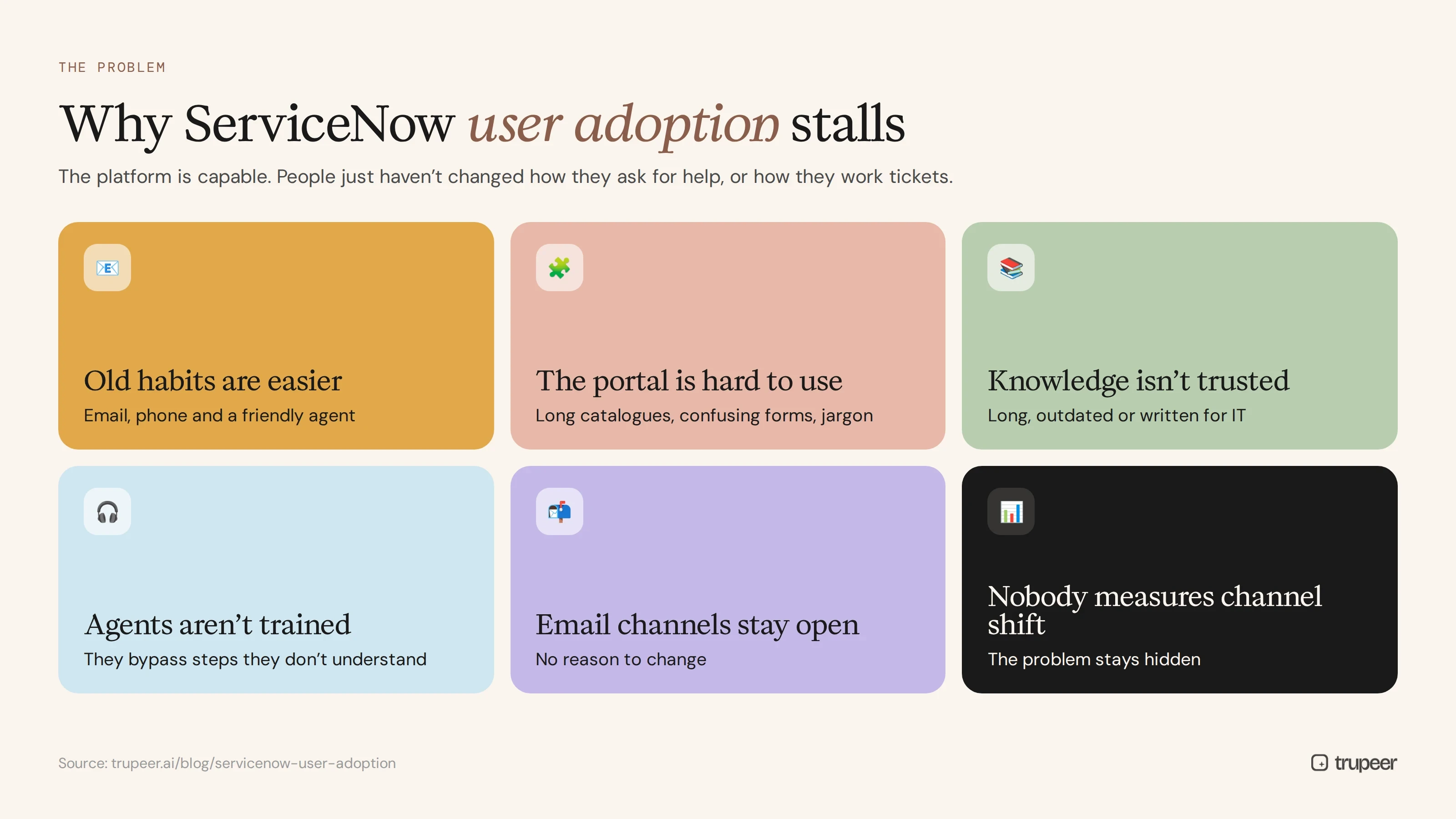
Old habits are easier. Email, phone calls and messaging a friendly agent feel faster than a portal.
The portal is hard to use. Long catalogues, confusing forms and jargon push people back to email.
Knowledge isn't findable or trusted. Articles are long, outdated or written for IT, not employees.
Agents aren't trained on the new workflows. They bypass steps they don't understand.
Email channels stay open, so there's no reason to change.
Nobody measures channel shift, so the problem stays hidden.
How does ServiceNow user adoption differ for employees and agents?
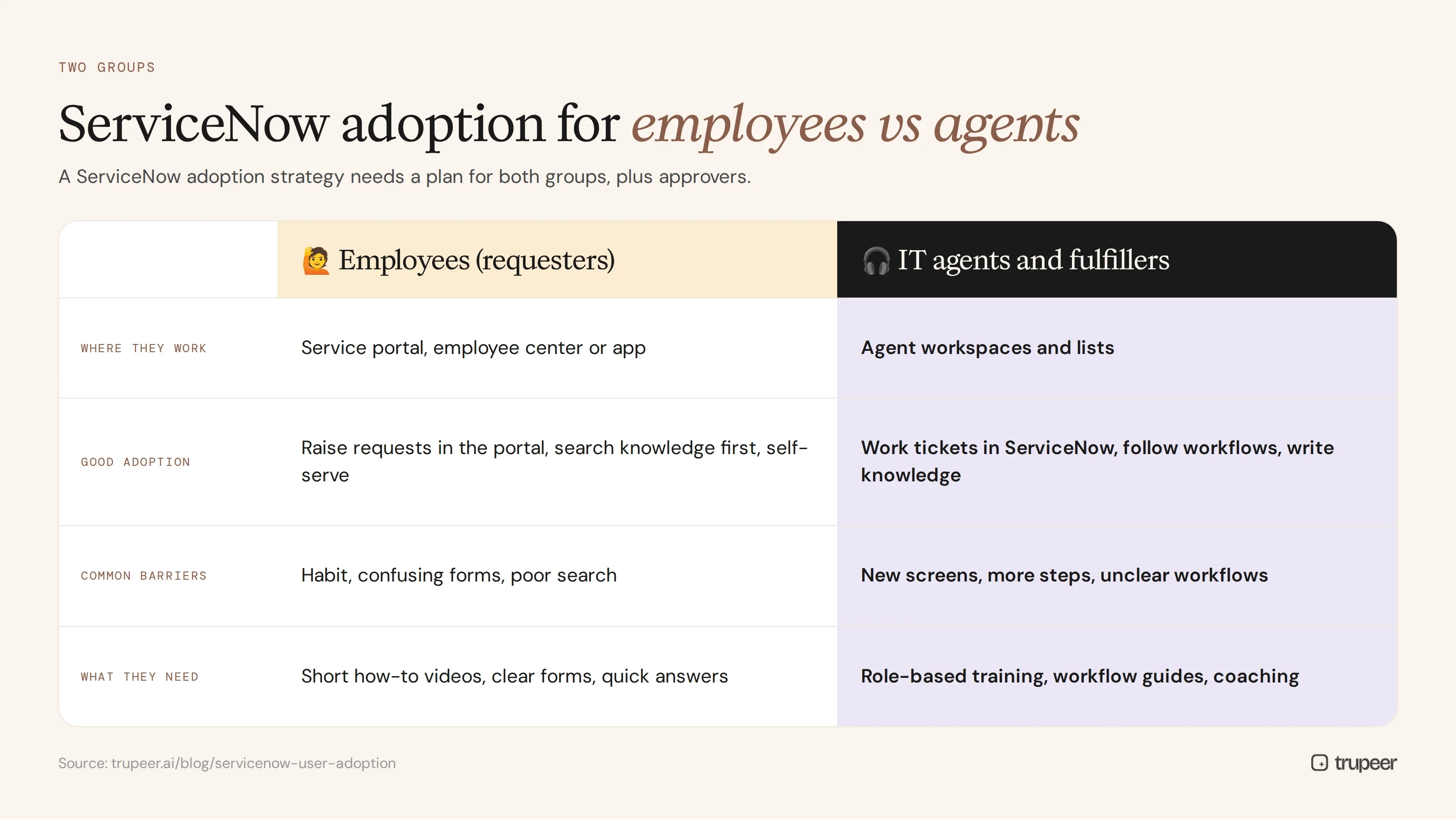
Employees (requesters) | IT agents and fulfillers | |
|---|---|---|
Where they work | Service portal, employee center or mobile app | Agent workspaces and lists |
What good adoption looks like | Raise requests in the portal, search knowledge first, use self-service | Work tickets in ServiceNow, follow workflows, write and update knowledge |
Common barriers | Habit, confusing forms, poor search | New screens, more steps, unclear workflows |
What they need | Short how-to videos, clear forms, quick answers | Role-based training, workflow guides, coaching |
A ServiceNow user adoption strategy needs a plan for both groups, plus approvers and managers who sign off requests.
ServiceNow user adoption strategy: 8 steps
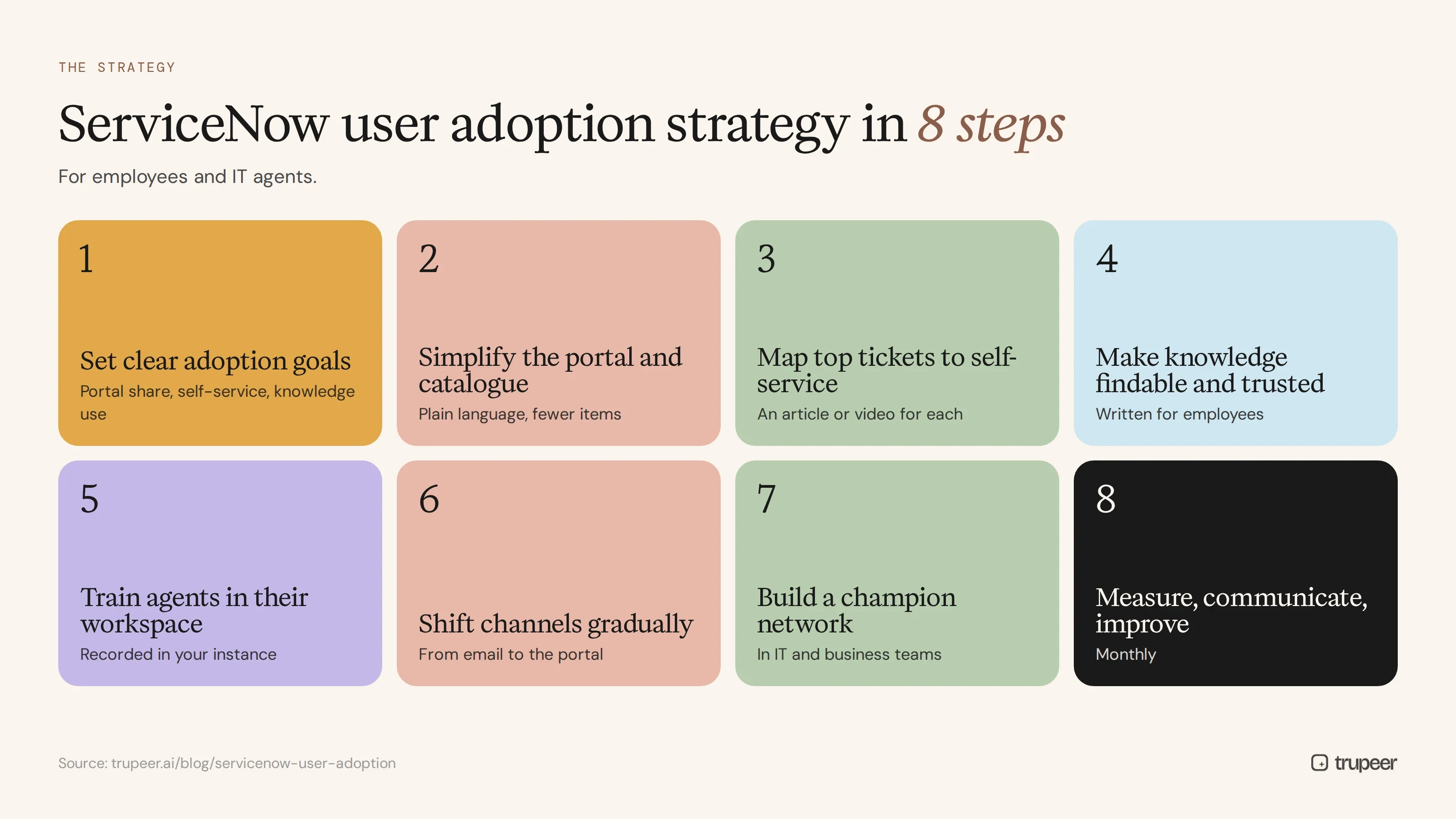
1. Set clear adoption goals
Agree what success looks like, such as the share of tickets raised through the portal, self-service resolution and knowledge use, and set targets by team or region.
2. Simplify the portal and catalogue
Cut unused catalogue items, write forms in plain language, ask only for information you need and make search the centre of the portal.
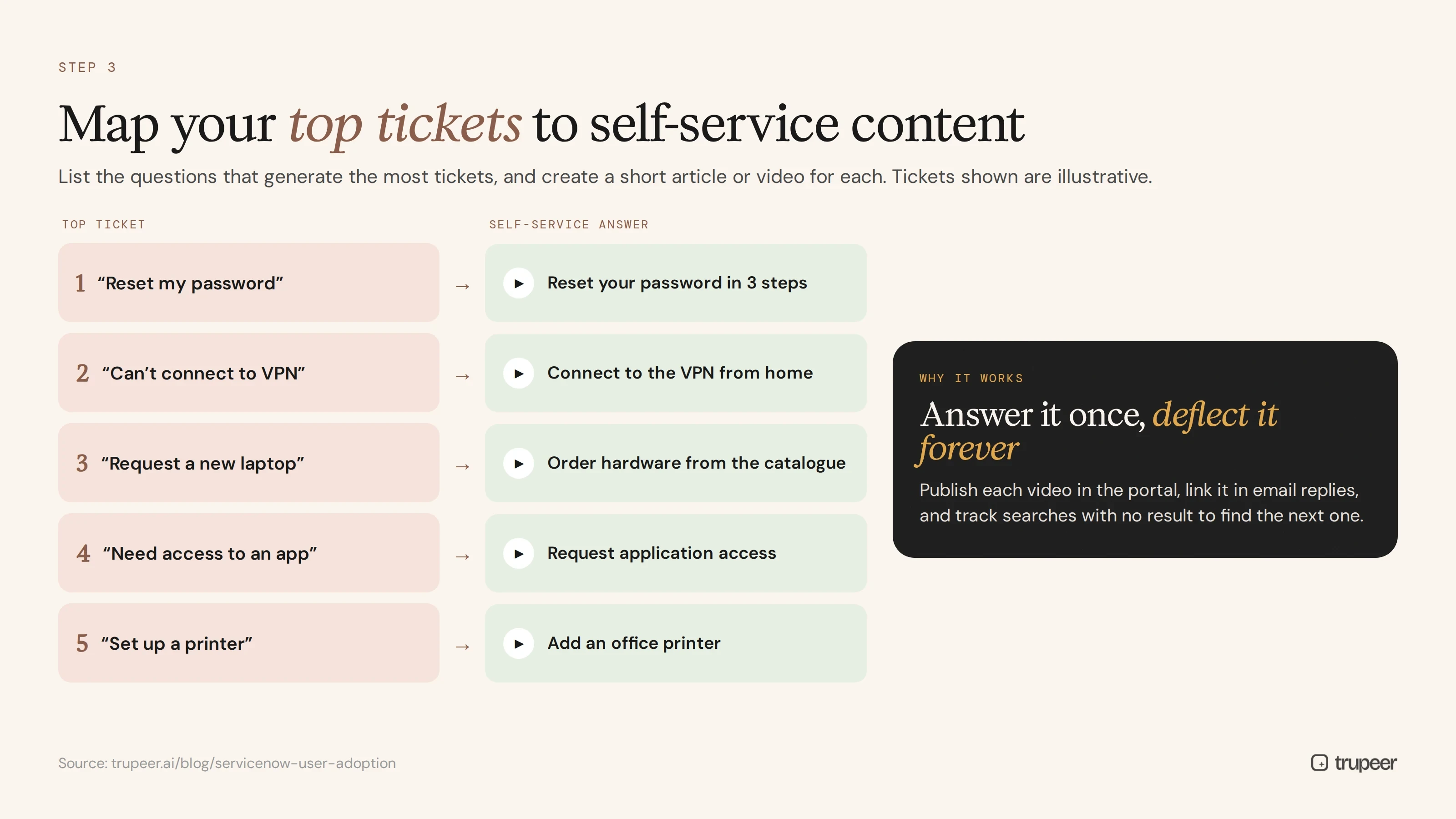
3. Map your top tickets to self-service content
List the questions and requests that generate the most tickets and create a short article or video for each. See how to map your top 20 tickets to how-to videos.
4. Make knowledge easy to find and trust
Write articles for employees, not IT, with clear titles, short steps and screenshots or videos, and keep them current. See ITSM knowledge base best practices.
5. Train agents in their own workspace
Give agents role-based training on the workflows they'll use every day, recorded in your own ServiceNow instance. See ServiceNow training video best practices for ITSM teams.
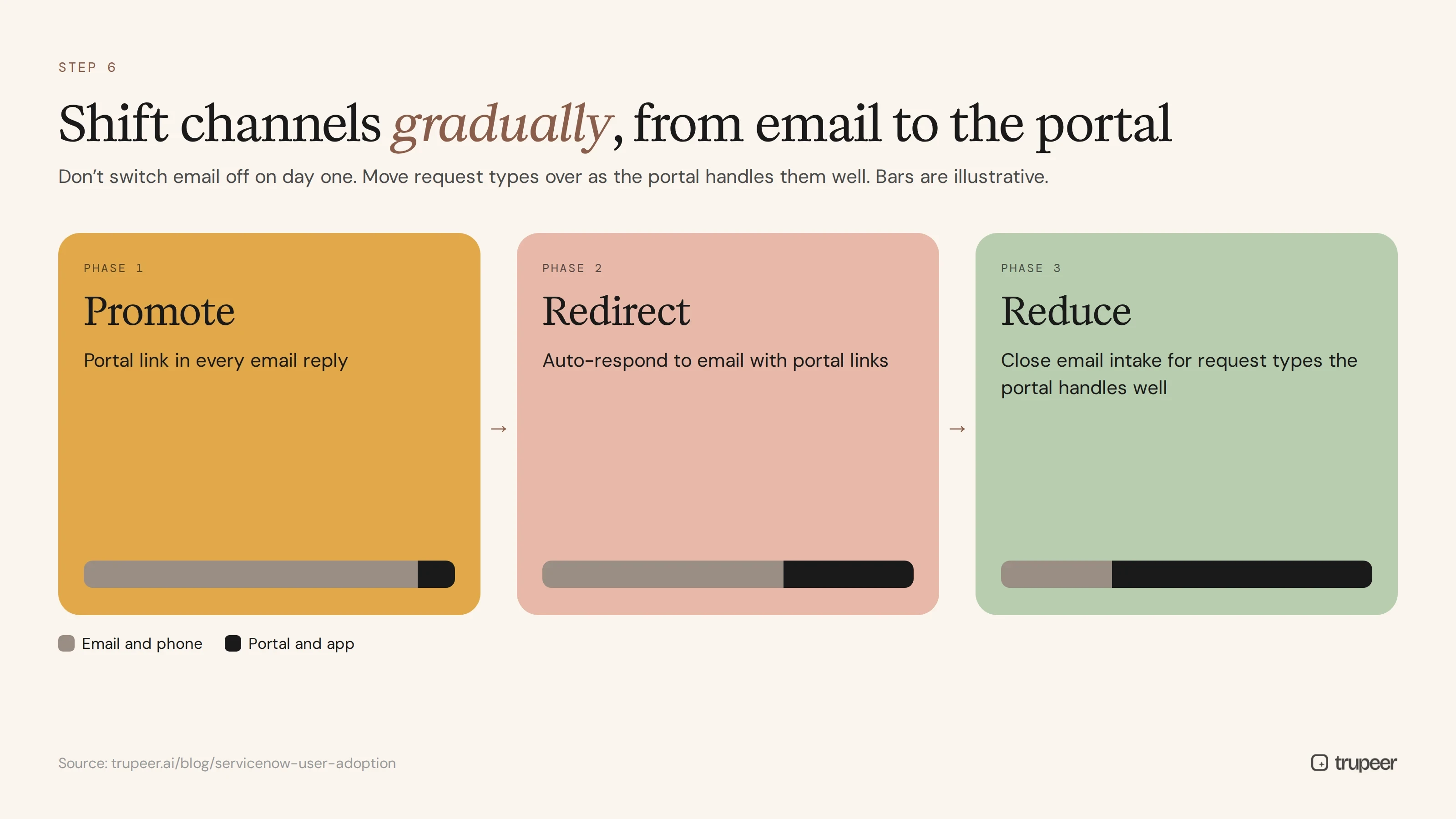
6. Shift channels gradually
Promote the portal in every email reply, auto-respond to email with portal links, then reduce email intake for request types the portal handles well.
7. Build a champion network
Appoint champions in IT and in business teams to promote the portal, collect feedback and help colleagues. A super user training program gives champions the depth they need.
8. Measure, communicate and improve
Track adoption metrics monthly, share wins and fix the friction points users report, from confusing forms to missing articles.
What training drives ServiceNow user adoption?
Two-minute videos for employees showing how to raise common requests, check status and find answers.
Workflow guides for agents covering incident, request, problem and change processes in your instance.
Knowledge-writing guidance so agents create articles employees can actually use.
Approver quick guides for managers who approve requests on the go.
"What's new" updates after each ServiceNow upgrade or portal change.
Record key users doing each task in your own instance with Trupeer's AI screen recorder, and Trupeer turns each recording into a step-by-step guide and short video you can publish in the portal.
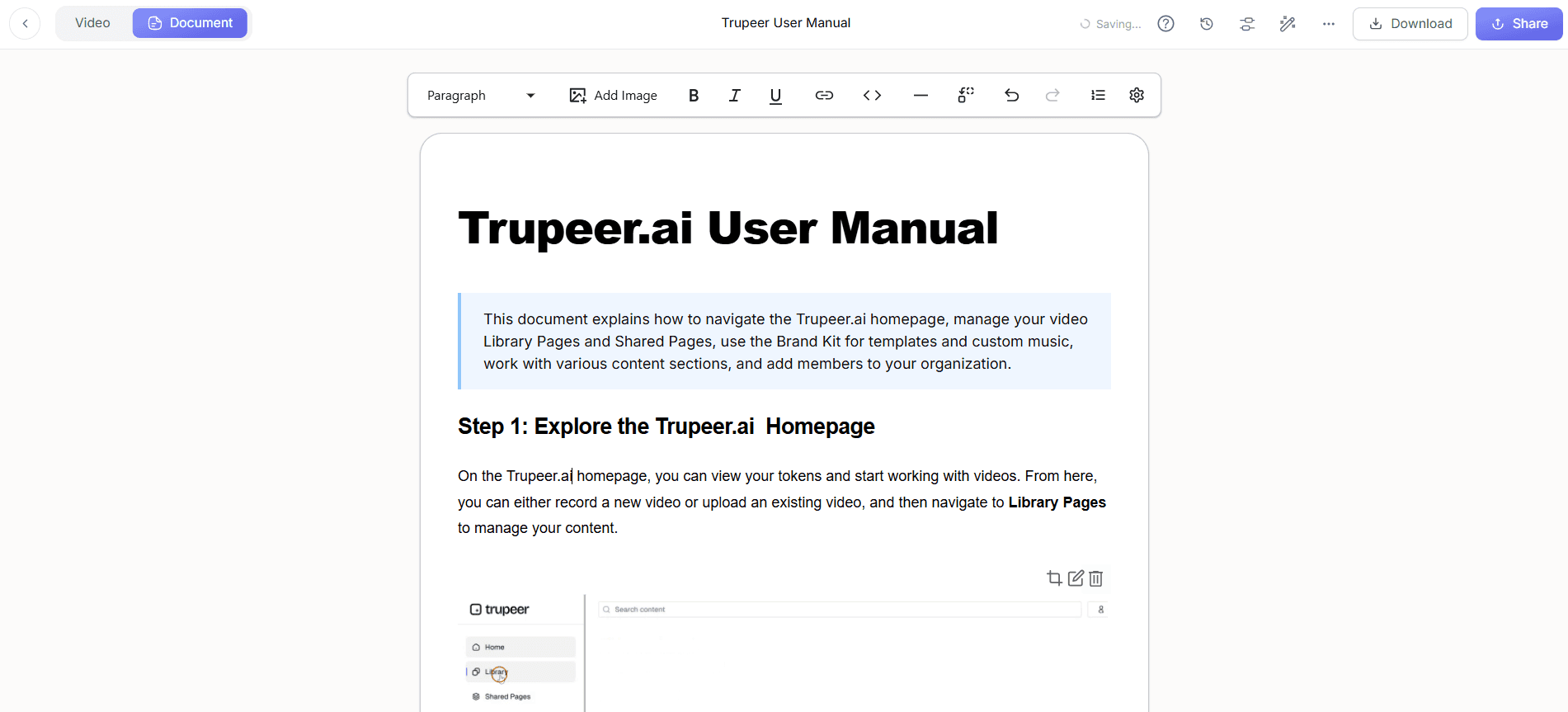
For examples, see how to create service desk solution videos inside ServiceNow.
How do you measure ServiceNow user adoption?
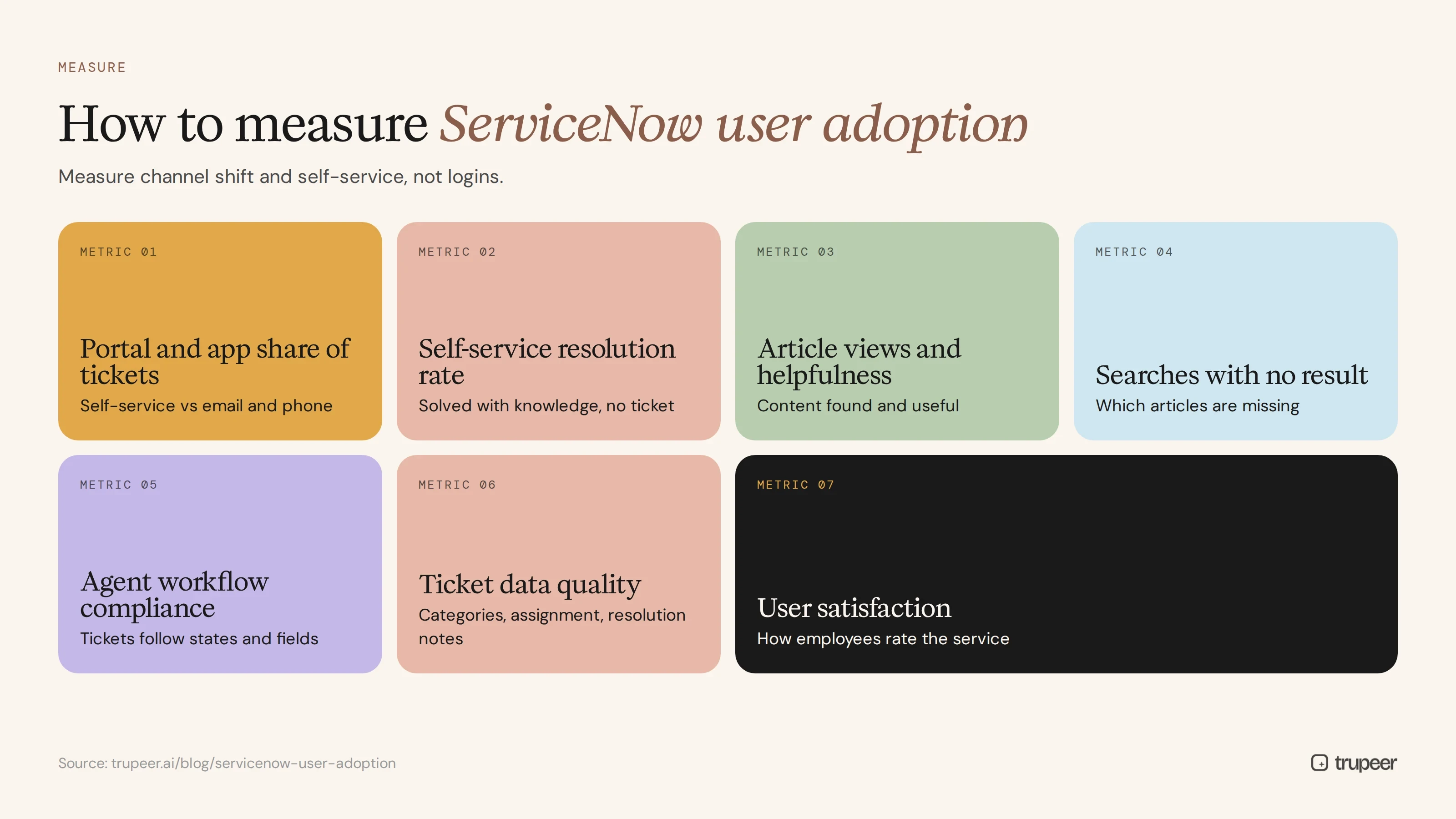
Metric | What it shows |
|---|---|
Portal and app share of tickets | How many requests come through self-service channels versus email and phone |
Self-service resolution rate | How often employees solve issues with knowledge, without a ticket |
Knowledge article views and helpfulness | Whether content is found and useful |
Searches with no result | Which articles are missing |
Workflow compliance for agents | Whether tickets follow defined states and fields |
Ticket data quality | Whether categories, assignment and resolution notes are accurate |
User satisfaction | How employees rate the service experience |
To benchmark self-service, see what a good knowledge base deflection score looks like.
ServiceNow user adoption for approvers and managers
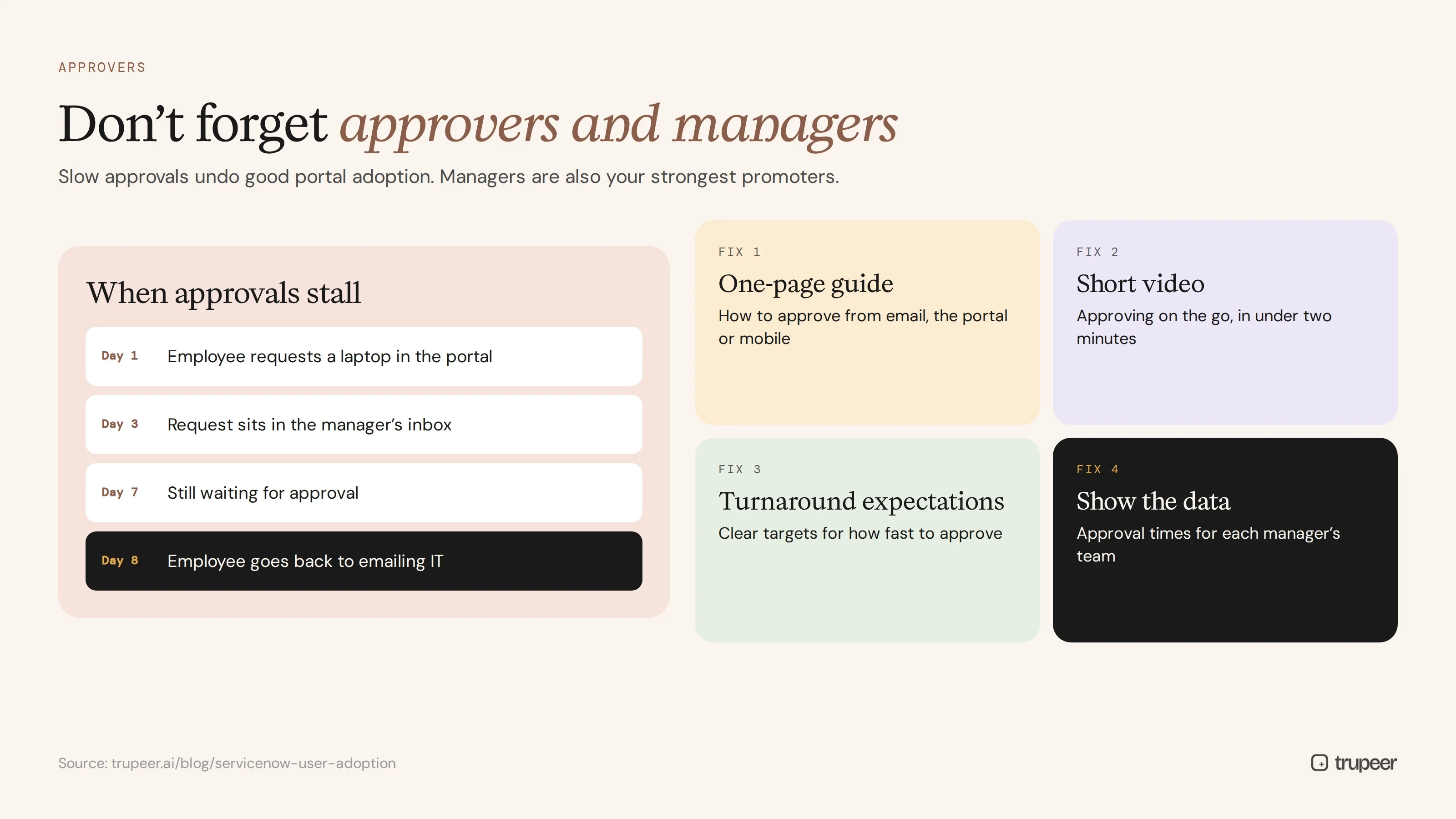
Approvers are easy to forget, but slow approvals undo good portal adoption. When a laptop request sits in a manager's inbox for a week, the employee goes back to emailing IT. Give approvers a one-page guide and a short video on approving from email notifications, the portal or the mobile app, set clear expectations for turnaround, and show managers the approval data for their teams. Managers are also your strongest promoters: when they direct their teams to the portal, adoption follows.
ServiceNow user adoption checklist
Adoption goals and targets are agreed for employees and agents.
The catalogue is simplified and written in employees' language.
Your top tickets each have a short article or video.
Search is prominent and returns useful results.
Agents are trained on workflows in your own instance.
Approvers have a quick guide and turnaround expectations.
Email replies and auto-responses point to the portal.
Champions are named in IT and in business teams.
Adoption metrics are reviewed monthly.
Help content is updated after every upgrade and form change.
How do you keep ServiceNow adoption high after go-live?
ServiceNow is upgraded regularly and your own team keeps adding catalogue items and workflows, so adoption needs ongoing care:
Review adoption metrics every month and after every major change.
Update help content as soon as forms or screens change; see how to update a training video without re-recording.
Retire outdated articles that erode trust in the knowledge base.
Keep champions informed before each upgrade.
Ask for feedback in the portal and act on it visibly.
Common ServiceNow user adoption mistakes
Launching the portal without closing email channels or a plan to shift them.
Mirroring IT's structure in the catalogue instead of employees' language.
Writing knowledge for experts, not the people raising tickets.
Training agents once and never on later changes.
Measuring logins instead of channel shift and self-service.
Ignoring approvers and managers, whose delays frustrate everyone.
Improve ServiceNow user adoption with Trupeer
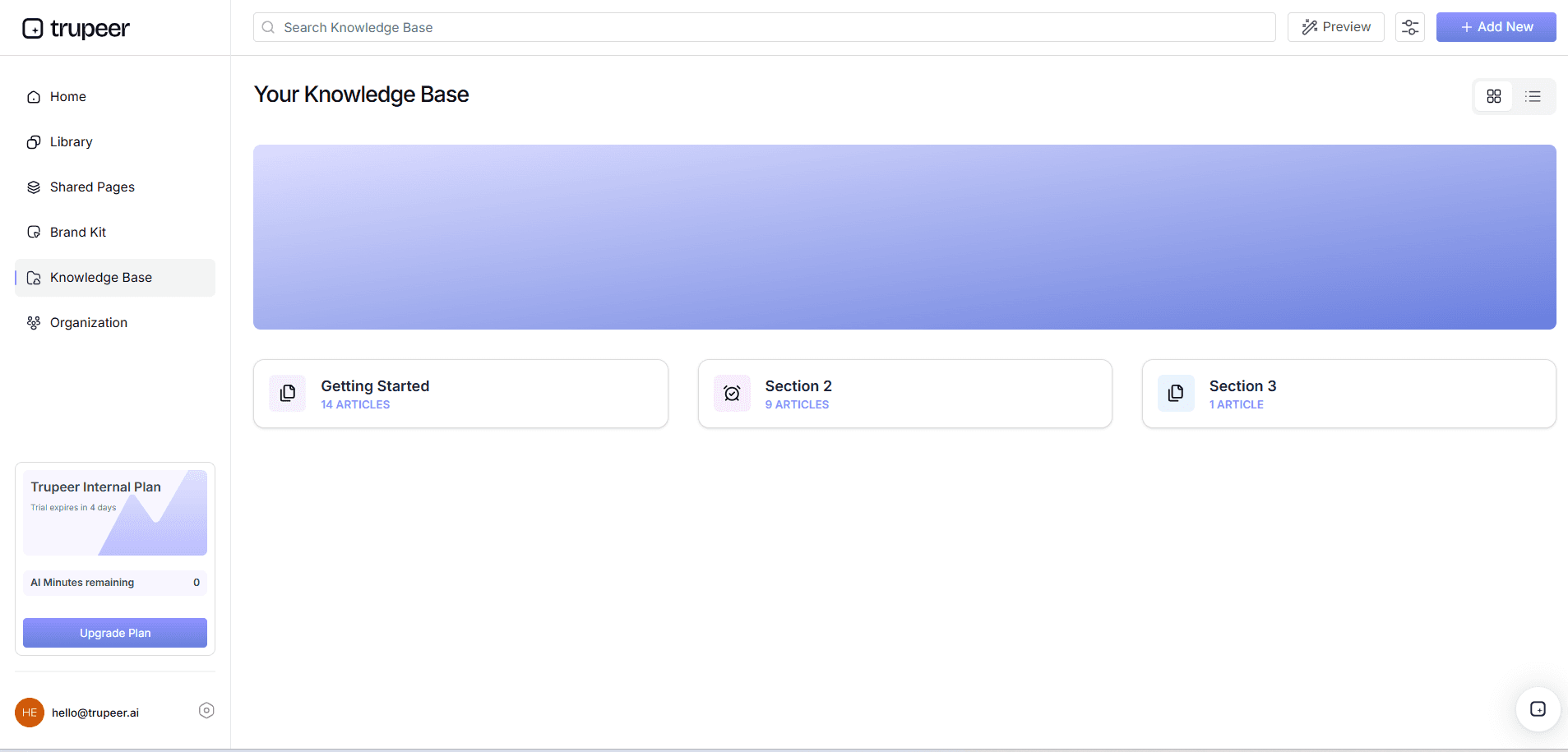
Trupeer turns recordings of your own ServiceNow instance into short how-to videos and step-by-step guides for employees and agents, ready to publish in your portal and easy to update after every upgrade. See Trupeer's IT knowledge base and SOP platform or start free with Trupeer.
Frequently asked questions
What is ServiceNow user adoption?
It's how fully employees and IT agents use ServiceNow as intended: employees raising requests and using self-service through the portal, and agents working tickets, following workflows and maintaining knowledge in ServiceNow.
Why is ServiceNow adoption low?
Common reasons are habit, confusing portals and forms, knowledge that's hard to find or trust, untrained agents, email channels left open and no measurement of channel shift.
How do you increase ServiceNow portal adoption?
Simplify the catalogue, put search first, create self-service content for your top tickets, promote the portal in every email reply, shift channels gradually and measure portal share of tickets.
How do you train agents on ServiceNow?
Use short, role-based videos and workflow guides recorded in your own instance, covering the incident, request, problem and change processes agents use every day.
What metrics measure ServiceNow user adoption?
Portal and app share of tickets, self-service resolution rate, knowledge views and helpfulness, searches with no result, workflow compliance, data quality and user satisfaction.
How do you get employees to stop emailing the service desk?
Make the portal faster than email, auto-reply to emails with portal links, publish answers to the most common questions and gradually reduce email intake for request types the portal handles well.
Does ServiceNow adoption need change management?
Yes. Adoption depends on changing habits for employees and agents, so communication, champions, training and measurement matter as much as configuration.
How do you keep ServiceNow training current?
Assign owners to each guide and video, review content after every upgrade and catalogue change, and update videos by editing the script rather than re-recording.