Trupeer Blog

Self-Service Rate Benchmark: What's a Good Knowledge Base Deflection Score

目次

ラフな画面録画から、AIで製品動画とドキュメントを即座に作成

無料で始める

Picture this: Your support team is overwhelmed, dealing with a constant influx of repetitive queries. Customers are frustrated by long wait times, and your team is stretched thin. This scenario is all too common for many businesses. A strong knowledge base can alleviate this pressure, allowing customers to find answers themselves. But how do you know if your knowledge base is doing its job? That's where deflection scores come into play. These scores measure the effectiveness of your self-service options in reducing the need for direct support interactions.

On average, businesses with effective knowledge bases see a 30% reduction in support tickets.

Understanding what constitutes a good deflection score is crucial for setting realistic goals and optimizing your knowledge base. By implementing strategies to improve these scores, you can enhance customer satisfaction and simplify your support operations. This is particularly important for companies aiming to maintain high customer satisfaction while managing costs. If you're responsible for customer support or knowledge management, comprehending and improving your deflection score should be a priority. Teams weighing tools often start with a Loom alternatives comparison before standardizing on a workflow.

Why does knowledge base deflection score matter?

Knowledge base deflection scores are vital for businesses seeking to enhance customer satisfaction and reduce operational costs. A high deflection score indicates that your customers are effectively using self-service resources to find answers, thus minimizing the need for direct interaction with support staff. This not only lightens the workload for your team but also ensures that customers receive quicker responses to their inquiries.

In a competitive market, customer experience is a key differentiator. Companies that fail to provide efficient self-service options risk higher churn rates and lower customer loyalty. By focusing on improving your deflection score, you can enhance your customer success workflow. A well-optimized knowledge base serves as a 24/7 resource, offering customers the convenience of self-help. This is especially crucial for businesses with global operations, where time zones can complicate live support availability. By prioritizing deflection scores, you're investing in a scalable solution that aligns with both customer and business needs.

What are the benefits of improving your knowledge base deflection score?

Improving your knowledge base deflection score offers multiple advantages that directly impact your business and customer satisfaction.

  • Reduced support costs. A higher deflection score means fewer support tickets, which translates to lower operational costs. Resources can be reallocated to more complex issues.

  • Enhanced customer satisfaction. Customers appreciate quick, self-service solutions. A well-deflected query leads to faster issue resolution, improving overall satisfaction.

  • Improved team efficiency. With fewer tickets to handle, your support team can focus on more complex, high-value tasks, increasing productivity.

  • Scalability. A solid knowledge base can handle increased customer interactions without additional staffing, crucial for fast-growing companies.

  • Data-driven insights. Analyzing deflection scores provides insights into customer behavior, helping you refine content and improve your best knowledge base examples.

  • Brand reputation. Efficient self-service options reflect well on your brand, enhancing public perception and customer loyalty. This is particularly true when using an AI video platform to deliver engaging and informative content.

Which Trupeer features help you improve your knowledge base deflection score?

Trupeer offers a suite of features designed to enhance your knowledge base and improve deflection scores. These tools aim to make your content more accessible, engaging, and effective.

AI-searchable knowledge base

Trupeer's AI-searchable knowledge base is a powerful tool that enhances user experience by providing quick and accurate search results. This feature indexes every piece of content, ensuring that users find relevant information with ease. Timestamp-level deep links allow users to jump directly to the most pertinent sections of a video or document. This immediacy helps in reducing the time spent searching for information, thus improving the deflection score. By making information retrieval smooth and intuitive, Trupeer ensures that users can self-serve effectively.

Automatic SOP generation

Through its AI documentation platform, Trupeer facilitates the automatic generation of Standard Operating Procedures (SOPs) from recorded content. This feature turns complex processes into easy-to-follow documents, which are then tied to the underlying video recordings. The resulting documentation is not only comprehensive but also continuously updated, ensuring it remains relevant. This capability is a big shift for companies needing to maintain accurate and current resources, directly contributing to a better deflection score by making complex information accessible.

Auto chapters and segment detection

Trupeer's auto chapters and segment detection feature breaks down long videos into manageable sections. This enables users to navigate to specific information quickly, enhancing their ability to find answers without sifting through entire videos. By structuring content in this way, Trupeer increases the likelihood of successful self-service interactions, which positively affects deflection scores. Users engage more with content that's presented in bite-sized, digestible segments, leading to higher satisfaction and reduced ticket submissions.

AI translation and dubbing

With knowledge base generator capabilities that include AI translation into 40+ languages and dubbing, Trupeer ensures your knowledge base is accessible to a global audience. Language barriers are a significant hurdle in self-service success, and this feature effectively removes that barrier. By providing localized content, Trupeer allows non-English speaking users to benefit from the same resources, improving their self-help experience and boosting deflection scores.

Viewer engagement analytics

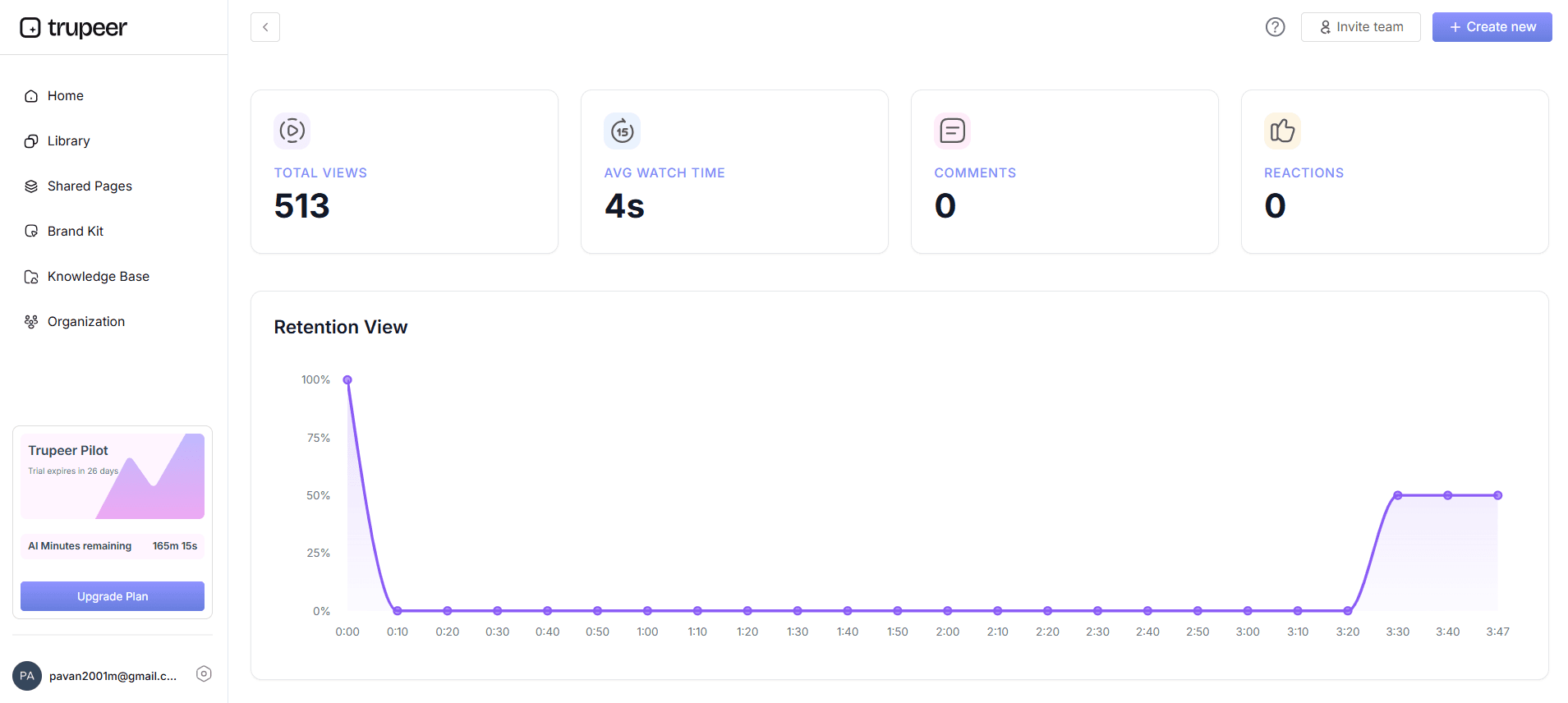
Trupeer's viewer engagement analytics offer insights into how users interact with your knowledge base content. By analyzing data such as drop-off rates and heatmaps, you can identify which parts of your content are working and which aren't. This information is invaluable for making data-driven decisions to improve content quality and layout. Understanding user behavior helps in refining resources to better meet user needs, so increasing the deflection score and ensuring a higher rate of successful self-service interactions.

How do you improve your knowledge base deflection score step by step with Trupeer?

Step 1: Capture Video Content

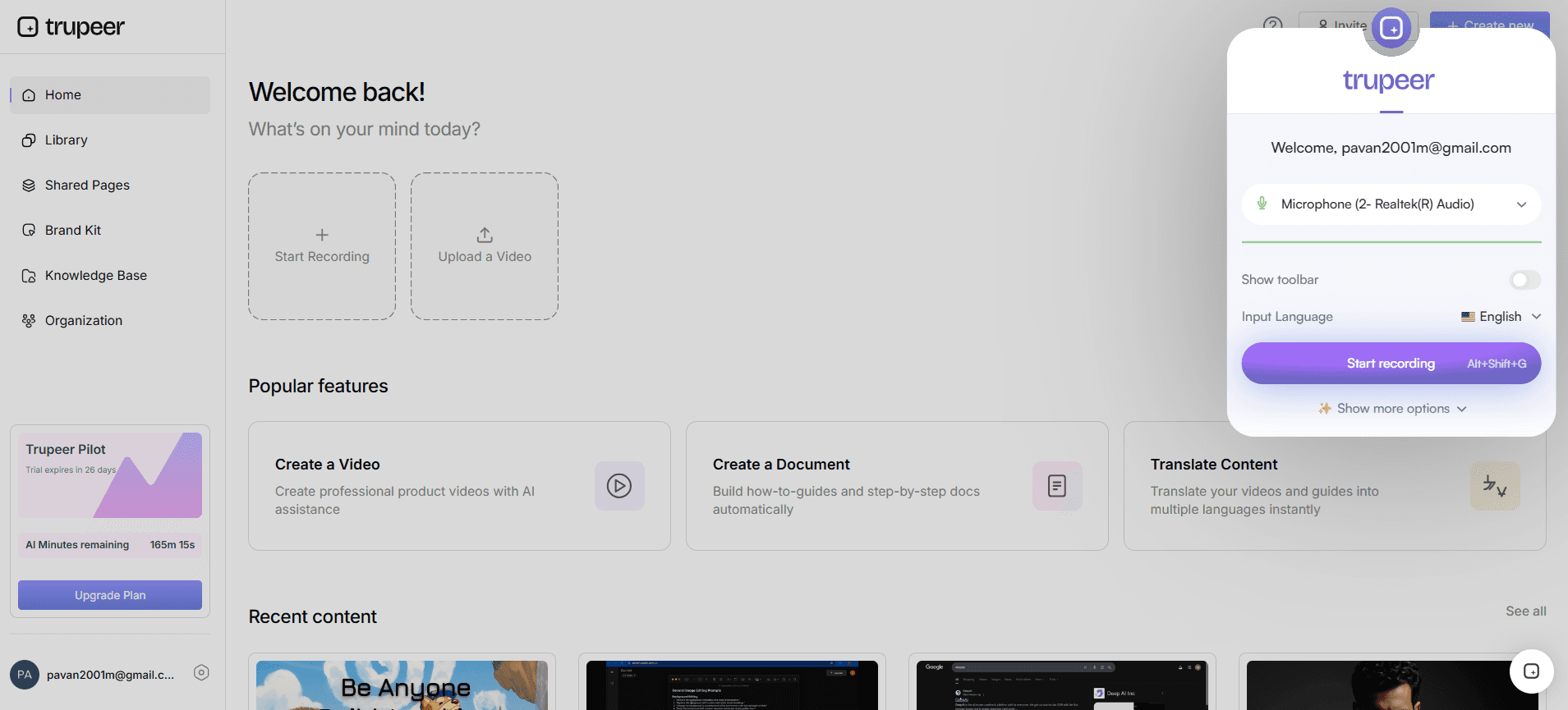
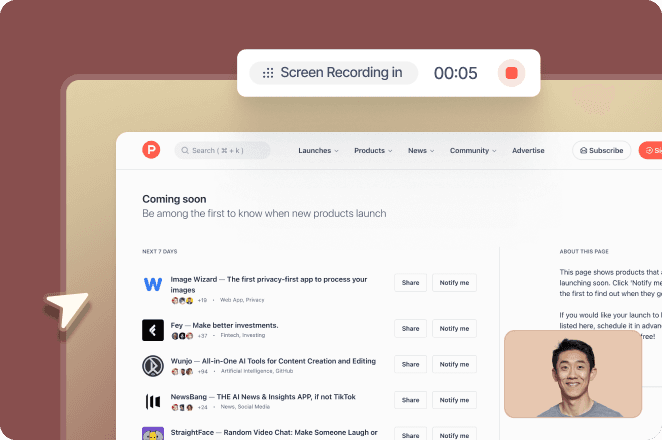
Begin by using Trupeer's AI screen recording with auto-zoom and click detection. Launch the browser-based recorder, which requires no installation, and start capturing your tutorial or process walkthrough. The auto-zoom feature ensures that critical sections of your screen are highlighted, while click detection automatically emphasizes user actions. This process takes as long as your presentation requires, typically ranging from a few minutes to an hour. The AI-driven features help maintain focus and clarity, minimizing the need for post-production edits. For a deeper look, our guide on knowledge base one covers the adjacent playbook.

Capture Video Content

Step 2: Edit and Enhance Recordings

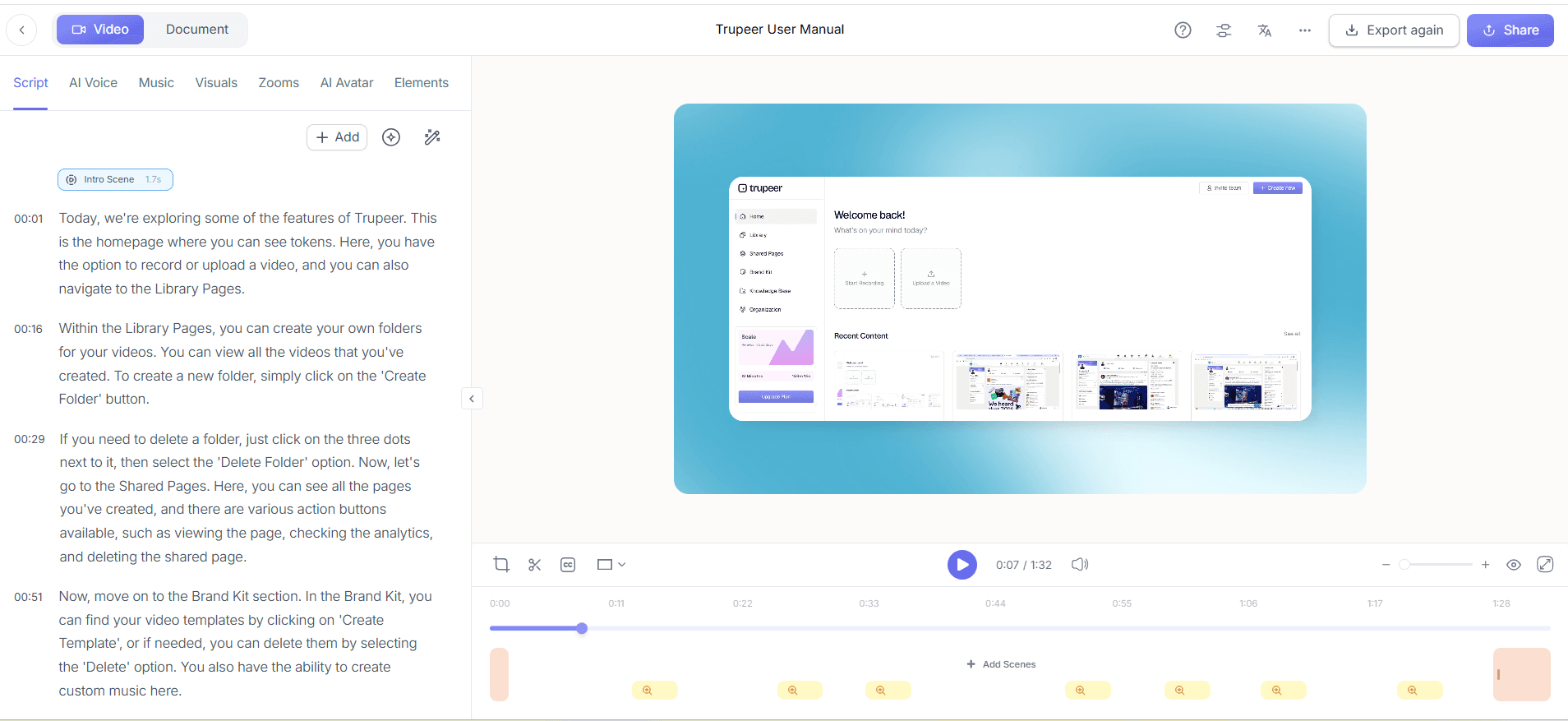
After capturing the video, use Trupeer's editing and enhancement capabilities. Automatically remove filler words like "um" and "ah" to ensure a smooth and professional flow. You can also use AI voiceover to add narration in one of 65+ natural voices, adjustable for pace and tone. This step usually takes 15-30 minutes, depending on the video length. These enhancements make your content more engaging and easier for users to follow, increasing the likelihood of successful self-service interactions.

Edit and Enhance Recordings

Step 3: Generate Documentation and SOPs

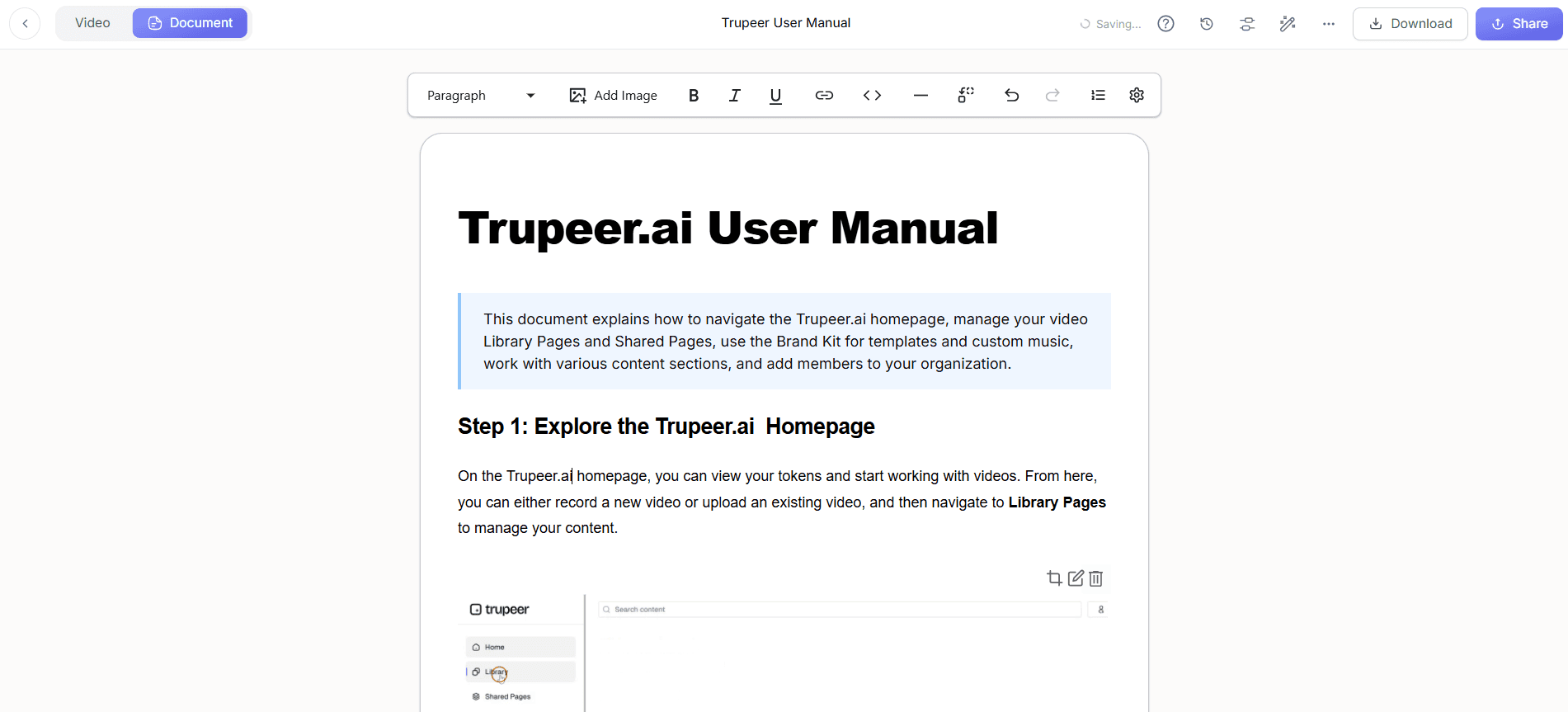
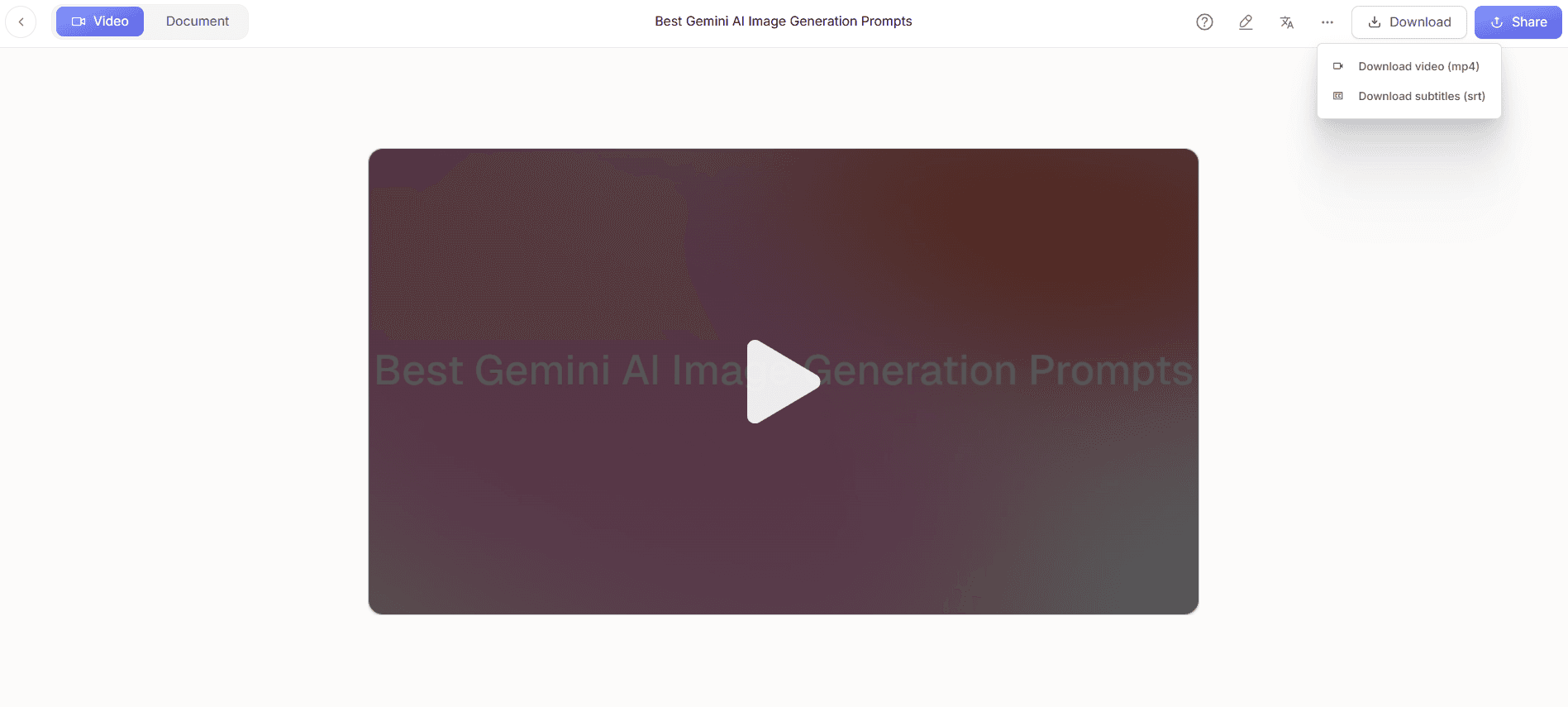
Next, use Trupeer's automatic SOP generation from your recordings. This feature creates edit-ready documents that are directly tied to the video content. You can export these as MP4, HTML, or PDF files. This step is crucial for providing users with both visual and textual guidance, catering to different learning preferences. It usually takes about 10 minutes to produce and review the documentation, ensuring that all necessary details are captured.

Generate Documentation and SOPs

Step 4: Localize Content for Global Reach

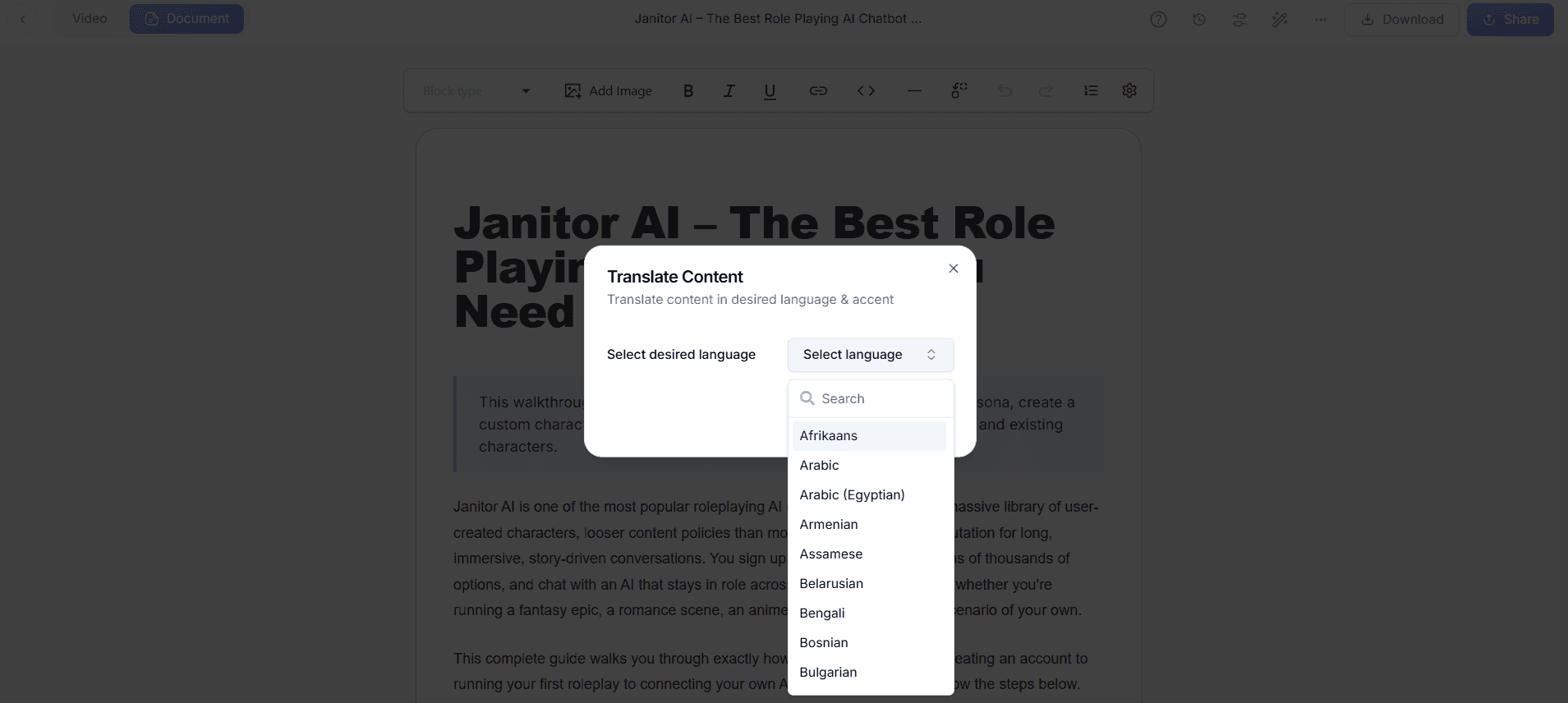
Trupeer makes it easy to localize your knowledge base content. Use the AI translation feature to convert your materials into over 40 languages with precise lip-syncing. AI dubbing is available for non-English audiences, making your content accessible worldwide. This step generally requires a few minutes per video for the translation and dubbing process, depending on the length. Localization broadens your audience reach, ensuring that language barriers don't limit self-service success.

Localize Content for Global Reach

Step 5: Distribute Through Custom Portals

Once your content is ready, distribute it using Trupeer's custom-domain hosting with SSO. Create shared pages or client-facing portals where users can easily access your knowledge base. These portals serve as centralized hubs for all your resources, making navigation straightforward for users. Setting up a portal typically takes about 20 minutes, and it allows you to maintain brand consistency across all user interactions.

Distribute Through Custom Portals

Step 6: Analyze Viewer Engagement

Finally, use Trupeer's viewer engagement analytics to understand how users interact with your content. Track metrics such as drop-off rates and heatmaps to identify which parts of your knowledge base are most effective and where improvements are needed. This step involves reviewing analytics dashboards, which can be done weekly or monthly, depending on your needs. By refining your content based on real data, you can enhance user experience and further boost your deflection scores.

Analyze Viewer Engagement

What tips help you improve your knowledge base deflection score?

Improving your knowledge base deflection score requires strategic actions. Here are some practical tips to guide your efforts and maximize the effectiveness of your self-service resources.

  • Regularly update content. Ensure your knowledge base stays relevant by frequently reviewing and updating articles. This prevents outdated information from frustrating users.

  • use visual aids. Incorporate videos and images to complement textual content. These aids make complex topics easier to understand and increase user engagement.

  • Optimize for search. Use clear, concise titles and keywords to improve the discoverability of your articles. An optimized search function helps users find answers quickly.

  • Encourage user feedback. Implement feedback mechanisms to gather insights on content effectiveness. This data can guide future improvements and enhance user satisfaction.

  • Segment your audience. Tailor content to different user groups, ensuring it addresses specific needs. Segmentation makes your knowledge base more relevant and accessible.

  • Use analytics insights. Regularly review engagement data to identify popular topics and areas needing attention. Make data-driven decisions to refine your knowledge base.

  • Benchmark against competitors. Compare your knowledge base with Scribe alternatives for SOPs to identify strengths and areas for improvement, keeping your resources competitive.

  • Trupeer also ships a internal knowledge base wiki software that handles this step without extra setup.

Frequently asked questions

How can I measure my knowledge base deflection score?

To measure your deflection score, track the number of users who successfully find answers through your knowledge base compared to those who escalate to direct support. Implement analytics tools to monitor user interactions, such as search queries and article views. Calculate the deflection score by dividing the resolved issues via the knowledge base by the total support interactions, then multiply by 100 to get a percentage. Regularly reviewing this metric helps identify trends and areas for improvement.

What is considered a good knowledge base deflection score?

A good deflection score usually ranges between 20% to 40%, indicating that a significant portion of user inquiries are resolved through self-service. However, the ideal score can vary depending on industry and customer expectations. Higher scores reflect better optimization of your knowledge base, resulting in more efficient customer support operations and improved satisfaction. Continuously refining content and using analytics insights can help maintain and improve this score.

Why should I focus on improving my deflection score?

Focusing on your deflection score is essential because it directly impacts customer satisfaction and operational efficiency. A higher score means fewer support tickets, allowing your team to focus on more complex issues. This leads to cost savings and quicker response times for customers. also, it enhances the customer experience by providing instant solutions, building loyalty and trust in your brand. Consistent improvement of your deflection score is a strategic investment in your business's success.

Can Trupeer help with video localization for my knowledge base?

Yes, Trupeer offers solid localization features, including AI translation into over 40 languages and dubbing, ensuring content is accessible to a global audience. This feature allows you to reach non-English speaking users effectively, broadening your customer base and increasing self-service success. By using Trupeer's video localization tool, you can enhance the inclusivity and reach of your knowledge base, driving higher deflection scores.

Does using video improve knowledge base effectiveness?

Absolutely. Videos are a powerful medium for conveying complex information clearly and engagingly. They cater to visual learners and can simplify intricate processes that text alone might not effectively communicate. Incorporating videos into your knowledge base can significantly enhance user engagement and understanding, leading to better self-service outcomes. This approach not only improves the user experience but also contributes to higher deflection scores by making information more accessible and easier to digest.

動画編集者、翻訳者、脚本家が必要ですか?

Trupeerを無料でお試しください

デモを予約する

動画編集者、翻訳者、脚本家が必要ですか?

Trupeerを無料でお試しください

デモを予約する

動画編集者、翻訳者、脚本家が必要ですか?

Trupeerを無料でお試しください

デモを予約する