Verwenden Sie diese Vorlage
Transitions go wrong when every one is run differently. With Trupeer, you can save hours on transition planning by starting with a free transition SOP template, customizing it with your brand guidelines, and turning each step into a video walkthrough your transition teams can follow from the first wave to the last.
What is a transition SOP template?
A transition SOP template is a ready-made transition standard operating procedure (SOP) for running a transition: moving work, processes or services from one team, location or provider to another. It sets out the phases every transition follows, who does what, the gates between phases, and the evidence needed before work can move on.
It's different from the documents it sits alongside:
A transition plan schedules one specific transition: these processes, these people, these dates.
A knowledge transfer SOP covers how knowledge moves from one person or team to another.
A handover document records what's being handed over at a point in time.
The transition SOP is the method behind all of them. It's written once and reused for every transition, so wave three runs the same way as wave one, and the next outsourcing deal doesn't start from a blank page.
When do you need a transition SOP?
You need one when your organization runs transitions more than once, or when one transition has several waves. Common cases:
Outsourcing to a BPO or managed service provider, where processes move in waves.
Vendor-to-vendor transitions, where work moves from an incumbent provider to a new one.
GCC or GBS setups, where processes move from local teams or providers into a captive center.
Insourcing, where work comes back from a provider to an internal team.
Service transitions, where a delivered system or service moves from a project team into operations.
If you're planning a single role change or handover, the transition plan template or handover document template is the better fit.
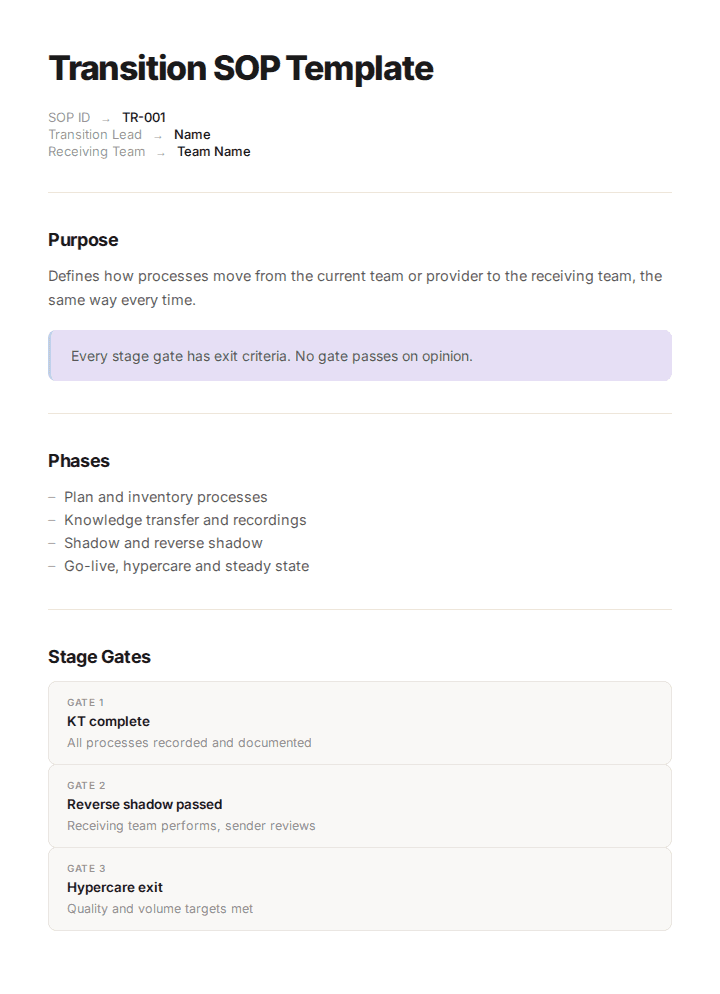
Preview the transition SOP template
The template opens with purpose and scope, then a RACI for the five core transition roles. The procedure follows as a six-phase table with owners and outputs, then a stage-gate table with exit criteria for each gate. The remaining sections set the knowledge transfer and documentation standards, acceptance and certification, hypercare exit, escalation, records and revision history. Every section is editable, so you can rename phases, add gates or change roles to match your transition method.
How to customize this template in Trupeer
Step 1: Open the Templates Section
Go to the Templates section from the main navigation.

Step 2: Select and Open a Template
Click on any template you want to work with to open it.
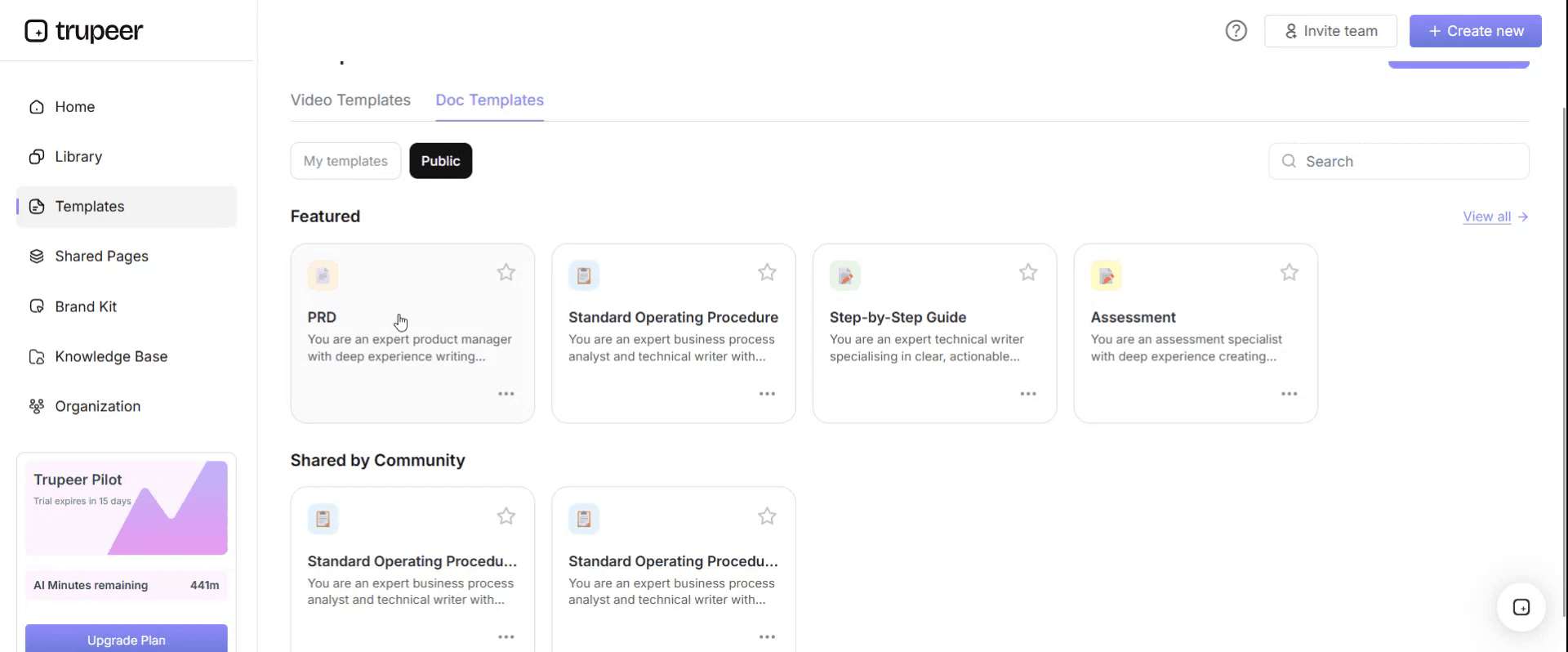
Step 3: Expand the Template View
If needed, expand the template view to see the full layout and details clearly.

Step 4: Edit the Template
Click on Edit to start modifying the selected template.

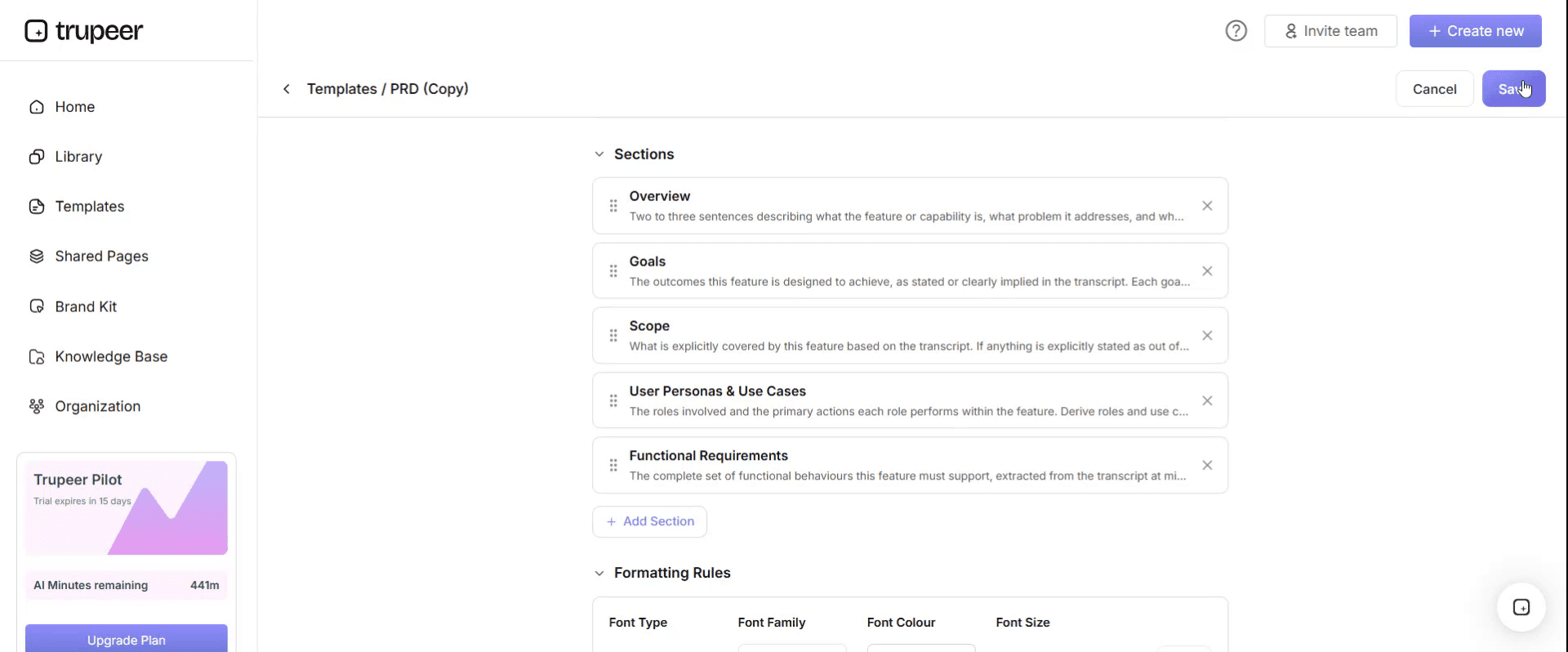
Within the editor, you can:
Add new sections
Define or update formatting rules
Add a logo and adjust its position and related settings
Step 5: Save Your Customized Template
After making all necessary changes, click Save to store the updated template as your own.
Step 6: Preview and Fine-Tune the Template
When you want to see how your customized template looks, open the Preview.

From the preview screen, you can continue to make adjustments directly if needed, ensuring the template appears exactly as you want.
With a transition SOP template you can:
Run every transition the same way: One procedure for every wave, team and provider.
Make gates objective: Entry and exit criteria replace "we think it's ready."
Protect knowledge transfer: A recording-first KT standard captures exceptions, not just the happy path.
Stay on-brand: Apply your logo, fonts and colors with Trupeer's brand kit.
Train transition teams faster: Turn each step of the SOP into a short video.
Show evidence to clients and auditors: Every phase produces a defined record.
What a transition SOP template must contain
A useful transition SOP has these sections. The template below follows the same order.
Purpose and scope: what the SOP covers and what it doesn't.
Roles and responsibilities: who owns each part of the transition, usually as a RACI.
Definitions: terms such as wave, KT, shadow, reverse shadow, go-live and hypercare.
Phases and steps: the procedure itself, phase by phase.
Stage gates: entry and exit criteria for every phase.
Knowledge transfer standard: how KT sessions are run, recorded and documented.
Documentation standard: what every process must have before go-live.
Acceptance and certification: how the receiving team is assessed and signed off.
Hypercare and exit criteria: how support works after go-live and when it ends.
Risk and escalation: how issues are raised and decided.
Records: the artifacts each phase produces and where they're stored.
Revision history: who changed the SOP, when and why.
Free transition SOP template: the procedure to copy
Copy the structure below into your own document, or open it in Trupeer and customize it.
1. Purpose. This SOP defines how [Organization] transitions processes from [current team or provider] to [receiving team or provider], so every transition is planned, executed and accepted in the same way.
2. Scope. Applies to all process transitions in [function or program]. Excludes [e.g. technology migrations, which follow the change management SOP].
3. Roles and responsibilities.
Activity | Transition lead | Sending lead | Receiving lead | Process owner | SME |
|---|---|---|---|---|---|
Process inventory and wave plan | A | C | C | R | C |
KT sessions and recordings | A | R | C | I | R |
SOPs and process documentation | A | C | R | A | C |
Shadow and reverse shadow | A | R | R | I | C |
Go/no-go decision | R | C | C | A | I |
Hypercare exit decision | R | C | C | A | I |
R = responsible, A = accountable, C = consulted, I = informed.
4. Definitions. Wave, knowledge transfer (KT), shadowing, reverse shadowing, go-live, hypercare, steady state, SME.
5. Procedure.
Phase | Key steps | Owner | Output |
|---|---|---|---|
1. Plan | Build process inventory, assign owners and SMEs, set wave plan, confirm access | Transition lead | Inventory, wave plan, RACI |
2. Knowledge transfer | Run and record KT sessions, capture exceptions, generate SOPs and videos | Sending lead | Recordings, draft SOPs |
3. Document and validate | SME review, process owner approval, translation, publish to knowledge base | Receiving lead | Approved SOPs and videos |
4. Parallel run | Shadow, then reverse shadow, log gaps and fix SOPs | Receiving lead | Shadow logs, error rates |
5. Go-live | Go/no-go review, cutover, communications | Transition lead | Go/no-go record |
6. Hypercare | Daily issue triage, SLA tracking, SOP updates, exit review | Receiving lead | Issue log, exit scorecard |
6. Stage gates.
Gate | Exit criteria |
|---|---|
Plan to KT | Inventory complete, every process has an owner and SME, KT calendar agreed |
KT to parallel run | Every process recorded, SOP drafted and approved, exceptions documented |
Parallel run to go-live | Reverse shadowing passed at agreed quality, access live, staff certified |
Hypercare to steady state | SLAs met for agreed period, no critical issues, SOPs current, owner sign-off |
7. Knowledge transfer standard. Every KT session is recorded. SMEs perform the task in the live system, explain each step and its exceptions, and use masked data where possible. Each recording is turned into an SOP and video within [X] working days.
8. Documentation standard. Before go-live, every process has a step-level SOP, a video walkthrough, documented business rules and exceptions, systems and access, SLAs, controls and an escalation path, published in [knowledge base].
9. Acceptance and certification. Each receiving team member is assessed against the approved SOPs and certified per process. The process owner signs off each process at the go/no-go review.
10. Hypercare and exit. Hypercare starts at go-live and ends per process when the exit criteria in section 6 are met, not on a fixed date.
11. Risk and escalation. Risks are logged in [tool] and reviewed weekly. Escalation runs from receiving lead to transition lead to steering committee.
12. Records. Inventory, RACI, KT recordings, SOPs, shadow logs, go/no-go record, issue log and exit scorecard, stored in [location] for [retention period].
13. Revision history. Version, date, author, summary of change.
Transition SOP example: a claims processing transition
Here's the template filled in for an illustrative example. A mid-sized insurer, Harbourline Insurance, is moving claims processing from its in-house team to an outsourcing provider in two waves.
Purpose. Defines how Harbourline transitions claims processes to the provider, so both waves follow the same procedure and acceptance standard.
Scope. Wave 1: first notice of loss (FNOL) intake, claims registration and document indexing. Wave 2: simple claims assessment and payments. Excludes complex and litigated claims, which stay in-house.
Roles. Transition lead: Harbourline transition manager. Sending lead: claims operations manager. Receiving lead: provider delivery manager. Process owners: Harbourline claims team leaders. SMEs: four senior claims handlers.
Wave 1 procedure, as run.
Phase | What happened | Output |
|---|---|---|
Plan | 14 processes inventoried; two flagged high risk because only one SME knew them | Inventory, wave plan |
Knowledge transfer | 38 KT recordings captured, most of them SMEs recording their own walkthroughs | Recordings, 14 draft SOPs |
Document and validate | SOPs reviewed by SMEs and approved by team leaders; 23 exceptions added | 14 approved SOPs and videos |
Parallel run | 2 weeks shadow, 2 weeks reverse shadow; 11 gaps logged and fixed in SOPs | Shadow logs |
Go-live | Go/no-go passed for 13 processes; 1 held back for another week of reverse shadowing | Go/no-go record |
Hypercare | Processes exited individually as SLA and quality criteria were met | Exit scorecard |
What the SOP changed. Without a standard, Wave 1 would have relied on live sessions and notes. With the KT standard in place, every session was recorded, so the provider's second shift could learn from the same material as the first, and Wave 2 started from a working method instead of a blank page.
The numbers in this example are illustrative. Replace them with your own as you run each wave.
Service transition SOP: moving a project into operations
A service transition SOP covers the move from a project team that built or changed a system or service to the operations team that will run it. The phases are the same, but the content of each one shifts:
Plan: confirm the service scope, support model, operating hours and service levels before handover starts.
Knowledge transfer: record the project team walking through the architecture, configuration, known errors, monitoring and routine maintenance.
Document and validate: produce runbooks, support SOPs and a known-error list, approved by the operations lead.
Parallel run: operations handles tickets while the project team stays on call, then the project team steps back.
Go-live: operational acceptance is signed, support contacts change and users are told who to call.
Hypercare: the project team remains available for a defined period while incident volumes and resolution times stabilize.
The key addition is an operational acceptance checklist at the go-live gate: monitoring in place, runbooks approved, access granted, support contracts live and the first round of incidents handled by operations. The runbook template covers the operational documentation in more depth.
BPO and outsourcing transition SOP
A BPO or outsourcing transition SOP is the version most outsourcing providers and their clients use. It adds three things to the core template:
Commercial and contractual checks. Each gate references the contract: transition milestones, service credits that start at go-live and any exit obligations of an outgoing provider.
Tri-party roles. In a vendor-to-vendor transition, the RACI has columns for the client, the incumbent provider and the incoming provider, and the client owns acceptance.
People moves. Where staff are rebadged from the client or the incumbent, the SOP includes training on new policies and tools, and assesses rebadged staff and new hires against the same approved SOPs.
For a BPO transition, the knowledge transfer standard matters most. The incumbent's or client's SMEs may be leaving or overloaded, so every session should be recorded and turned into SOPs and videos within days. See our guides to vendor-to-vendor transition knowledge transfer and rebadging in outsourcing transitions for detail on each.
How to write a transition SOP in six steps
Start from your last transition. List what worked, what slipped and where knowledge was lost.
Define the phases and gates. Agree the six phases and the exit criteria for each with the process owners.
Assign roles. Fill in the RACI, so every activity has one accountable owner.
Set the KT and documentation standards. Decide what every process must have before go-live.
Pilot it on one wave. Run the SOP, log where it didn't fit, and adjust.
Publish and train. Store the SOP in your knowledge base and turn each phase into a short video for new transition team members.
Transition SOP vs transition plan vs knowledge transfer SOP
Document | What it covers | How often it's written |
|---|---|---|
Transition SOP | The standard method for running any transition | Once, then revised |
Transition plan | The schedule for one specific transition | Once per transition |
Knowledge transfer SOP | How knowledge moves between people or teams | Once, then revised |
Handover document | What is being handed over at a point in time | Once per handover |
Most organizations need the transition SOP plus a transition plan per wave. The knowledge transfer SOP template goes deeper on the KT phase.
Common mistakes to avoid
Writing a plan and calling it an SOP. Dates and names belong in the plan; the SOP should work for any transition.
Gates without criteria. "KT complete" means nothing unless the evidence is defined.
Counting KT sessions instead of outputs. Track recordings, approved SOPs and certified staff.
Leaving exceptions out. The standard path is easy to transfer; exceptions cause the errors after go-live.
Ending hypercare on a date. Exit on agreed metrics, process by process.
Never updating the SOP. Review it after every wave.
Metrics to track in a transition SOP
A transition SOP should say what's measured at each phase, so progress is reported the same way on every wave:
Phase | Metric | Why it matters |
|---|---|---|
Plan | Processes with a named owner and SME | No owner means no one to approve the SOP |
Knowledge transfer | Processes recorded vs in scope | Shows real KT coverage, not sessions held |
Document and validate | SOPs approved vs in scope | The gate into parallel run |
Parallel run | Reverse shadow error rate | Proves the receiving team can do the work |
Go-live | Processes passing go/no-go | Shows which processes can move |
Hypercare | SLA attainment, backlog, open critical issues | The basis for exit decisions |
Transition SOP checklist
Before you sign off a transition under this SOP, check that:
Every process has an owner, an SME and a receiving lead.
Every KT session was recorded and turned into an SOP and video.
Every SOP was reviewed by the SME and approved by the process owner.
Exceptions and business rules are documented, not only the standard path.
The receiving team passed reverse shadowing and was certified per process.
The go/no-go decision is recorded with the evidence behind it.
Hypercare exit was decided on metrics, process by process.
All records are stored and the SOP was reviewed after the wave.
Capture the procedure on video while you run it
The fastest way to make a transition SOP stick is to show it. Record the transition lead walking through each phase, record SMEs during KT, and turn every recording into an SOP and video with Trupeer's SOP creator. Publish everything to a searchable knowledge base, and use translation for teams in other locations.
Genpact used this recording-first approach for a company-wide Workday rollout. Its team recorded existing MS Teams process design sessions and SME walkthroughs, uploaded them to Trupeer, and got back SOPs and demo videos in five languages: more than 500 training collaterals across 20 workstreams for 140,000 employees in 40 countries, delivered in 3 months instead of the 12 the traditional approach required. Read the Genpact customer story.
For more on each phase, read our guides to process documentation for outsourcing, vendor-to-vendor transition knowledge transfer and the transition hypercare period.
Download the free transition SOP template
Open the template in Trupeer, apply your brand kit, fill in your phases, roles and gates, and share it with every transition team. Get the free transition SOP template.
Frequently Asked Questions
What is a transition SOP?
A transition SOP is a standard operating procedure for moving work, processes or services from one team, location or provider to another. It defines the phases, roles, stage gates, knowledge transfer standard and acceptance criteria every transition follows.
What should a transition SOP include?
Purpose and scope, roles and responsibilities, definitions, the procedure by phase, stage gates with exit criteria, a knowledge transfer standard, a documentation standard, acceptance and certification, hypercare exit criteria, risk and escalation, records and revision history.
What is the difference between a transition SOP and a transition plan?
The transition SOP is the reusable method for running any transition. The transition plan applies that method to one specific transition, with its own processes, people and dates.
Is there a transition SOP template in Word?
Word suits the SOP itself, because it combines tables such as the RACI and stage gates with narrative sections. Open this template in Trupeer and export it, or copy the structure above into Word.
Is there a transition SOP template in Excel?
Excel works well for the parts that are grids, such as the process inventory, RACI and stage gate tracker. Keep the procedure and standards in a document.
Is there a transition SOP template in PPT?
Slides suit presenting the transition method to a steering committee or a new provider. Use one slide per phase, with its steps, owner and exit criteria.
Is there a transition SOP template in PDF?
PDF suits the approved, signed-off version of the SOP that you share with providers, clients or auditors. Keep the working copy editable, and export a PDF each time a new version is approved.
Is there a transition SOP template in Google Docs?
Yes. Copy the structure above into Google Docs, or open the template in Trupeer and export it. Google Docs works well when the client and provider need to comment on the SOP together.
What is a transition SOP example?
A transition SOP example is the template filled in for a real or illustrative transition. The claims processing example on this page shows each section completed, including the wave 1 procedure as it was run.
How many phases does a transition SOP have?
Most use five to seven. This template uses six: plan, knowledge transfer, document and validate, parallel run, go-live and hypercare.
Who owns the transition SOP?
Usually the transition management office or the transition lead, with process owners approving the stage gates and acceptance criteria. Review it after every wave.