
Използвайте този шаблон
Most transitions don't fail at go-live. They fail at a sign-off nobody checked properly. With Trupeer, you can save hours on transition governance by starting with a free transition handover sign-off checklist, customizing it with your brand guidelines, and attaching recorded walkthroughs as evidence at every gate.
What is a transition handover sign-off checklist?
A transition handover sign-off checklist is a document that defines what must be true, and what evidence must exist, before each stage of a transition can be signed off. It turns "we think the handover is done" into a set of named checks, owners and signatures. It's also called a transition sign-off form, KT sign-off checklist, handover acceptance checklist or transition acceptance criteria.
This template is built around four gates that appear in almost every knowledge transfer and service transition:
KT plan agreed: everyone agrees what will be transferred, by whom and by when.
Handover sign-off: the sending team confirms knowledge transfer has been delivered and documented.
Playback: the receiving team plays back what it has learned, proving it understood.
Certification: the receiving team is certified to run the work on its own.
At each gate, the checklist lists the items to confirm, the evidence required and who signs.
The four transition gates at a glance
Gate | Question it answers | Who signs | Key evidence |
|---|---|---|---|
1. KT plan agreed | Do we agree what's being transferred and how? | Transition lead, sending lead, receiving lead | Approved KT plan, process inventory, calendar |
2. Handover sign-off | Has the sending team delivered all KT and documentation? | Sending lead, SMEs, process owner | Recordings, approved SOPs, open items list |
3. Playback | Can the receiving team explain the work back correctly? | Receiving lead, SMEs | Playback recordings, scored playback sheets |
4. Certification | Can the receiving team do the work to standard? | Process owner, client or business owner | Reverse shadow results, assessments, certification log |
When to use this checklist
Use a transition handover sign-off checklist whenever work moves and someone needs to be accountable for saying it's ready:
Outsourcing and BPO transitions, where a provider takes over business processes.
Vendor-to-vendor transitions, where an incumbent hands over to a new provider.
GCC or GBS setups, where work moves into a captive center.
Application management (AMS) transitions, where support for applications changes hands.
Internal handovers, where a team or role passes work to another team.
Preview the transition handover sign-off checklist
The template opens with transition details: scope, parties and dates. Each of the four gates then has its own page, with a checklist of items, an evidence column, a status column and a sign-off block for names, decisions, dates and conditions. A final section records conditional approvals and open actions. Every gate is editable, so you can add items or rename gates to match your transition method.
How to customize this template in Trupeer
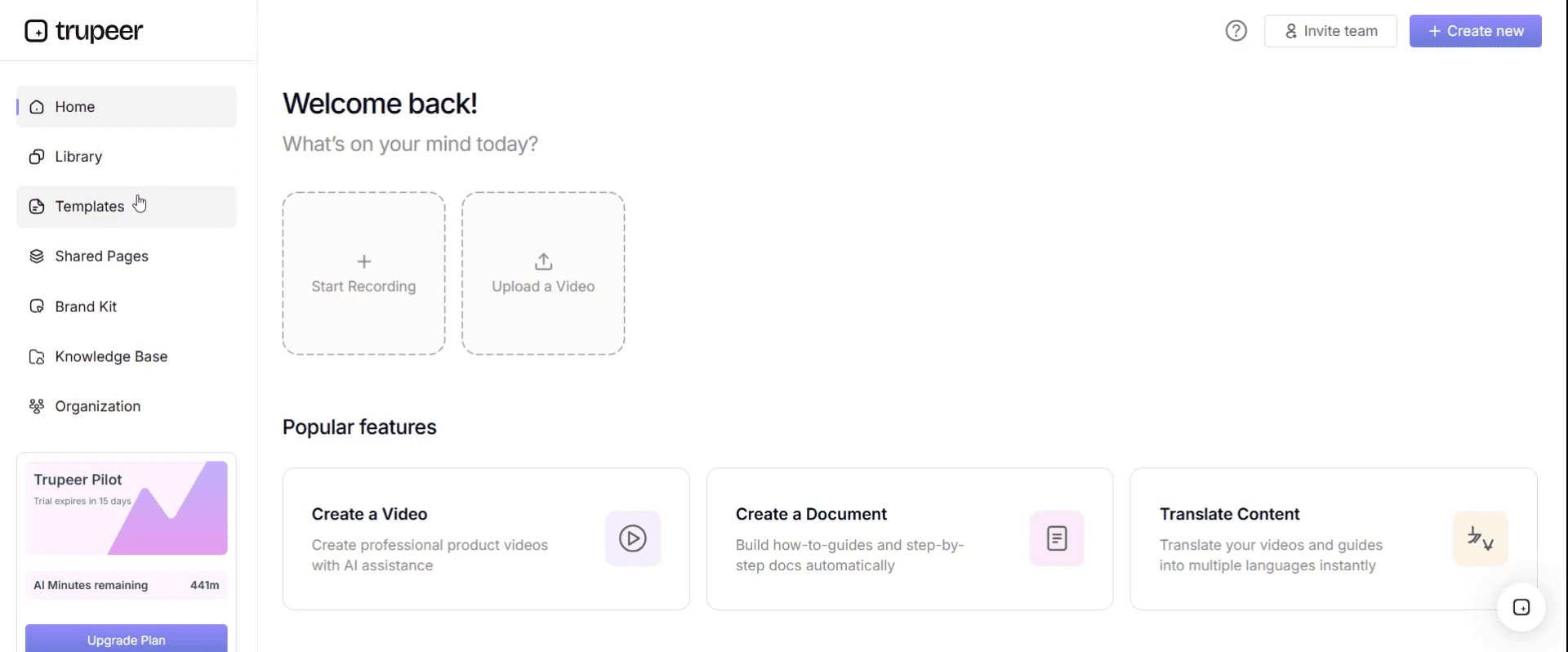
Step 1: Open the Templates Section
Go to the Templates section from the main navigation.
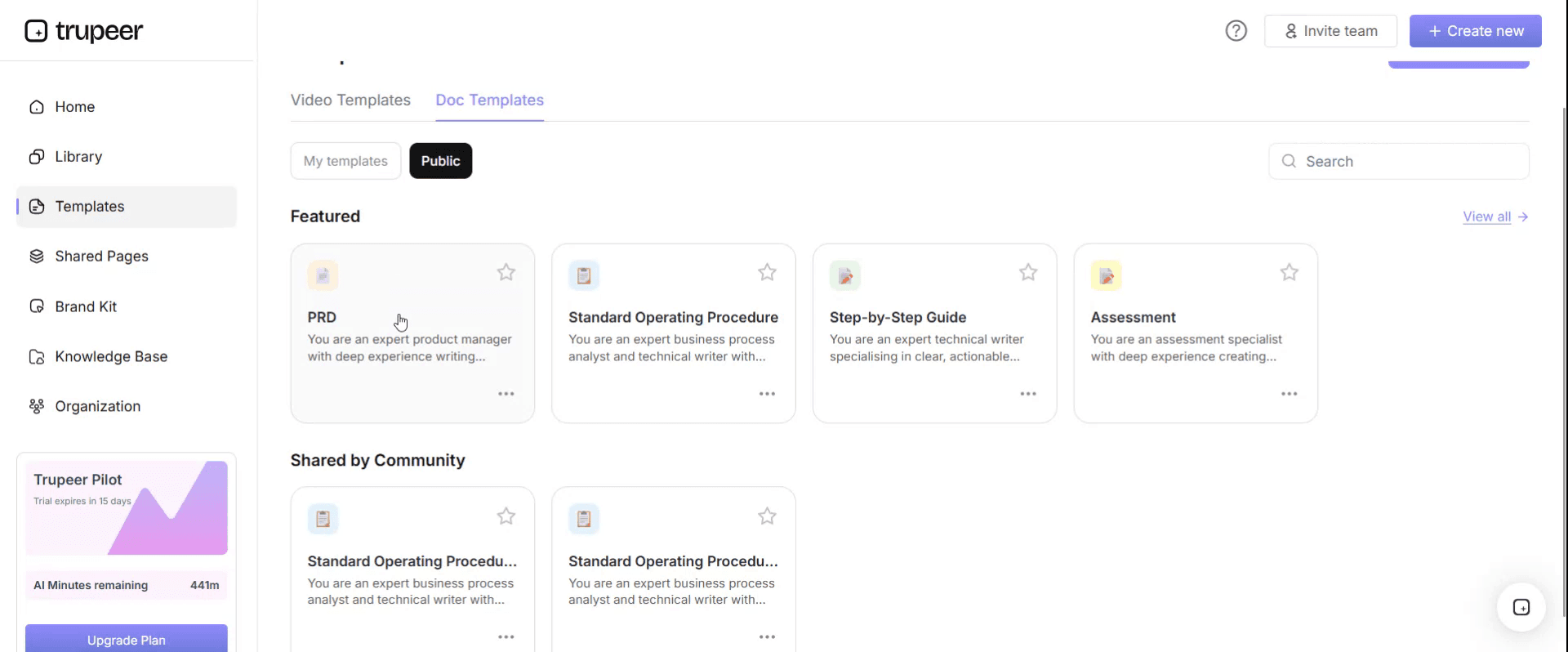
Step 2: Select and Open a Template
Click on any template you want to work with to open it.
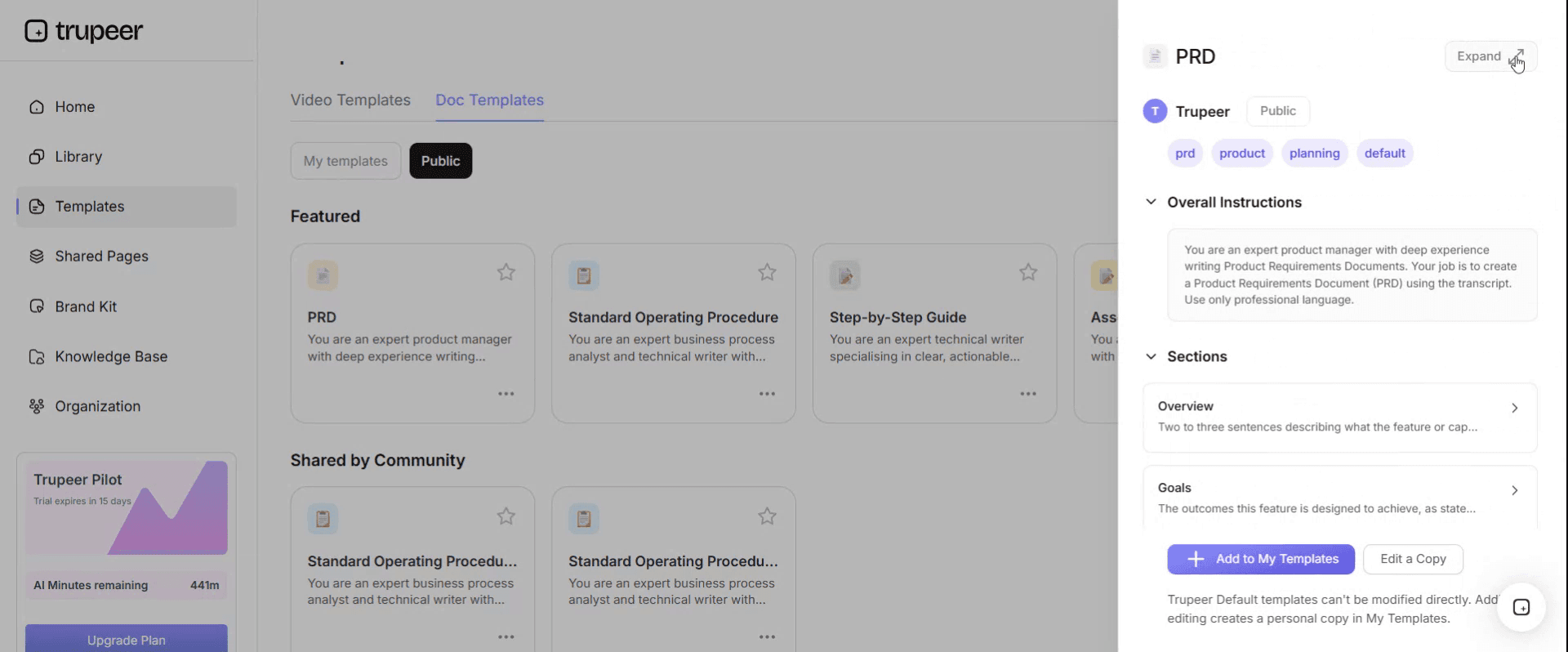
Step 3: Expand the Template View
If needed, expand the template view to see the full layout and details clearly.
Step 4: Edit the Template
Click on Edit to start modifying the selected template.
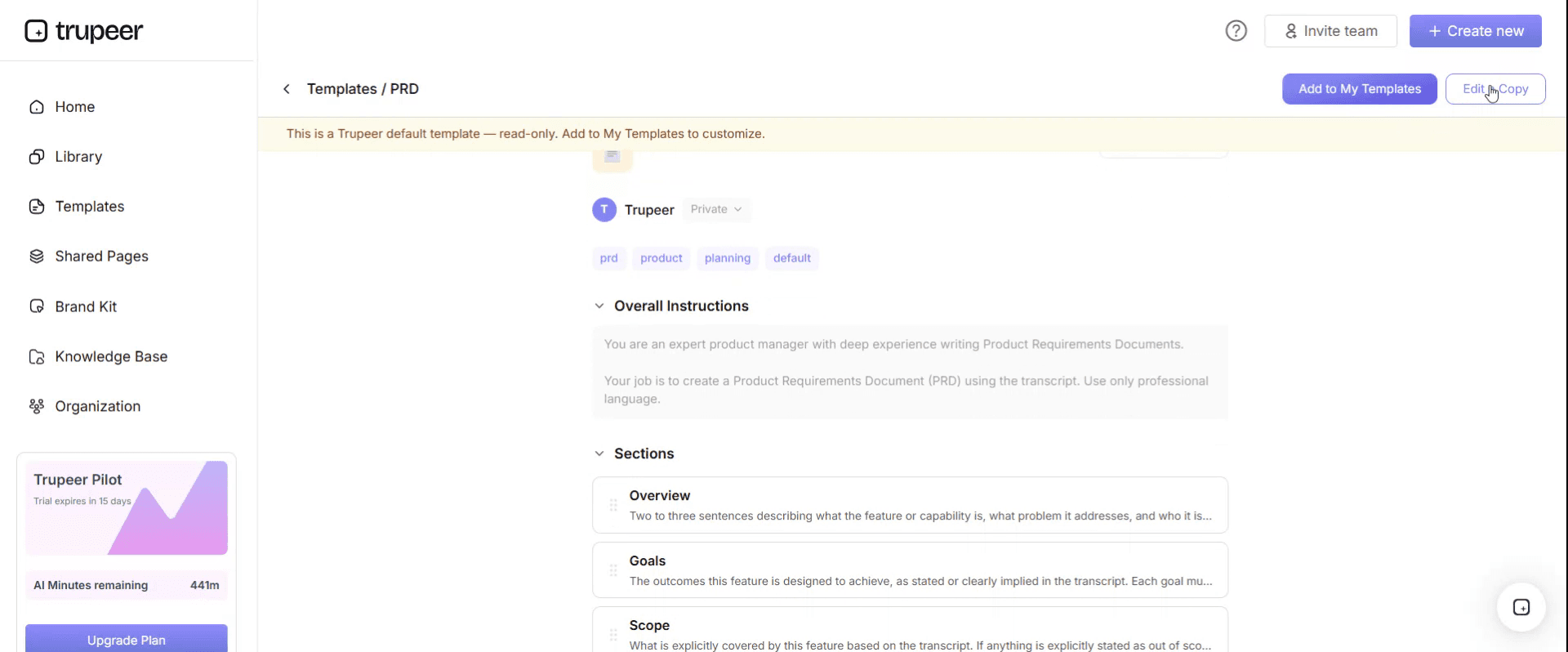
Within the editor, you can:
Add new sections
Define or update formatting rules
Add a logo and adjust its position and related settings
Step 5: Save Your Customized Template
After making all necessary changes, click Save to store the updated template as your own.
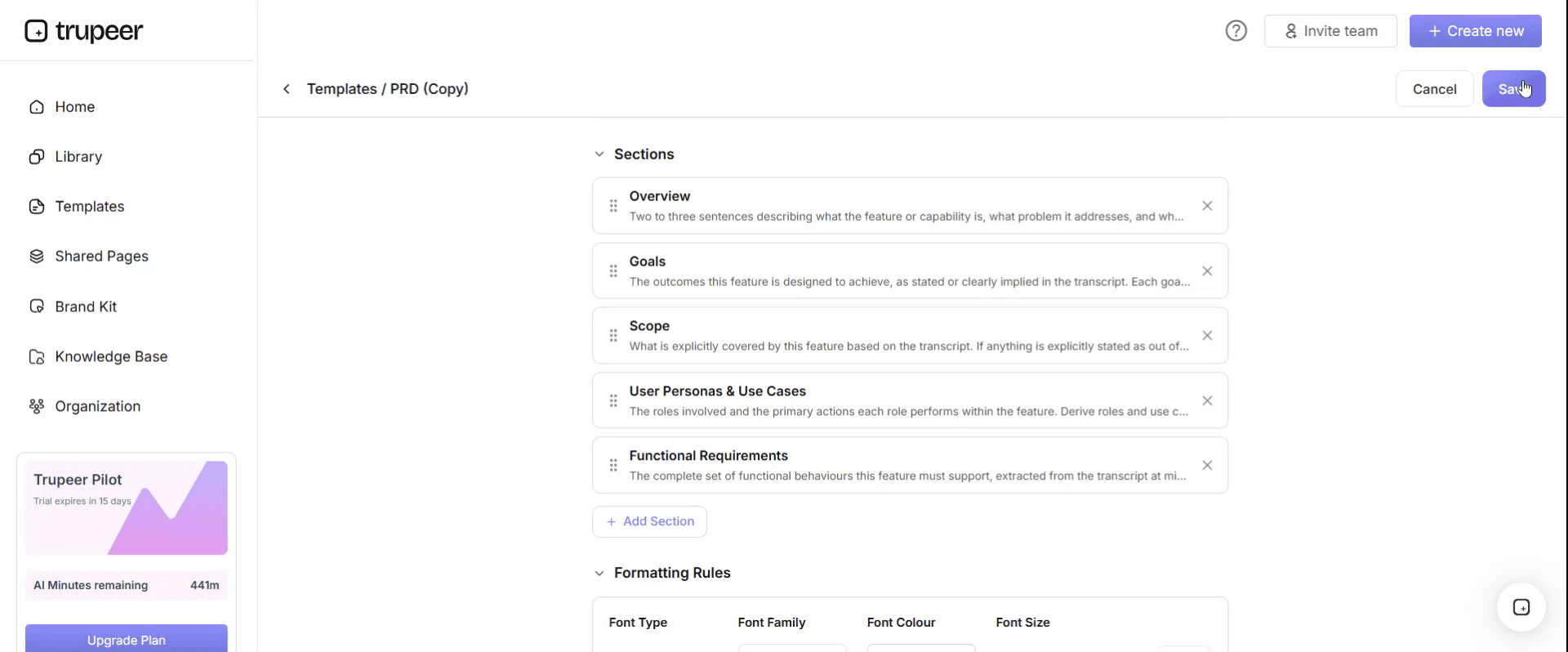
Step 6: Preview and Fine-Tune the Template
When you want to see how your customized template looks, open the Preview.
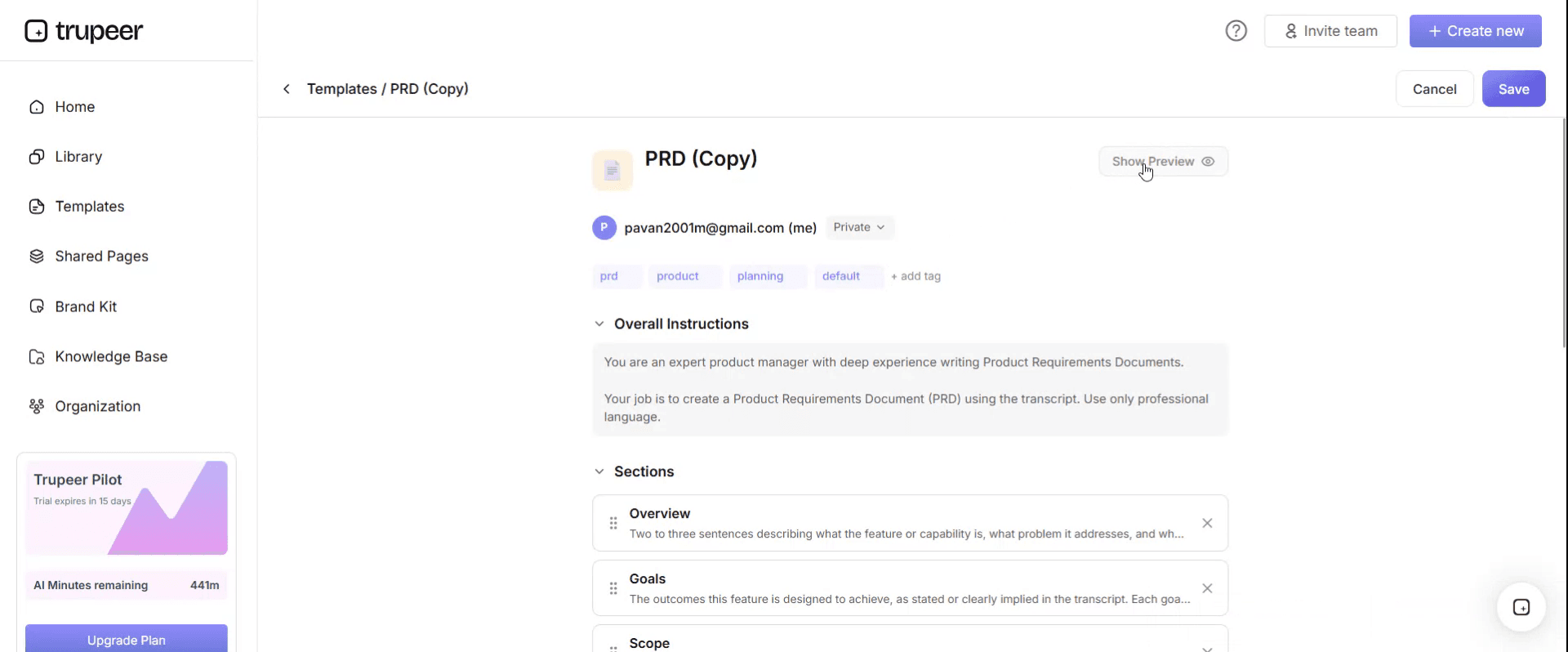
From the preview screen, you can continue to make adjustments directly if needed, ensuring the template appears exactly as you want.
With a transition handover sign-off checklist you can:
Make every gate objective: Each sign-off is backed by named evidence, not opinion.
Catch gaps before go-live: Playback and certification reveal what knowledge transfer missed.
Hold each party accountable: Every gate has named signatories.
Stay on-brand: Apply your logo, fonts and colors with Trupeer's brand kit.
Attach recordings as evidence: Link KT sessions and playbacks directly to each checklist item.
Give clients and auditors a clear record: One document shows what was checked and who approved it.
What a transition handover sign-off checklist must contain
Transition details: scope, sending and receiving parties, key dates.
Gate criteria: the items that must be true at each gate.
Evidence required: what proves each item, and where it's stored.
Status: met, not met, or met with conditions.
Sign-off block: role, name, decision, date and any conditions.
Conditions and open actions: what's still outstanding, with owners and deadlines.
Revision history: changes to the checklist during the transition.
Free transition handover sign-off checklist: the structure to copy
Copy the structure below into your own document, or open it in Trupeer and customize it.
Transition details. Transition: [name]. Scope: [processes or applications]. Sending party: [team or provider]. Receiving party: [team or provider]. Client or business owner: [name]. Planned go-live: [date].
Gate 1: KT plan agreed
Check | Evidence required | Status |
|---|---|---|
All in-scope processes are listed with owners and SMEs | Process inventory | [Met / Not met] |
KT method agreed, including recording of every session | KT plan | [Met / Not met] |
KT calendar agreed and SMEs' time confirmed | KT calendar with SME names | [Met / Not met] |
Documentation standard agreed for every process | Documentation standard | [Met / Not met] |
Playback and certification criteria agreed in advance | Gate criteria section of KT plan | [Met / Not met] |
Access to systems arranged for the receiving team | Access request log | [Met / Not met] |
Gate 2: Handover sign-off
Check | Evidence required | Status |
|---|---|---|
Every planned KT session has been delivered | KT tracker, session recordings | [Met / Not met] |
Every process has a step-level SOP and video | Links to approved SOPs and videos | [Met / Not met] |
Exceptions, business rules and workarounds are documented | Exception lists in each SOP, KEDB if relevant | [Met / Not met] |
SMEs have reviewed and approved their documentation | SME approval record | [Met / Not met] |
Open questions are listed with owners | Open items log | [Met / Not met] |
Gate 3: Playback
Check | Evidence required | Status |
|---|---|---|
Receiving team has played back every in-scope process | Playback recordings | [Met / Not met] |
Each playback is scored against agreed criteria | Scored playback sheets | [Met / Not met] |
Gaps found in playback are fixed in the documentation | Updated SOPs, change log | [Met / Not met] |
SMEs confirm the playback was accurate | SME sign-off per process | [Met / Not met] |
Gate 4: Certification
Check | Evidence required | Status |
|---|---|---|
Reverse shadowing passed at the agreed quality level | Reverse shadow log, error rates | [Met / Not met] |
Each team member assessed against the approved SOPs | Assessment results | [Met / Not met] |
Each team member certified per process | Certification log | [Met / Not met] |
Documentation published in the receiving team's knowledge base | Knowledge base links | [Met / Not met] |
Process owner and client accept the transition | Signed acceptance | [Met / Not met] |
Sign-off block (repeat for each gate).
Role | Name | Decision | Date | Conditions |
|---|---|---|---|---|
Transition lead | [Name] | [Approved / Approved with conditions / Not approved] | [Date] | [Conditions] |
Sending lead | [Name] | [Decision] | [Date] | [Conditions] |
Receiving lead | [Name] | [Decision] | [Date] | [Conditions] |
Process owner | [Name] | [Decision] | [Date] | [Conditions] |
Conditions and open actions. Action, owner, deadline, gate it relates to, status.
What counts as evidence at each gate
The value of a sign-off checklist depends on the evidence behind it. Strong evidence can be checked by someone who wasn't in the room:
Weak evidence | Strong evidence |
|---|---|
"KT sessions were held" | Recordings of every KT session, linked from the tracker |
"Documentation is in progress" | Approved SOPs and videos, with approval dates |
"The team understands the process" | Recorded playback sessions, scored against criteria |
"Shadowing went well" | Reverse shadow log with error rates against the threshold |
"Everyone is ready" | Individual certification per person and per process |
How to run a KT playback session
Playback is the gate most transitions skip, and the one that catches the most gaps. In a playback session, a member of the receiving team explains and demonstrates a process back to the SME who taught it.
Schedule one playback per process after KT and documentation are complete.
Ask the receiving team member to lead. They walk through the process in the system, explaining each step, the business rules and the main exceptions.
Have the SME listen, not teach. The SME notes anything missing, wrong or unclear.
Score it against agreed criteria, such as steps correct, exceptions covered, controls explained and questions answered.
Record the session. The recording is your evidence, and it often becomes useful training material.
Fix the gaps. Update the SOP for anything the playback revealed, and repeat the playback if the score falls short.
Who signs at each gate, and what they're accountable for
A signature only means something if the signatory can judge what they're signing. Assign roles like this:
Role | Signs at | Accountable for |
|---|---|---|
Transition lead | All gates | Running the gate review and confirming the evidence is complete |
Sending lead | Gates 1 and 2 | Confirming KT was delivered and documentation is complete |
SMEs | Gates 2 and 3 | Confirming the documentation and playback are accurate |
Receiving lead | Gates 1, 3 and 4 | Confirming the team understands and can run the work |
Process or business owner | Gates 2 and 4 | Approving the documentation and accepting the transition |
Client (in outsourcing) | Gate 4 | Final acceptance of the transition |
Keep the list of signatories short. Two or three people with direct knowledge of the work are worth more than a long list of approvers who sign without checking.
Metrics that support each sign-off
Numbers make gate reviews faster and harder to argue with:
Gate 1: share of in-scope processes with a named owner and SME.
Gate 2: share of processes with recorded KT and an approved SOP and video.
Gate 3: playback pass rate on the first attempt, and number of gaps found.
Gate 4: reverse shadow error rate against the agreed threshold, and share of staff certified.
Transition handover sign-off checklist example
Here's the checklist filled in for an illustrative example. A retailer, Alder Retail, is moving its accounts receivable process from an in-house team to its new GCC.
Transition details. Scope: cash application, collections and customer account queries. Sending party: AR team, head office. Receiving party: GCC finance team. Business owner: financial controller. Planned go-live: start of the next quarter.
Gate | Result | Evidence | Decision |
|---|---|---|---|
1. KT plan agreed | All 9 processes listed; every KT session to be recorded | KT plan, inventory, calendar | Approved |
2. Handover sign-off | 27 recordings, 9 approved SOPs and videos; 3 open questions | Tracker, SOP links, open items log | Approved with conditions: answer 3 open questions within 5 days |
3. Playback | 8 of 9 processes passed; disputed deductions failed on exceptions | Playback recordings and score sheets | Approved with conditions: repeat playback for disputed deductions |
4. Certification | Reverse shadow error rate below threshold for 2 weeks; 12 of 12 staff certified | Reverse shadow log, certification log | Approved |
What the checklist changed. Without the playback gate, the gap in disputed deductions would have surfaced as errors after go-live. Because it was caught at gate 3, the SOP was updated and the process passed playback a week later. The details in this example are illustrative; replace them with your own transition.
Conditional sign-off: how to handle gaps
Not every gate passes cleanly. Conditional sign-off lets the transition move forward without hiding gaps:
Approve with conditions only for minor, specific gaps, such as a small number of open questions.
Give every condition an owner and a deadline, and record it in the open actions section.
Never carry conditions past certification. All conditions from earlier gates should be closed before gate 4 is signed.
Refuse sign-off for major gaps, such as an undocumented process or a failed playback, and set a date to re-run the gate.
Variants of the transition sign-off checklist
Vendor-to-vendor transition sign-off
Add the incumbent provider and the client as signatories at every gate. The client should own the signed checklist, so the record survives future provider changes. See our guide to vendor-to-vendor transition knowledge transfer.
GCC and insourcing sign-off
Add checks for the outgoing provider's exit obligations at gate 2, and for documentation being stored in the GCC's own knowledge base at gate 4. See our guide to GCC setup knowledge transfer.
AMS and IT application transition sign-off
Add the known error database, runbooks and access to monitoring tools as evidence at gate 2, and include handling a live incident in reverse shadowing at gate 4. The KEDB template covers the known error records.
Internal team handover sign-off
For a handover between internal teams, combine gates 1 and 2 if the scope is small, but keep playback and certification separate.
Government and public sector transition sign-off
Add checks for records management, data protection and delegated authorities, and include the senior responsible owner as a signatory at gate 4.
Generate the evidence from recordings
Most of the evidence this checklist asks for can come from recordings. Record every KT session and playback with Trupeer's AI screen recorder, and turn each recording into a step-by-step SOP and video with the SOP creator. Publish everything in a searchable knowledge base, link it from the checklist, and use translation for teams in other locations.
The recording-first approach works at scale. Genpact recorded existing MS Teams process sessions and SME walkthroughs, uploaded them to Trupeer and got back SOPs and demo videos in five languages: more than 500 training collaterals for 140,000 employees in 40 countries, delivered in 3 months instead of 12. Read the Genpact customer story.
Sign-off checklist vs handover document vs transition plan vs transition SOP
Document | What it does |
|---|---|
Transition handover sign-off checklist | Defines and records the gates, evidence and approvals |
Handover document | Records what is being handed over |
Transition plan | Schedules one transition: processes, people and dates |
Transition SOP | Sets the standard method every transition follows |
Use them together: the transition SOP sets the method, the plan schedules it, the handover document captures the content and the sign-off checklist proves each gate was passed. See the transition SOP template, transition plan template, handover document template and project handover checklist template.
Common mistakes to avoid
Signing off on activity, not evidence. Sessions held isn't proof that knowledge transferred.
Skipping playback. It's the cheapest way to find gaps before they become errors.
Agreeing criteria too late. Set gate criteria at gate 1, before anyone has a reason to lower them.
Letting conditions pile up. Close every condition before certification.
One signature for everything. Each gate needs the people who can genuinely judge it.
How to use this checklist in five steps
Fill in the transition details and agree the signatories for each gate.
Agree the gate criteria and evidence at the start, as part of gate 1.
Collect evidence as you go, linking recordings, SOPs and logs to each item.
Run each gate review with the signatories, recording decisions and conditions.
Close conditions and store the signed checklist with the transition records.
Download the free transition handover sign-off checklist
Open the template in Trupeer, apply your brand kit, link your recordings as evidence and share the checklist with every party in the transition. Get the free transition handover sign-off checklist.
Frequently Asked Questions
What is a transition handover sign-off checklist?
It's a document that defines the checks, evidence and approvals required at each gate of a transition, so each stage is signed off on proof rather than opinion.
What are the four transition gates?
KT plan agreed, handover sign-off, playback and certification. Together they confirm the plan, the delivery of knowledge transfer, the receiving team's understanding and its ability to do the work.
What is a KT playback?
A KT playback is a session where the receiving team explains and demonstrates a process back to the SME who taught it. It proves understanding and reveals gaps before go-live.
What evidence is needed for transition sign-off?
Typically KT session recordings, approved SOPs and videos, open items logs, playback recordings and scores, reverse shadow results, assessment results and individual certifications.
Who signs off a transition handover?
Usually the transition lead, the sending and receiving leads, the SMEs and the process or business owner. In outsourcing, the client signs final acceptance.
What is the difference between handover and sign-off?
A handover is the transfer of work, knowledge and documents. Sign-off is the formal approval that a stage of the handover has been completed to the agreed standard.
What is conditional sign-off?
Approval of a gate with specific, minor gaps still open. Each condition gets an owner and a deadline, and all conditions should be closed before final certification.
What happens if a gate fails?
The gate isn't signed. The gaps are fixed, such as updating SOPs or repeating a playback, and the gate review is re-run on an agreed date.
What is a transition sign-off checklist example?
It's the checklist filled in for a real or illustrative transition. The accounts receivable example on this page shows the result, evidence and decision at each of the four gates.
Is there a transition handover sign-off checklist in Word?
Word suits the checklist and sign-off blocks. Open this template in Trupeer and export it, or copy the structure above into Word.
Is there a transition handover sign-off checklist in Excel?
Excel works well for tracking checklist items and evidence across many processes. Keep the signed sign-off blocks in a document.
Is there a transition handover sign-off checklist in PDF?
PDF suits the signed, final version stored with the transition records. Keep an editable version during the transition.
Is there a transition handover sign-off checklist in Google Docs?
Yes. Copy the structure above into Google Docs or Sheets, or open the template in Trupeer and export it. Google Docs is useful when several parties need to review and comment on each gate.

