Trupeer Blog
Özetle
Finance leaders are being asked to do more with less: close faster, forecast better, support the business with insight rather than spreadsheets, and adopt cloud ERP, automation and AI along the way. Most finance teams know they need to change. The hard part is deciding where to start, what to do in which order and how to keep the business running while it all happens.
A finance transformation roadmap answers those questions. It turns a broad ambition into a sequence of practical steps, with clear priorities, owners and measures. This guide explains what a finance transformation roadmap is, why documenting how finance works today should be step one, a seven-step approach to building the roadmap, an example timeline, the KPIs to track and the mistakes to avoid.
What is a finance transformation roadmap?
A finance transformation roadmap is a phased plan that moves a finance function from how it works today to a target operating model. It covers processes, people, technology and data, and sets out which initiatives happen when, what they depend on, who owns them and how success will be measured.
Typical initiatives on a finance transformation roadmap include standardising processes across entities, moving transactional work into shared services, implementing or upgrading an ERP, automating high-volume tasks, speeding up the month-end close, improving planning and analysis, and building finance teams' data and analytics skills.
Why should documentation be step one of a finance transformation roadmap?
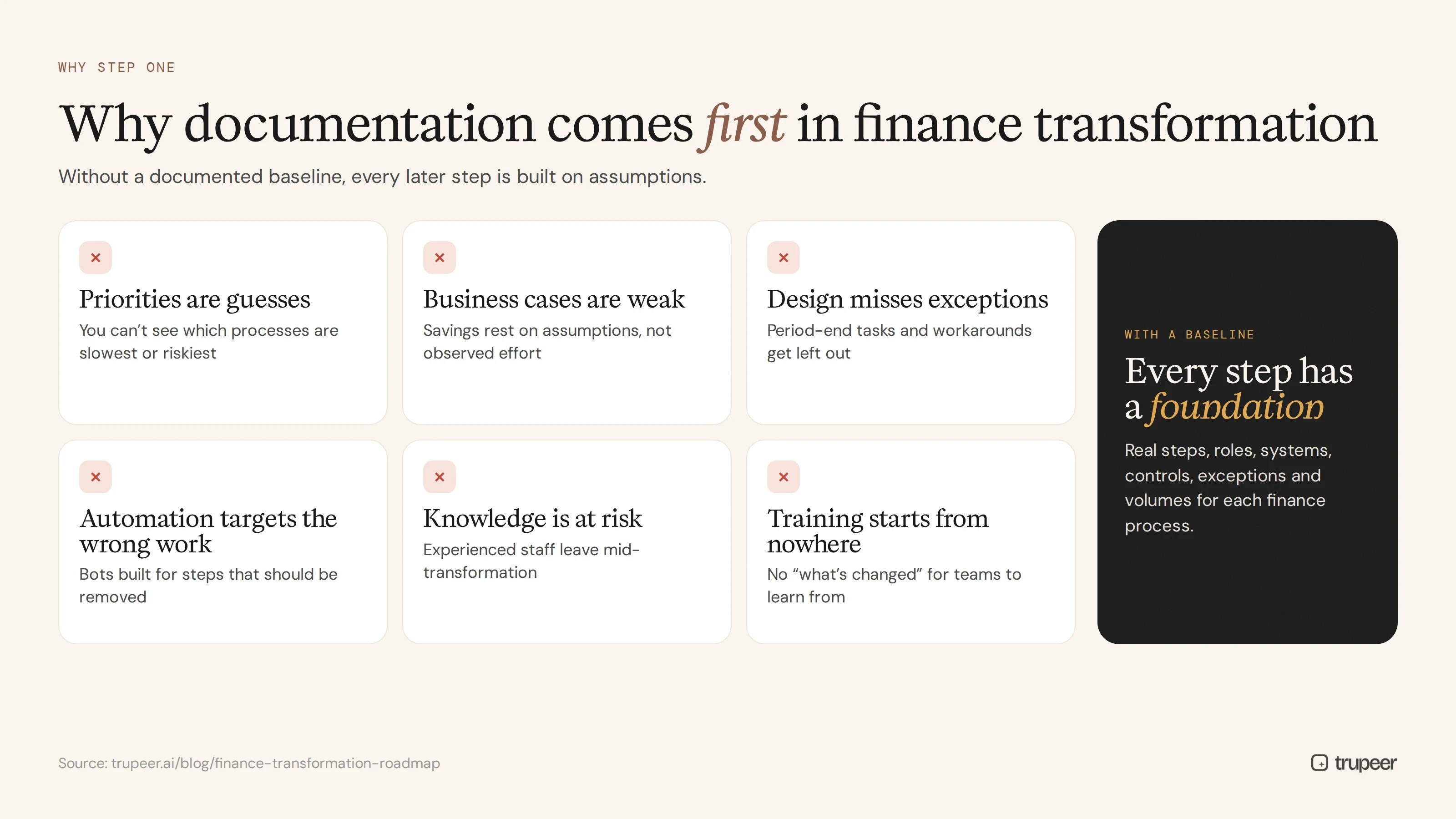
Every later step depends on knowing how finance actually works today. Without that baseline:
Priorities are guesses. You can't tell which processes are slowest, riskiest or most manual.
Business cases are weak. Savings estimates rest on assumptions rather than observed effort.
Design misses exceptions. New processes and systems are built without the period-end tasks, workarounds and controls people rely on.
Automation targets the wrong work. Bots get built for steps that should have been removed.
Knowledge is at risk. Experienced finance staff hold critical knowledge, and transformations often coincide with people leaving.
Training starts from nowhere. Teams learn new ways of working faster when training explains what's changed.
Documenting current finance processes first gives every later step of the roadmap a reliable foundation. For a detailed method, see SAP S/4HANA transformation: document as-is processes first; the same approach works for any finance system.
The finance transformation roadmap in 7 steps
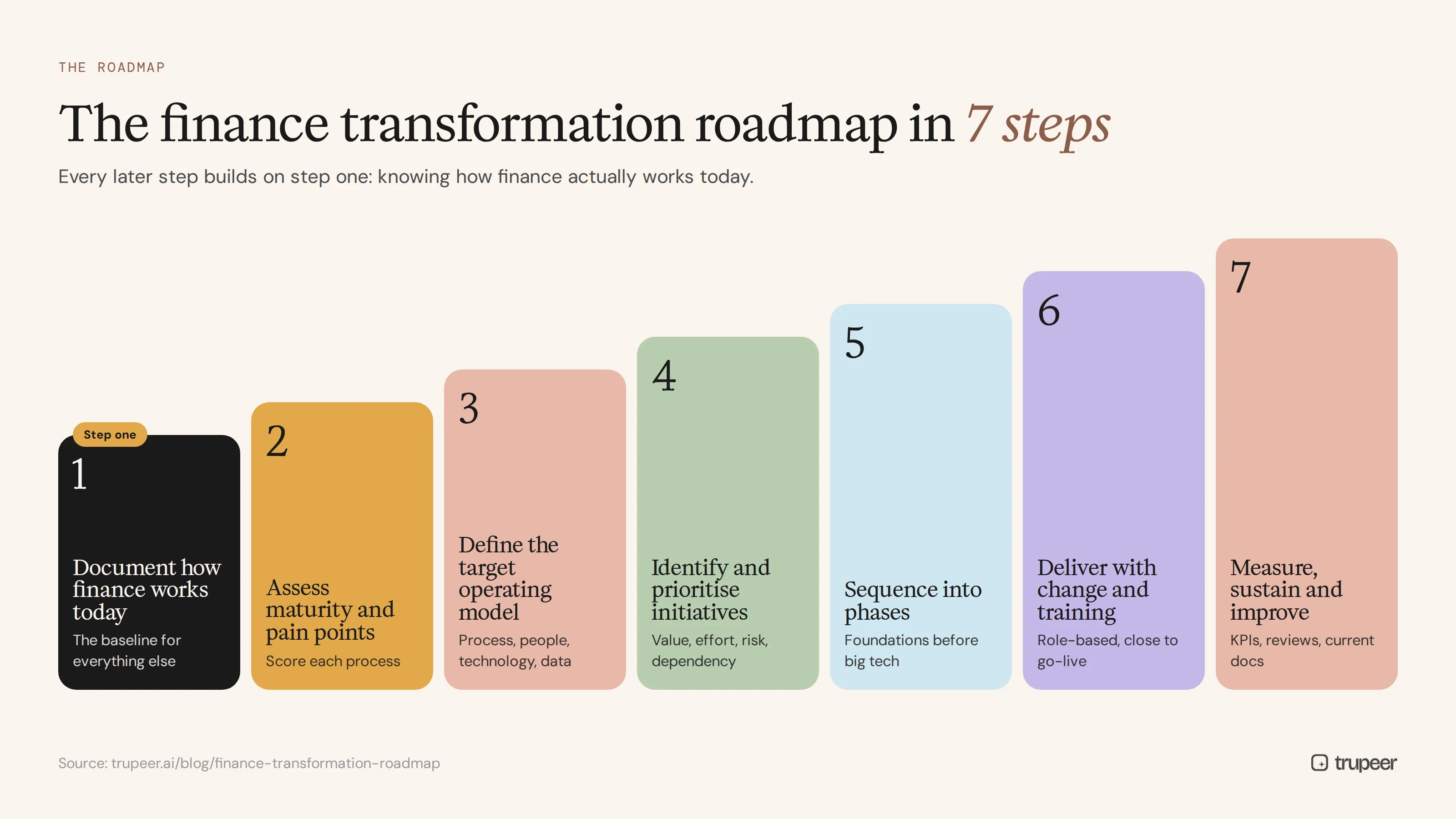
Step 1: Document how finance works today
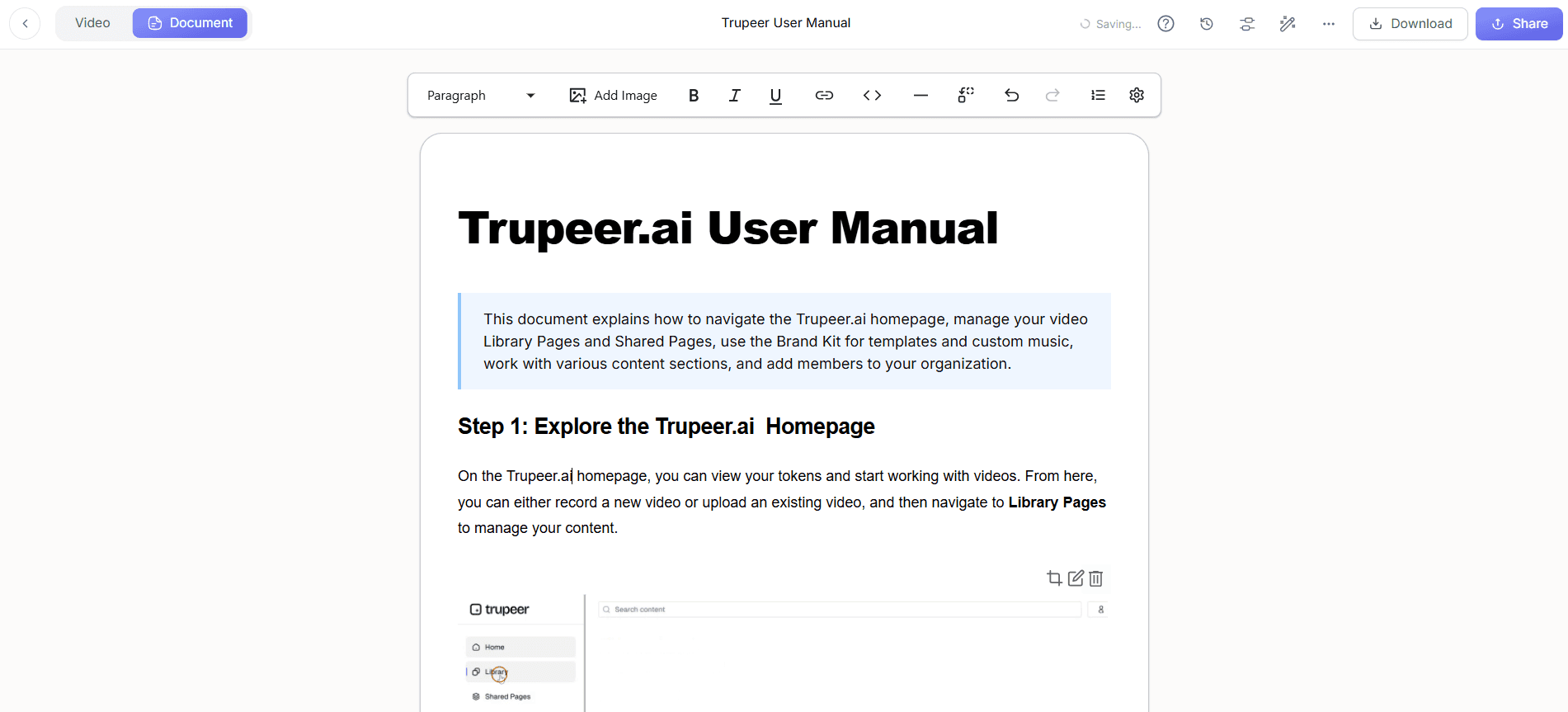
Map and document the core finance processes: procure to pay, order to cash, record to report, planning and analysis, treasury and tax. For each, capture the steps, roles, systems, controls, exceptions and volumes. The fastest way is to record experienced team members doing the real work with Trupeer's AI screen recorder, and turn each recording into a step-by-step process document.
Step 2: Assess maturity and pain points
Using the documentation, assess each process for efficiency, control, consistency across entities and use of technology. Talk to finance staff and business partners about pain points: slow close, manual reconciliations, late reporting, weak forecasts. A simple maturity score per process shows where the biggest gaps are.
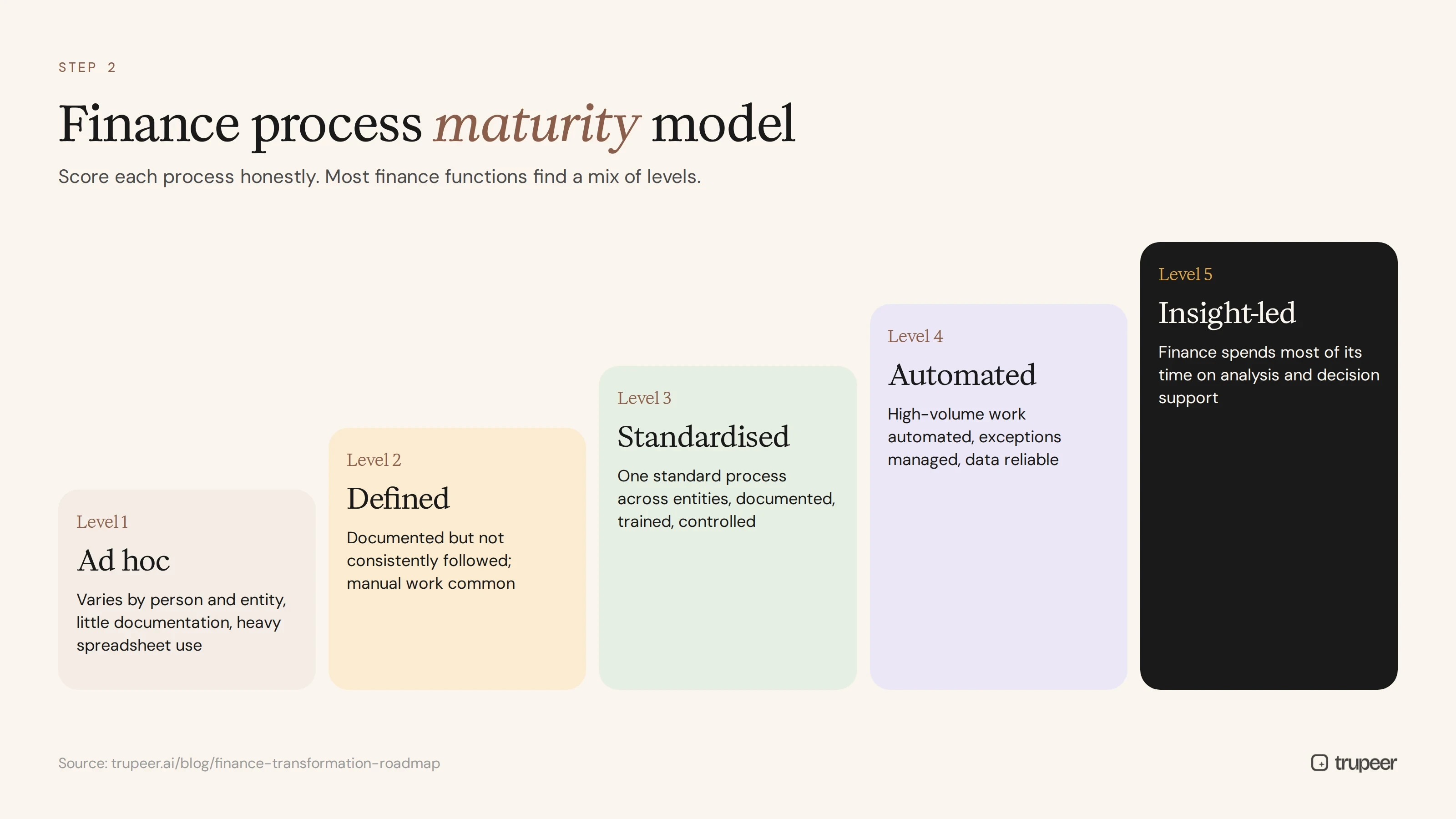
Maturity level | What it looks like |
|---|---|
1. Ad hoc | Processes vary by person and entity, little documentation, heavy spreadsheet use |
2. Defined | Processes documented but not consistently followed; manual work common |
3. Standardised | One standard process across entities, documented and trained, with clear controls |
4. Automated | High-volume work automated, exceptions managed, data reliable |
5. Insight-led | Finance spends most of its time on analysis and decision support |
Score each process honestly. Most finance functions find a mix of levels, which is exactly what the roadmap should address.
Step 3: Define the target operating model
Set out where finance is heading, across four dimensions:
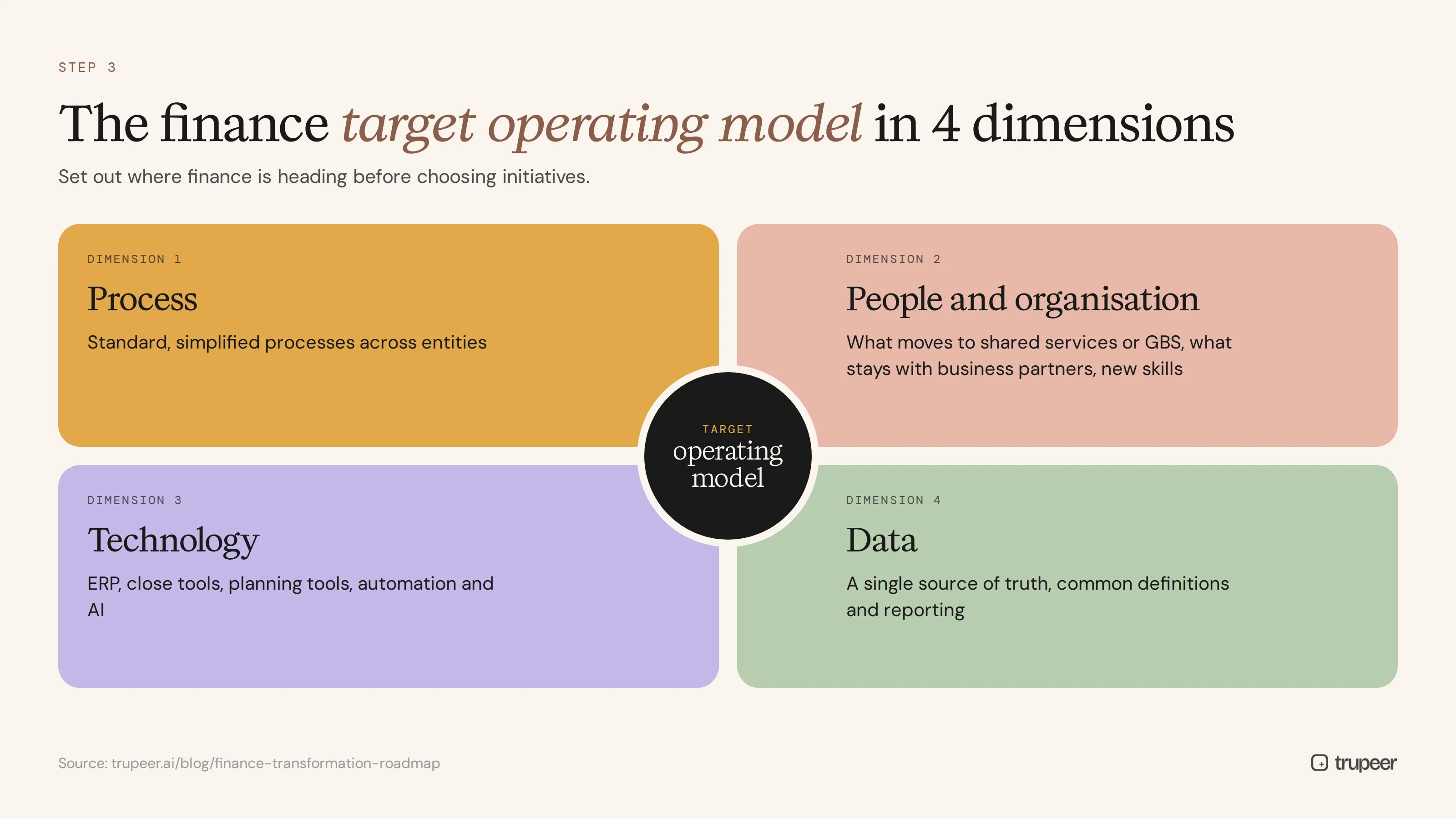
Process: standard, simplified processes across entities.
People and organisation: which work moves to shared services or global business services, what stays with business partners and what new skills are needed.
Technology: the role of ERP, close tools, planning tools, automation and AI.
Data: a single source of truth, common definitions and reporting.
If shared services is part of the model, see shared services SOP documentation at scale.
Step 4: Identify and prioritise initiatives
List the initiatives needed to close the gap between today and the target model, then prioritise them by value, effort, risk and dependency. Use the documented processes to find quick wins, such as automation candidates in high-volume transactional work; see how to identify automation opportunities in documented processes.
Step 5: Sequence the roadmap into phases
Group initiatives into phases that build on each other. Foundations, such as process standardisation and data clean-up, usually come before large technology changes, and large technology changes come before advanced analytics. Make dependencies explicit, and plan for the business to keep running throughout.
Step 6: Deliver with change management and training
Each initiative changes how people work, so plan communication, role-based training and support from the start. Build training on the new processes and systems, close to go-live, and keep it current afterwards. For finance teams, see accounts payable training for new hires as an example of role-based enablement.
Appoint super users in each finance team and entity, so colleagues have help close at hand during each wave of change. A super user training program gives them the depth they need to support others.
Step 7: Measure, sustain and improve
Track KPIs for each initiative and for finance overall, review them regularly and adjust the roadmap as priorities change. Keep process documentation current, so the baseline stays accurate for the next wave of improvement; see how to keep training documentation current after go-live.
Who should own the finance transformation roadmap?
A finance transformation roadmap needs a clear owner and a small governance structure:
The CFO sponsors the transformation, sets the ambition and resolves trade-offs between speed, cost and risk.
A finance transformation lead owns the roadmap day to day: priorities, sequencing, dependencies and progress reporting.
Process owners for procure to pay, order to cash, record to report and planning own the design and the results in their area.
IT and data leads own the technology and data initiatives and how they fit with the wider enterprise architecture.
HR and change leads own the people side: organisation design, skills, communication and training.
Review the roadmap regularly, for example quarterly, so it reflects what has been delivered, what has been learned and how business priorities have shifted.
How do you build the business case for a finance transformation roadmap?
A strong business case connects each initiative to measurable outcomes, using the documented baseline:
Quantify today's effort for each process from the documentation: volumes, time per transaction and the people involved.
Estimate the improvement each initiative can deliver, such as fewer manual steps, faster close or lower error rates.
Add the benefits beyond cost, including better control, faster decisions and lower key-person risk.
Estimate the full cost, including technology, implementation partners, internal time, training and change management.
Phase benefits realistically, since most benefits arrive after adoption, not at go-live.
Because the baseline comes from documented processes rather than estimates, the business case is easier to defend and the benefits are easier to prove later.
How do you protect finance knowledge during a transformation?
Finance transformations often run for several years, and experienced people move on during them. Much of what they know, such as period-end adjustments, intercompany workarounds and the reasons behind certain controls, is rarely written down. Protect it by recording experts doing their work early in the roadmap, turning the recordings into searchable guides, and making those guides the first place new and moving staff look. A tribal knowledge audit helps find where knowledge sits with only one or two people.
Finance transformation roadmap example
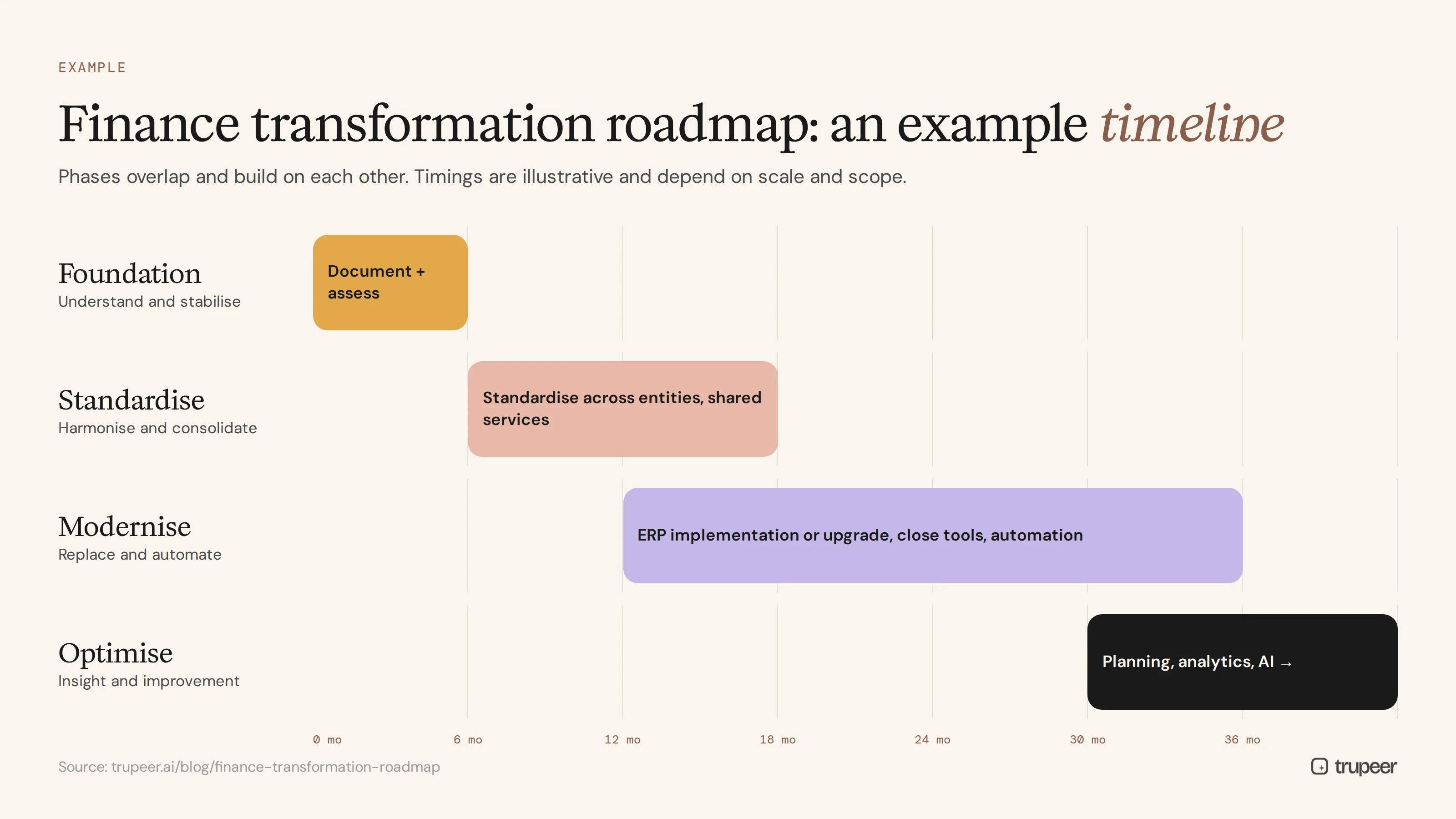
Here's how a finance transformation roadmap might be phased. The timings are illustrative and depend on scale and scope.
Phase | Typical timing | Focus | Example initiatives |
|---|---|---|---|
Foundation | First 6 months | Understand and stabilise | Document current processes, assess maturity, standardise key policies, clean master data |
Standardise | 6 to 18 months | Harmonise and consolidate | Standard processes across entities, move transactional work to shared services, controls framework |
Modernise | 12 to 36 months | Replace and automate | ERP implementation or upgrade, close and reconciliation tools, automation of high-volume tasks |
Optimise | Ongoing | Insight and continuous improvement | Better planning and forecasting, analytics, AI-assisted work, continuous process improvement |
Which finance processes should the roadmap cover?
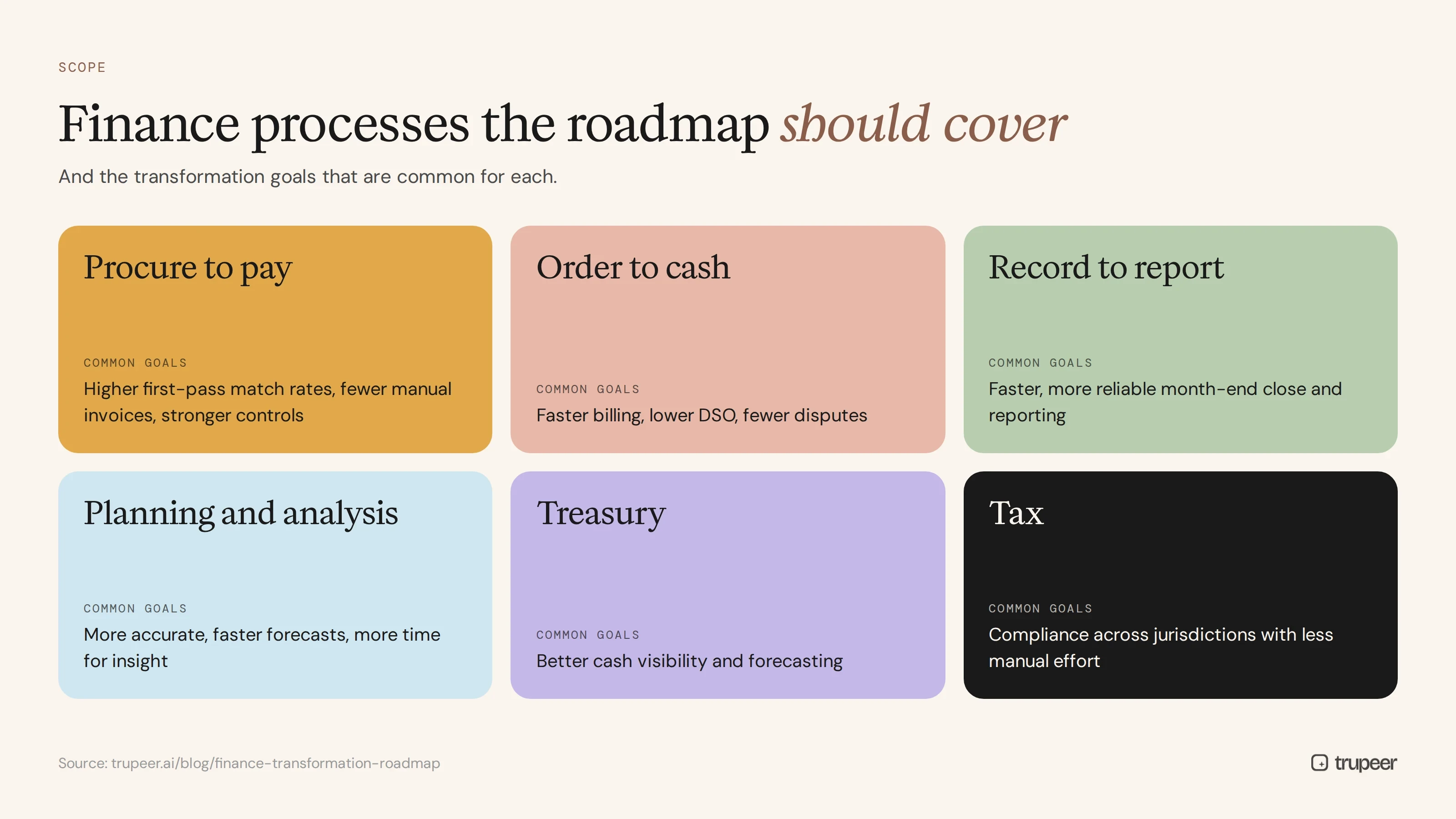
Process | Common transformation goals |
|---|---|
Procure to pay | Higher first-pass match rates, fewer manual invoices, stronger controls |
Order to cash | Faster billing, lower days sales outstanding, fewer disputes |
Record to report | Faster, more reliable month-end close and reporting |
Planning and analysis | More accurate, faster forecasts and more time for insight |
Treasury | Better cash visibility and forecasting |
Tax | Compliance across jurisdictions with less manual effort |
For a worked example of documenting one finance area in depth, see accounts payable process documentation.
What KPIs should a finance transformation roadmap track?
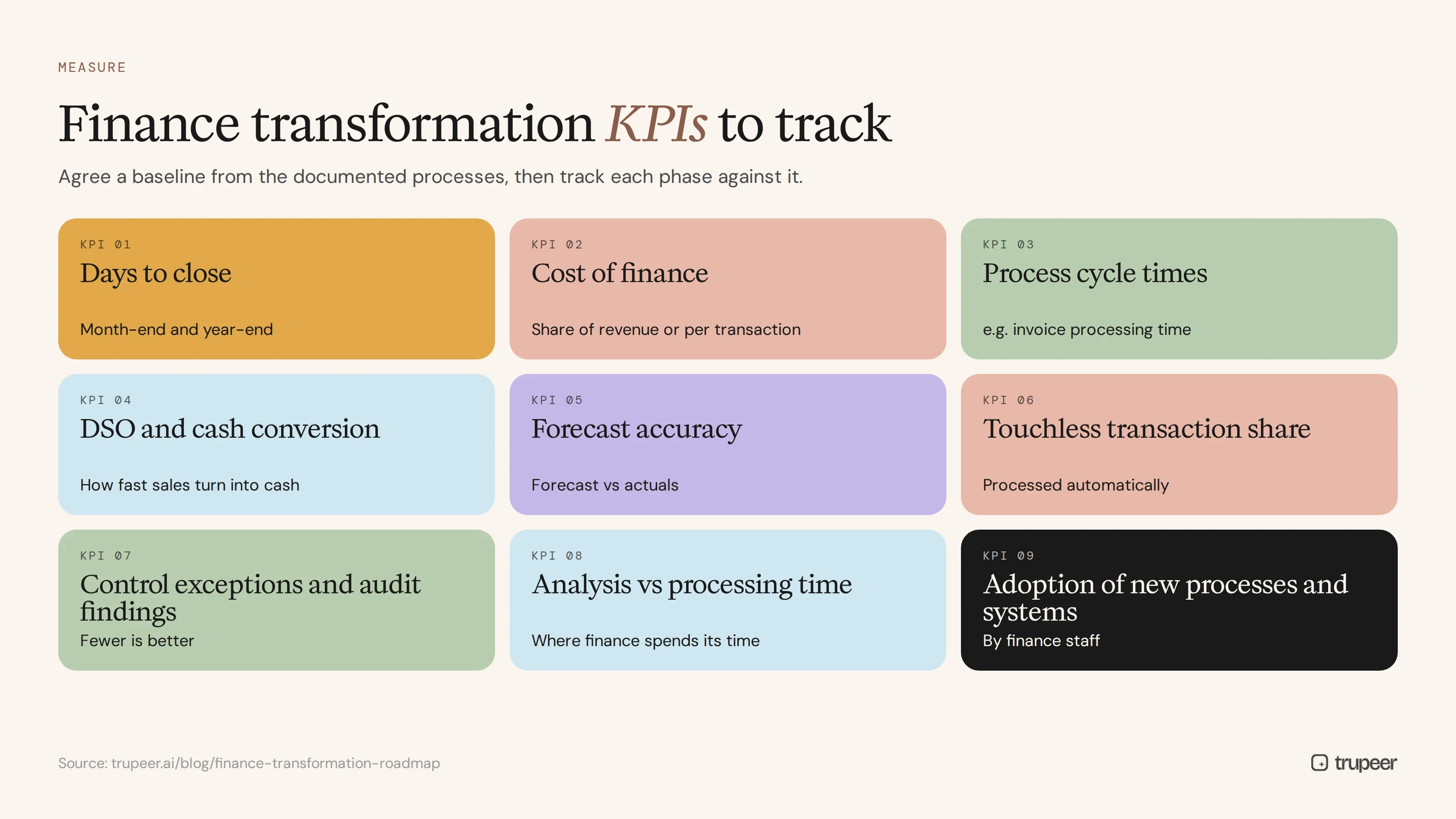
Days to close for month-end and year-end.
Cost of finance as a share of revenue or per transaction.
Process cycle times, such as invoice processing time.
Days sales outstanding and cash conversion.
Forecast accuracy against actuals.
Share of transactions processed automatically or touchlessly.
Control exceptions and audit findings.
Time spent on analysis versus transaction processing.
Adoption of new processes and systems by finance staff.
Common finance transformation roadmap mistakes
Starting with technology, before understanding current processes and the target operating model.
Skipping the baseline, so benefits can't be proven later.
Trying to change everything at once, instead of phasing.
Automating broken processes rather than simplifying them first.
Underinvesting in people: communication, training and new skills.
Losing knowledge when experienced staff move on during the transformation.
Treating go-live as the finish line, instead of measuring adoption and benefits.
For a broader look at where transformations go wrong, see why digital transformations fail.
Finance transformation roadmap checklist
Current finance processes are documented, with controls, exceptions and volumes.
Each process has a maturity assessment and a list of pain points.
The target operating model covers process, people, technology and data.
Initiatives are prioritised by value, effort, risk and dependency.
The roadmap is phased, with dependencies and owners.
Each initiative has a change management and training plan.
KPIs and a baseline are agreed for each phase.
Process documentation is kept current as the roadmap progresses.
How Trupeer supports your finance transformation roadmap
Documentation is step one of a finance transformation roadmap, and it's usually the step that slips. Trupeer makes it fast enough to do properly, then keeps it useful at every later step:
Roadmap step | How Trupeer helps |
|---|---|
Document how finance works today | Finance specialists record real tasks, including period-end work and exceptions, and Trupeer turns each into a step-by-step process document |
Assess maturity and build the business case | A documented baseline shows the steps, effort and workarounds in each process |
Deliver with change management and training | The same recording approach produces role-based guides and short training videos for the new system |
Protect knowledge during the programme | Expert knowledge becomes searchable guides that stay after people move on |
Measure, sustain and improve | Guides are updated by editing the script or re-recording one step, so documentation keeps pace with each wave of change |
Genpact used this approach for a company-wide Workday rollout, turning recorded process sessions into more than 500 training collaterals across 20 workstreams in five languages, in 3 months instead of 12. Read the Genpact customer story.
For finance teams, that means the baseline is ready in weeks, training is ready before go-live and nothing is lost when experienced people move on.
Frequently asked questions
What is a finance transformation roadmap?
It's a phased plan that moves a finance function from how it works today to a target operating model, covering processes, people, technology and data, with priorities, owners and measures.
What are the steps in a finance transformation roadmap?
Document how finance works today, assess maturity and pain points, define the target operating model, identify and prioritise initiatives, sequence them into phases, deliver with change management and training, and measure and improve.
Why should documentation come first?
Because every later step depends on knowing how finance actually works: priorities, business cases, design, automation and training all need an accurate baseline.
How long does a finance transformation take?
It depends on scope and scale. Foundation work often takes months, while large system and operating model changes typically run over several years, delivered in phases.
Which finance processes should be transformed first?
Usually high-volume, high-cost or high-risk processes, such as procure to pay, order to cash and record to report, where documentation shows the biggest gaps.
What role does technology play in finance transformation?
Technology, such as cloud ERP, close tools, planning tools and automation, is an enabler. It delivers most value when processes are standardised and people are trained to use it well.
What KPIs measure finance transformation success?
Common KPIs include days to close, cost of finance, process cycle times, days sales outstanding, forecast accuracy, automation rates, control exceptions and adoption.
How does Trupeer help with finance transformation?
Trupeer turns recordings of finance processes into step-by-step documentation, training videos and a searchable knowledge base, supporting the baseline at the start and training and knowledge retention throughout.
Start your finance transformation roadmap with what you know
The best finance transformation roadmaps start with an honest picture of how finance works today. Document it first, and every later step, from design to automation to training, rests on solid ground. Learn more about Trupeer AI.