Use este modelo
When everyone thinks someone else owns a task, nobody does. With Trupeer, you can save hours on planning by starting with a free RACI matrix template, customizing it with your brand guidelines, and drafting it from recordings of the work and the planning sessions you already run.
What is a RACI matrix template?
A RACI matrix template is a ready-made grid for assigning who does what on a project, process or transition. Tasks or deliverables run down the rows, roles run across the columns, and each cell shows one of four letters:
R, Responsible: does the work.
A, Accountable: owns the outcome and makes the final decision. There should be exactly one A per task.
C, Consulted: gives input before the work is done or a decision is made. Two-way communication.
I, Informed: kept up to date on progress or decisions. One-way communication.
It's also called a RACI chart, responsibility assignment matrix (RAM) or RACI model. The copy-ready template below is free to use as it is; you don't need an account to copy it.
Why use a RACI matrix?
A RACI matrix answers questions that cause most delays and disputes:
Who decides? One accountable person per task removes "I thought you were signing that off."
Who needs to be asked? Consulted roles are agreed up front, so nobody is surprised by a decision.
Who just needs to know? Informed roles get updates without being pulled into every meeting.
Is anyone overloaded? Reading down a column shows who has too many Rs or As.
Is anything unowned? Reading across a row shows tasks with no A at all.
When do you need a RACI matrix?
RACI is useful in any work involving several teams. It's essential when:
Running a transition, such as outsourcing, a vendor change or a GCC setup, where work moves between parties.
Implementing a system, such as an ERP, CRM or HR platform, where IT, the business and a vendor all share the work.
Managing a project with several teams, suppliers or approvers.
Defining an operating model or a new process after a reorganization.
Preparing for an audit, where you need to show who owns each control.
Preview the RACI matrix template
The template opens with a short header for the project or transition name, owner and date. The main section is the RACI grid, with tasks grouped by phase down the left and roles across the top. A legend explains R, A, C and I, and a validation section lists the checks to run before you share the matrix. Every row, column and phase is editable.
How to customize this template in Trupeer
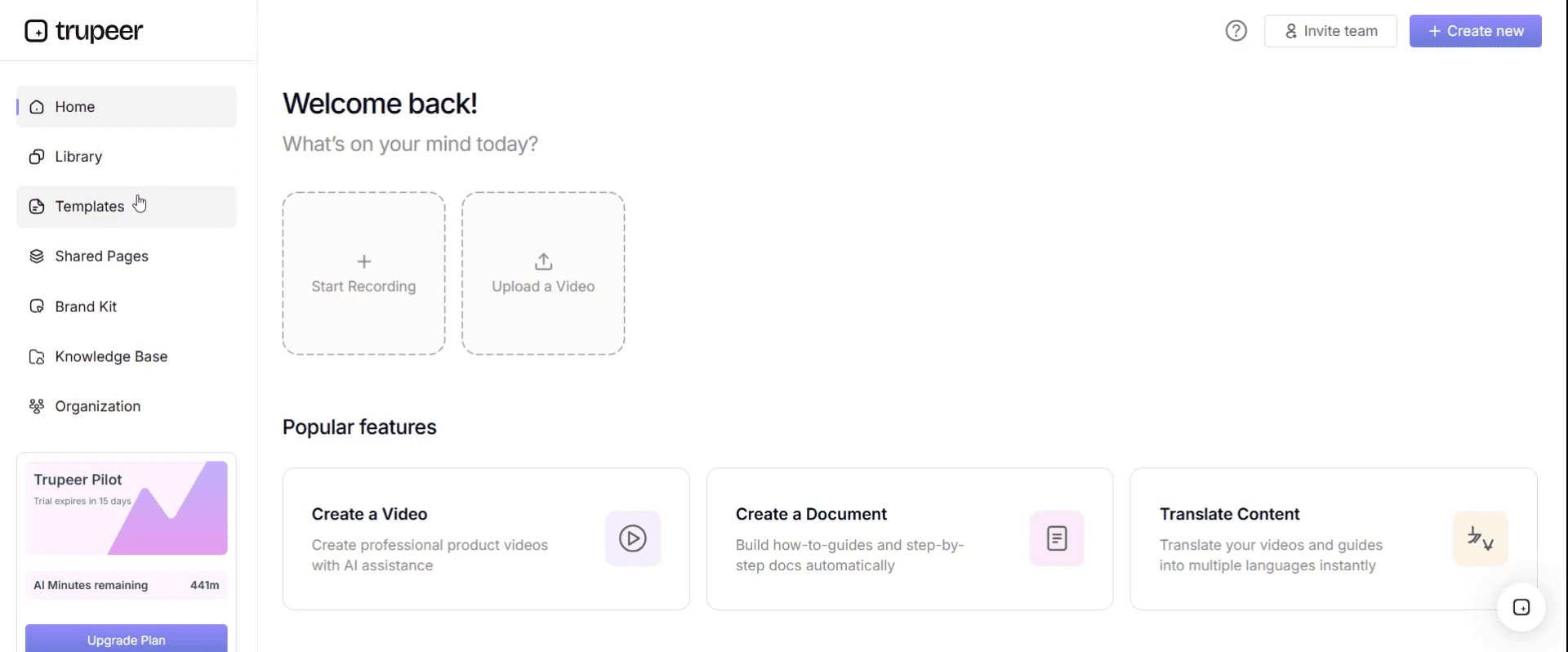
Step 1: Open the Templates Section
Go to the Templates section from the main navigation.
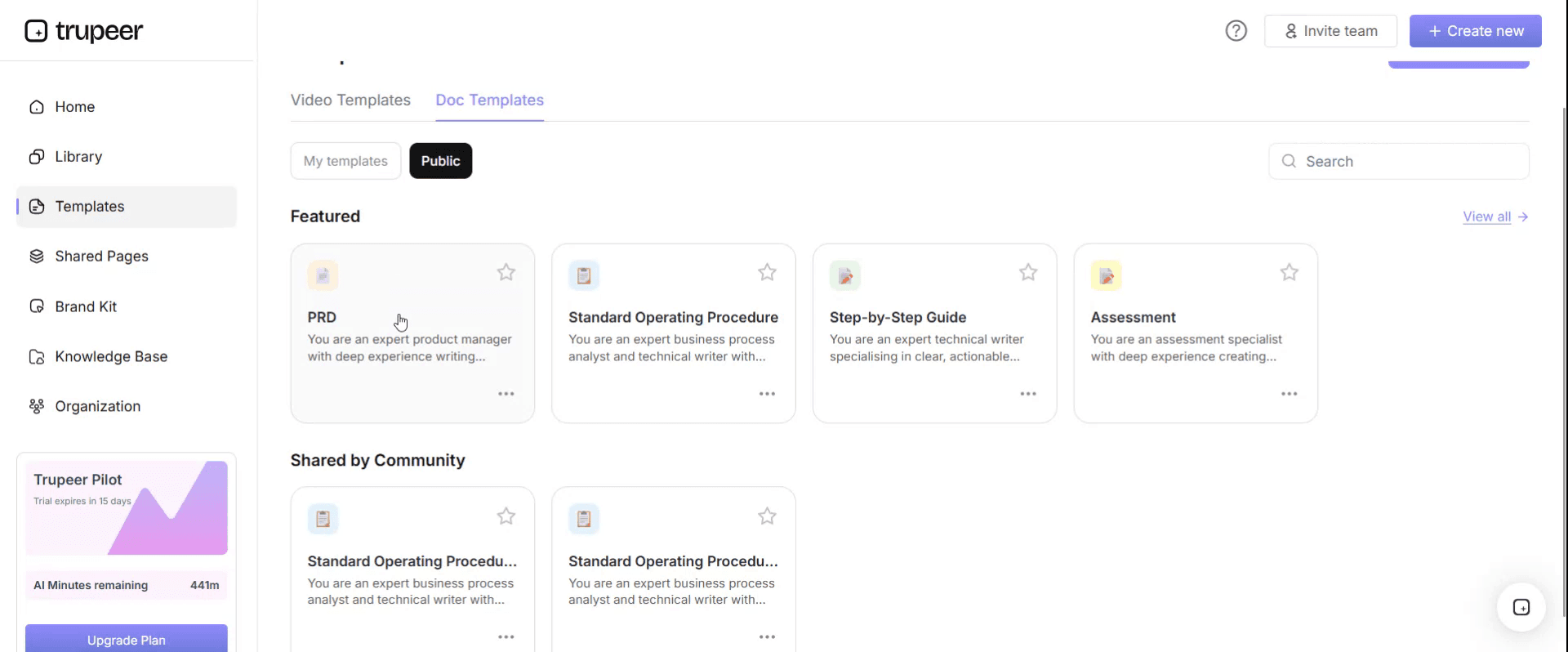
Step 2: Select and Open a Template
Click on any template you want to work with to open it.
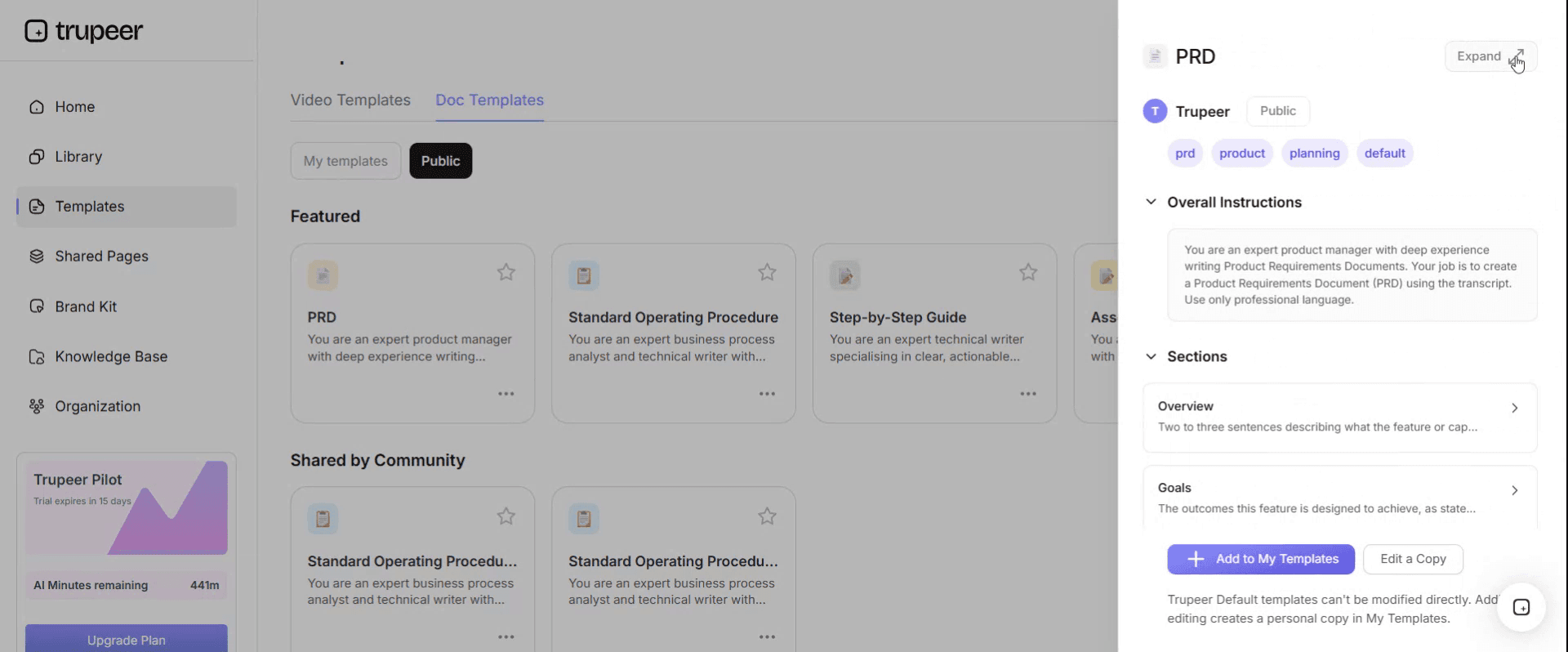
Step 3: Expand the Template View
If needed, expand the template view to see the full layout and details clearly.
Step 4: Edit the Template
Click on Edit to start modifying the selected template.
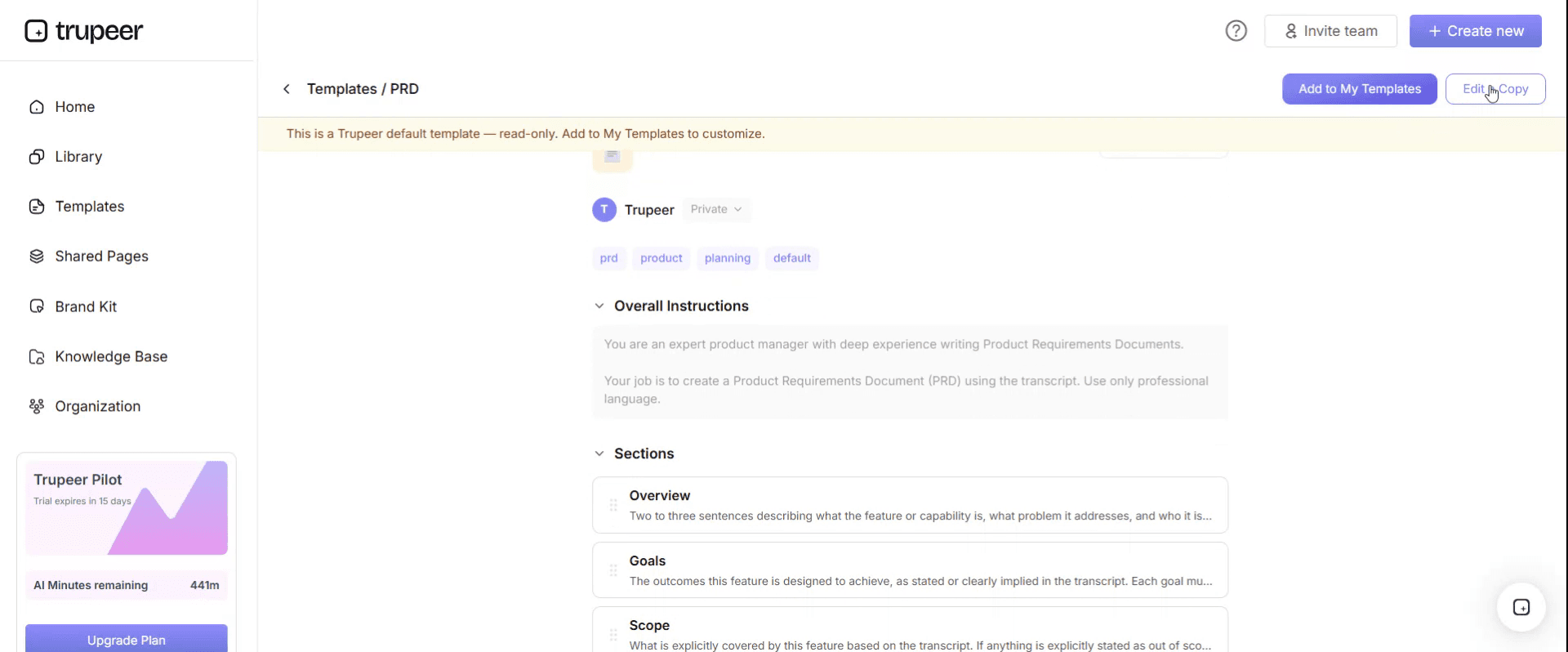
Within the editor, you can:
Add new sections
Define or update formatting rules
Add a logo and adjust its position and related settings
Step 5: Save Your Customized Template
After making all necessary changes, click Save to store the updated template as your own.
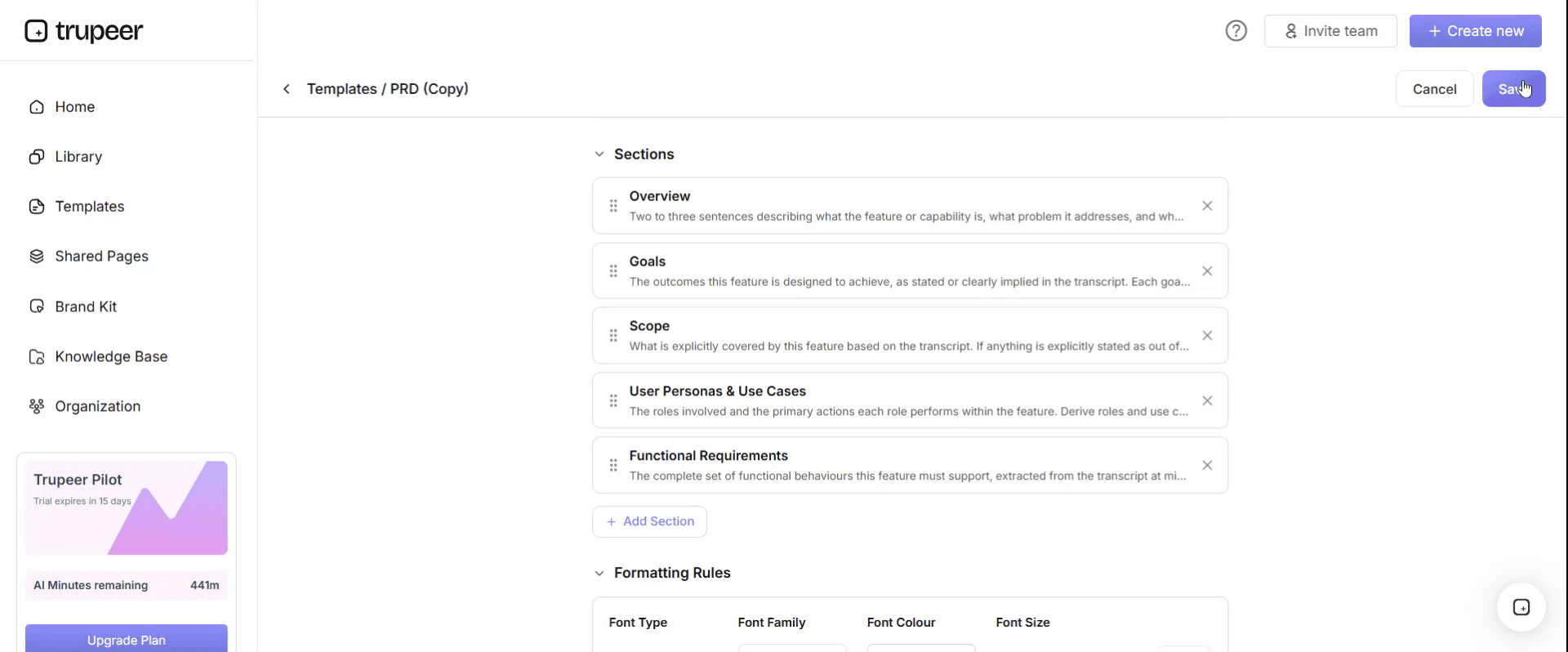
Step 6: Preview and Fine-Tune the Template
When you want to see how your customized template looks, open the Preview.
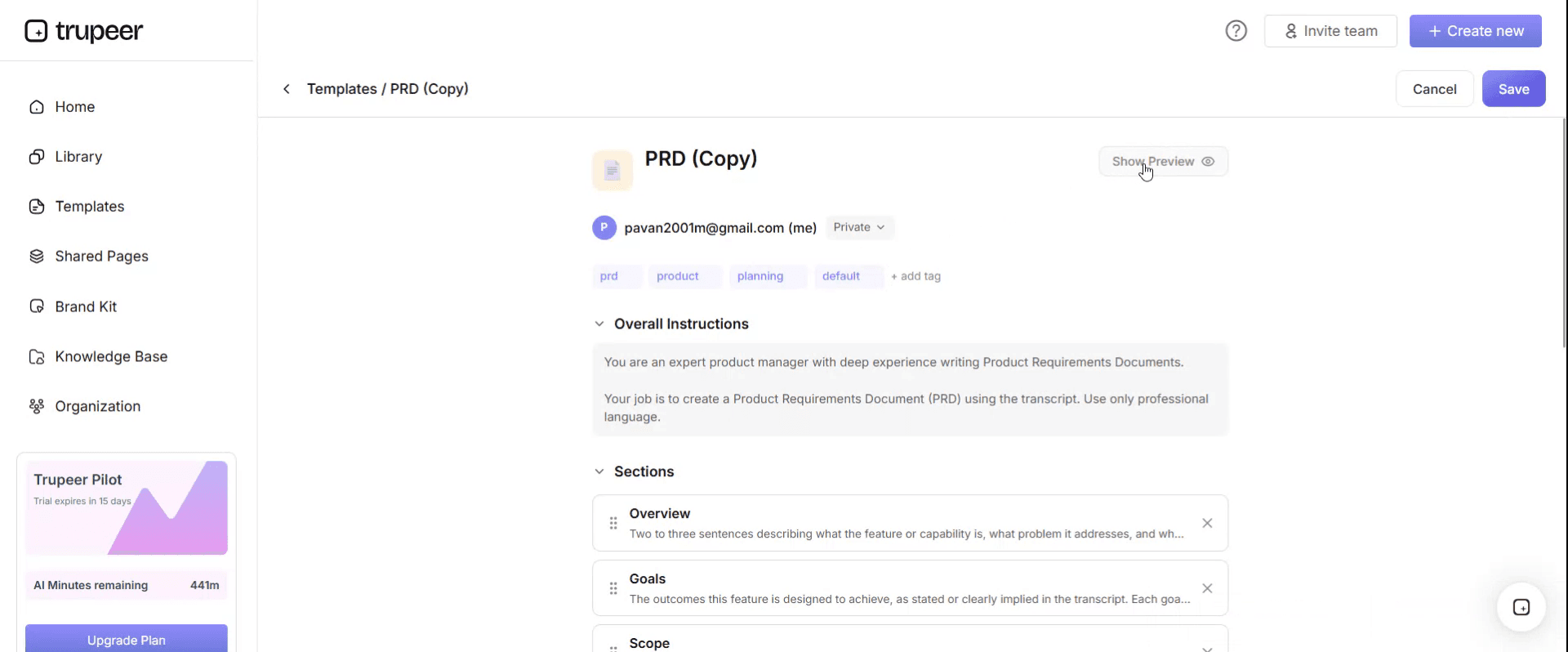
From the preview screen, you can continue to make adjustments directly if needed, ensuring the template appears exactly as you want.
With a RACI matrix template you can:
Remove confusion about ownership: One accountable person per task, agreed up front.
Speed up decisions: Everyone knows who decides and who must be consulted.
Spot overload early: See who carries too much responsibility.
Stay on-brand: Apply your logo, fonts and colors with Trupeer's brand kit.
Draft it from recordings: Use recorded planning sessions and process walkthroughs as the source.
Share one clear reference: Give every team the same view of who does what.
RACI rules: how to fill in the matrix correctly
Exactly one A per task. Two accountable people means nobody is.
At least one R per task. If nobody is responsible, the work won't get done.
A and R can be the same person, especially in small teams, but say so explicitly.
Keep Cs to the people whose input changes the outcome. Too many Cs slow everything down.
Use roles, not names, in the columns, then map names to roles separately. People change; roles last longer.
Describe tasks as outcomes or deliverables, such as "approve test plan," not vague activities.
Check each column for overload and each row for gaps before you share it.
Free RACI matrix template: the structure to copy
Copy the structure below into your own document or spreadsheet, or open it in Trupeer and customize it.
Header. Project or transition: [name]. Matrix owner: [name]. Version and date: [v1.0, date].
RACI grid.
Task or deliverable | [Role 1] | [Role 2] | [Role 3] | [Role 4] | [Role 5] |
|---|---|---|---|---|---|
[Phase 1: task] | A | R | C | I | I |
[Phase 1: task] | R | A | C | C | I |
[Phase 2: task] | I | R | A | C | I |
[Phase 2: task] | A | C | R | R | I |
[Phase 3: task] | C | I | R | A | I |
Legend. R = Responsible, A = Accountable, C = Consulted, I = Informed.
Role to name mapping. Role, name, team, backup.
Validation checks. Every row has exactly one A and at least one R; no column is overloaded; every role has agreed its assignments.
Revision history. Version, date, author, summary of change.
RACI matrix example for a transition
Here's the template filled in for a typical outsourcing or GCC transition. These are the same roles used in our transition SOP template.
Task | Transition lead | Sending lead | Receiving lead | Process owner | SME |
|---|---|---|---|---|---|
Process inventory and wave plan | A | C | C | R | C |
KT plan and calendar | A | R | R | C | C |
KT sessions and recordings | A | R | C | I | R |
SOPs and process documentation | C | C | R | A | C |
Playback sessions | C | I | R | I | A |
Shadow and reverse shadow | A | R | R | I | C |
Go/no-go decision | R | C | C | A | I |
Hypercare issue management | C | C | R | A | I |
Hypercare exit decision | R | C | C | A | I |
Each row has exactly one A. The process owner, not the transition lead, is accountable for SOPs and the go/no-go and hypercare exit decisions, because they own the process after the transition ends. The transition lead is accountable for running the transition itself.
RACI matrix example for knowledge transfer
Knowledge transfer is where ownership is most often unclear, because the people who know the work and the people taking it over report to different managers. Here's a RACI for the KT phase alone.
Task | KT coordinator | SME | Receiving team member | Receiving lead | Process owner |
|---|---|---|---|---|---|
Schedule KT sessions | R | C | I | C | A |
Record walkthroughs of each task | C | R | I | I | A |
Turn recordings into SOPs and videos | R | C | I | C | A |
Review and approve SOPs | I | R | C | C | A |
Play back each process | I | C | R | A | I |
Answer open questions | C | R | I | A | I |
Splitting KT tasks this finely shows something a phase-level RACI hides: the SME is responsible for a lot of the work, so their time needs protecting. See our guide to knowledge transfer when SMEs have no time.
RACI matrix example for a system implementation
Here's a version for an ERP or SaaS implementation. Adjust the roles to your project.
Task | Project sponsor | Project manager | Vendor or integrator | IT lead | Business process owner | Key users |
|---|---|---|---|---|---|---|
Approve scope and budget | A | R | C | C | C | I |
Design future-state processes | I | C | R | C | A | C |
Configure the system | I | C | R | A | C | I |
Data migration | I | A | R | R | C | I |
User acceptance testing | I | C | C | C | A | R |
Training and documentation | I | A | C | C | R | R |
Go-live decision | A | R | C | C | C | I |
Hypercare support | I | A | R | R | C | I |
Training and documentation is often where implementations slip, because responsibility is spread across the vendor, IT and the business. Making the process owner and key users responsible, with the project manager accountable, keeps it moving.
Generate a RACI from your recordings
Most of the information a RACI needs already exists in your recordings: kickoff and planning meetings where tasks are assigned, and process walkthroughs that show who does each step. Trupeer helps you turn those into a first draft.
Record the sessions where roles are discussed. Capture planning meetings, KT sessions and process walkthroughs in MS Teams or Zoom, or with Trupeer's AI screen recorder.
Generate documentation from each recording. Upload the recordings, and Trupeer turns process walkthroughs into step-by-step SOPs with the SOP creator, so you can see who performs each step and who approves it.
Apply the RACI template. Open the RACI matrix template in Trupeer and use the generated documentation to draft the rows and assignments.
Review with every role. Share the draft and ask each person to confirm their R, A, C and I assignments.
Publish it with the process documentation. Store the RACI next to the SOPs in a searchable knowledge base, so roles and procedures stay together.
Starting from recordings means the RACI reflects how the work is actually done, not just how the org chart says it should be.
The same recording-first approach works at scale. Genpact recorded existing MS Teams process design sessions and SME walkthroughs, uploaded them to Trupeer and got back SOPs and demo videos in five languages: more than 500 training collaterals for 140,000 employees in 40 countries, delivered in 3 months instead of 12. Read the Genpact customer story.
How to analyze a RACI matrix
Once the matrix is filled in, read it in both directions before you share it.
Reading across a row (one task):
No A: nobody owns the outcome. Assign one.
More than one A: decisions will stall. Pick one and make the others C.
No R: nobody will do the work. Assign someone.
Lots of Cs: the task will be slow. Keep only the people whose input changes the result.
Lots of Is: consider whether a regular update would replace individual notifications.
Reading down a column (one role):
Many As: this role may be a bottleneck. Delegate some accountability.
Many Rs: this role may be overloaded. Check capacity before the work starts.
No R or A at all: question whether the role needs to be on the matrix.
Only Cs and Is: fine for stakeholders, but check they agree with being consulted rather than deciding.
When to update your RACI matrix
A RACI is only useful if it reflects reality. Review and update it:
At each phase or wave of a transition, because roles shift as work moves.
When people join, leave or change roles, updating the name mapping.
When scope changes, adding or removing tasks.
When a decision is disputed, because disputes usually reveal a missing or unclear A.
After go-live, when project roles hand over to operational owners.
How to create a RACI matrix in six steps
List the tasks or deliverables, grouped by phase.
List the roles across the top, using roles rather than names.
Assign the A first for every row, then the Rs, then the Cs and Is.
Validate the matrix: one A per row, at least one R, no overloaded columns.
Review it with everyone named and resolve disagreements.
Publish it and keep it current when roles, people or scope change.
RACI matrix variants
RASCI matrix
Adds S, Supportive: people who help the responsible person but don't own the work. Useful when many teams contribute resources.
RACI-VS matrix
Adds V, Verifier, who checks the work against criteria, and S, Signatory, who formally signs it off. Common in regulated industries and transitions with formal acceptance.
DACI matrix
Uses Driver, Approver, Contributors and Informed, and is often used for individual decisions rather than ongoing tasks.
RACI for vendor and outsourcing transitions
Add columns for the client, the incumbent provider and the incoming provider. The client usually holds the A for acceptance decisions. See our guide to vendor-to-vendor transition knowledge transfer.
RACI for government and public sector projects
Include the senior responsible owner, the business case owner and any governance board, and mark which decisions require formal approval under delegated authority rules.
RACI matrix vs roles and responsibilities document
Document | What it shows | Best for |
|---|---|---|
RACI matrix | Who is R, A, C or I for each task | Projects, transitions and cross-team processes |
Roles and responsibilities document | What each role owns and decides | Defining jobs and team structures |
Transition SOP | How a transition is run, including its RACI | Repeatable transition method |
Sign-off checklist | Who approves each gate, with evidence | Formal acceptance in transitions |
See the roles and responsibilities template, team charter template and transition handover sign-off checklist.
RACI matrix checklist
Every task or deliverable is listed and grouped by phase.
Every row has exactly one A.
Every row has at least one R.
No column has an unmanageable number of Rs and As.
Consulted roles are limited to people whose input changes the outcome.
Roles are mapped to named people, with backups.
Everyone named has reviewed and agreed their assignments.
The matrix has an owner and a version date.
Common mistakes to avoid
More than one A on a task. Shared accountability usually means no accountability.
Everyone marked C. Over-consulting slows decisions and creates meetings nobody needs.
Vague tasks. "Support the project" can't be assigned; "approve test plan" can.
Using names instead of roles. The matrix breaks as soon as someone leaves.
Never updating it. A RACI from the kickoff is rarely right by go-live.
Download the free RACI matrix template
Copy the template above for free, or open it in Trupeer to apply your brand kit, draft it from your recordings and share it with every team. Open the free RACI matrix template in Trupeer.
Frequently Asked Questions
What is a RACI matrix?
A RACI matrix is a grid that shows who is Responsible, Accountable, Consulted and Informed for each task or deliverable in a project, process or transition.
What does RACI stand for?
Responsible, Accountable, Consulted and Informed.
What is the difference between responsible and accountable?
The responsible person does the work. The accountable person owns the outcome and makes the final decision. There can be several responsible people, but only one accountable person per task.
Can someone be both responsible and accountable?
Yes. In small teams, the same person often does the work and owns the outcome. Mark them as A and R, or as A with the understanding that they also do the work.
How many people should be accountable for a task?
Exactly one. If two people are accountable, decisions stall and nobody fully owns the result.
What is a RACI matrix example?
A RACI matrix example is the template filled in for a real situation. This page includes examples for an outsourcing or GCC transition, knowledge transfer and a system implementation.
Who should create a RACI matrix?
Usually the project manager or transition lead drafts it, with input from every role on the matrix. The sponsor or process owner should approve it, and everyone named should agree their assignments before it's shared.
What is the difference between RACI and RASCI?
RASCI adds an S for Supportive: people who help the responsible person but don't own the work.
How do I create a RACI matrix from recordings?
Record planning meetings and process walkthroughs, use Trupeer to turn the walkthroughs into step-by-step documentation, then use that documentation to draft the rows and assignments in the RACI matrix template before reviewing it with each role.
Is there a RACI matrix template in Excel?
Excel is the most common format for a RACI because the matrix is a grid. Copy the structure above into Excel, using one row per task and one column per role.
Is there a RACI matrix template in Word?
Word works well when the RACI is part of a larger document, such as a project charter or transition SOP. Open this template in Trupeer and export it, or copy the structure above.
Is there a RACI matrix template in PowerPoint?
Slides suit presenting the RACI to a steering committee or project team. Use one slide per phase so the grid stays readable.
Is there a RACI matrix template in PDF?
PDF suits the agreed version shared with all parties. Keep an editable copy for updates.
Is there a RACI matrix template in Google Sheets?
Yes. Copy the structure above into Google Sheets, or open the template in Trupeer and export it. Google Sheets is useful when several teams need to review and comment on their assignments.