Trupeer Blog
Synthétiser
Standard operating procedures were written for people. They assume a reader who can fill gaps, notice when something looks wrong, ask a colleague and use common sense. AI agents can't do any of that reliably. Hand an agent an ordinary SOP and it will follow the happy path confidently, guess at the exceptions and carry on when it should have stopped. As more work moves to agents, organisations need a new kind of procedure, written so both people and agents can follow it safely. We call it an agentic operating procedure.
This pillar guide defines the agentic operating procedure, explains why most SOPs aren't agent-ready, sets out the seven components every agentic operating procedure needs, compares it with SOPs, runbooks and agent skills, gives you a structure and a worked example to copy, and shows how to turn your existing SOPs into agent-ready procedures and connect them to agents through MCP.
What is an agentic operating procedure?
An agentic operating procedure (AOP) is a standard operating procedure written so that an AI agent, as well as a person, can carry it out safely: it states the goal, the inputs, the tools the agent may use, the steps, the decision rules, the exceptions and when to stop and hand off to a human, in a structured form an agent can read and follow.
An agentic operating procedure is also called an agent-ready SOP. It keeps everything a human operator needs, but makes explicit the things a person would normally infer: what "done" looks like, which actions are allowed, which rules decide each branch, and where human judgement is required. That explicitness is what lets an agent act reliably and lets a person audit what it did.
Why most SOPs aren't agent-ready
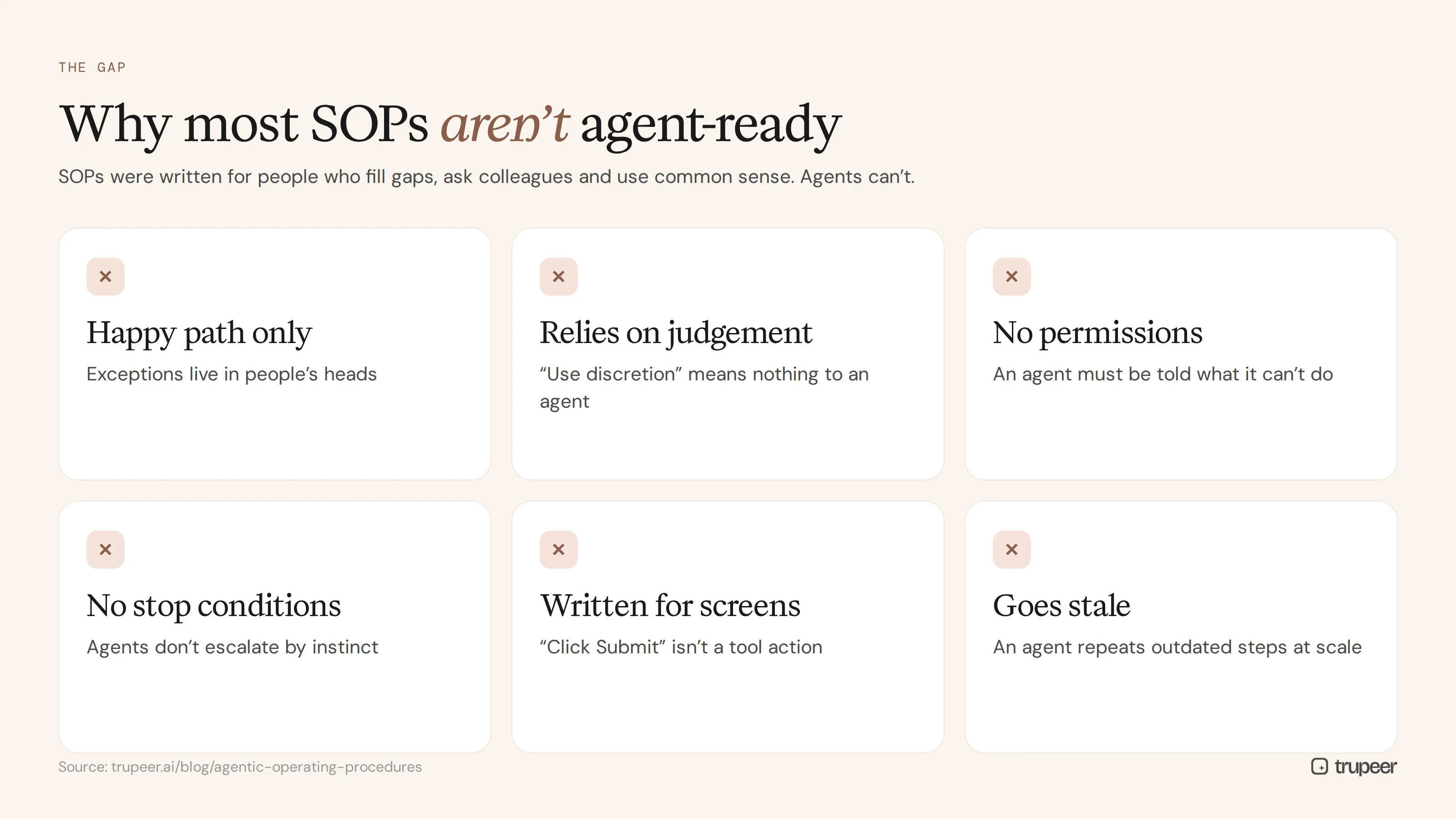
They describe the happy path. Exceptions live in people's heads, not in the document.
They rely on judgement. Phrases like "use discretion" or "check if it looks right" mean nothing to an agent.
They don't define permissions. A person knows not to approve their own request; an agent needs to be told.
They don't say when to stop. Humans escalate instinctively; agents need explicit stop conditions.
They're written for screens, not tools. "Click Submit" isn't an action an agent can take through an API or tool.
They go stale. An agent following an outdated procedure repeats the error at scale.
The seven components of an agentic operating procedure
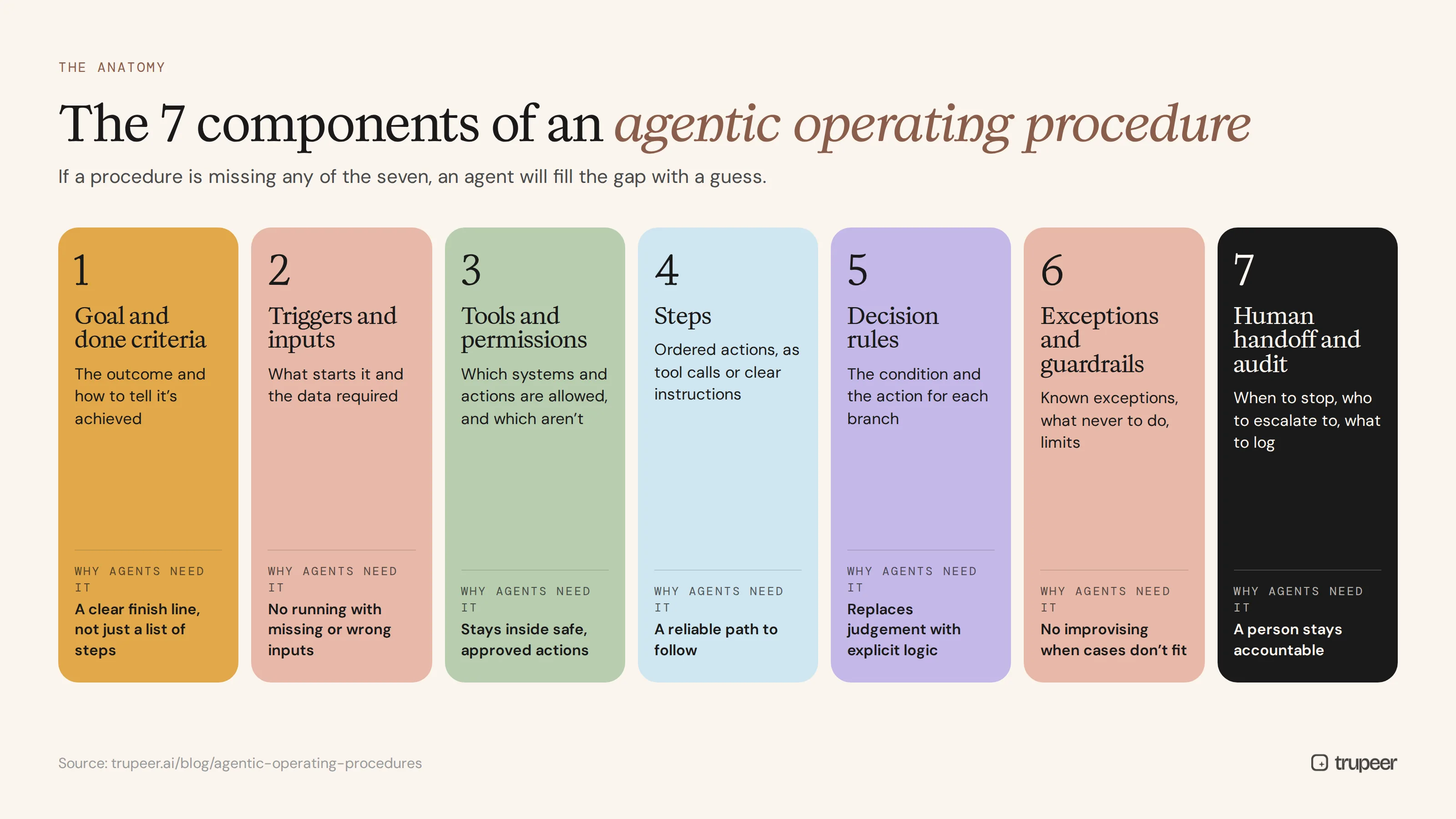
Component | What it defines | Why agents need it |
|---|---|---|
1. Goal and done criteria | The outcome and how to tell it's achieved | Agents need a clear finish line, not just a list of steps |
2. Triggers and inputs | What starts the procedure and the data required | Prevents the agent running with missing or wrong inputs |
3. Tools and permissions | Which systems and actions the agent may use, and which it may not | Keeps the agent inside safe, approved actions |
4. Steps | The ordered actions, written as tool calls or clear instructions | Gives the agent a reliable path to follow |
5. Decision rules | The conditions and the action for each branch | Replaces human judgement with explicit logic |
6. Exceptions and guardrails | Known exceptions, what never to do, and limits | Stops the agent improvising when cases don't fit |
7. Human handoff and audit | When to stop and escalate, to whom, and what to log | Keeps a person accountable and the work auditable |
If a procedure is missing any of the seven, an agent will fill the gap with a guess.
Agentic operating procedure vs SOP, runbook and agent skill
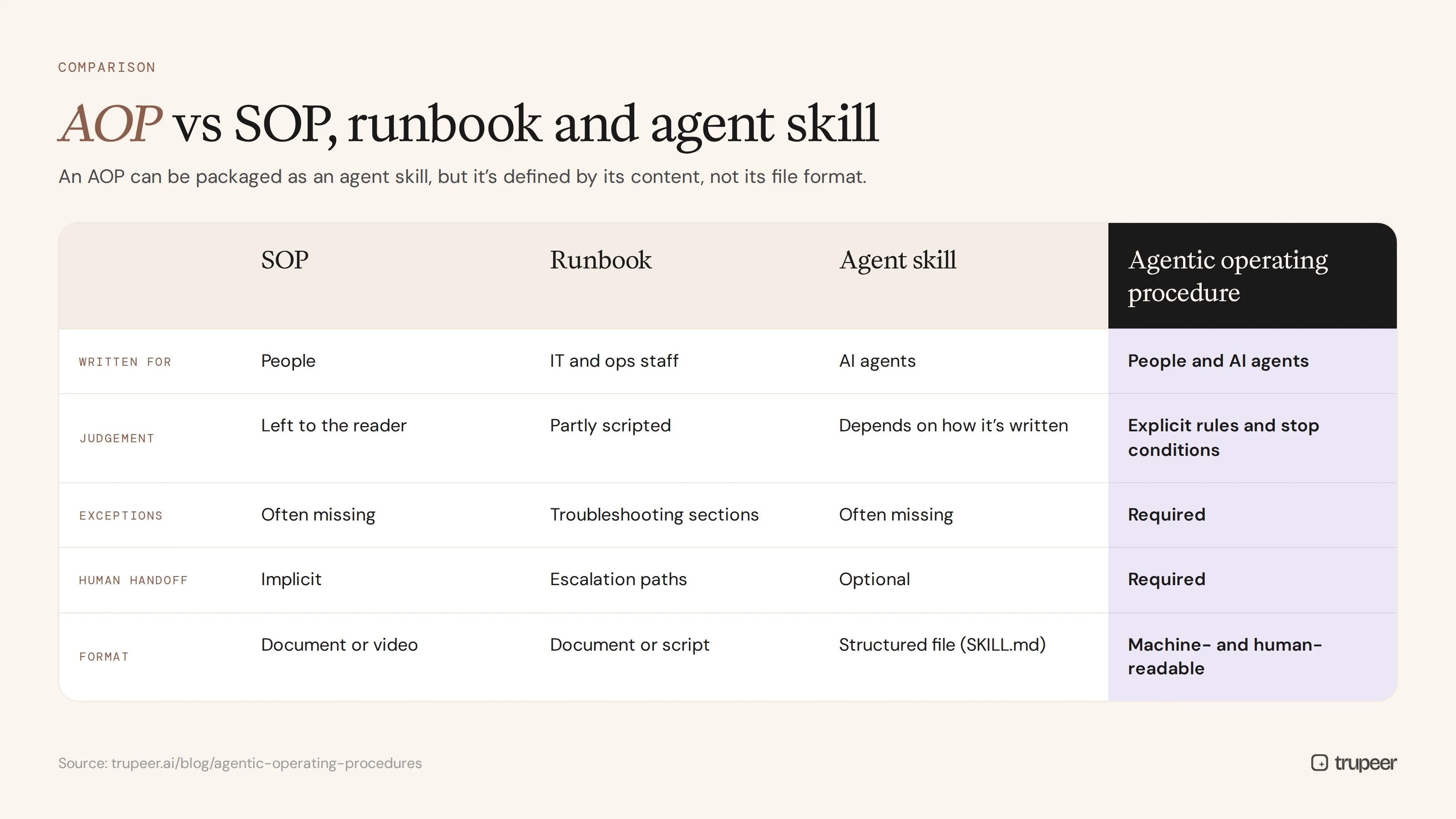
Standard operating procedure | Runbook | Agent skill | Agentic operating procedure | |
|---|---|---|---|---|
Written for | People | IT and operations staff | AI agents | People and AI agents |
Typical content | Steps for a business process | Steps for a technical operation or incident | Instructions and resources an agent loads when relevant | Goal, inputs, tools, steps, decision rules, exceptions, handoff and audit |
Judgement | Left to the reader | Partly scripted | Depends on how it's written | Made explicit as rules and stop conditions |
Exceptions | Often missing | Troubleshooting sections | Often missing | Required |
Human handoff | Implicit | Escalation paths | Optional | Required |
Format | Document or video | Document or script | Structured file, such as SKILL.md | Structured, machine-readable and human-readable |
An agentic operating procedure can be packaged as an agent skill, but it's defined by its content, not its file format. For packaging procedures as skills, see how to turn SOPs into AI agent skills.
Agentic operating procedure structure to copy
Use this structure for each procedure. It works as a document people can read and as structured text an agent can follow.
Agentic operating procedure example: supplier invoice with a price variance
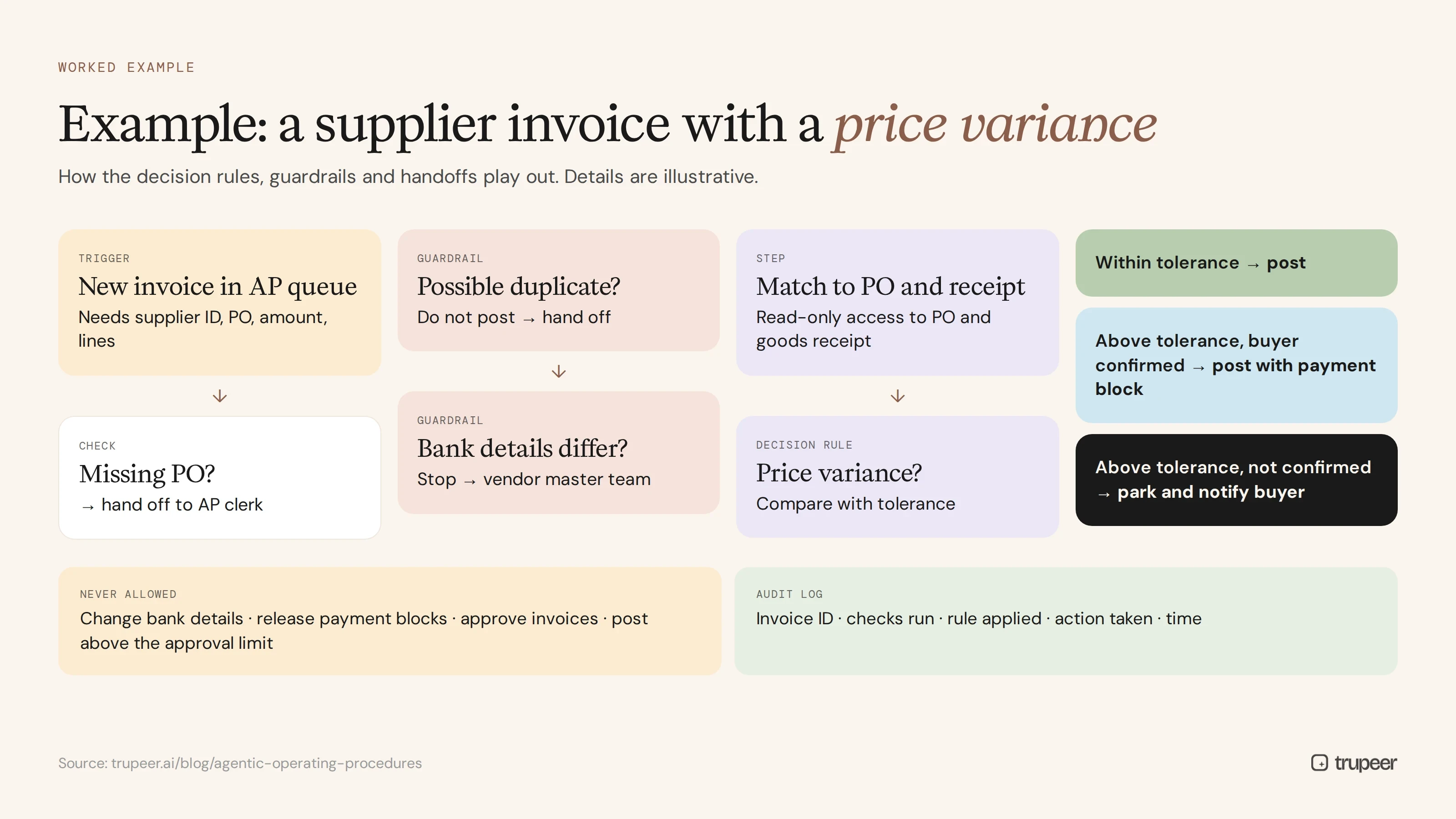
Here's how the structure looks for one accounts payable task. The details are illustrative.
Component | Content |
|---|---|
Goal | Post supplier invoices correctly. Done when the invoice is posted, parked with a note, or handed off with a reason. |
Trigger and inputs | A new invoice in the AP queue. Requires supplier ID, PO number, invoice amount and lines. Missing PO: hand off to AP clerk. |
Tools and permissions | Allowed: read invoice, read PO and goods receipt, post or park invoice. Not allowed: change supplier bank details, release payment blocks, approve invoices. |
Steps | Read invoice. Check for duplicates. Match to PO and receipt. Post or park. |
Decision rules | Within tolerance: post. Above tolerance with buyer confirmation on file: post with payment block. Above tolerance without confirmation: park and notify buyer. |
Exceptions and guardrails | Possible duplicate: do not post; hand off. Bank details on invoice differ from vendor record: stop; hand off to vendor master team. Never post invoices above the approval limit. |
Human handoff | Hand off to the AP clerk with the invoice, the check that failed and the next suggested action. |
Audit | Log invoice ID, checks run, rule applied, action taken and time. |
A person can follow this procedure exactly as written, and an agent can too. That's the test of an agentic operating procedure.
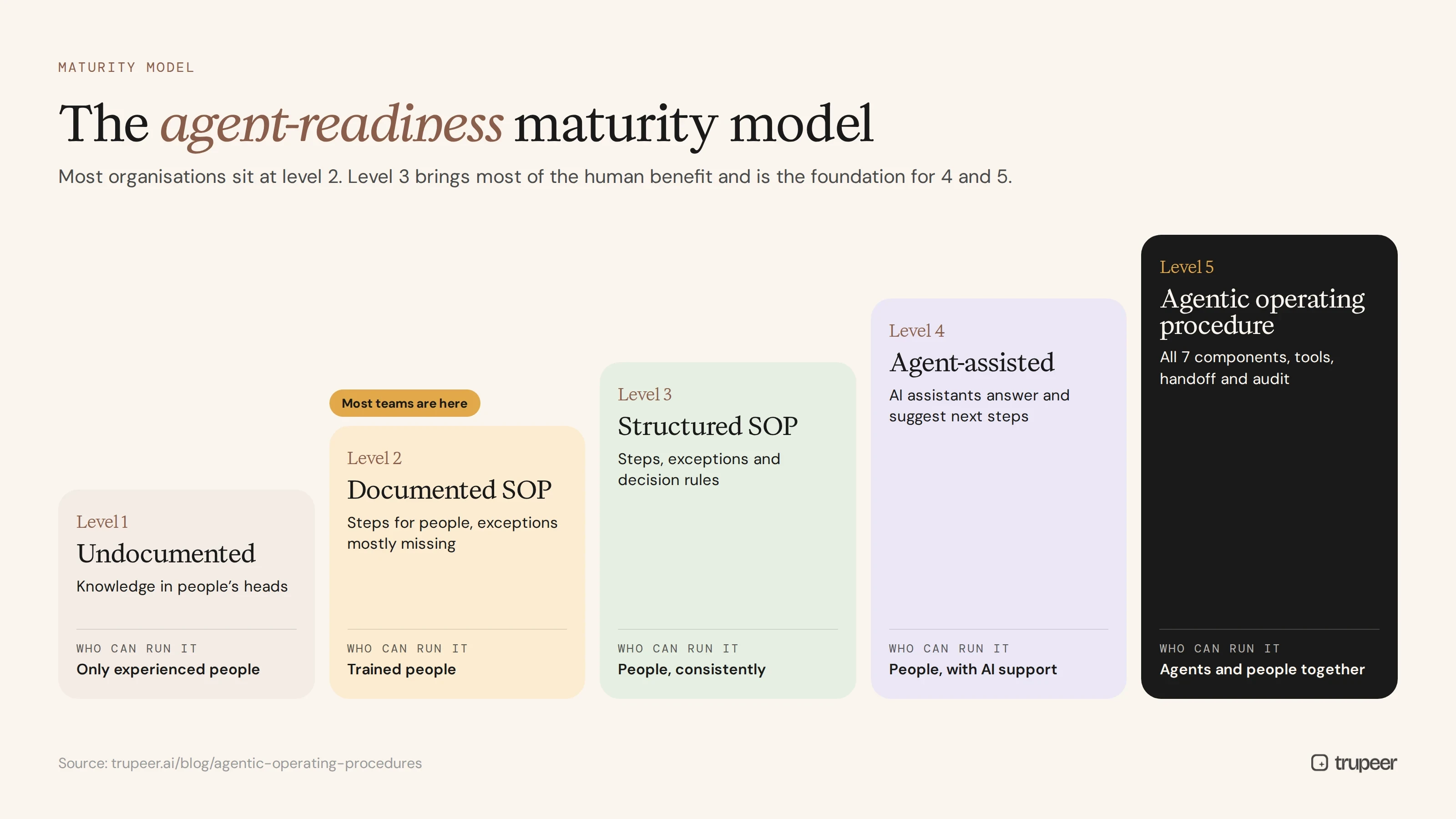
The agent-readiness maturity model
Level | What it looks like | Who can run it |
|---|---|---|
1. Undocumented | Knowledge in people's heads | Only experienced people |
2. Documented SOP | Steps written for people, exceptions mostly missing | Trained people |
3. Structured SOP | Steps, exceptions and decision rules documented | People, consistently |
4. Agent-assisted | Procedures available to AI assistants that answer questions and suggest next steps | People, with AI support |
5. Agentic operating procedure | All seven components, connected to tools, with handoff and audit | Agents and people together |
Most organisations sit at level 2. Moving to level 3 brings most of the human benefit, and it's also the foundation for levels 4 and 5.
How to turn an SOP into an agentic operating procedure
Pick a high-volume, rule-heavy procedure where the cost of mistakes is manageable.
Record the expert doing the task while they explain their decisions, so you capture the exceptions and judgement the SOP leaves out; see tacit knowledge capture.
Write the goal and done criteria in one sentence each.
List the inputs and what to do when they're missing.
Define tools and permissions, starting with read-only actions.
Turn judgement into decision rules, and anything that can't be a rule into a handoff.
Add exceptions, guardrails and limits, including what the agent must never do.
Define the handoff and audit log.
Test with a person first, then with an agent on past cases, before it touches live work.
Assign an owner and a review cycle, and update the procedure whenever the process or system changes.
For a ready-made exception structure, use the SOP template with exceptions.
How agents access procedures through MCP
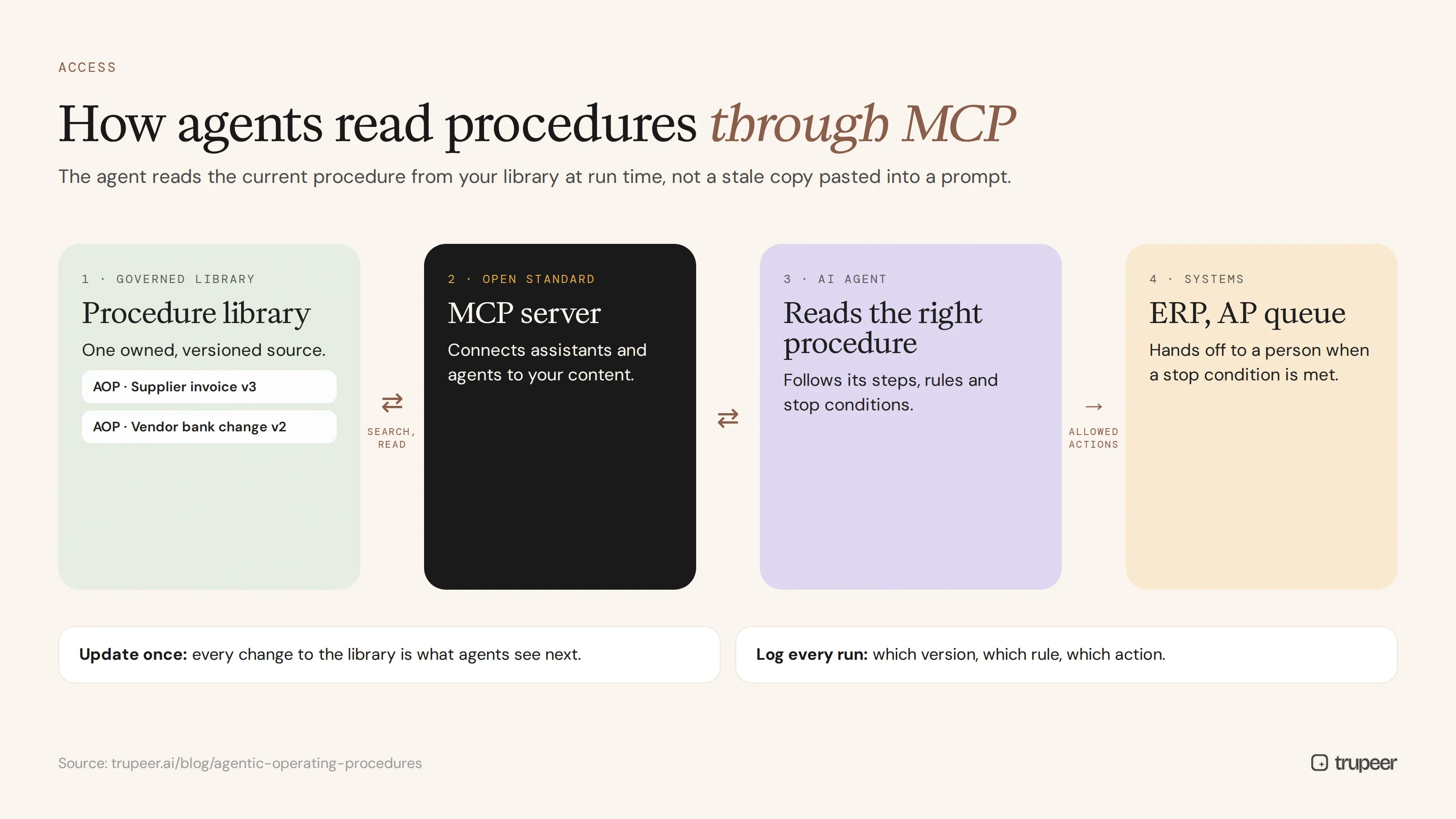
An agentic operating procedure only helps if the agent can find and read the current version when it needs it. The Model Context Protocol (MCP) is an open standard for connecting AI assistants and agents to external tools and content. Through an MCP connection, an agent can search your procedure library, read the right procedure for the task and follow it, instead of relying on a copy pasted into a prompt that goes out of date.
Keep procedures in one governed library, expose them to agents through MCP, and make sure every update to the library is what agents see next.
For the technical side, see how to integrate your video knowledge base with AI agents via MCP.
For a question-answering example, see building an AI agent that answers questions from your video library.
How to govern agent-ready procedures
Every procedure has an owner who approves changes and reviews it on a schedule.
Permissions are least-privilege, starting with read-only and adding actions as trust grows.
High-risk actions need a human, such as payments, bank detail changes and anything irreversible.
Every run is logged, with the rule applied and the action taken.
Procedures are versioned, so you know which version an agent followed.
Freshness is monitored, because stale procedures cause errors at scale; see stale SOP detection.
Common mistakes with agent-ready SOPs
Pasting existing SOPs into an agent without adding decision rules, permissions or handoffs.
Leaving judgement implicit, with phrases like "use common sense".
Giving agents broad permissions before the procedure is proven.
No stop conditions, so the agent carries on when it should hand off.
No owner or versioning, so agents follow outdated procedures.
Skipping the human test, when a procedure people can't follow won't work for agents either.
Agentic operating procedure checklist
Goal and done criteria are stated.
Triggers and required inputs are listed, with what to do if inputs are missing.
Allowed and forbidden tools and actions are defined.
Steps are ordered and specific.
Judgement is written as decision rules.
Exceptions, guardrails and limits are listed.
Human handoff conditions and content are defined.
Every run is logged, and the procedure has an owner, version and review date.
How Trupeer helps you build agent-ready procedures
AOP challenge | How Trupeer helps |
|---|---|
The judgement isn't written down | Record experts doing real work while they explain decisions, and Trupeer turns it into a step-by-step SOP and video |
SOPs need a consistent, structured format | Trupeer Skills apply your procedure structure to every SOP |
Agents need machine-readable procedures | Export SOPs as Markdown |
Agents need access to the current version | Connect your Trupeer library to AI assistants and agents through Trupeer's MCP server |
Procedures change | Update by editing the script or replacing a single step, so agents and people see the same current version |
Genpact used Trupeer's recording-first approach for a company-wide Workday rollout, turning recorded process sessions into more than 500 training collaterals across 20 workstreams in five languages, for 140,000 employees in 40 countries, in 3 months instead of 12. Read the Genpact customer story.
Frequently asked questions
What is an agentic operating procedure?
An agentic operating procedure is a standard operating procedure written so that an AI agent, as well as a person, can carry it out safely, with a goal, inputs, allowed tools, steps, decision rules, exceptions and clear human handoff and audit.
What's the difference between an SOP and an agentic operating procedure?
An SOP is written for people and leaves judgement, permissions and stop conditions to the reader. An agentic operating procedure makes them explicit, so an agent can follow it and a person can audit what it did.
What is an agent-ready SOP?
It's another name for an agentic operating procedure: an SOP that includes everything an AI agent needs to act safely, including decision rules, permissions, exceptions and handoff conditions.
What are the components of an agentic operating procedure?
Goal and done criteria, triggers and inputs, tools and permissions, steps, decision rules, exceptions and guardrails, and human handoff and audit.
How is an agentic operating procedure different from an agent skill?
An agent skill is a packaging format for instructions an agent can load. An agentic operating procedure is defined by its content, and it can be packaged as a skill, a document or a knowledge base article.
How do AI agents access agentic operating procedures?
Through a connection to your procedure library, such as an MCP server, so the agent can search for and read the current version of the right procedure when it needs it.
Which processes should become agentic operating procedures first?
High-volume, rule-heavy processes where mistakes are manageable and the rules are clear, such as invoice matching, ticket triage or data checks, before anything involving payments or irreversible actions.
Do agentic operating procedures replace people?
No. They define what an agent can do on its own and when it must hand off to a person, so people stay accountable for judgement, exceptions and high-risk actions.
Start with one agent-ready procedure
Agents are only as good as the procedures they follow. Pick one rule-heavy process, record your expert doing it, and turn it into an agentic operating procedure with clear rules, guardrails and handoffs. Start free with Trupeer.
Articles de blog associés