Trupeer Blog
Özetle

Every transformation programme has a destination: a new ERP, a cloud platform, a shared services model, an AI-enabled way of working. Boards approve the destination, vendors sell it and project plans march towards it. Yet most transformations still disappoint. BCG's research found that 70% of digital transformations fall short of their objectives, and only about 30% achieve what they set out to do.
The usual explanations are budget, technology, leadership or culture. All of them matter. But look closely at programmes that fall short and a pattern appears: they rarely fail at the destination. They fail in the handoffs, the moments when knowledge has to move from one group of people to another. This article explains why digital transformations fail through four handoffs, the evidence behind each one and what successful programmes do differently.
Why digital transformations fail: the short answer
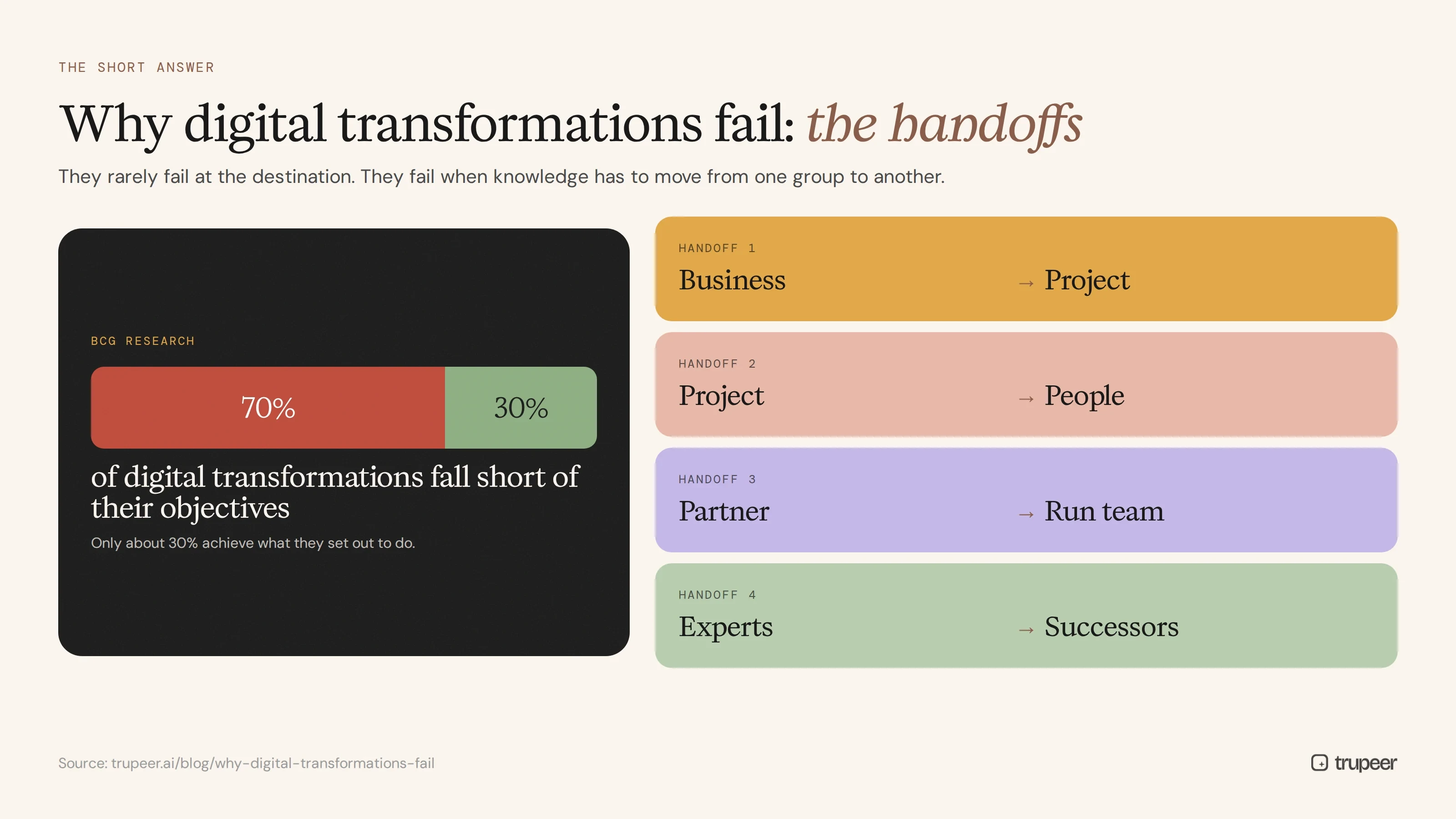
Digital transformations fail when the knowledge needed to run the business doesn't make it intact from the old way of working to the new one. Requirements miss how work is really done. Users go live without the skills to work in the new system. The implementation partner leaves and takes the reasoning behind the design with them. Experienced people move on, and what they knew leaves with them.
Each of these is a handoff. A transformation involves dozens of them, but four matter most:
Business to project: how work is done today has to reach the people designing the future.
Project to people: what was built has to reach the people who will use it.
Partner to run team: what the implementation team knows has to reach the people who will run and change the system.
Experts to successors: what experienced people know has to reach the people who come after them.
Handoff 1: Business to project
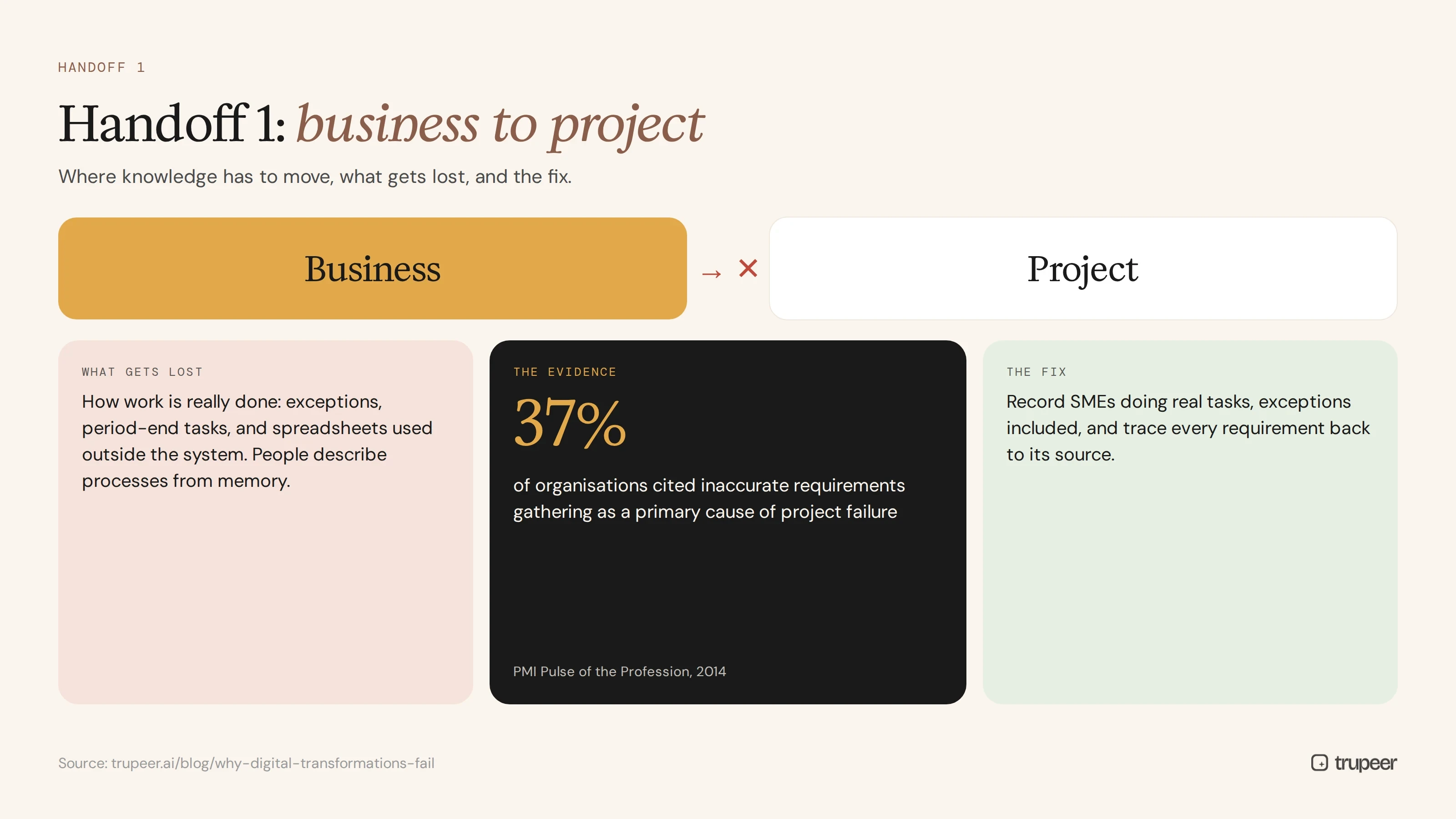
What happens: In discovery and design, the project team has to learn how the business really works. They run workshops, interview subject matter experts and write requirements. But people describe processes from memory. They forget exceptions, period-end tasks and the spreadsheets they use outside the system.
The evidence: PMI's 2014 Pulse of the Profession found that 37% of organisations cited inaccurate requirements gathering as a primary cause of project failure, and its follow-up research found poor requirements management behind 47% of unsuccessful projects.
The fix: Capture how work is actually done, not how it's remembered. Record subject matter experts doing their real tasks, including exceptions and workarounds, and write every requirement with a reference back to its source. See how to approach ERP requirements gathering from process recordings.
Handoff 2: Project to people
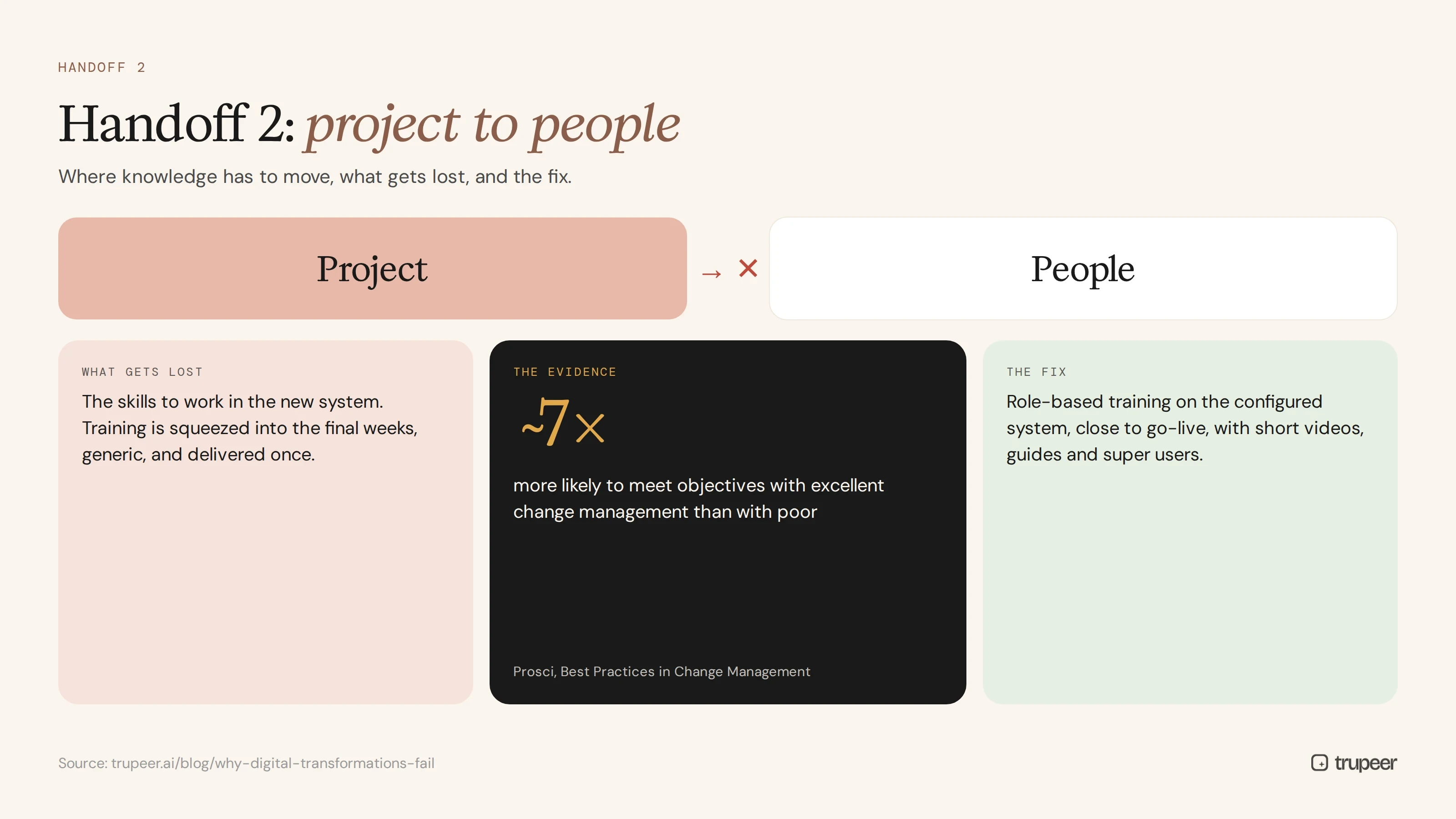
What happens: The system is built, tested and ready. Now thousands of people need to use it on Monday morning. Training is often squeezed into the final weeks, built on generic content, and delivered once in a classroom. Users go live unsure of their new tasks, workarounds appear and support desks are flooded.
The evidence: Prosci's Best Practices in Change Management research found that projects with excellent change management were about seven times more likely to meet their objectives than those with poor change management.
The fix: Treat enablement as part of the destination, not an afterthought. Build role-based training on the configured system, close to go-live, with short videos and step-by-step guides people can return to when they need them. Appoint and train super users so help is close at hand; see how to run a super user training program.
Handoff 3: Partner to run team
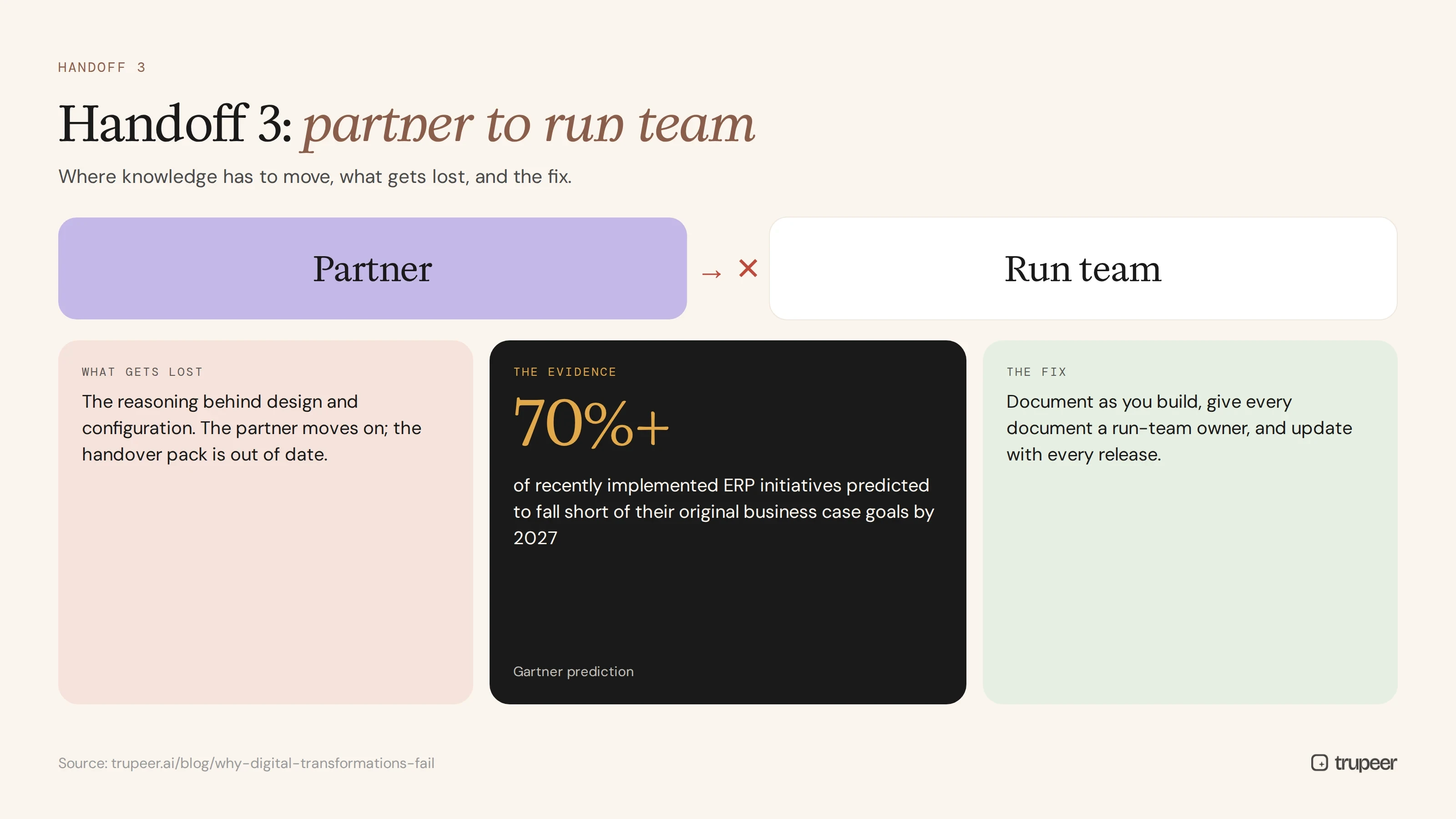
What happens: Most large transformations rely on implementation partners. At the end of hypercare, the partner's team moves to its next client. The design decisions, configuration reasoning and workarounds they carried are supposed to transfer to the internal run team, often through a handover pack that's out of date by the time it's read.
The evidence: Gartner predicts that by 2027, more than 70% of recently implemented ERP initiatives will fail to fully meet their original business case goals. Commentators on that research point to what typically happens after go-live: the programme manager moves on, the executive sponsor changes roles and the integrator rotates its best people to a new client.
The fix: Document the system as it's built, not after. Record walkthroughs of key configurations and processes, give every document an owner on the run team and agree how documentation will be updated after every release. See how to keep training documentation current after go-live.
Handoff 4: Experts to successors
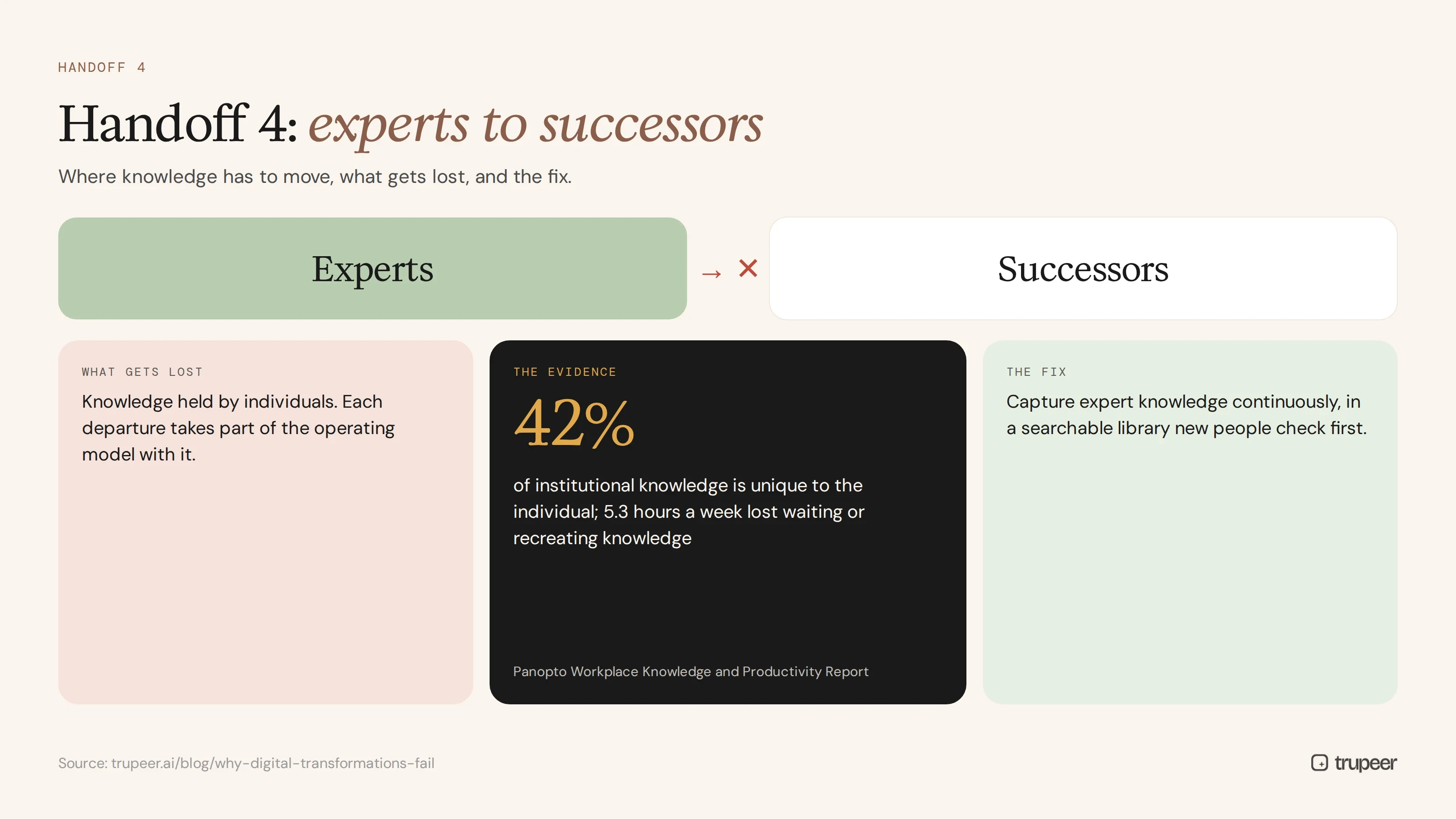
What happens: Transformations take years, and people move during them. Experienced users retire, change roles or leave. New hires join and need to learn processes that were never fully written down. Without a deliberate way to capture what experts know, each departure takes part of the operating model with it.
The evidence: Panopto's Workplace Knowledge and Productivity Report, based on a survey of more than 1,000 US workers, found that 42% of institutional knowledge is unique to the individual, and that employees spend 5.3 hours a week waiting for information or recreating knowledge that already exists.
The fix: Capture expert knowledge continuously, not just when someone resigns. Record experts doing their work, turn the recordings into searchable guides and make them the first place new people look. A tribal knowledge audit shows where the biggest risks sit.
The four handoffs at a glance
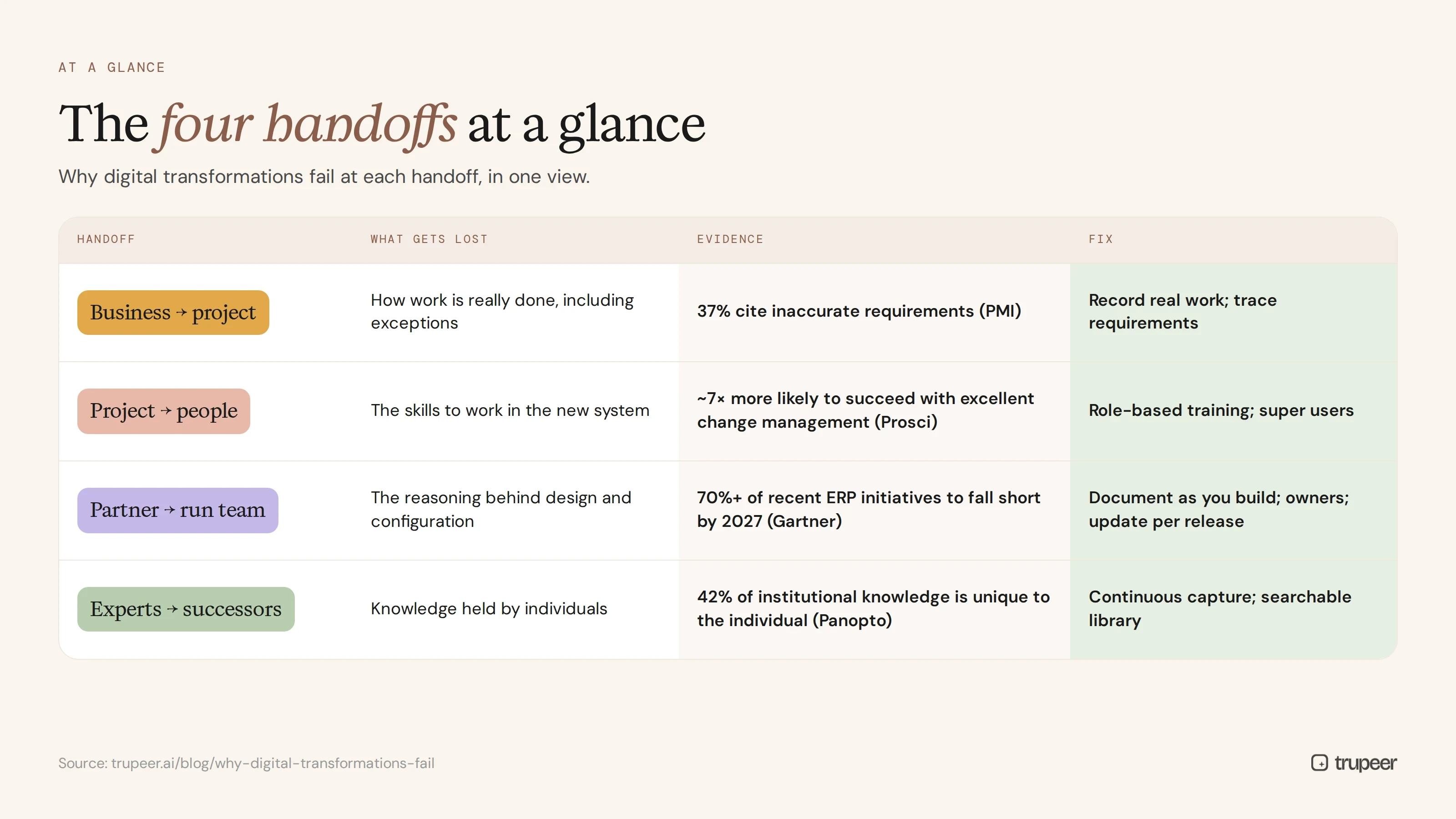
Here's why digital transformations fail at each handoff, in one view:
Handoff | What gets lost | Evidence | Fix |
|---|---|---|---|
Business to project | How work is really done, including exceptions | 37% of organisations cite inaccurate requirements gathering as a primary cause of failure (PMI) | Record real work and trace requirements to their source |
Project to people | The skills to work in the new system | Excellent change management makes projects about 7 times more likely to meet objectives (Prosci) | Role-based training on the configured system, super users |
Partner to run team | The reasoning behind design and configuration | More than 70% of recent ERP initiatives expected to fall short of business case goals by 2027 (Gartner) | Document as you build, assign owners, update with every release |
Experts to successors | Knowledge held by individuals | 42% of institutional knowledge is unique to the individual (Panopto) | Capture expert knowledge continuously in a searchable library |
Common myths about why digital transformations fail
Some of the usual explanations are only partly true:
"The technology wasn't ready." Platforms rarely fail on their own. More often, the system works as built but people can't use it as intended, or it was built on incomplete requirements.
"We ran out of budget." Overruns are usually a symptom. Rework caused by missed requirements and late training is a common cause.
"People resisted the change." Resistance often reflects missing knowledge: people who don't know how to do their job in the new system fall back on the old one.
"The partner let us down." Partners can only transfer what's captured. If knowledge lives in their heads, it leaves with them.
"Culture ate the strategy." Culture matters, but culture changes when people have the skills, guidance and support to work differently.
Each myth points back to the same root cause: knowledge that didn't make it across a handoff. Understanding why digital transformations fail in this way turns a vague problem into four specific ones you can plan for.
Why the handoffs get overlooked
If handoffs explain so much of why digital transformations fail, why do programmes keep underinvesting in them?
They fall between owners. Technology teams own the build, change teams own communication and HR owns training, but nobody owns the knowledge moving between them.
They're invisible on the plan. Milestones track configuration and testing, not whether knowledge reached the next group intact.
They're expensive to do by hand. Writing documentation and training manually takes time that projects rarely have, so it's cut first.
Their failure shows up late. Knowledge gaps appear after go-live, when the budget has gone and the project team has moved on.
What successful transformations do differently
Programmes in BCG's successful 30% share several traits, from leadership commitment to agile governance. Through the lens of the four handoffs, they also tend to:
Name an owner for knowledge, not just for technology, from the start.
Capture the as-is before designing the to-be; see SAP S/4HANA transformation: document as-is processes first.
Build training and documentation as part of the build, not after testing.
Plan the partner exit on day one, with documentation that the run team owns.
Make knowledge capture routine, so expertise is recorded while people are still in role.
Measure adoption, not just go-live, and keep investing after hypercare.
How recorded knowledge closes the handoffs
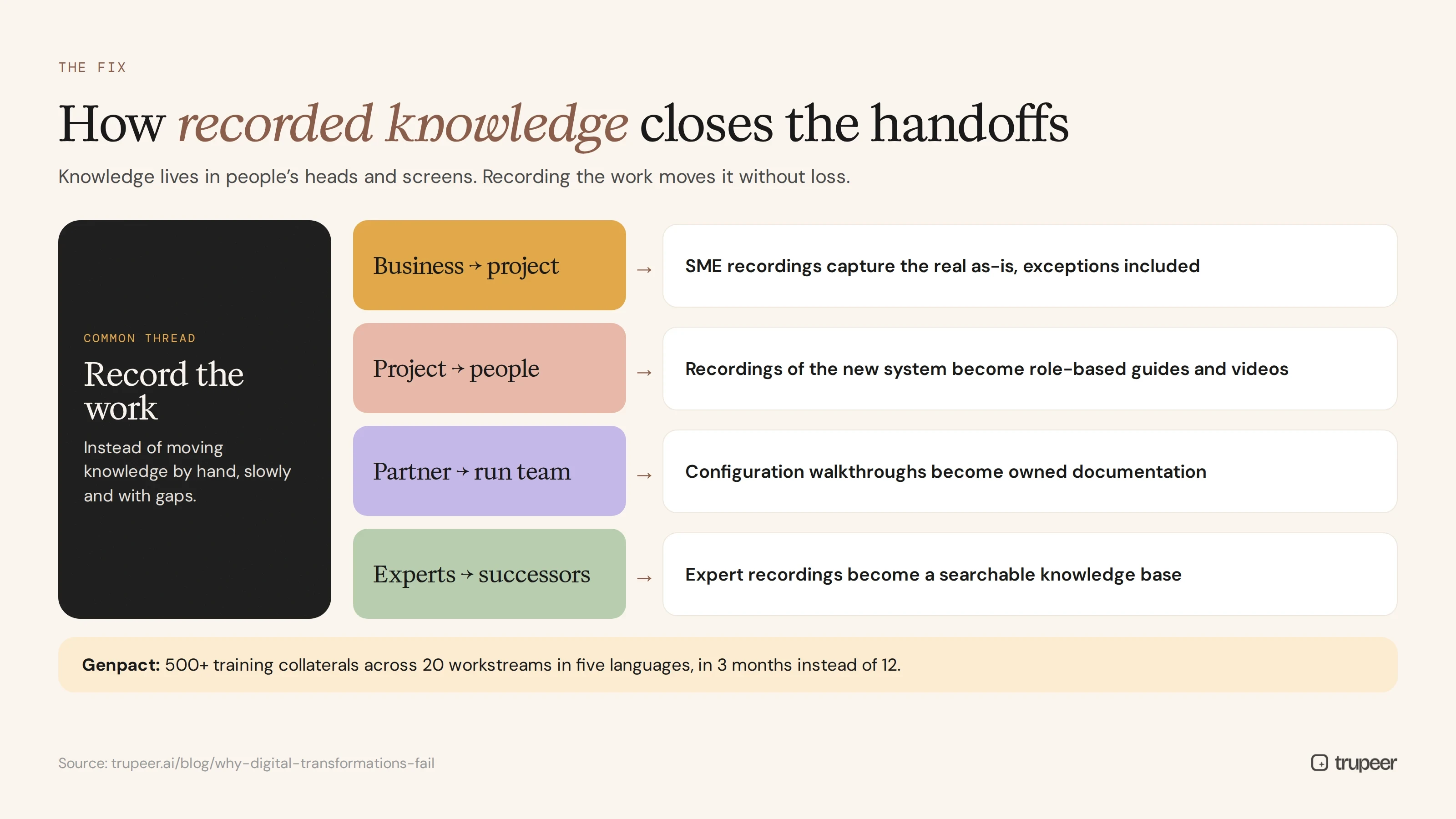
The common thread across all four handoffs is that knowledge lives in people's heads and screens, and moving it by hand is slow and lossy. Recording the work changes that:
Business to project: SME recordings capture the real as-is, exceptions included.
Project to people: recordings of the new system become role-based guides and training videos.
Partner to run team: configuration walkthroughs and process recordings become owned documentation.
Experts to successors: expert recordings become a searchable knowledge base for everyone who follows.
Genpact used this approach for a company-wide Workday rollout, turning recorded process sessions into more than 500 training collaterals across 20 workstreams in five languages, in 3 months instead of 12. Read the Genpact customer story.
A handoff checklist for transformation leaders
Is there a named owner for knowledge transfer across the programme?
Have subject matter experts recorded their real processes before design?
Can every requirement be traced to a source?
Is role-based training being built on the configured system, before go-live?
Is there a super user in every team and site?
Will the run team own documentation before the partner leaves?
Is there a process for updating training and documentation after every release?
Do you know where knowledge sits with a single person, and is it being captured?
For the people side of a large technology change, see change management for technology implementation.
Frequently asked questions
Why do digital transformations fail?
Many fail in the handoffs, when knowledge has to move between groups: from the business to the project team, from the project to users, from the implementation partner to the run team and from experts to their successors. Lost knowledge at each handoff leads to missed requirements, poor adoption and fragile operations.
What percentage of digital transformations fail?
BCG research found that 70% of digital transformations fall short of their objectives, with only about 30% achieving them.
What are the four handoffs in a transformation?
Business to project, project to people, partner to run team and experts to successors. Each one moves critical knowledge from one group to another.
How does change management affect transformation success?
Prosci's research found that projects with excellent change management were about seven times more likely to meet their objectives than those with poor change management.
Why do ERP projects fail to meet their business case?
Gartner predicts that more than 70% of recently implemented ERP initiatives will fail to fully meet their original business case goals by 2027. Common causes include weak alignment with strategy, poor stakeholder engagement and knowledge lost when project teams move on.
How can organisations prevent knowledge loss during a transformation?
Capture how work is actually done by recording experts, build documentation and training as part of the build, give the run team ownership of documentation and keep it current after every release.
Who should own knowledge transfer in a transformation?
A named leader, often within the transformation office or change team, with clear accountability for each of the four handoffs.
How does Trupeer help with transformation handoffs?
Trupeer turns screen recordings into step-by-step guides, training videos and a searchable knowledge base, so knowledge can move intact through each handoff and stay current afterwards.
Transformations succeed when knowledge moves
That's why digital transformations fail so often: not at the destination, but in the handoffs. Programmes that treat knowledge transfer as part of the destination, and make it fast and repeatable, are far more likely to land in the successful 30%. See how Trupeer supports transformation programmes, or learn more about Trupeer AI.
İlgili Bloglar