Trupeer Blog
Resumir
HR transformation programmes usually start with something visible: a new HCM system, an HR shared services centre, a redesigned operating model or a push for employee self-service. Months later, success or failure often comes down to something much less visible: whether people know how the new HR processes actually work. Managers can't find how to approve a transfer. HR operations staff in the new shared services centre follow three different versions of the leaver process. Employees email HR because the self-service guide is out of date.
That's why documentation deserves a central place in any HR transformation. This playbook explains what HR transformation involves, why documentation decides whether it sticks, what documentation an HR transformation needs, and eight practical plays to build and maintain it, from capturing today's processes to keeping self-service guides current after go-live.
What is HR transformation?
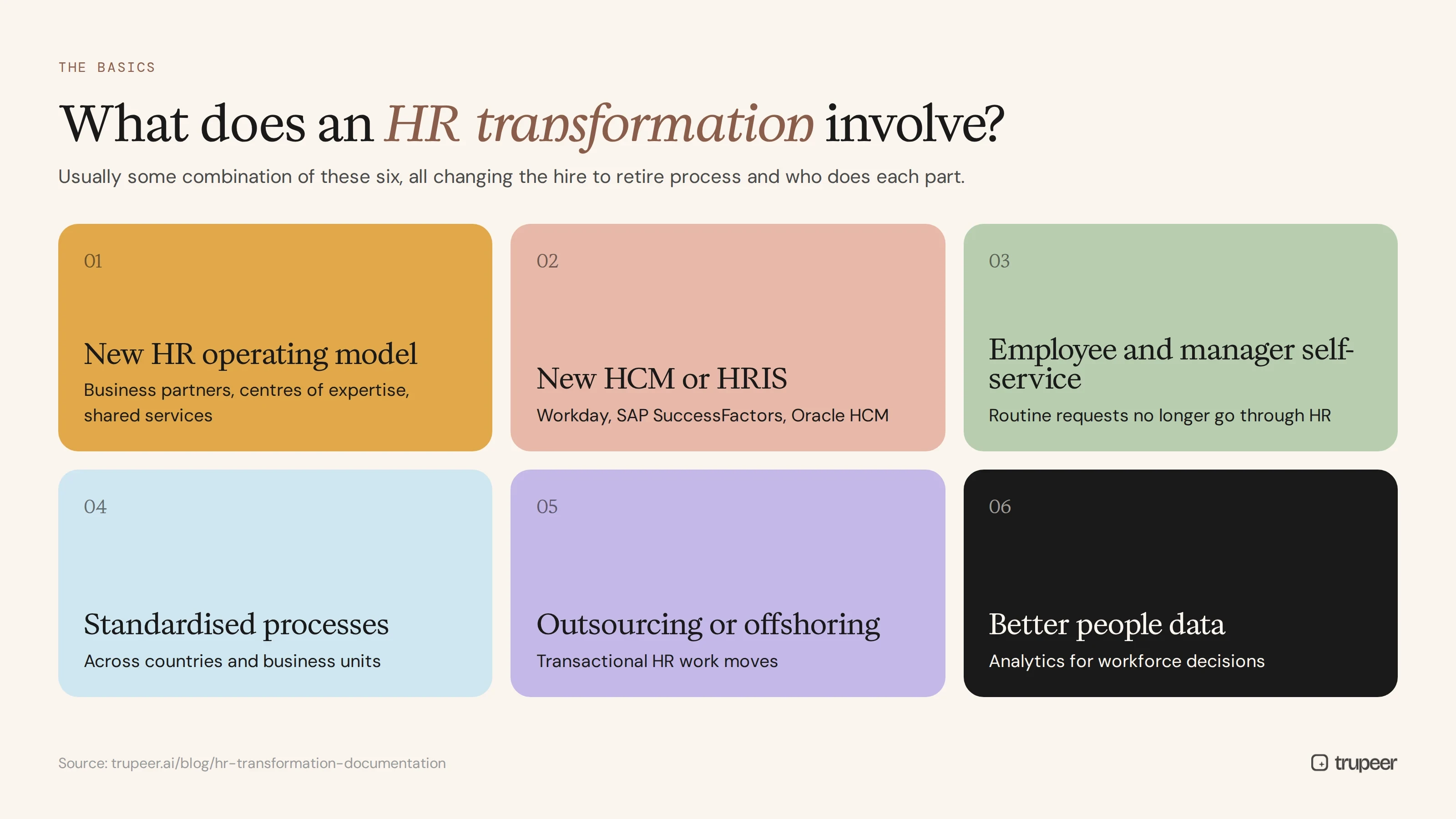
HR transformation is the redesign of how the HR function delivers its services, usually to make HR more efficient, consistent and strategic. It typically involves some combination of:
A new HR operating model, often splitting work between HR business partners, centres of expertise and HR shared services.
A new HCM or HRIS platform, such as Workday, SAP SuccessFactors or Oracle HCM.
Employee and manager self-service, so routine requests no longer go through HR.
Standardised processes across countries and business units.
Outsourcing or offshoring transactional HR work.
Better people data and analytics for workforce decisions.
At its core, HR transformation changes the end-to-end hire to retire process and who does each part of it. For a picture of that flow, see the hire to retire process flow.
Why does documentation decide HR transformation success?
HR processes are full of rules. Leave policies, payroll cut-offs, approval limits and country-specific requirements all need to be applied consistently.
Work moves between people. In an HR transformation, tasks move from local HR teams to shared services, providers or self-service, and knowledge must move with them.
Self-service only works if people can follow it. Employees and managers need clear, current guides, or they go back to emailing HR.
Compliance depends on it. Employment law, data protection and audit requirements all expect documented, consistent processes.
HR knowledge is often concentrated. A few experienced HR specialists know how unusual cases are handled, and that knowledge is at risk during any reorganisation.
Without documentation, an HR transformation changes the systems and structure but not how work is done.
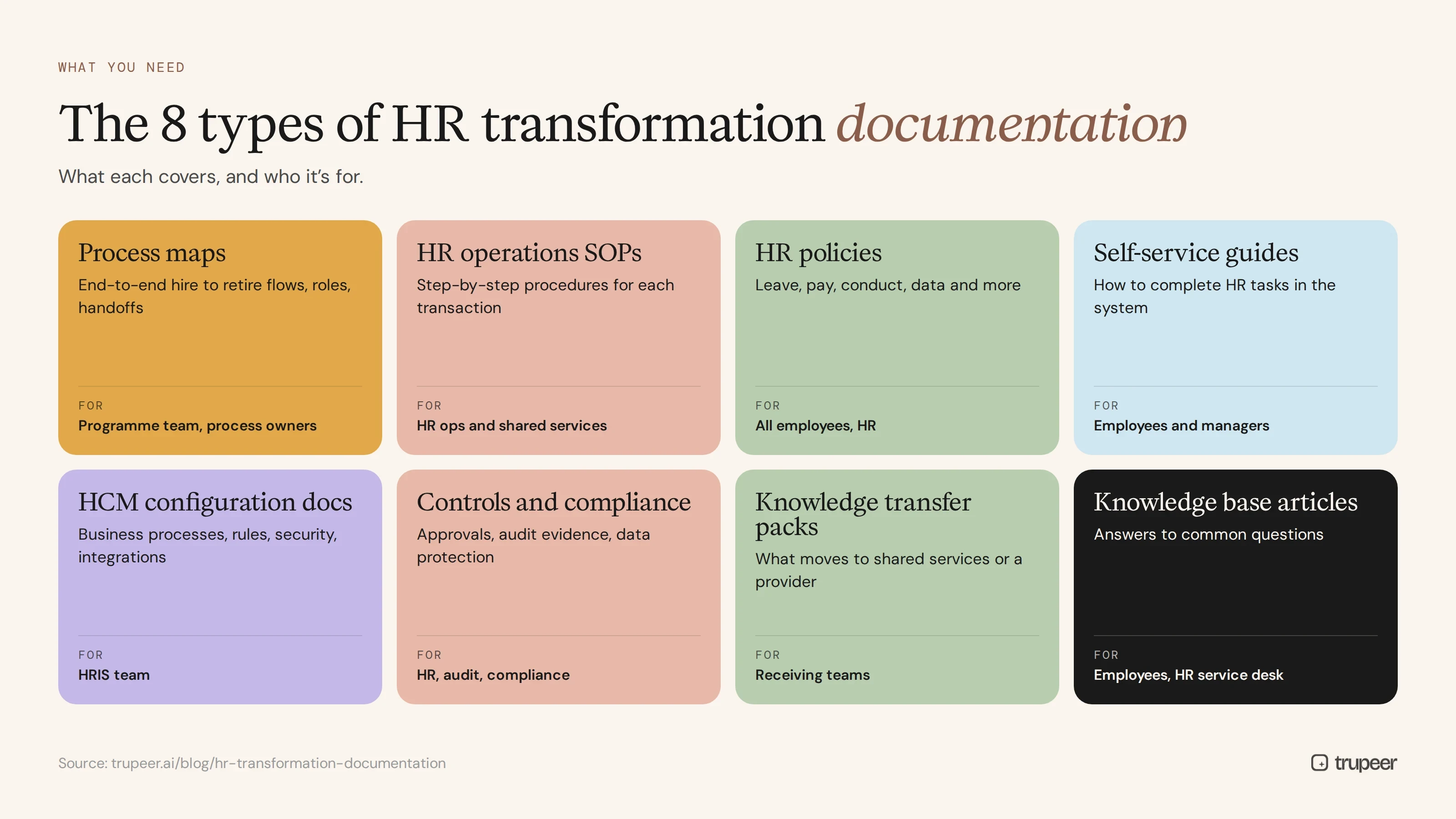
What documentation does an HR transformation need?
Documentation | What it covers | Main audience |
|---|---|---|
Process maps | End-to-end hire to retire flows, roles and handoffs | Programme team, process owners |
HR operations SOPs | Step-by-step procedures for each HR transaction | HR operations and shared services |
HR policies | Rules on leave, pay, conduct, data and more | All employees, HR |
Self-service guides | How employees and managers complete HR tasks in the system | Employees and managers |
HCM configuration documentation | Business processes, rules, security and integrations in the HCM | HRIS team |
Controls and compliance records | Approvals, audit evidence, data protection measures | HR, audit, compliance |
Knowledge transfer packs | What moves to shared services or a provider, and how | Receiving teams |
Knowledge base articles | Answers to common employee and manager questions | Employees, HR service desk |
The HR transformation documentation playbook
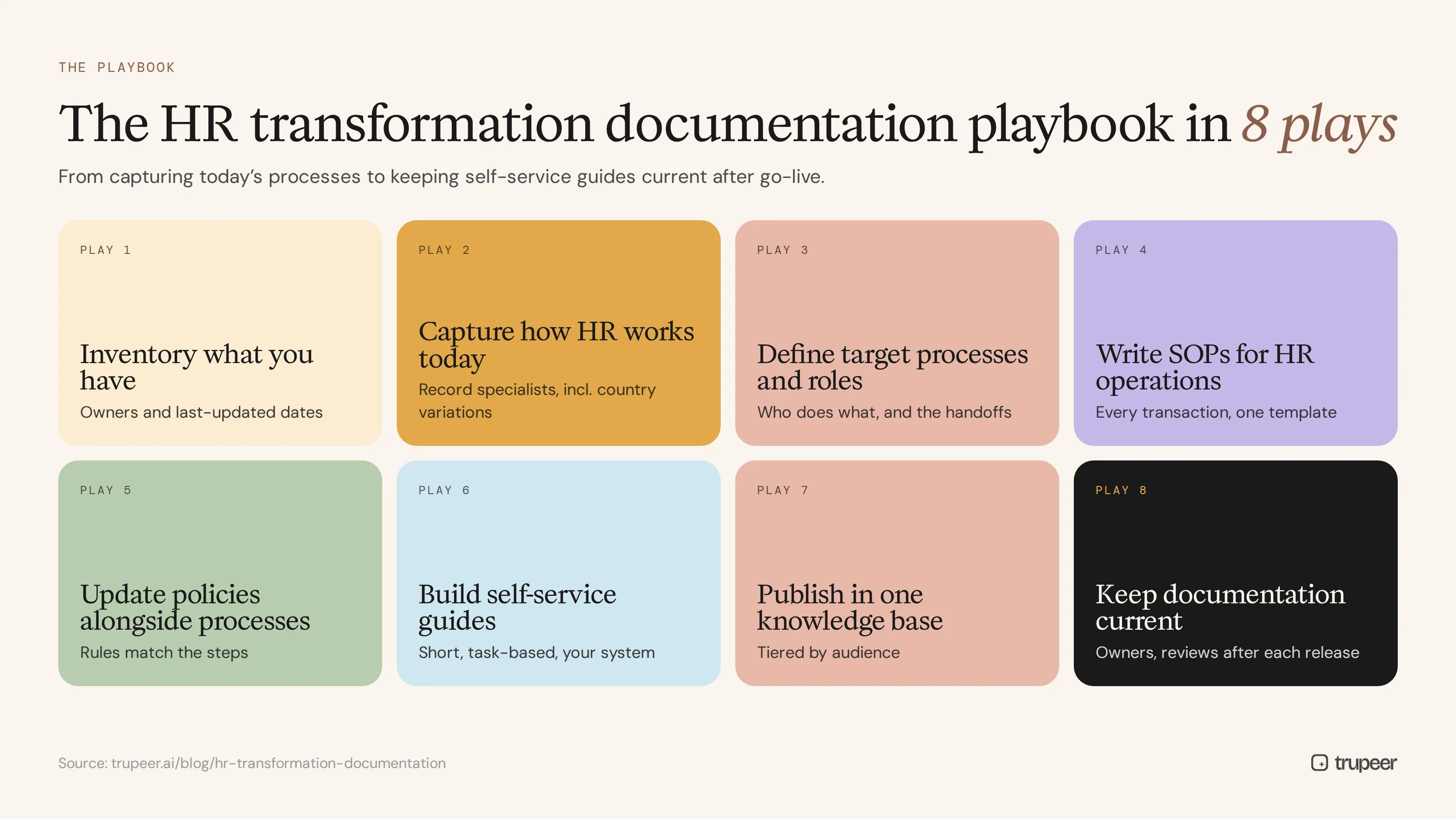
Play 1: Inventory what you have
List existing HR policies, procedures, guides and training, with owners and last-updated dates. Most HR teams find a mix of current documents, outdated versions and gaps, often spread across shared drives, intranets and email.
Play 2: Capture how HR work is done today
Before redesigning anything, document current HR processes, including country variations and exceptions. Record HR specialists doing each task in today's systems with Trupeer's AI screen recorder, narrating the rules they apply. The recordings become the as-is baseline for design, and protect knowledge if people move on during the programme.
Play 3: Define the target processes and who does what
Design the future hire to retire processes, decide which work sits with business partners, centres of expertise, shared services, providers and self-service, and document the handoffs between them. Use a single, consistent definition of each process; see hire to retire (H2R).
Play 4: Write SOPs for HR operations
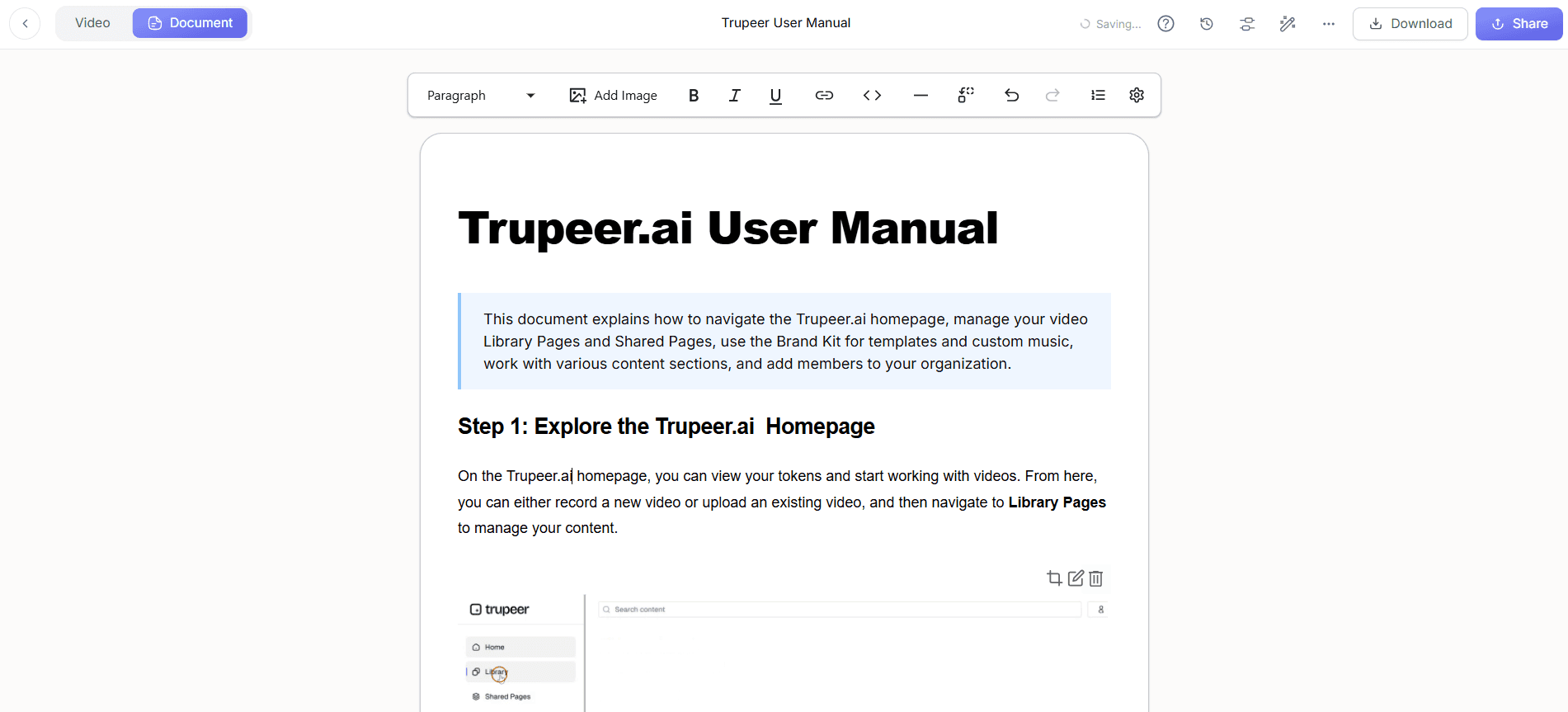
Create a step-by-step SOP for every HR transaction the operations or shared services team handles, from new hire setup to leaver processing. Record each task once in the new HCM, turn it into a guide and video, and use a consistent HR SOP template so every procedure has the same structure.
Play 5: Update policies alongside processes
Review HR policies as processes change, so the rules people read match the steps they follow. Policies can be generated and maintained from recorded walkthroughs too; see the HR documentation workflow for auto-generating policies from recordings.
Play 6: Build self-service guides for employees and managers
Create short, task-based guides and videos for the employee and manager self-service tasks people use most, built on your own configured system. For what to cover and how to roll it out, see HR self-service training for employees and supervisors.
Play 7: Publish in one searchable HR knowledge base
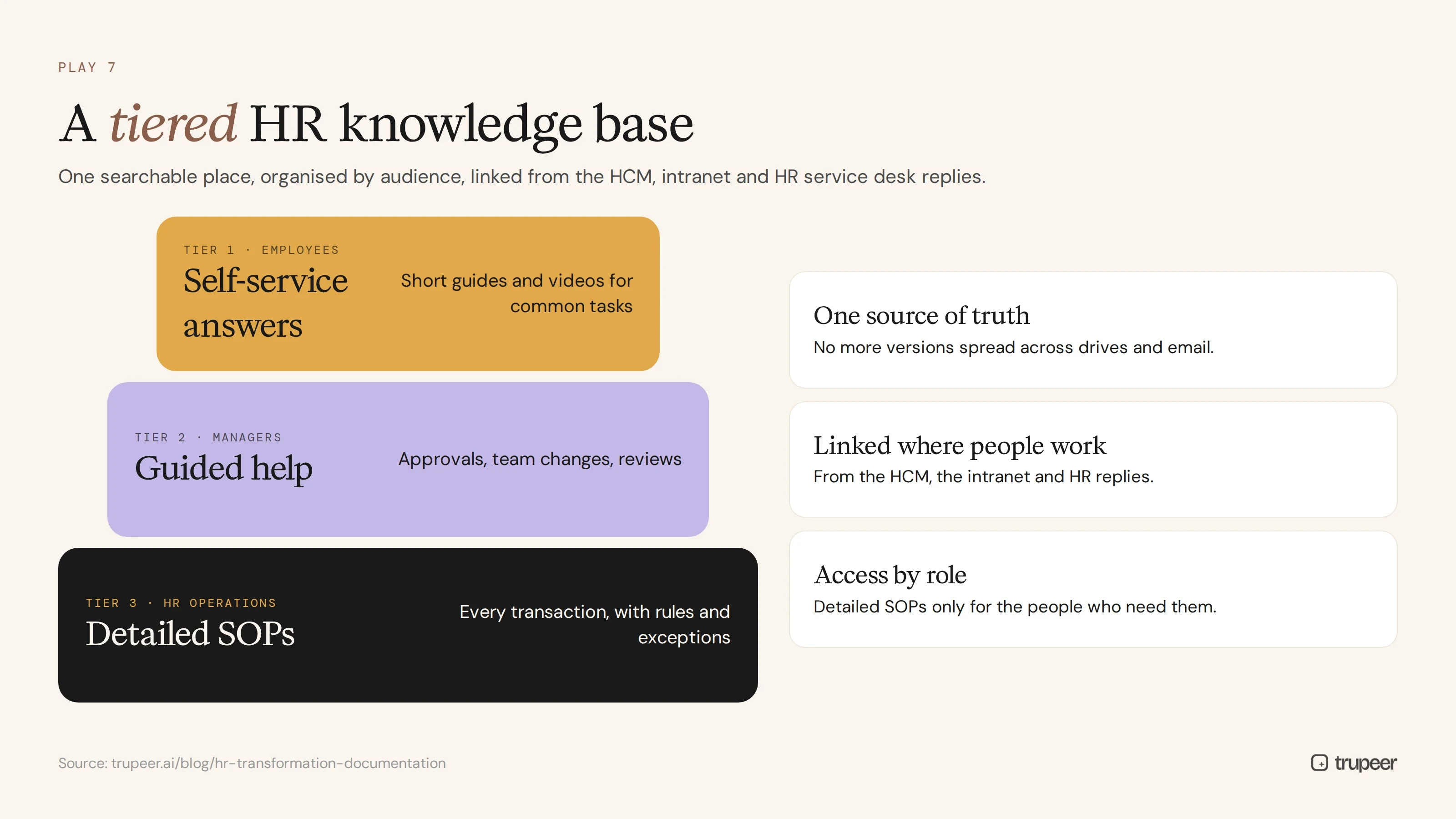
Bring SOPs, policies and guides into one place, organised by audience and topic, and link to it from the HCM, the intranet and HR service desk replies. A tiered model works well: self-service answers for employees, guided help for managers and detailed SOPs for HR operations.
Play 8: Keep documentation current after go-live
HCM platforms are updated regularly, and HR policies change with the law and the business. Give every document an owner, review content after each release and policy change, and update guides by editing them rather than starting again; see how to keep training documentation current after go-live.
How does documentation differ by type of HR transformation?
HCM implementation
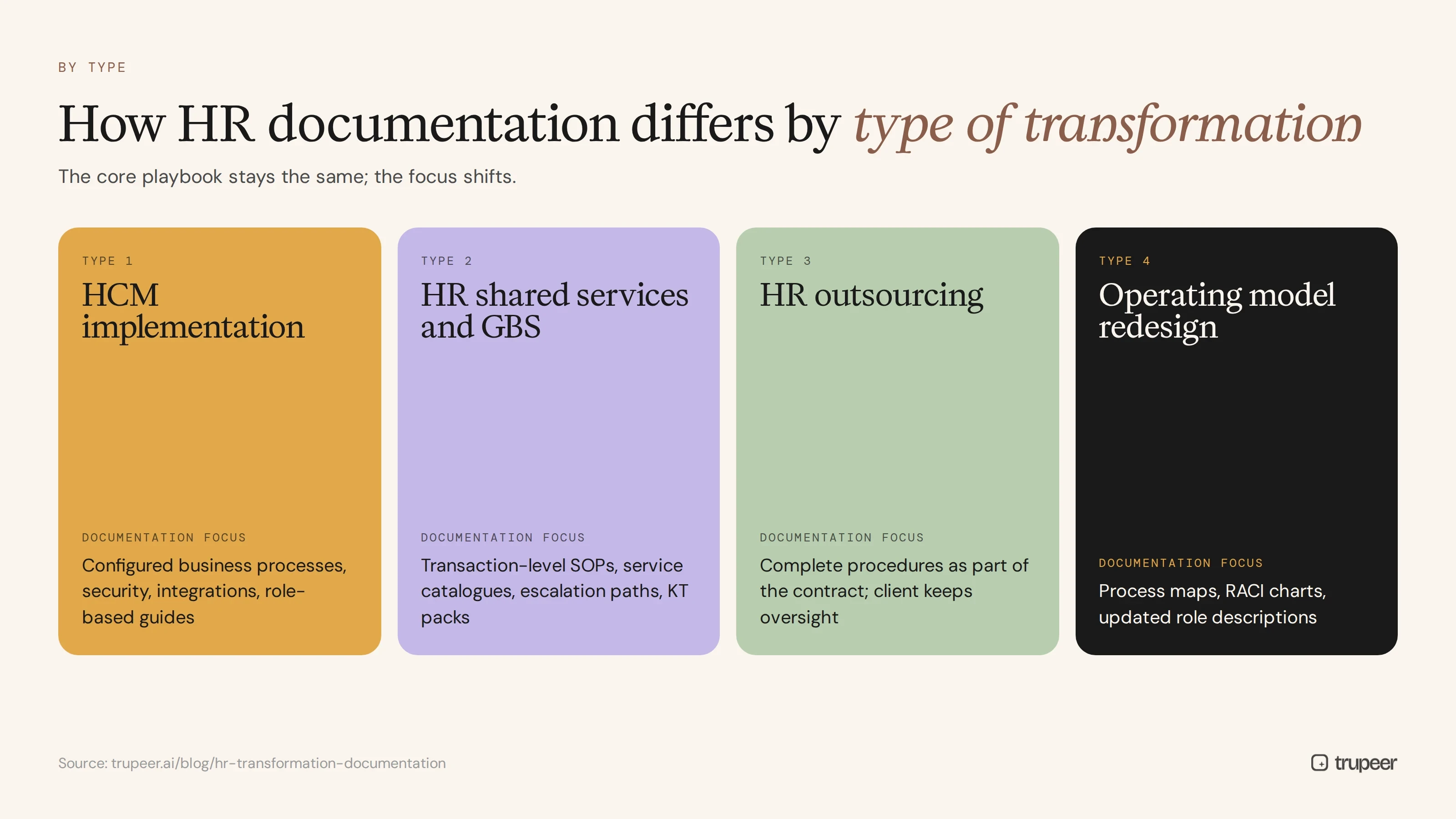
When implementing Workday, SAP SuccessFactors or Oracle HCM, documentation focuses on configured business processes, security, integrations and role-based guides for HR, managers and employees. For a module-by-module view of Workday, see Workday training videos for HR managers.
HR shared services and GBS
Moving work into a shared services centre means transferring knowledge from local HR teams to a new team, often in another country. Documentation focuses on transaction-level SOPs, service catalogues, escalation paths and knowledge transfer packs. A practical approach is to have each local HR specialist record the transactions they handle, including country-specific steps, before the work moves. The receiving team then performs the same tasks while the original specialist reviews their work, using the recordings as the reference, until the new team is working accurately on its own.
HR outsourcing
When a provider takes over HR transactions, documentation becomes part of the contract: the provider needs complete, current procedures, and the client needs to keep oversight. Capture knowledge before the transition rather than relying on handover meetings.
Operating model redesign
When roles change between business partners, centres of expertise and shared services, documentation clarifies who does what, with process maps, RACI charts and updated role descriptions.
HR transformation documentation roadmap example
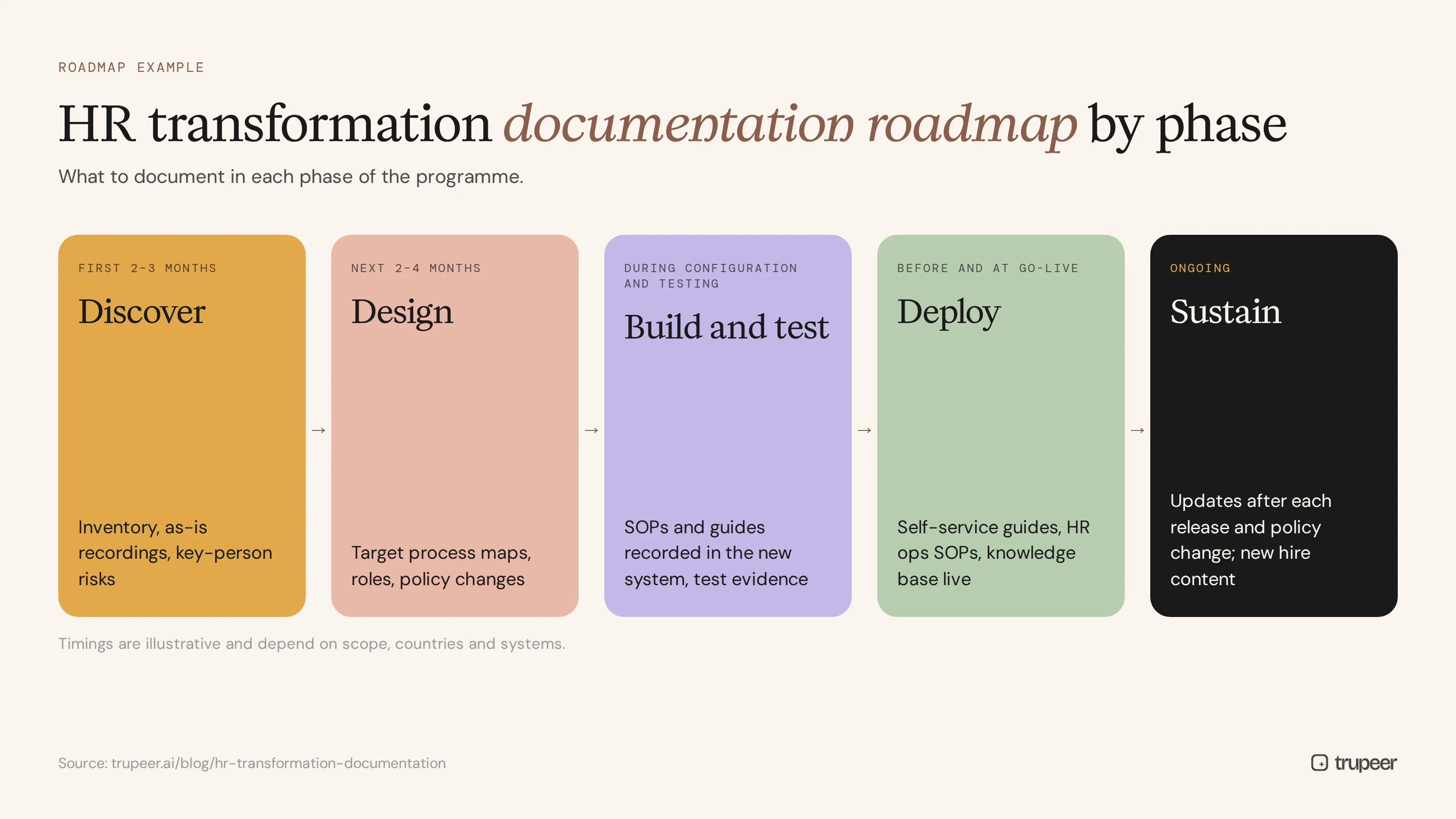
Phase | Typical timing | Documentation focus |
|---|---|---|
Discover | First 2 to 3 months | Inventory, as-is recordings, key-person risks |
Design | Next 2 to 4 months | Target process maps, roles, policy changes |
Build and test | During configuration and testing | SOPs and guides recorded in the new system, test evidence |
Deploy | Before and at go-live | Self-service guides, HR operations SOPs, knowledge base live |
Sustain | Ongoing | Updates after each release and policy change, new hire onboarding content |
The timings are illustrative and depend on scope, countries and systems.
Who should own HR transformation documentation?
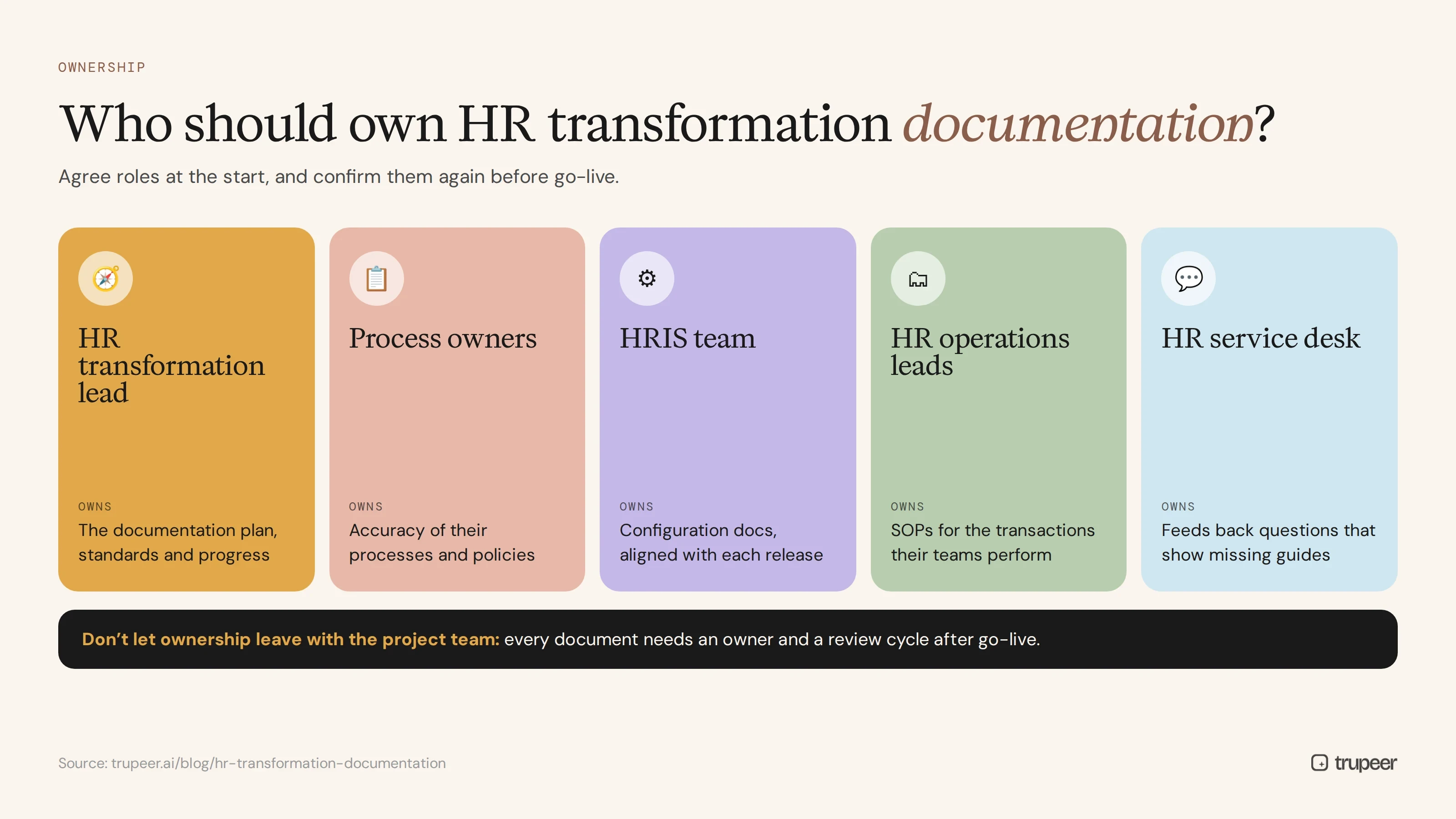
Documentation needs clear ownership, during the programme and after it:
The HR transformation lead owns the documentation plan, standards and progress.
Process owners in each area, such as onboarding, payroll, absence and talent, own the accuracy of their processes and policies.
The HRIS team owns configuration documentation and keeps system guides aligned with each release.
HR operations or shared services leads own SOPs for the transactions their teams perform.
The HR service desk feeds back the questions that show where guides are missing or unclear.
Agree these roles at the start, and confirm them again before go-live, so ownership doesn't disappear with the project team.
What about data protection in HR documentation?
HR documentation often shows employee records, pay details and other personal data. Record and document processes in a test or training environment with realistic but non-personal data, blur or replace anything sensitive before publishing, and restrict access to detailed HR operations SOPs to the people who need them. Involve your data protection and legal teams when you set the documentation standard, so privacy is built in rather than fixed later.
How do you protect HR knowledge during a transformation?
Reorganisations are often when experienced HR people leave or change roles. Much of what they know, such as how unusual leave cases are handled, which payroll corrections need which approvals, or how a particular country's rules are applied, isn't written down. Record those specialists early, turn their recordings into searchable guides and make capturing knowledge part of every role change. A tribal knowledge audit shows where knowledge is concentrated in one or two people.
What should HR transformation documentation measure?
Coverage: the share of HR processes with a current SOP or guide.
Freshness: the share of documents reviewed since the last relevant change.
Self-service adoption: the share of HR transactions completed through self-service.
HR ticket volume for topics covered by guides.
Time to proficiency for new HR operations staff.
Compliance findings related to inconsistent processes.
Common HR transformation documentation mistakes
Leaving documentation to the end of the programme.
Copying old procedures into the new model without checking them against the new system.
Writing for HR, not for employees, so self-service guides are full of jargon.
Ignoring country variations until they cause errors.
Spreading content across too many places, so nobody knows which version is current.
No owners after go-live, so documentation goes stale within months.
HR transformation documentation checklist
Existing HR documentation is inventoried, with owners.
Current HR processes are recorded, including country variations.
Target processes and roles are documented.
Every HR operations transaction has a current SOP.
Policies match the new processes.
Employee and manager self-service guides cover the most common tasks.
Everything is published in one searchable HR knowledge base.
Every document has an owner and a review cycle.
How Trupeer powers HR transformation documentation
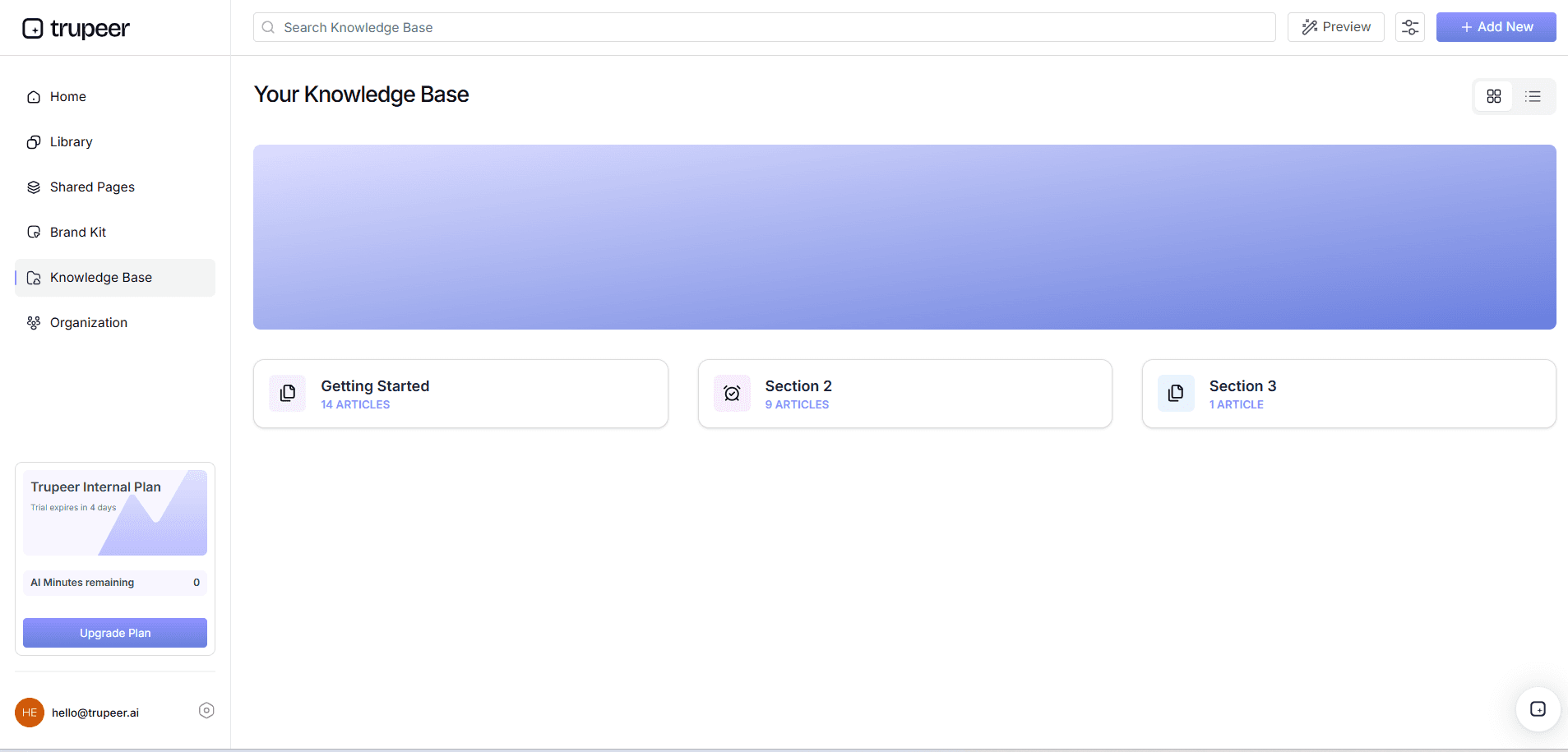
Most HR transformation documentation stalls because it's slow to write, hard to keep current and scattered across tools. Trupeer is built to remove each of those blockers:
HR transformation problem | How Trupeer solves it |
|---|---|
HR knowledge sits with a few specialists | Specialists record each task once, and Trupeer turns it into a step-by-step SOP and narrated video |
SOPs take weeks to write for a new HCM | Every recording in the new system becomes a ready-to-review guide in minutes, not days |
Every country needs its own version | One source can be translated into 65+ languages, so every country gets the same process |
Self-service guides are hard to find | Guides and videos sit in one searchable knowledge base, linked from the HCM and intranet |
Documentation goes stale after each release | Updates are made by editing the script or re-recording a single step, not rebuilding the guide |
Genpact used this approach for a company-wide Workday rollout, turning recorded sessions into more than 500 training collaterals across 20 workstreams in five languages, in 3 months instead of 12. Read the Genpact customer story.
If your HR transformation needs SOPs, self-service guides and training that keep pace with the programme, Trupeer gives HR teams one place to capture, publish and update them.
Frequently asked questions
What is HR transformation?
HR transformation is the redesign of how HR delivers its services, typically through a new operating model, a new HCM system, self-service, standardised processes and sometimes shared services or outsourcing.
Why is documentation important in HR transformation?
Because HR processes depend on rules, move between people and teams during transformation, and must be followed consistently for self-service and compliance to work.
What documentation does an HR transformation need?
Process maps, HR operations SOPs, HR policies, self-service guides for employees and managers, HCM configuration documentation, controls records, knowledge transfer packs and knowledge base articles.
How do you document HR processes quickly?
Record HR specialists doing each task in the system and use a tool like Trupeer to turn the recordings into step-by-step SOPs, guides and videos.
How does documentation support HR shared services?
It gives the shared services team clear, consistent procedures for every transaction and captures knowledge from local HR teams before work moves.
How do you keep HR documentation current?
Give every document an owner, review content after each HCM release and policy change, and update guides by editing them rather than recreating them.
Who should own HR transformation documentation?
The HR transformation lead owns the overall plan, process owners own content in their area, and HR operations or HRIS teams maintain it after go-live.
How does Trupeer help with HR transformation?
Trupeer turns recordings of HR processes into SOPs, self-service guides, training videos and a searchable knowledge base, supporting capture, go-live and ongoing updates.
Make documentation the foundation of your HR transformation
HR transformations succeed when people know how the new processes work. Capture what HR knows today, document the new way of working as you build it and keep it current afterwards. Explore Trupeer for HR teams or learn more about Trupeer AI.
Artigos relacionados