
Gunakan template ini
Moving a process to a BPO provider is a project with a deadline, a contract and a client watching every service level. With Trupeer, you can save hours on transition planning by starting with a free BPO transition plan template, customizing it with your brand guidelines, and turning knowledge transfer into recorded SOPs and videos the provider's team can learn from.
What is a BPO transition plan template?
A BPO transition plan template is a ready-made structure for planning the move of business processes from a client's in-house team, or from another provider, to a business process outsourcing (BPO) provider. It sets out the scope, waves, timeline, governance, knowledge transfer approach, staffing ramp-up, risks and acceptance criteria for one specific transition.
It's also called a BPO transition plan, outsourcing transition plan or process transition plan. Where a transition SOP describes the standard method every transition follows, the BPO transition plan applies that method to one deal: these processes, these people, these dates.
Who uses a BPO transition plan?
Clients outsourcing a function, such as finance and accounting, HR, customer service or procurement.
BPO providers, whose transition teams build the plan with the client and run it.
Clients switching providers, in a vendor-to-vendor transition.
Shared services and GCC teams taking work over from a BPO provider.
Consultants and advisors who manage outsourcing transitions on behalf of clients.
Preview the BPO transition plan template
The template opens with a transition summary: scope, parties, contract dates and go-live targets. It then covers waves and timeline, governance and roles, the knowledge transfer plan, documentation, staffing and training, technology and access, communication, risks, acceptance gates and hypercare exit criteria. Each section has prompts and example entries, and every section is editable to match your contract and method.
How to customize this template in Trupeer
Step 1: Open the Templates Section
Go to the Templates section from the main navigation.

Step 2: Select and Open a Template
Click on any template you want to work with to open it.
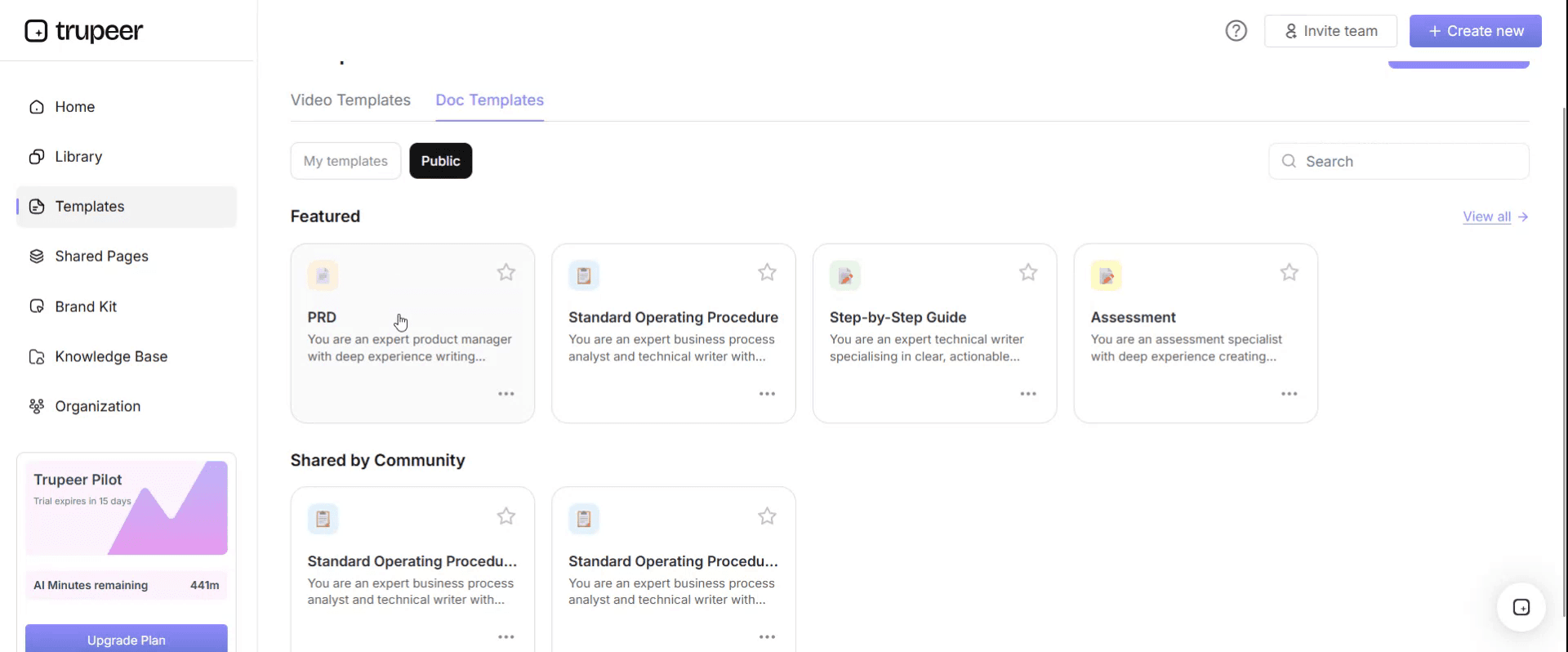
Step 3: Expand the Template View
If needed, expand the template view to see the full layout and details clearly.

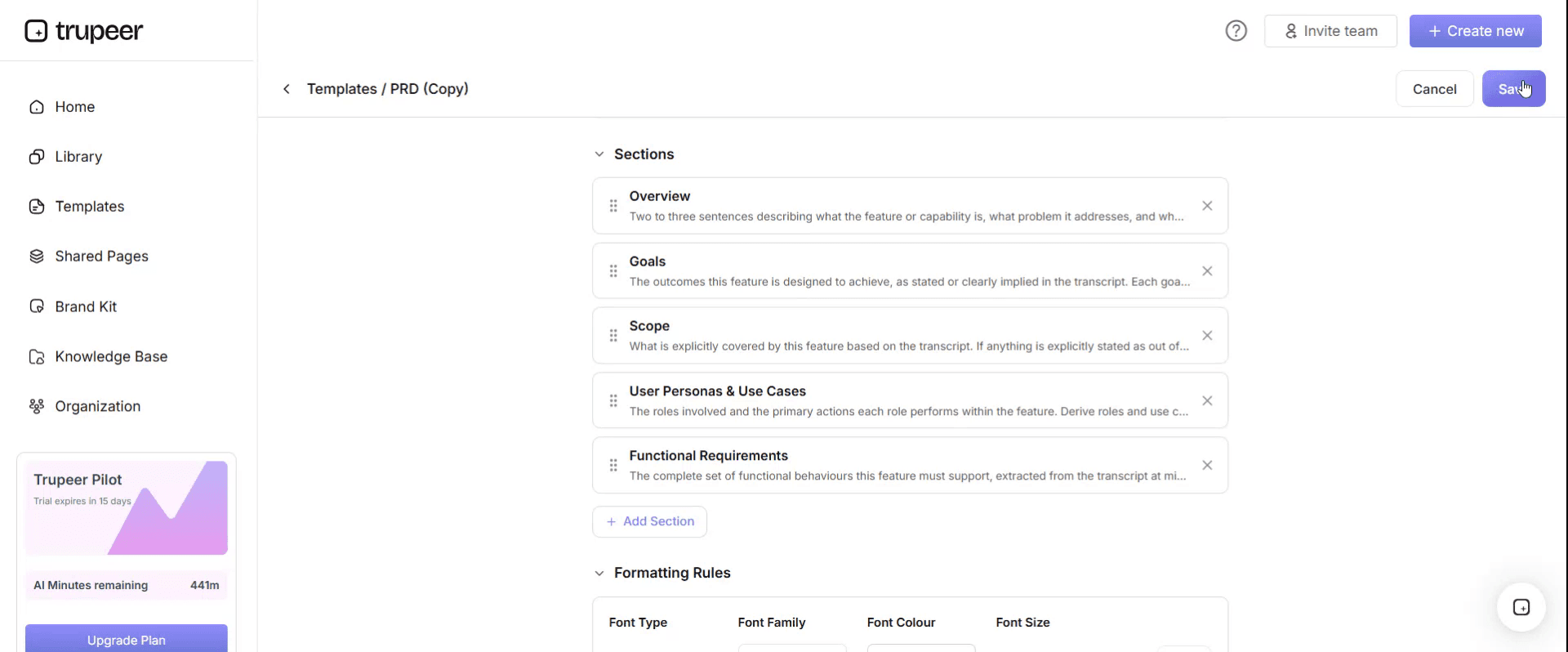
Step 4: Edit the Template
Click on Edit to start modifying the selected template.

Within the editor, you can:
Add new sections
Define or update formatting rules
Add a logo and adjust its position and related settings
Step 5: Save Your Customized Template
After making all necessary changes, click Save to store the updated template as your own.
Step 6: Preview and Fine-Tune the Template
When you want to see how your customized template looks, open the Preview.

From the preview screen, you can continue to make adjustments directly if needed, ensuring the template appears exactly as you want.
With a BPO transition plan template you can:
Plan the whole transition on one page set: Scope, waves, KT, staffing and risks in one place.
Align client and provider early: Agree governance, roles and acceptance before KT starts.
Protect service levels: Plan parallel run and hypercare so service doesn't dip at go-live.
Stay on-brand: Apply your logo, fonts and colors with Trupeer's brand kit.
Speed up knowledge transfer: Record KT sessions and turn them into SOPs and videos.
Show progress to stakeholders: Track every wave against its gates and dates.
What a BPO transition plan template must contain
Transition summary: scope, parties, contract references and key dates.
Scope and waves: which processes move, grouped into waves, with volumes and locations.
Timeline and milestones: phase dates for each wave, from planning to steady state.
Governance and roles: steering committee, transition management office (TMO), workstream leads and a RACI.
Knowledge transfer plan: KT method, sessions, SMEs, recording approach and calendar.
Documentation plan: which SOPs, job aids and training materials will exist before go-live.
Staffing and training: provider hiring, ramp-up, training and certification.
Technology and access: systems, access, connectivity, security and data handling.
Communication plan: who is told what, and when, internally and externally.
Risks and dependencies: key risks, mitigations, owners and dependencies.
Acceptance gates: the criteria and sign-offs for each gate.
Hypercare and exit criteria: support after go-live and the metrics for ending it.
Free BPO transition plan template: the structure to copy
Copy the structure below into your own document, or open it in Trupeer and customize it.
1. Transition summary. Client: [name]. Provider: [name]. Processes in scope: [list]. Contract signed: [date]. Planned go-live by wave: [dates]. Transition lead (client): [name]. Transition lead (provider): [name].
2. Scope and waves.
Wave | Processes | Monthly volume | Delivery location | Go-live |
|---|---|---|---|---|
1 | [Processes] | [Volume] | [Location] | [Date] |
2 | [Processes] | [Volume] | [Location] | [Date] |
3. Timeline and milestones (per wave).
Phase | Key activities | Start | End | Gate |
|---|---|---|---|---|
Plan | Process inventory, KT plan, access requests, hiring | [Date] | [Date] | KT plan agreed |
Knowledge transfer | Recorded KT sessions, SOPs and videos | [Date] | [Date] | Handover sign-off |
Validate | SME review, playback, documentation fixes | [Date] | [Date] | Playback passed |
Parallel run | Shadow, reverse shadow, certification | [Date] | [Date] | Certification |
Go-live | Cutover and communications | [Date] | [Date] | Go/no-go |
Hypercare | Daily triage, SLA tracking, SOP updates | [Date] | [Date] | Hypercare exit |
4. Governance and roles. Steering committee members and cadence. TMO lead and weekly review. Workstream leads per wave. RACI for key activities.
5. Knowledge transfer plan. KT method: every session recorded, SMEs demonstrate the real work in the live system, recordings turned into SOPs and videos within [X] days. SMEs per process. KT calendar.
6. Documentation plan. For each process: SOP, video walkthrough, business rules and exceptions, KEDB entries if relevant, quality checklist. Where documentation will be stored and who owns it.
7. Staffing and training. Provider headcount by wave and role, hiring dates, training plan, certification criteria, rebadged staff if any.
8. Technology and access. Systems and environments, access requests, VPN and connectivity, security reviews, data handling and masking rules.
9. Communication plan. Audience, message, channel, timing and owner, including the client's internal teams, customers and suppliers where relevant.
10. Risks and dependencies.
Risk | Impact | Likelihood | Mitigation | Owner |
|---|---|---|---|---|
Key SME leaves before KT ends | High | Medium | Record KT from day one; prioritize single-source processes | Client transition lead |
Access not ready for parallel run | High | Medium | Raise access requests in the plan phase | Provider IT lead |
11. Acceptance gates. KT plan agreed, handover sign-off, playback, certification and go/no-go, each with criteria, evidence and signatories.
12. Hypercare and exit criteria. Hypercare support model, daily triage, and exit criteria: SLAs met for an agreed period, error rates at target, backlog normal, no critical open issues, documentation current.
BPO transition plan example: customer service outsourcing
Here's the template filled in for an illustrative example. A telecoms company, Brightwave Telecom, is outsourcing first-line customer service and back-office order processing to a BPO provider, in two waves.
Transition summary. Processes in scope: inbound customer service (billing and account queries), order processing and number porting. Delivery location: provider's offshore center. Wave 1 go-live: week 12. Wave 2 go-live: week 20.
Wave | Processes | Approach | Go-live |
|---|---|---|---|
1 | Billing and account queries | 4 weeks KT, 2 weeks shadow, 2 weeks reverse shadow | Week 12 |
2 | Order processing and number porting | KT started during wave 1 hypercare | Week 20 |
Knowledge transfer approach. Every KT session recorded. Senior agents recorded short walkthroughs of their own tasks between calls, and each recording became an SOP and a video. The provider's trainers built the new-hire curriculum from the same content.
Key risk and mitigation. Number porting depended on two senior agents. Both were recorded in the first week of the wave 2 KT window, before anything else.
Outcome. Wave 1 passed certification on schedule, and wave 2 started KT with a working method and a template set already in place. The details in this example are illustrative; replace them with your own transition.
Example BPO transition timeline for one wave
Every transition is different, but it helps to see how the phases fit together. Here's an illustrative 16-week wave for a mid-sized process. Treat it as a starting point, not a benchmark.
Weeks | Phase | What happens |
|---|---|---|
1 to 2 | Plan | Process inventory, KT plan, SME calendar, access requests, provider hiring starts |
3 to 6 | Knowledge transfer | Recorded KT sessions and walkthroughs; SOPs and videos generated as recordings arrive |
6 to 7 | Validate | SME review, playback sessions, documentation fixes |
8 to 11 | Parallel run | Two weeks shadowing, two weeks reverse shadowing, certification |
12 | Go-live | Go/no-go review, cutover, communications |
13 to 16 | Hypercare | Daily triage, SLA tracking, SOP updates, exit review per process |
Notice the overlap between weeks 6 and 7. Starting validation while the last KT sessions are still running saves time, but only if documentation is generated from recordings as KT happens.
Governance rhythm for a BPO transition
Forum | Members | Frequency | Purpose |
|---|---|---|---|
Steering committee | Client and provider sponsors | Monthly, plus at each go/no-go | Approve gates, resolve escalations |
TMO review | Transition leads, workstream leads | Weekly | Track plan, risks and dependencies |
Workstream stand-up | Wave leads, SMEs, provider team | Daily during KT and hypercare | Unblock issues and track KT progress |
Gate review | Signatories for each gate | At each gate | Review evidence and sign off |
Staffing ramp-up
Plan provider staffing in step with knowledge transfer. Team leads and trainers should be in place before KT starts, so they can attend sessions and build training from the recordings. Agents can join in cohorts, each trained from the same SOPs and videos, and certified before reverse shadowing. If staff are rebadged from the client, plan training on the provider's policies, tools and SLAs, and assess them against the same SOPs as new hires. See our guide to rebadging in outsourcing transitions.
How to write a BPO transition plan in seven steps
Confirm scope from the contract. List every process the provider will deliver and the service levels that apply.
Group processes into waves by complexity, volume and risk, starting with stable, well-understood processes.
Set the timeline for each wave, working back from contracted go-live dates.
Agree governance and roles, including a RACI that both client and provider sign off.
Plan knowledge transfer and documentation, including how every session will be recorded and documented.
Plan staffing, technology and communications in parallel, so hiring and access don't hold up KT.
Agree acceptance gates and hypercare exit criteria before the first wave starts.
Knowledge transfer: the part of the plan that slips most
In most BPO transitions, the phase that runs late is knowledge transfer. SMEs are busy, sessions get rescheduled, and documentation is written weeks after the session it came from. When KT slips, parallel run, certification and go-live slip with it.
Plan KT as recording-first:
Record every KT session, and ask SMEs to record short walkthroughs of their own tasks with Trupeer's AI screen recorder.
Generate SOPs and videos from each recording with the SOP creator, so documentation keeps pace with KT.
Translate for offshore and multi-language teams with translation.
Publish to one searchable knowledge base the client owns and the provider uses.
Genpact used this approach for a company-wide Workday rollout, recording existing MS Teams process sessions and SME walkthroughs and turning them into 500+ SOPs and training videos in five languages in 3 months, for a program that would otherwise have taken 12. Read the Genpact customer story.
BPO transition plan variants
Finance and accounting BPO transition plan
Plan waves around the financial calendar, so no process goes live just before month-end or year-end. Include controls, segregation of duties and audit evidence in the documentation plan.
Customer service BPO transition plan
Add call or ticket volumes by hour, quality monitoring and customer communication. Plan for a temporary dip in handling time and build it into the hypercare criteria.
HR and payroll BPO transition plan
Run at least one full payroll cycle in parallel before go-live, and include data protection reviews for employee data.
Vendor-to-vendor BPO transition plan
Add the incumbent provider's exit obligations, tri-party governance and client ownership of documentation. See our guide to vendor-to-vendor transition knowledge transfer.
Government and public sector BPO transition plan
Include procurement and contract governance milestones, records management, data residency requirements and the senior responsible owner's approvals at each gate.
BPO transition plan vs transition SOP vs sign-off checklist
Document | Purpose | Written |
|---|---|---|
BPO transition plan | Schedules one specific BPO transition | Once per transition |
Transition SOP | Standard method every transition follows | Once, then revised |
Transition handover sign-off checklist | Evidence and approvals at each gate | Once per transition |
RACI matrix | Who is responsible and accountable for each activity | Once per transition |
See the transition SOP template, transition handover sign-off checklist, RACI matrix template and knowledge transfer gap analysis template. For a single role or responsibility transition, use the transition plan template.
BPO transition plan checklist
Every in-scope process is listed and assigned to a wave.
Each wave has dates for every phase and a gate at each stage.
Governance, roles and the RACI are agreed by client and provider.
The KT plan says every session will be recorded and documented.
Every process will have an SOP and video before go-live.
Provider hiring, training and access are scheduled ahead of KT.
Risks have owners and mitigations, especially single-source knowledge.
Acceptance gates and hypercare exit criteria are agreed up front.
Common mistakes to avoid
Planning KT as meetings, not outputs. Plan for recordings and approved SOPs, not sessions held.
Moving everything in one wave. Waves let you learn and adjust.
Leaving access and hiring too late. They often become the critical path.
Ignoring the business calendar. Don't go live just before a peak or a period close.
Ending hypercare on a date. Exit on agreed metrics, process by process. See our guide to the transition hypercare period.
Download the free BPO transition plan template
Open the template in Trupeer, apply your brand kit, fill in your scope, waves and dates, and share it with your provider and stakeholders. Get the free BPO transition plan template.
Frequently Asked Questions
What is a BPO transition plan?
A BPO transition plan sets out how business processes will move to an outsourcing provider: the scope, waves, timeline, governance, knowledge transfer, staffing, risks and acceptance criteria for one transition.
What are the phases of a BPO transition?
Typically planning, knowledge transfer, validation, parallel run, go-live and hypercare, followed by steady state.
How long does a BPO transition take?
It depends on the number of processes, waves, locations and complexity. Plan each wave from the contracted go-live date backwards, and allow time for parallel run and hypercare.
What should a BPO transition plan include?
A transition summary, scope and waves, timeline, governance and roles, knowledge transfer plan, documentation plan, staffing and training, technology and access, communication plan, risks, acceptance gates and hypercare exit criteria.
Who owns the BPO transition plan?
It's usually built jointly, with a transition lead on each side. The provider often runs the plan day to day, and the client approves it and owns the acceptance decisions.
What is the difference between a BPO transition plan and a transition SOP?
The transition SOP is the standard method for any transition. The BPO transition plan applies that method to one specific outsourcing deal, with its own processes, people and dates.
What is a BPO transition plan example?
A BPO transition plan example is the template filled in for a real or illustrative deal. The customer service example on this page shows the scope, two waves, the KT approach and how a key risk was handled.
How do you make BPO knowledge transfer faster?
Record every KT session, have SMEs record short walkthroughs of their own tasks, turn each recording into an SOP and video within days, and publish everything to one searchable knowledge base.
Is there a BPO transition plan template in Word?
Word suits the full plan, because it combines narrative sections with tables for waves, timelines and risks. Open this template in Trupeer and export it, or copy the structure above.
Is there a BPO transition plan template in Excel?
Excel works well for the wave plan, timeline, RACI and risk log. Keep the narrative sections in a document.
Is there a BPO transition plan template in PowerPoint?
Slides suit presenting the plan to a steering committee. Use one slide per wave with its timeline, gates and key risks.
Is there a BPO transition plan template in PDF?
PDF suits the agreed version signed by client and provider. Keep an editable copy for updates during the transition.
Is there a BPO transition plan template in Google Docs?
Yes. Copy the structure above into Google Docs or Sheets, or open the template in Trupeer and export it. Google Docs is useful when client and provider need to comment on the plan together.


