Trupeer Blog
Zusammenfassen
Ask your best accounts payable specialist how to process an invoice and you'll get the steps in a minute. Watch them do it for an hour and you'll see something else: they hold one invoice because the supplier "always sends duplicates in March", call a buyer instead of emailing because that buyer never reads email, and override a tolerance because they know the contract allows it. None of that is in the SOP. It's judgement, built up over years, and it walks out of the door when they leave. Tacit knowledge capture is how you keep it.
Steps are now the easy part. They can be pulled from existing documents, screen recordings and even AI tools. What can't be scraped is the reasoning behind the steps: the decisions, exceptions, workarounds and cues that experienced people use without thinking. This pillar guide explains what tacit knowledge capture is, what judgement to capture, the methods that work and the ones that don't, a recording method with the prompts that draw judgement out, and how to turn it into SOPs, decision tables and training people can use.
What is tacit knowledge capture?
Tacit knowledge capture is the practice of recording the know-how experienced people use but rarely write down: how they make decisions, recognise problems, handle exceptions and work around system limits. It goes beyond documenting the steps of a process to documenting the judgement that makes those steps work in real conditions.
Tacit knowledge is hard to capture because experts often don't know they have it. They'll describe the standard process and leave out the dozen small calls they make each day. Good tacit knowledge capture uses methods, especially observing and recording real work while the expert explains their thinking, that bring those calls to the surface.
Explicit, tacit and tribal knowledge: what's the difference?
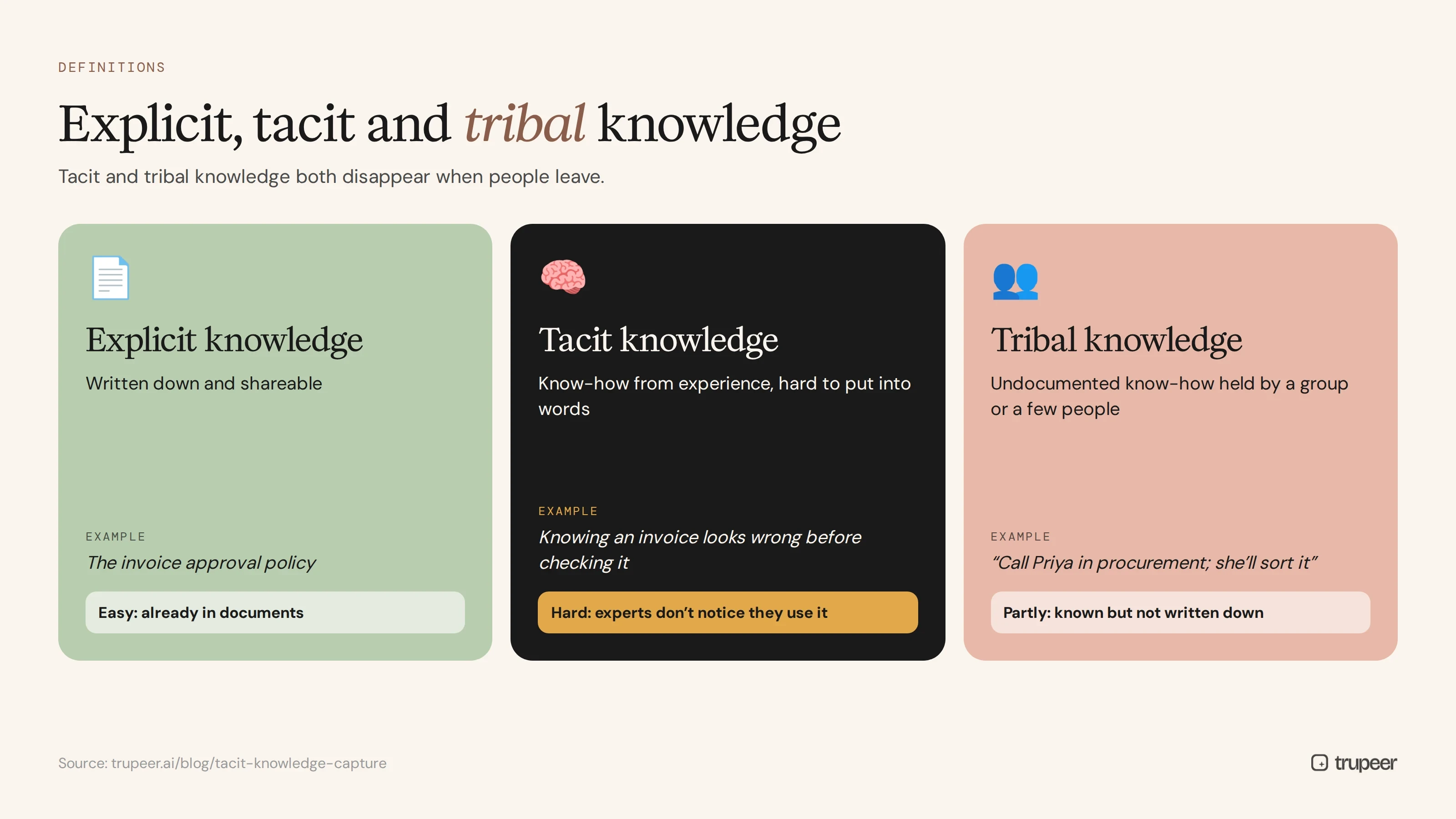
Type | What it is | Example | Easy to capture? |
|---|---|---|---|
Explicit knowledge | Written down and shareable | The invoice approval policy | Yes: it's already in documents |
Tacit knowledge | Know-how from experience, hard to put into words | Knowing an invoice looks wrong before checking it | No: experts don't notice they use it |
Tribal knowledge | Undocumented know-how held by a group or a few people | "Call Priya in procurement; she'll sort it" | Partly: it's known but not written down |
Tribal knowledge overlaps with tacit knowledge, and both disappear when people leave. To find where they sit in your organisation first, run a tribal knowledge audit.
Why capturing the steps isn't enough
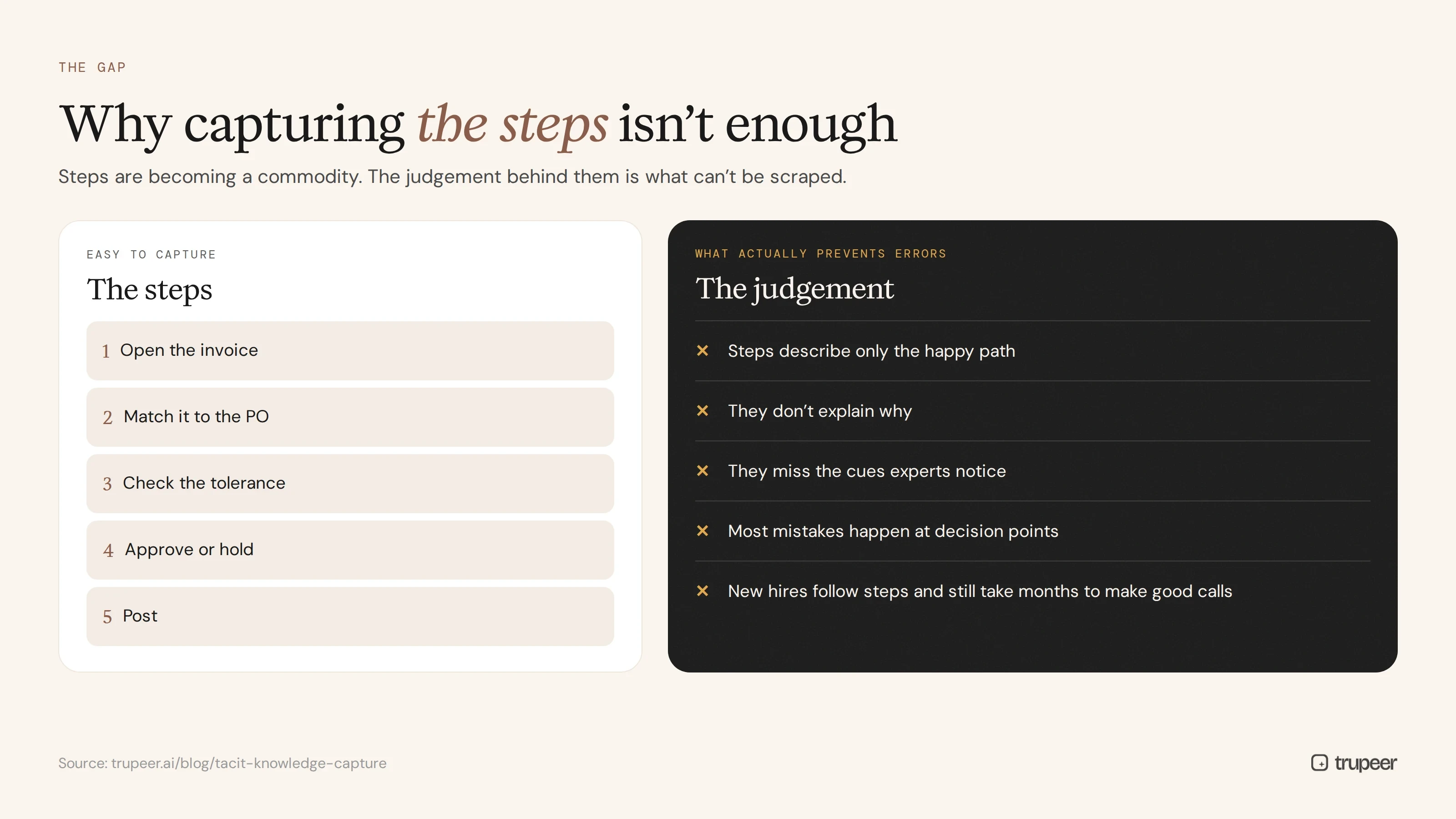
Steps describe the happy path. Real work is full of cases that don't follow it.
Steps don't explain why. Without the reason, people can't adapt when something changes.
Steps miss the cues. Experts notice things, such as an odd amount or an unusual supplier, that trigger a different action.
Steps are becoming a commodity. Tools can now generate step lists from documents and recordings; the competitive knowledge is the judgement.
Steps don't stop errors. Most mistakes happen at decision points, not in routine clicks.
Steps don't make someone an expert. New hires can follow steps on day one and still take months to make good calls.
What tacit knowledge should you capture?
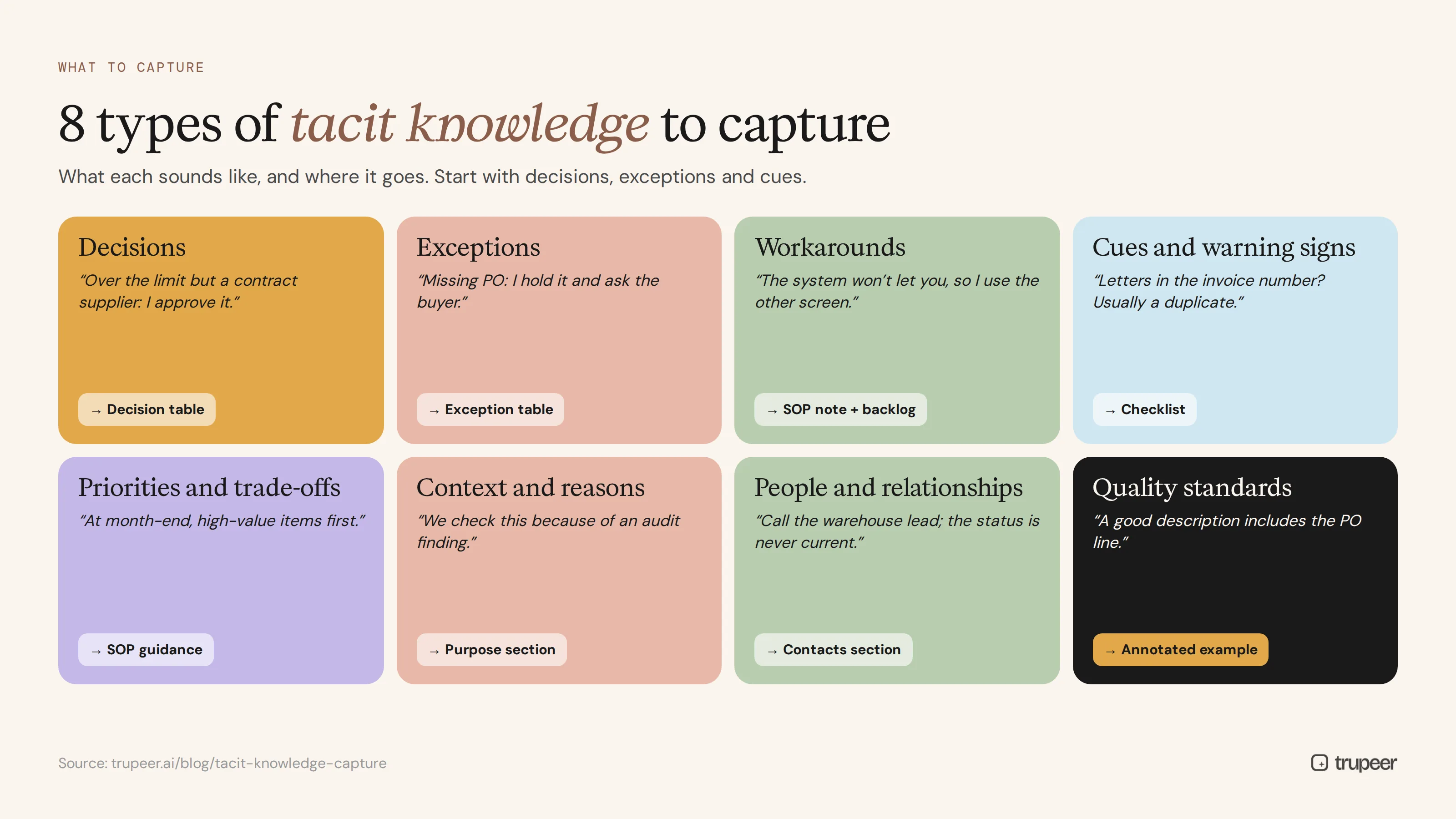
Type of judgement | What it sounds like | Where it goes |
|---|---|---|
Decisions | "If the amount is over the limit but it's a contract supplier, I approve it." | Decision table or rule in the SOP |
Exceptions | "When the PO is missing, I hold it and ask the buyer, not the requester." | Exception table |
Workarounds | "The system won't let you do that, so I use the other screen." | SOP note and improvement backlog |
Cues and warning signs | "If the invoice number has letters in it, it's usually a duplicate." | Checklist or annotated example |
Priorities and trade-offs | "At month-end, I clear high-value items first." | SOP guidance |
Context and reasons | "We check this because of an audit finding two years ago." | Purpose section and training |
People and relationships | "Call the warehouse lead; the system status is never current." | Contacts and escalation section |
Quality standards | "A good description includes the PO line, not just the item." | Annotated example |
Aim for decisions, exceptions and cues first. They cause the most errors and take the longest for new people to learn.
Why traditional knowledge capture methods miss judgement
Interviews rely on memory, and experts describe the process they think they follow.
Written questionnaires get the policy, not the practice.
Experts write documents at the level of steps, because judgement feels too obvious or too complicated to write down.
Workshops favour the loudest voices and the standard path.
Shadowing works, but the knowledge stays in the shadow's head unless it's recorded.
The common problem is distance from the real work. Judgement shows up when the expert is doing the task, with real cases in front of them.
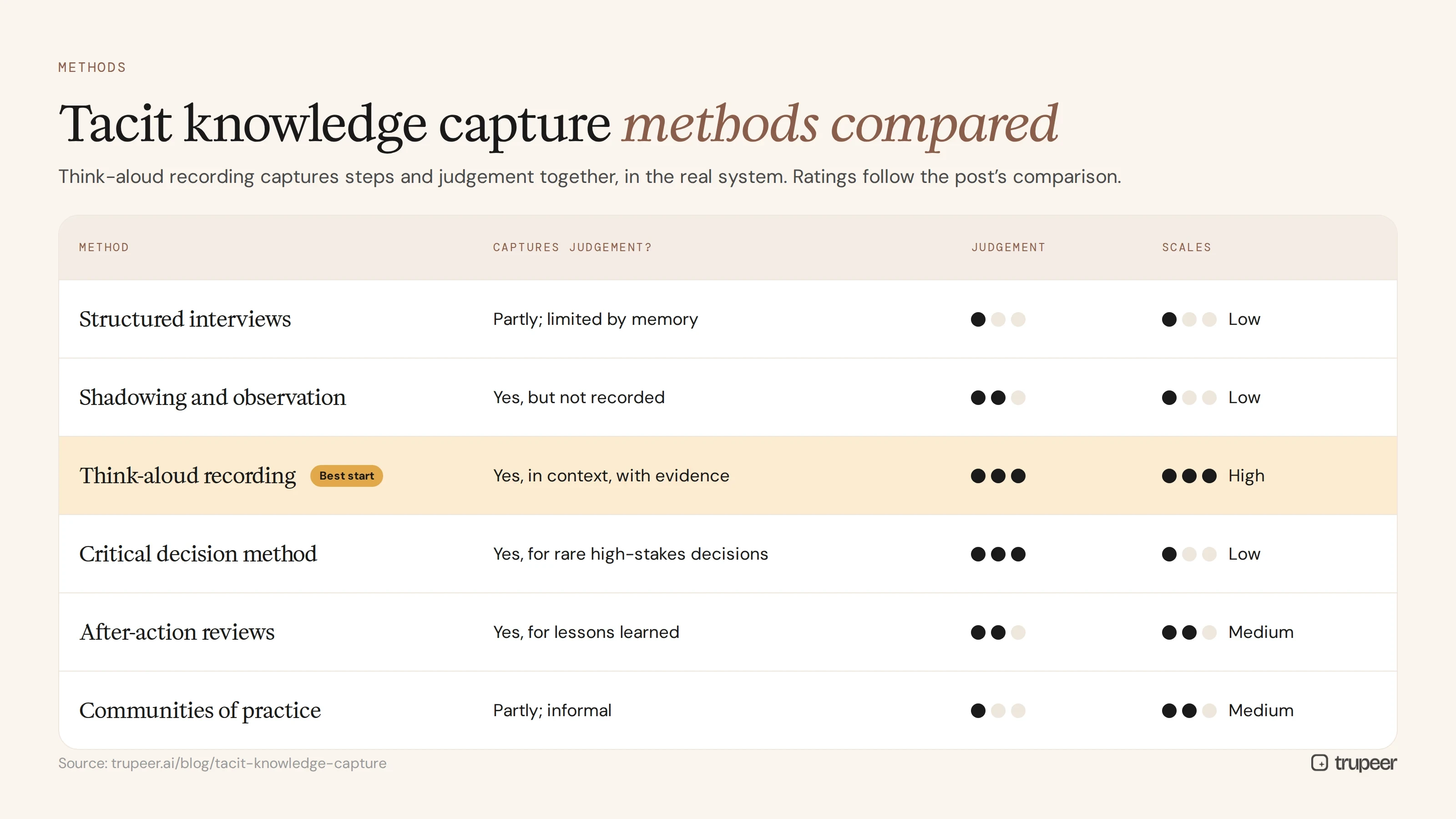
Tacit knowledge capture methods compared
Method | How it works | Captures judgement? | Scales? |
|---|---|---|---|
Structured interviews | Ask experts about their work | Partly; limited by memory | Low |
Shadowing and observation | A colleague watches the expert work | Yes, but it isn't recorded | Low |
Think-aloud recording | Record the expert doing real work while explaining each decision | Yes, in context, with evidence | High |
Critical decision method | Walk back through a difficult past case in detail | Yes, for rare high-stakes decisions | Low |
After-action reviews | Review what happened after a case or event | Yes, for lessons learned | Medium |
Communities of practice | Experts share tips and answer questions over time | Partly; informal | Medium |
Think-aloud recording is the most practical starting point for operational processes: it captures the steps and the judgement together, in the real system, and the recording becomes evidence and training. Use the critical decision method for rare, high-stakes cases that won't come up during a recording.
How to capture tacit knowledge by recording: step by step
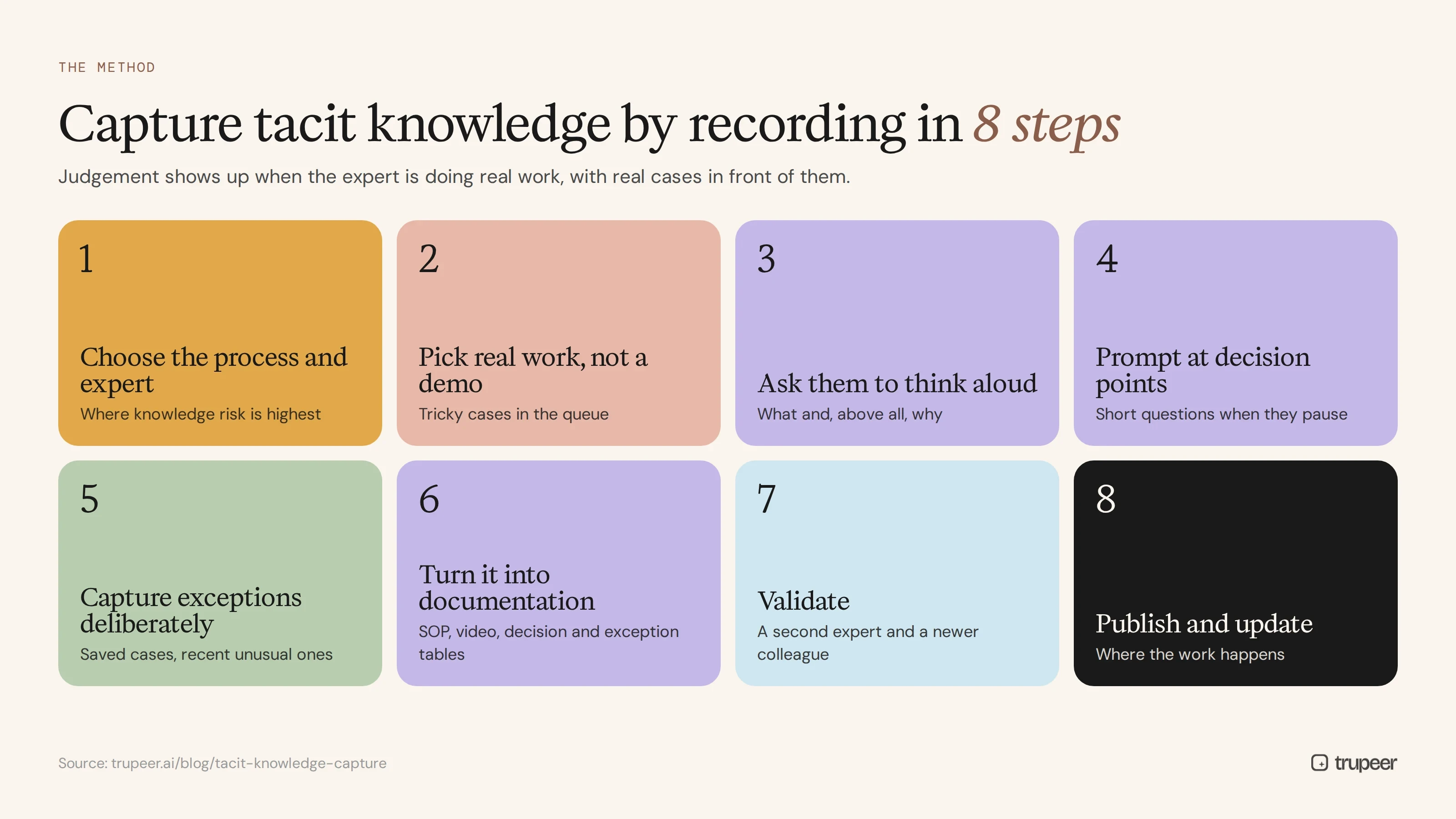
Choose the process and the expert. Start where knowledge risk is highest: a retirement, a transition, a single point of failure or a process with frequent errors.
Pick real work, not a demo. Schedule the recording when the expert is doing the task for real, ideally with a few tricky cases in the queue.
Ask them to think aloud. They narrate what they're doing and, more importantly, why: what they're checking, what they noticed, what they'd do differently if something were different.
Prompt at decision points. A facilitator asks short questions when the expert pauses, chooses or deviates (see the prompts below).
Capture exceptions deliberately. Ask the expert to show cases they've saved or describe the last few unusual ones.
Turn the recording into documentation. Generate the step-by-step SOP and video, then pull the judgement into a decision table, exception table and cues checklist.
Validate with a second expert and with someone newer, who can spot what's still unclear.
Publish and link it where the work happens, and update it when the process or system changes.
Prompts that draw out judgement
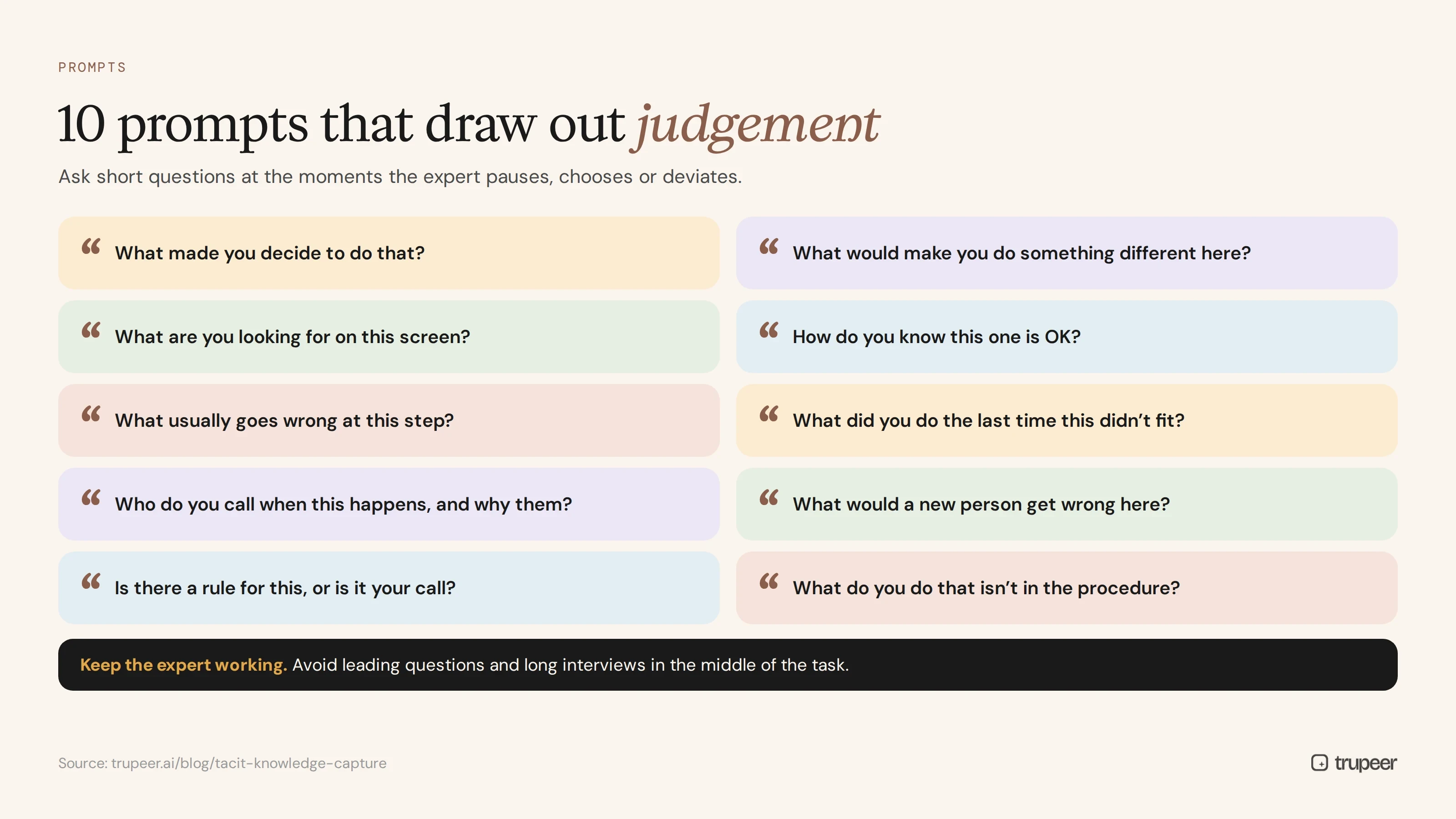
Use short, specific questions during the recording:
"What made you decide to do that?"
"What would make you do something different here?"
"What are you looking for on this screen?"
"How do you know this one is OK?"
"What usually goes wrong at this step?"
"What did you do the last time this didn't fit?"
"Who do you call when this happens, and why them?"
"What would a new person get wrong here?"
"Is there a rule for this, or is it your call?"
"What do you do that isn't in the procedure?"
Avoid leading questions and long interviews in the middle of the task. Keep the expert working, and ask for detail at the moments that matter.
How to turn captured judgement into usable knowledge
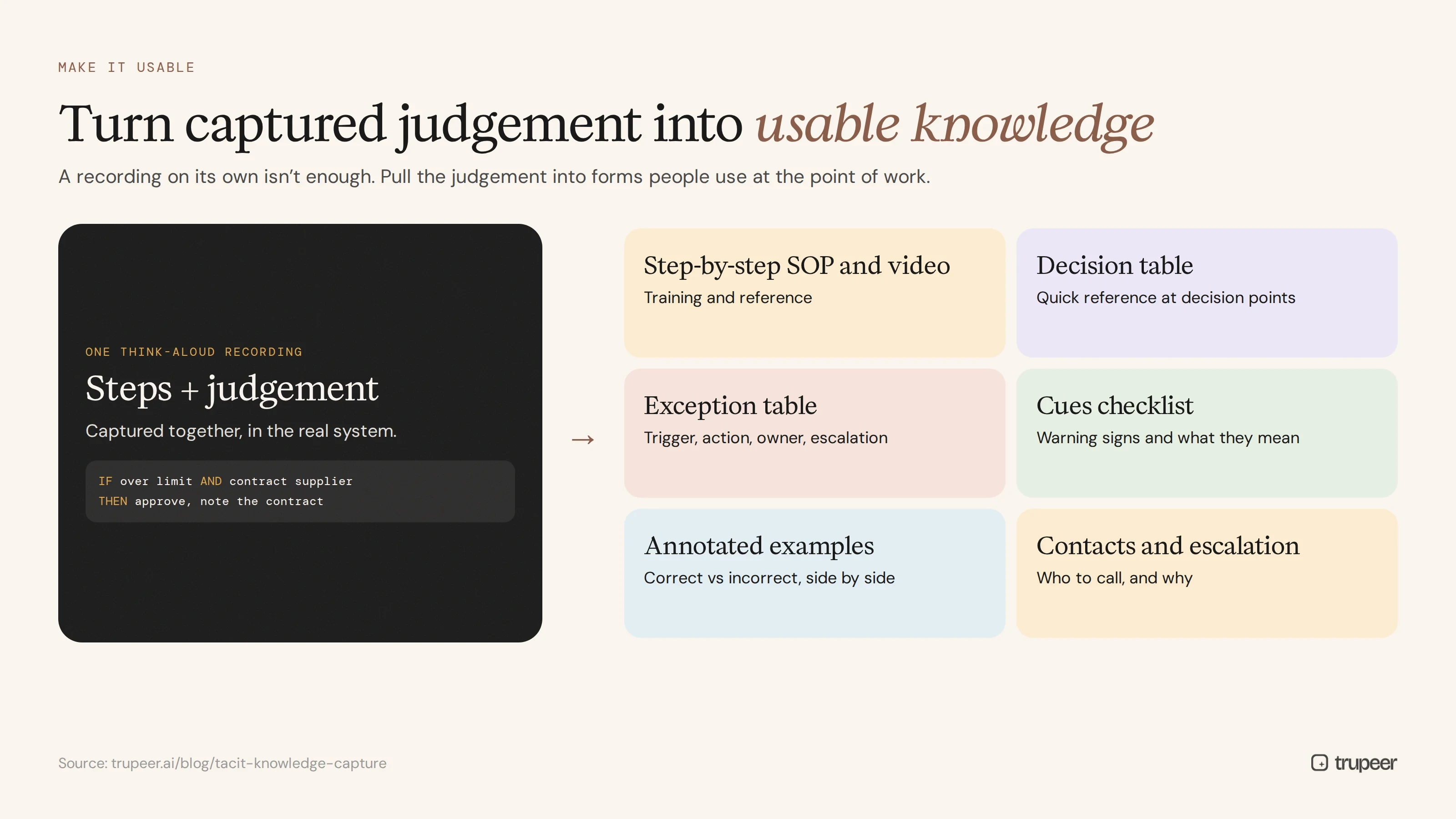
A recording on its own isn't enough; people need judgement in a form they can use at the point of work.
Output | What it holds | How to use it |
|---|---|---|
Step-by-step SOP and video | The steps, screens and narration | Training and reference |
Decision table | Conditions and the right action for each | Quick reference at decision points |
Exception table | Each exception, trigger, action, owner and escalation | Inside the SOP |
Cues checklist | Warning signs and what they mean | Before or during the task |
Annotated examples | A correct and an incorrect case, side by side | Training and quality checks |
Contacts and escalation | Who to call and why | Inside the SOP |
For the exception structure, use the SOP template with exceptions.
For turning tribal knowledge into step-level guidance, see how to convert tribal knowledge into standard work instructions.
Where tacit knowledge capture matters most
Retirements and long-tenured experts. Capture knowledge well before the leaving date; see succession planning documentation.
Transitions and outsourcing. The receiving team needs the judgement, not just the steps, before the sending team leaves.
ERP and system implementations. Today's workarounds and exceptions become requirements for the new system.
Single points of failure. Any task only one person can do is a risk.
High-error processes. Errors usually point to judgement that newer people don't have.
AI and automation. Rules and exceptions must be explicit before a system or agent can follow them.
How do you know tacit knowledge capture is working?
Coverage: share of critical processes with captured decisions and exceptions, not just steps.
Time to proficiency for new people in those processes.
Escalations to experts: fewer "quick questions" to the same few people.
Error and rework rates at the decision points you documented.
Handover readiness: whether receiving teams can handle exceptions without the original expert.
For checking what's still missing before a handover, use the knowledge transfer gap analysis.
Tacit knowledge capture and AI agents
AI agents can follow steps. What they can't do is invent the judgement an experienced person applies, so captured decisions and exceptions become the guardrails that keep an agent safe: when to stop, when to escalate and what never to do. Teams that capture tacit knowledge well are better placed to automate, because their rules are explicit. For the format, see how to turn SOPs into AI agent skills.
How Trupeer helps you capture tacit knowledge
Capture challenge | How Trupeer helps |
|---|---|
Experts can't spare time to write | They record real work once, narrating as they go, with Trupeer's AI screen recorder |
Judgement gets lost in long recordings | Trupeer turns each recording into a step-by-step SOP and video, ready for you to add decision and exception tables |
Knowledge is needed in many languages | Translate SOPs and videos from one source into 65+ languages |
Captured knowledge goes out of date | Update videos by editing the script, and replace a single step instead of re-recording |
Nobody can find it | Publish everything in one searchable knowledge base, linked from where the work happens |
Genpact used this recording-first approach for a company-wide Workday rollout, turning recorded process sessions and SME walkthroughs into more than 500 training collaterals across 20 workstreams in five languages, for 140,000 employees in 40 countries, in 3 months instead of 12. Read the Genpact customer story.
Common tacit knowledge capture mistakes
Documenting only the steps and calling the knowledge captured.
Interviewing instead of observing, so judgement stays hidden.
Recording a demo instead of real work with real cases.
Waiting until someone resigns, leaving weeks for years of know-how.
Leaving judgement inside long videos instead of pulling it into decision and exception tables.
Never validating with the people who'll use it.
Tacit knowledge capture checklist
Critical processes and experts are identified by knowledge risk.
Recordings are made during real work, with tricky cases included.
Experts think aloud, and facilitators prompt at decision points.
Decisions, exceptions, cues and workarounds are pulled into tables and checklists.
A second expert and a newer colleague validate the outputs.
Outputs are published where the work happens.
Coverage, time to proficiency and expert escalations are tracked.
Captured knowledge is updated when processes or systems change.
Frequently asked questions
What is tacit knowledge capture?
It's the practice of recording the know-how experienced people use but rarely write down, such as how they make decisions, recognise problems, handle exceptions and work around system limits, not just the steps of a process.
What's the difference between tacit and explicit knowledge?
Explicit knowledge is already written down, such as policies and procedures. Tacit knowledge comes from experience and is hard to put into words, such as knowing when something looks wrong.
Why is tacit knowledge hard to capture?
Experts often don't realise they're using it, so they leave it out when they describe or document their work. It shows up most clearly when they're doing real tasks.
What's the best way to capture tacit knowledge?
For operational processes, record experts doing real work while they explain their decisions, and prompt them at decision points. Then turn the judgement into decision tables, exception tables and checklists.
What questions help experts explain their judgement?
Ask what made them decide, what would make them act differently, what they're looking for, what usually goes wrong, and what they do that isn't in the procedure.
How do you turn tacit knowledge into documentation?
Generate the step-by-step SOP and video from the recording, then add a decision table, exception table, cues checklist, annotated examples and contacts, and validate them with a second expert.
When should you capture tacit knowledge?
Before retirements, transitions, outsourcing, system implementations and automation, and for any task only one person can do or where errors are frequent.
How does tacit knowledge capture help with AI agents?
Captured decisions and exceptions become explicit rules and guardrails, so an AI agent knows when to stop, escalate or avoid an action, instead of only following steps.
Record one process this week
Steps are easy to find. Judgement isn't, and it's the part that leaves with your experts. Pick one critical process, record your best person doing it while they explain their decisions, and turn it into an SOP with the decisions and exceptions built in. Start free with Trupeer.
Verwandte Blogbeiträge
Keine Artikel


