Trupeer Blog
Resumir
A CSM can lead a strong onboarding, watch a customer reach early value, then hit a wall when the renewal conversation turns to budget, business impact, and negotiation. Meanwhile, the training library still covers the same product basics it did last year. I've seen that mismatch leave capable CSMs underprepared, and it points to a bigger issue: training isn't working if it produces content but doesn't change what people do with customers.
Table of Contents
Why Does Customer Success Training Pay Back at the Business Level?
What Does a Four-Layer Curriculum Framework That Scales Look Like?
How Should Teams Build Onboarding Playbooks and Feature Launch Templates?
How Can You Measure Training With KPIs That Actually Matter?
How Should You Roll Out Customer Success Training Over 90 Days?
What Does Customer Success Training Actually Mean in 2026?
Customer success training is a system for building and measuring the behaviors that help CSMs and customers achieve better outcomes. It includes product fluency, customer workflows, commercial judgment, and the safe use of AI in day-to-day work.

In my experience, a content library can support training, but it can't stand in for a training program. Documentation tells someone how a process works. Support helps resolve a specific issue. Enablement equips employees to perform their roles. Customer success training connects those resources to practice and observed behavior, then checks whether the behavior leads to better customer outcomes.
That scope matters because CSMs need more than product knowledge. They need to guide onboarding, help customers adopt features, communicate value in business terms, manage renewal risk, and make sound decisions when using AI-generated information. One research summary reports that 52% of CSMs believe they lack the tools and training to achieve their goals, with sales and negotiation the most cited skill gap at 42%, followed by business skills at 37% and analytical skills at 32% (ChurnZero's CSM careers research).
The practical test: Can a CSM demonstrate the skill in a realistic account scenario, and can a manager see it being used in customer work?
For a closer look at how customer education can fit into a broader retention strategy, I'd also recommend LearnStream's course creator success playbook. It's a useful companion for teams thinking beyond a collection of training assets.
Working definition: customer success training is the ongoing practice of teaching, rehearsing, and measuring the CSM and customer behaviors that produce adoption, value, and durable relationships.
Why Does Customer Success Training Pay Back at the Business Level?
Sit in on a renewal review and the return on training becomes visible, or its absence does. The CSM who walks a champion through the value their team gained last quarter got there through practice. The one who can't is relying on goodwill.
The funding case rests on adoption, retention, satisfaction, and support demand. Course volume proves none of it.
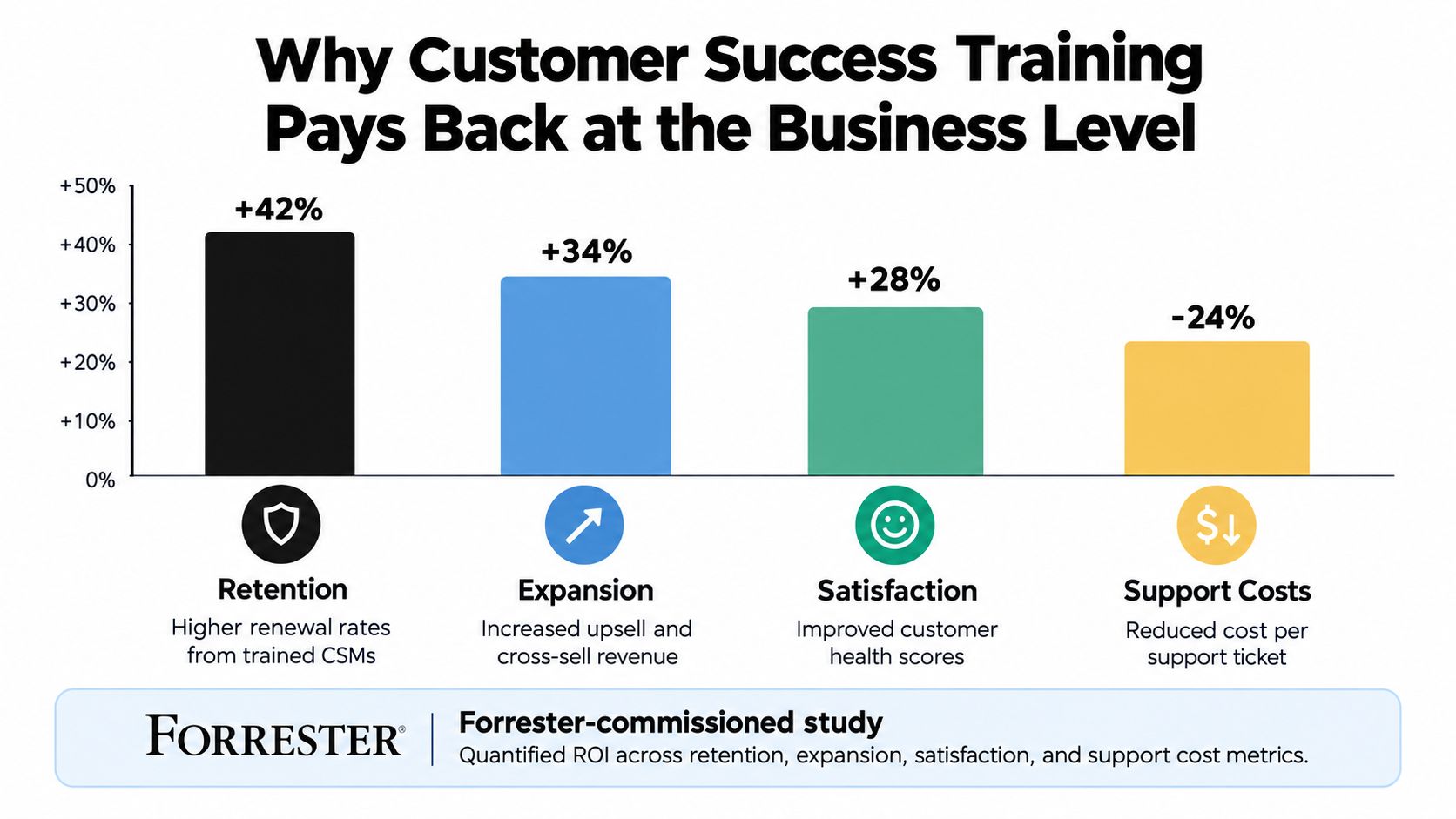
A Forrester study commissioned by Intellum found that 90% of organizations reported a positive ROI from formal customer education programs. Companies in the study recorded average gains of 6.2% in revenue, 7.4% in customer retention, and 11.6% in customer satisfaction, alongside a 6.1% decrease in support costs (the 2019 study findings summarized by SaaS Academy Advisors).
Those gains trace back to specific behaviors. A CSM who helps an administrator configure a feature correctly supports adoption. A CSM who ties product usage to the customer's business priorities makes renewal value easier to defend. A customer who finds an accurate how-to guide skips the support queue for routine tasks.
Research summarized by TechClass reports that 68% of customers used products more frequently after training, while 56% used more product features than they otherwise would have (TechClass on customer training and success). Frequency and breadth of use are the adoption signals that come before renewal, so aim education at real customer workflows rather than generic product tours.
One caution on figures like these: they describe educated customers, not the mechanism. The mechanism is observed behavior. Did the CSM run the configuration session? Did the customer finish the workflow? Did usage move? Manager call reviews and product analytics answer those questions. Attendance reports do not.
Build the business case the way a CFO reads it. Tie each program to one outcome leadership already tracks, then measure the behavior between the course and the result. A video-first customer education strategy produces reusable assets customers can return to, but every asset needs a defined customer outcome behind it. I've seen well-funded programs stall because managers treated certification as the finish line and never observed a live call afterward.
Training belongs in the operating plan, not just the service budget. Its value shows up when customers reach value faster and CSMs can prove why the relationship deserves to continue.
What Does a Four-Layer Curriculum Framework That Scales Look Like?
A scalable curriculum builds CSM capability in layers, from product understanding to strategic customer partnership. Each layer should describe observable work, not a vague expectation that someone feels confident.

Research summarized by TechClass cites Aberdeen findings associating strong new-hire onboarding with a 54% increase in new-hire productivity. It also recommends turning broad customer-success competencies into observable, level-defined behaviors (TechClass on customer success training and enablement). I'd define each skill across four proficiency levels: aware, working, independent, and coach-level.
Start with product fluency
At the aware level, a CSM can explain the purpose of key features. At the independent level, they can guide a customer through a standard configuration and recognize when a problem needs escalation. A mock product walkthrough is more useful here than a quiz alone.
Add customer and workflow knowledge
Next, teach the CSM to map the customer's business process to product use. A CSM working with a team that struggles to route requests, for example, should identify where the product fits into the workflow and which users need guidance. A searchable knowledge base gives CSMs and customers a practical reference after training; teams building one can consult this guide to create a SaaS knowledge base customers will use.
Teach commercial and renewal judgment
CSMs need to explain value in terms that matter to customer stakeholders, identify renewal risks, and handle expansion conversations without turning every interaction into a sales pitch. Practice can include a role-play where a customer questions the value of a feature and the CSM has to ask useful questions before recommending a next step.
Build toward strategic partnership
At coach level, a CSM can connect product outcomes to executive priorities, adapt a success plan to changing customer needs, and help colleagues improve their approach. In a mock account exercise, a new CSM might inspect low feature adoption, identify a likely workflow gap, propose a relevant enablement action, then explain what customer signal would show whether it worked.
Use this audit checklist to check whether each layer produces something observable:
Product fluency: A customer-ready product walkthrough and sound escalation decisions.
Workflow knowledge: A success plan tied to a customer's use case.
Commercial judgment: A clear value conversation and documented renewal risks.
Strategic partnership: Evidence of executive alignment and progress toward customer outcomes.
A curriculum scales when managers can coach the work, not just assign the content.
How Should Teams Build Onboarding Playbooks and Feature Launch Templates?
A useful onboarding playbook gives customers a guided path to value; a feature-launch template helps CSMs teach new workflows consistently. Both should combine relevant instruction with resources customers can revisit while doing the work.
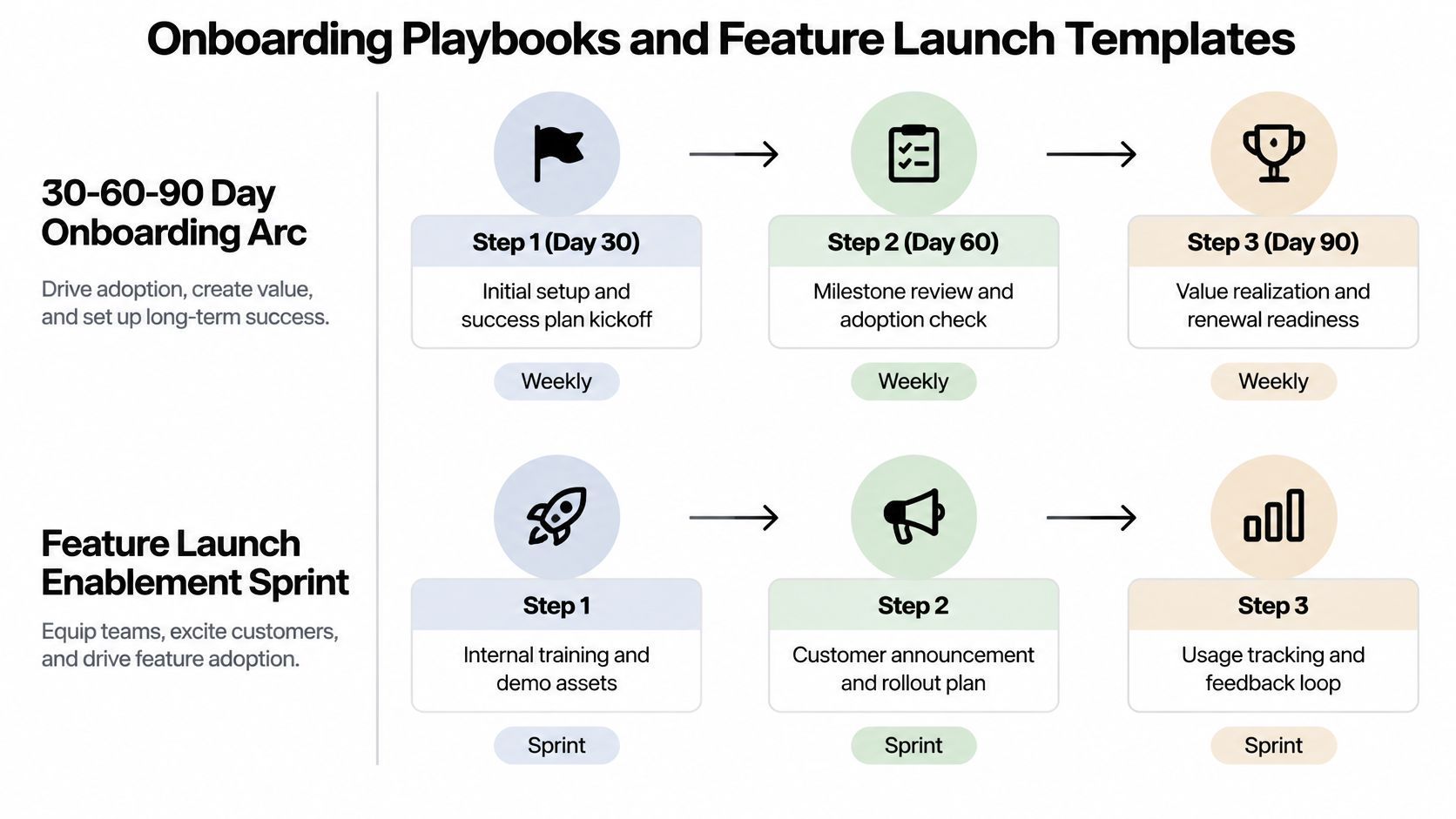
I'd build onboarding around a 30-60-90 day arc. In the first phase, the CSM and customer agree on the intended outcome, configure the product, and assign clear responsibilities. The next milestone checks setup progress and adoption. The final review examines whether the customer has reached value and what support or learning they need next. The CSM owns the relationship and success plan; enablement owns reusable materials and consistent learning design.
For a feature launch, the enablement team can prepare an internal demonstration, workflow guide, and customer-facing explanation before rollout. The CSM then identifies which customers need the feature, explains its relevance to their goals, and shares the right resource. Product usage and customer feedback help the team decide what needs clarification.
Consider a hypothetical mid-market customer whose administrator is configuring a new workflow. Rather than repeat the same live walkthrough for each user, the CSM records a task-specific demonstration and provides a step-by-step reference. Customers can use the recording during setup, while the CSM stays available for decisions that require context. That's a better division of labor than expecting a document to answer every question or scheduling a meeting for every routine task.
Training transfer improves when the material feels relevant to the job. Research involving 213 German bank employees found that perceived practical relevance had a substantial total effect on both motivation to transfer and actual transfer. A separate North American financial-services training case reported that 18 of 22 participants used new skills after a system change when practice, performance support, and access to experts were available (the research on training relevance and transfer).
For teams refining their first-use experience, Formbricks offers a useful perspective on privacy-first onboarding insights. For concise product-release demonstrations, this feature release video template can help teams focus the walkthrough on what customers need to see.
Keep the playbooks structured, but let CSMs adapt them to customer context.
How Can You Measure Training With KPIs That Actually Matter?
Measure the chain from training exposure to workplace behavior to customer outcome. Attendance and quiz scores can help explain what someone completed, but they don't prove that the CSM applied the skill or that the customer benefited.
A structural-equation study of 230 employees and their supervisors found that training affected service quality indirectly through training transfer and job satisfaction. The study also found that perceived organizational support moderated the relationship between training and transfer. The practical point is that managers need to reinforce new behaviors in real work, not assume that a completed session will change customer interactions (the employee-supervisor study on training transfer).
I use a simple chain: training exposure → demonstrated skill → workplace transfer → customer outcome. For example, if CSMs learn to run an adoption review, a manager can observe whether they use the agreed discovery questions, document a clear next step, and return to the account's progress in a later review.
Training Activity | Leading Indicator | Customer Outcome | Owner | Review Cadence |
|---|---|---|---|---|
Onboarding scenario practice | CSM can explain milestones and ownership | Faster progress toward time-to-value | Onboarding lead | During onboarding review |
Feature-adoption coaching | Relevant workflows discussed and tracked | Broader product use | CSM manager | Account review |
Support deflection walkthrough | Customers can find and follow task guidance | Fewer repeat questions about that task | Education or support lead | Content and support review |
Renewal conversation role-play | Value and risk are documented clearly | Better-prepared renewal discussions | CS leader | Renewal planning |
Expansion qualification exercise | CSM can connect an opportunity to a customer goal | Better-aligned expansion conversations | CS and sales leaders | Pipeline review |
A customer-education metrics report found that retention was formally linked to education by 59% of programs, ahead of deeper loyalty at 43%, product adoption at 29%, and revenue expansion at 26% (the customer-education KPI report). That ranking reinforces the need to track outcomes beyond course completion. Teams improving their broader service dashboard can also use this guide to improve customer service metrics, and review this resource on measuring product adoption.
Watch for two common traps: treating completion as impact, and crediting training for a result that may also reflect product changes, account mix, or customer tenure. Use operational evidence and manager observation, then interpret customer outcomes with those factors in view.
Which Training Format Fits Your Customer Success Team?
A new CSM can watch a clean product walkthrough, pass the quiz, and still freeze when a customer asks why a workflow failed in their own account. Pick the format from the behavior you need observed later: can the person run the task, explain the trade-off, and recover when the path breaks?
The adoption gains from training cited earlier apply here too: live sessions build first-run competence, while on-demand content supports repeat use.
Format | Best For | Strength | Watch Out For |
|---|---|---|---|
Live workshop | Complex workflows and discussion | Immediate questions and guided practice | Hard to repeat consistently |
Cohort program | New-hire or role-based development | Shared practice and peer learning | Requires time away from account work |
On-demand video | Product walkthroughs and repeatable tasks | Easy to revisit at the point of need | Can become outdated after product changes |
Embedded performance support | Steps used inside a CRM or support workflow | Guidance appears near the task | Needs clear ownership and maintenance |
AI-generated micro-learning | Breaking current source material into short lessons | Can help teams adapt learning assets quickly | Requires accuracy checks and human judgment |
My default stack stays simple: one live session for practice, one concise recording or guide for reference, then manager coaching against a real account. I break from that stack when the task is sensitive, changes weekly, or depends on customer-specific context. In those cases, keep a qualified person close to the learning experience and re-review the material whenever the process changes. Format matters less than proof of transfer: if a manager cannot see the behavior in a live call, ticket, or renewal plan, the content has not landed.
Choose the format around the work learners need to do, then inspect that work after training.
How Can AI Scale Training Without Losing Trust?
AI can help customer-success teams turn expert demonstrations into reusable learning materials, but people still need to verify the result. The safest workflow assigns automation to production tasks and keeps human review around accuracy, privacy, and customer-facing judgment.
Recent benchmarks report that about one-third of customer success teams use AI, while 27% identify data quality as their top barrier. Separate C-suite research found that roughly 80% of organizations provide AI training only a few times per year (EverAfter's digital customer success benchmark). Those findings point to a practical gap: teams may have access to AI but lack reliable data, clear policies, and regular practice.
Here's a workflow I'd test. A product expert records an administrator setting up a customer workflow. An AI content tool turns the recording into a polished video and a structured how-to guide. A reviewer checks terminology, steps, and screenshots, then approves the materials for onboarding and support. If the team creates translated versions, a fluent reviewer checks customer-facing language before publication. This is one way to build from an expert walkthrough into customer training videos without treating generated content as automatically trustworthy.
Workflow Step | Risk Level | Reviewer | Automation Guardrail |
|---|---|---|---|
Draft a standard internal outline | Lower | Enablement owner | Use approved source material |
Generate a routine walkthrough draft | Moderate | Product or support expert | Check every step against the current interface |
Create a customer-facing setup guide | Higher | Product owner and CS reviewer | Block publication until accuracy is confirmed |
Translate sensitive or technical guidance | Higher | Fluent subject-matter reviewer | Preserve approved terminology and meaning |
Summarize customer account details | Higher | CSM or manager | Use only permitted data and verify claims |
Recommend a response to a renewal risk | Higher | CSM and commercial lead | Treat output as a suggestion, never a decision |
The risks aren't limited to incorrect instructions. Teams also need rules for sensitive data, bias, escalation, and whether AI-generated content is appropriate for a particular customer situation. A CSM should know when to stop using an automated draft and bring in a human expert.
Automate production where the source is reliable; require review where an error could mislead a customer or damage trust.
How Should You Roll Out Customer Success Training Over 90 Days?
A focused rollout starts with a small set of observable skills, a measurement plan, and clear ownership. I'd bring this sequence to a VP as a practical way to get the program moving.
Weeks 1–2: CS leadership and enablement identify the skills that matter most, review current materials, and agree on the KPI map. Decision gate: approve the priority behaviors and their owners.
Weeks 3–6: Enablement builds realistic practice scenarios and manager observation guides. CSM managers test them with a small group. Decision gate: confirm the exercises reflect actual account work.
Weeks 7–10: Customer education and product experts create or refresh learning assets, then assign reviewers and workflow guardrails for any AI-assisted content. Decision gate: approve accuracy, privacy, and ownership checks.
Weeks 11–13: Managers observe transfer in customer work and review adoption, support volume, time-to-value, retention, or expansion where appropriate. Decision gate: keep, revise, or retire each training element based on evidence.
How often should customer success training be refreshed?
I refresh learning when a product, process, or customer workflow changes, then check whether CSMs can still apply it. A regular content review is useful, but observed behavior should drive the update.
What should I do when a CSM underperforms?
I'd first identify the specific behavior that's missing, then observe the CSM in a relevant scenario or customer interaction. Match coaching and practice to that gap, and follow up with manager observation rather than relying on course completion.
Where does Trupeer fit alongside an LMS?
An LMS can assign and track learning, while a content-production tool can help teams create reusable videos and guides from demonstrations. I'd connect the two through clear ownership, review, and maintenance processes.
Trupeer turns screen recordings into product videos and structured documentation, giving customer-success teams reusable materials for onboarding and self-service education. If you're building a training program that needs practical walkthroughs as well as manager-led coaching, visit Trupeer Inc. to see how its workflow fits your content-production needs.