Użyj tego szablonu
On most system implementations, requirements live in one document, designs in another, test cases in a test tool and SOPs, runbooks and training in folders nobody connects. Then a requirement changes, a defect appears or an auditor asks how a control was tested, and nobody can say where that requirement went. A requirements traceability matrix template fixes that by linking every requirement, in one table, to everything that delivers it and proves it works.
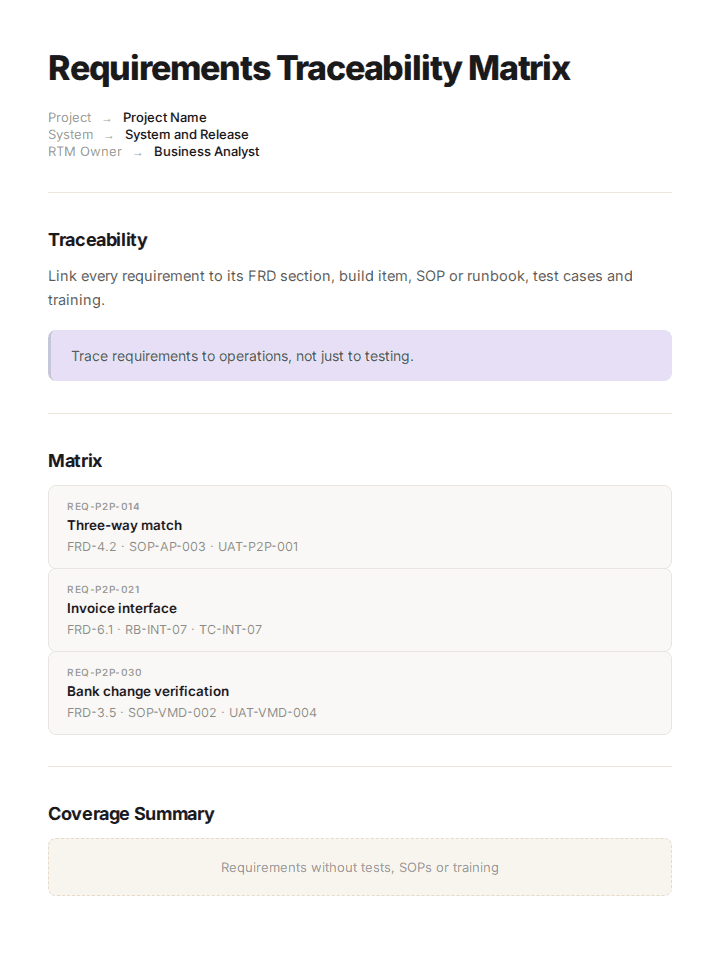
This free requirements traceability matrix template links each requirement to its functional requirements document (FRD) section, design, configuration or build item, the SOP or runbook that operates it, the test cases that verify it, the training that teaches it and its current status. It includes a filled-in example, the types of traceability to use, and a way to keep the matrix current as the project changes. Copy the structure below, or open it in Trupeer and customize it for your project.
What is a requirements traceability matrix template?
A requirements traceability matrix template, often called an RTM, is a structured table that links each requirement to the documents and work items that deliver and verify it. Each row starts with a requirement and traces it forward to the functional specification, design and build, the SOP or runbook that people use to operate it, the test cases that prove it works, and the training that prepares users. It can also trace backwards, from a test case or SOP to the requirement it serves.
The result is one view that answers the questions every project eventually asks: is every requirement covered, what's affected if this changes, and how do we know it works?
Why use a requirements traceability matrix?
Nothing falls through the gaps. Every requirement must have a design, a test and an owner.
Change impact is visible. When a requirement changes, you can see every document, test and SOP affected.
Testing is complete. Every requirement links to at least one test case, and every test case links back to a requirement.
Operations are ready. Requirements link to the SOPs and runbooks people will use after go-live, not just to the build.
Audits are easier. You can show how a control requirement was designed, tested and documented.
Handovers are cleaner. The run team inherits a map of what was built and why.
Who uses a requirements traceability matrix template?
Business analysts who own requirements and their links.
Project and programme managers who track coverage and change impact.
Solution architects and functional consultants who design and build to the requirements.
Test managers who confirm test coverage.
Operations and support teams who own SOPs and runbooks after go-live.
Training leads who make sure every changed process has training.
Quality, risk and audit teams who need evidence of control requirements.
Preview the requirements traceability matrix template
The template opens with a project summary and ID conventions. The main matrix follows, with one row per requirement: ID, description, source, priority, FRD section, design or build item, SOP or runbook, test cases, test status, training content, owner and overall status. A coverage summary shows requirements without designs, tests, SOPs or training, and a change log records every change to a requirement and its impact. Every column is editable, so you can add regulatory references, release numbers or links to your tools.
How to customize this template in Trupeer
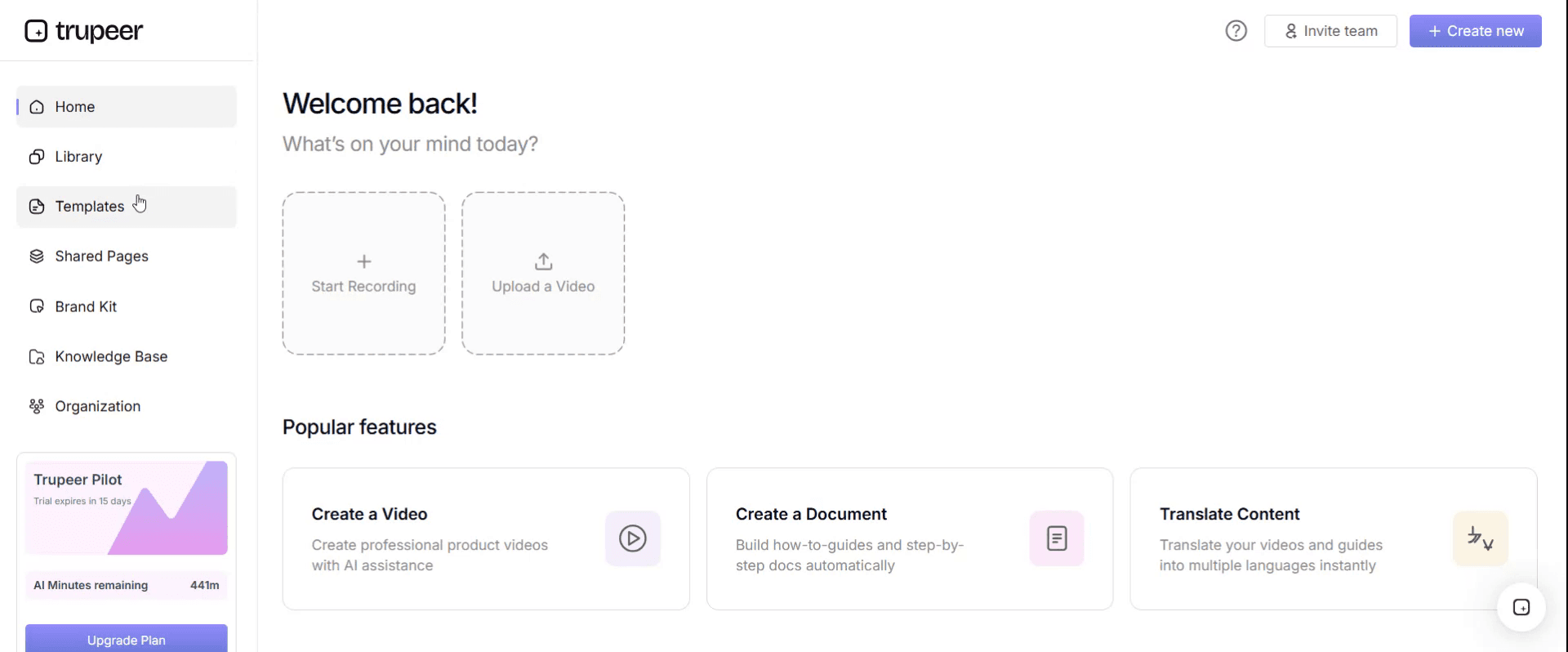
Step 1: Open the Templates Section
Go to the Templates section from the main navigation.
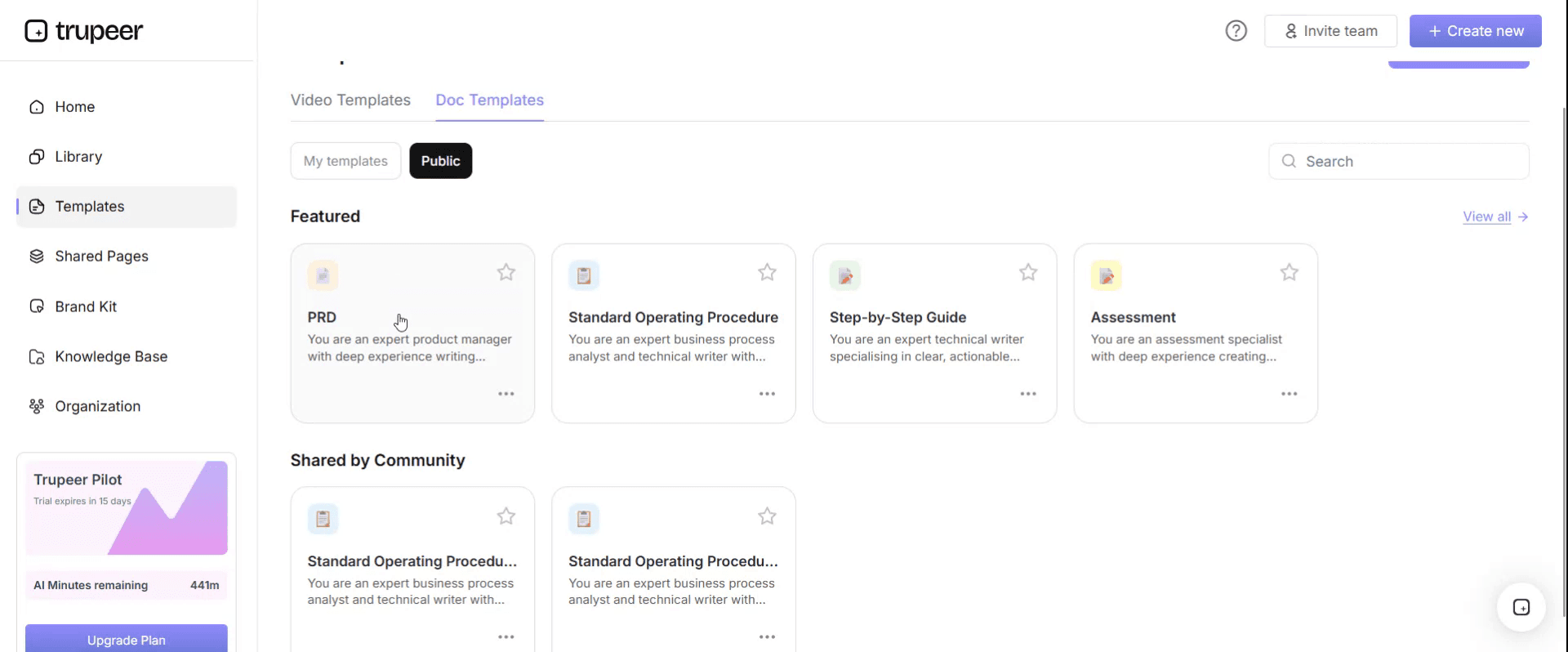
Step 2: Select and Open a Template
Click on any template you want to work with to open it.
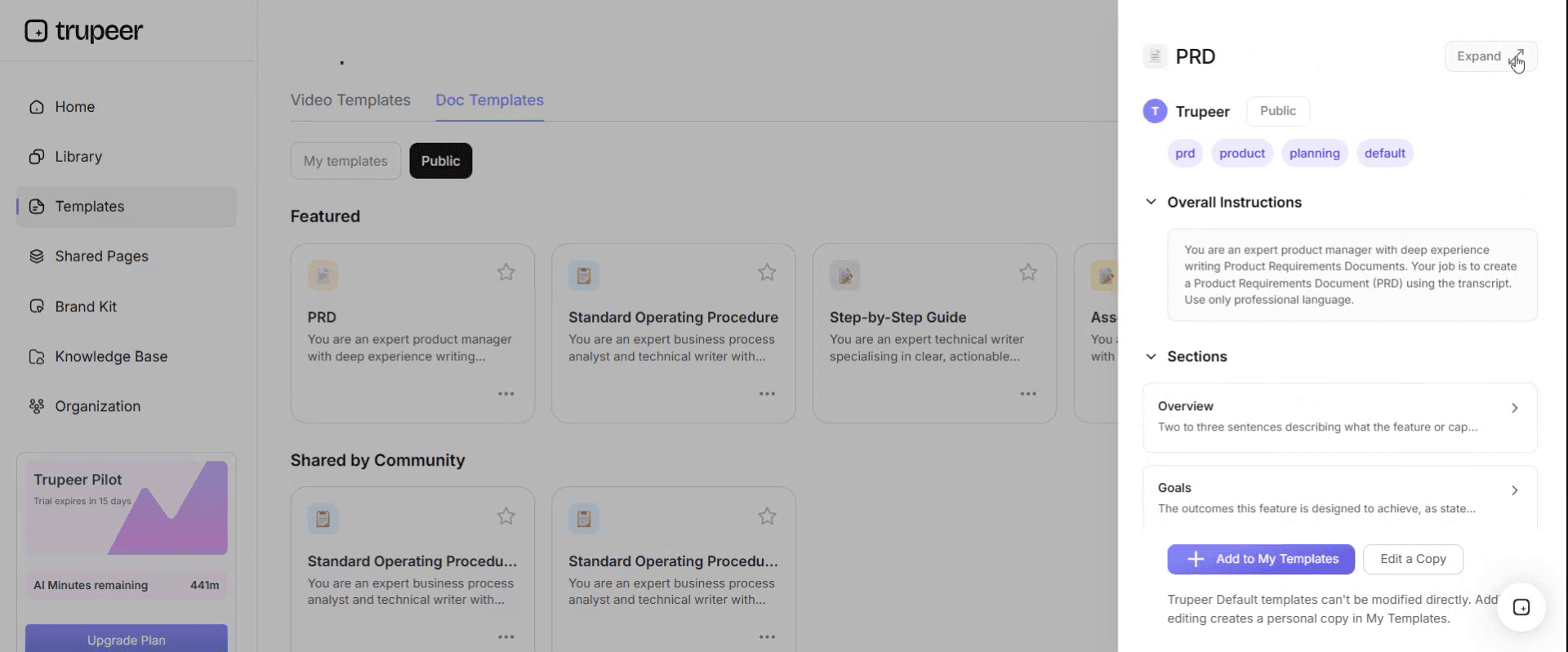
Step 3: Expand the Template View
If needed, expand the template view to see the full layout and details clearly.
Step 4: Edit the Template
Click on Edit to start modifying the selected template.
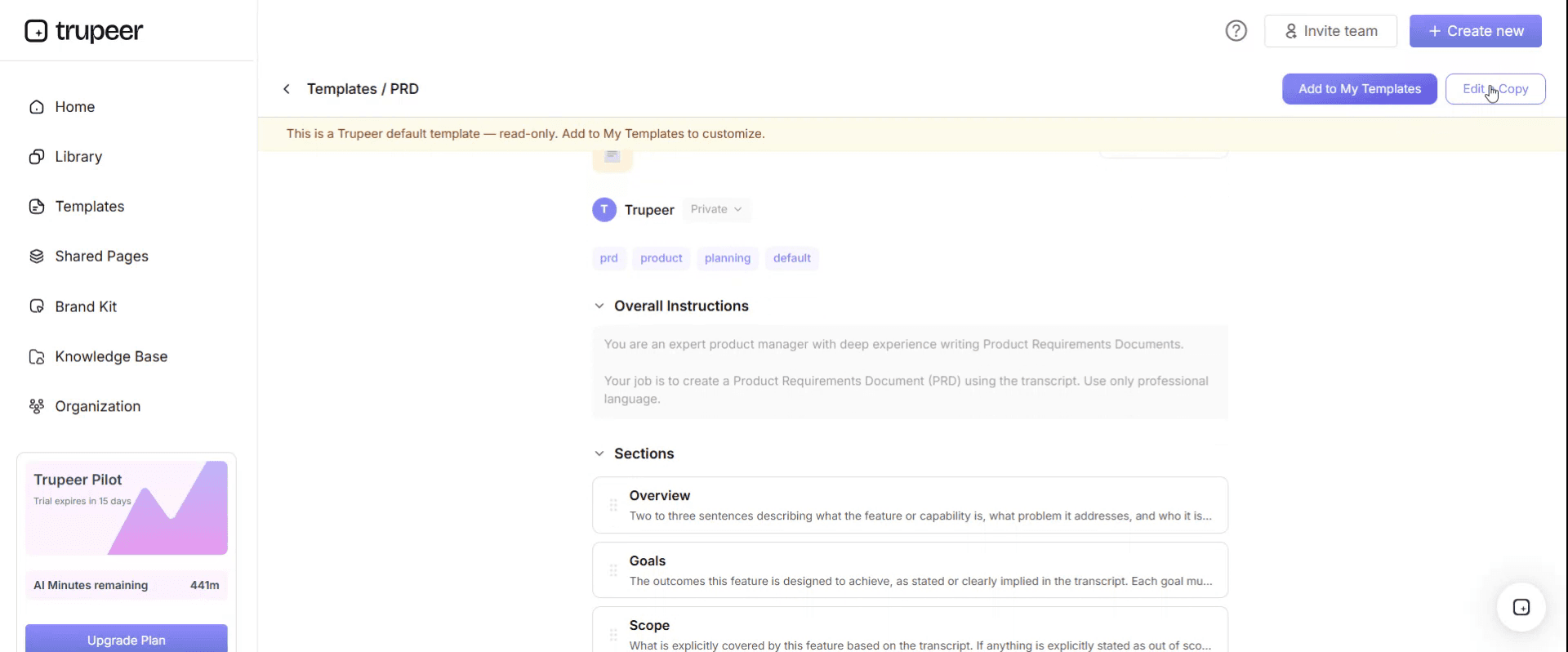
Within the editor, you can:
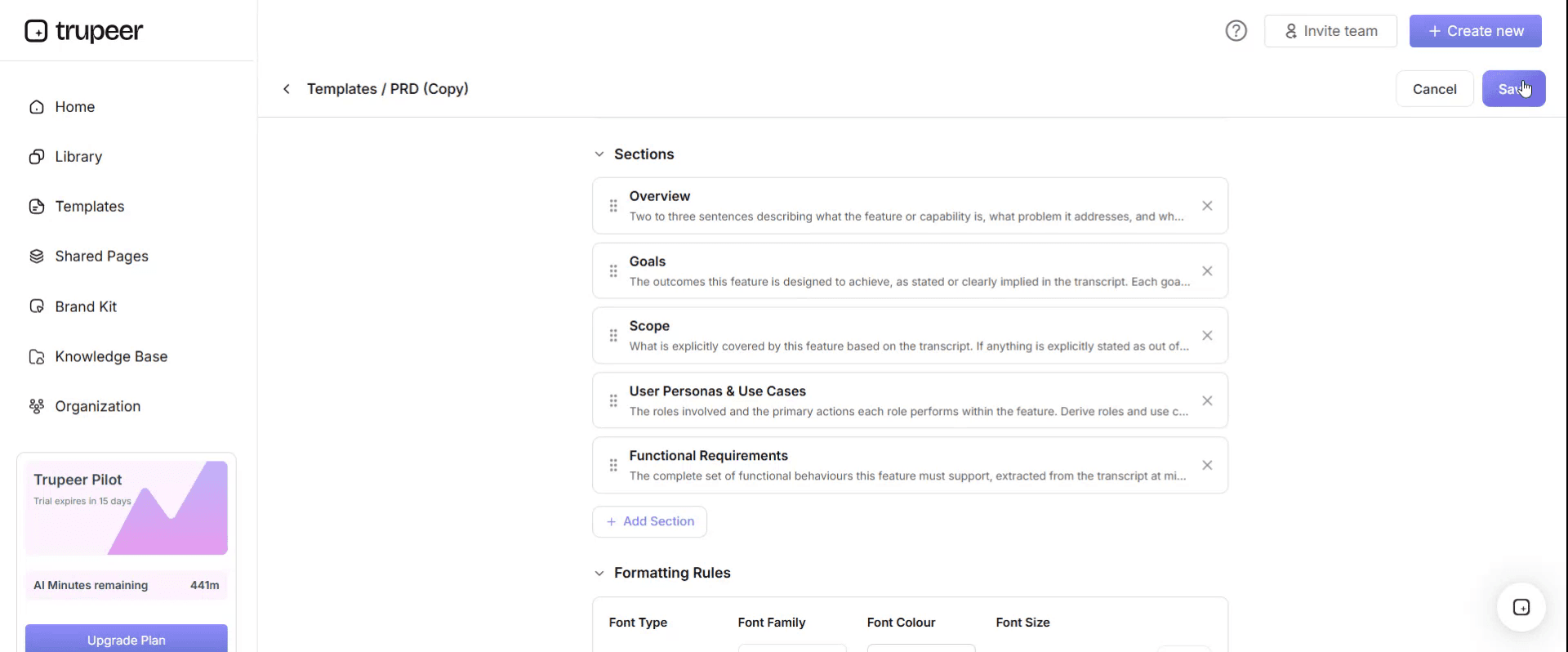
Add new sections
Define or update formatting rules
Add a logo and adjust its position and related settings
Step 5: Save Your Customized Template
After making all necessary changes, click Save to store the updated template as your own.
Step 6: Preview and Fine-Tune the Template
When you want to see how your customized template looks, open the Preview.
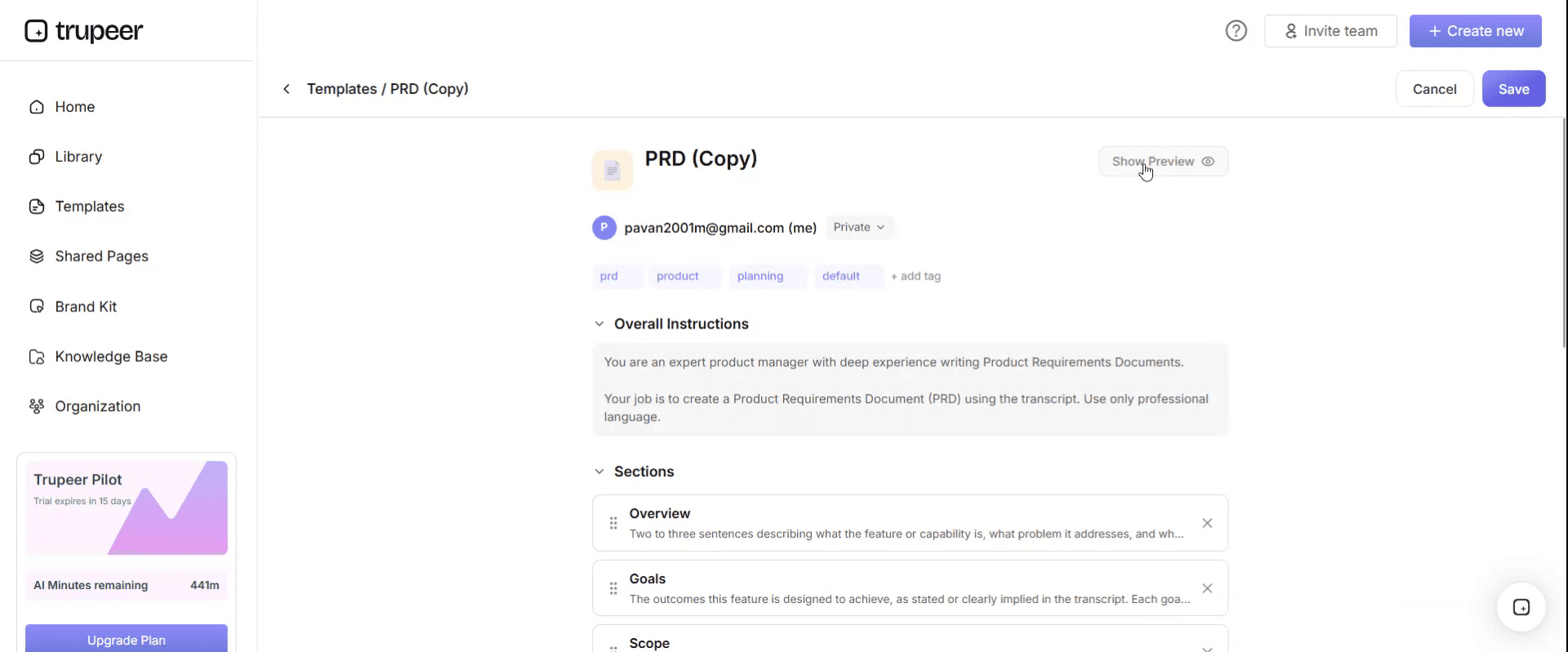
From the preview screen, you can continue to make adjustments directly if needed, ensuring the template appears exactly as you want.
With a requirements traceability matrix template you can:
Prove coverage: See at a glance which requirements are designed, built, tested and documented.
Trace requirements to operations: Link each requirement to the SOP or runbook that runs it after go-live.
Assess change impact quickly: Find every affected document, test and SOP in seconds.
Support audit and compliance: Show how each requirement was delivered and verified.
Hand over cleanly: Give the run team a complete map of the system.
What a requirements traceability matrix template must contain
Column | What to record |
|---|---|
Requirement ID | A unique, stable reference, such as REQ-P2P-014 |
Requirement description | What the business needs, in plain language |
Source | Where it came from: workshop, regulation, fit-gap row or as-is recording |
Priority | Must have, should have or could have |
FRD section | The functional requirements document section that specifies it |
Design or build item | Configuration, development object or interface that delivers it |
SOP or runbook | The operating procedure people follow to perform or support it |
Test case IDs | The test cases or UAT scripts that verify it |
Test status | Not run, passed, failed or blocked |
Training content | The guide or video that teaches users the change |
Owner | The person accountable for the requirement |
Status | Open, in design, in build, tested, documented or closed |
Change history | Changes to the requirement and their impact |
Free requirements traceability matrix template: the structure to copy
Copy the structure below into your own spreadsheet, or open it in Trupeer and customize it.
1. Project summary. Project: [name]. System: [system and release]. Scope: [processes]. RTM owner: [business analyst or PMO]. Last updated: [date].
2. ID conventions. Requirements: REQ-[process]-[number]. FRD sections: FRD-[section]. Build items: [development or configuration IDs]. SOPs and runbooks: SOP-[number] or RB-[number]. Test cases: TC-[number] or UAT-[number].
3. Traceability matrix.
Req ID | Requirement | Source | Priority | FRD section | Design or build item | SOP or runbook | Test cases | Test status | Training | Owner | Status |
|---|---|---|---|---|---|---|---|---|---|---|---|
[REQ-ID] | [Description] | [Source] | [Must / should / could] | [FRD-x.x] | [Item ID] | [SOP or RB ID] | [TC or UAT IDs] | [Status] | [Guide or video] | [Owner] | [Status] |
4. Coverage summary. Requirements without an FRD section, without a build item, without a test case, without an SOP or runbook, and without training.
5. Change log. Date, requirement ID, change, reason, affected items and approval.
Requirements traceability matrix example: procure to pay
Here's how part of an RTM might look for procure to pay in an ERP implementation. The details are illustrative.
Req ID | Requirement | FRD section | Build item | SOP or runbook | Test cases | Test status | Training | Status |
|---|---|---|---|---|---|---|---|---|
REQ-P2P-014 | Three-way match goods invoices within tolerance | FRD-4.2 | Tolerance configuration | SOP-AP-003 invoice processing | UAT-P2P-001 steps 3–4 | Passed | AP invoice video | Closed |
REQ-P2P-015 | Block invoices above price tolerance for buyer review | FRD-4.3 | Payment block configuration | SOP-AP-003, exception table | UAT-P2P-001 step 5 | Failed, then passed on retest | AP exceptions video | Closed |
REQ-P2P-021 | Nightly interface of approved invoices to the payment system | FRD-6.1 | Interface INT-07 | RB-INT-07 interface monitoring runbook | TC-INT-07-01 to 04 | Passed | Support team runbook walkthrough | Tested |
REQ-P2P-030 | Verify supplier bank detail changes before payment | FRD-3.5 | Dual-approval workflow | SOP-VMD-002 bank change verification | UAT-VMD-004 | Not run | Vendor master video | In build |
Each row shows not just whether the requirement was built and tested, but how it will be operated: the SOP for business users and the runbook for support teams.
Types of traceability
Type | Direction | What it answers |
|---|---|---|
Forward traceability | Requirement → design → build → test → SOP | Is every requirement delivered, tested and documented? |
Backward traceability | Test, SOP or build item → requirement | Does everything we built or wrote serve a requirement? |
Bidirectional traceability | Both directions | Full coverage and no unnecessary work; the standard for most projects |
Use bidirectional traceability on most system implementations. It catches missing tests and documentation, and it also catches custom work and procedures that no longer trace to a requirement.
The traceability chain across an implementation
The matrix connects documents that are usually produced by different teams at different times. This is how they fit together:
Stage | Document | What the matrix links |
|---|---|---|
Discover | As-is recordings and documents | The evidence behind each requirement |
Explore | Fit-gap analysis | Which requirements fit the standard and how gaps are resolved |
Specify | Functional requirements document (FRD) | The section that specifies each requirement |
Build | Configuration and development items | What delivers each requirement |
Test | Test cases and UAT scripts | How each requirement is verified, with results |
Deploy | SOPs, runbooks and training | How people operate and support each requirement after go-live |
Run | Change requests and releases | What changes, and which documents and tests are affected |
For the requirements and gap decisions at the start of the chain, use the fit-gap analysis template.
Requirements traceability for regulated and audited processes
In regulated industries, and for financial controls, traceability isn't optional. Auditors and validation teams typically want to see, for each control or regulated requirement, the specification, the test evidence and the procedure people follow. Add a column for the regulation or control reference, mark which requirements are controls, and attach test evidence, such as UAT recordings, directly to those rows. Review control requirements before every release, because a change that breaks a control is far more costly to fix after an audit finding.
Why trace requirements to SOPs and runbooks?
Most traceability matrices stop at testing. That proves the system works on the day it's tested, but not that people can run it afterwards. Adding SOPs and runbooks closes that gap:
Business users get an SOP for every requirement that changes how they work.
Support teams get a runbook for every interface, job and technical requirement they'll monitor.
Exceptions in the requirement appear in the SOP's exception table and the runbook's troubleshooting steps.
Changes to a requirement show exactly which SOPs and runbooks need updating.
For a ready-made operational procedure format, use the runbook template.
How to build a requirements traceability matrix step by step
Agree ID conventions for requirements, FRD sections, build items, SOPs, runbooks and tests.
List every requirement with its source, linking to as-is evidence where you have it; see ERP requirements gathering from process recordings.
Link each requirement to its FRD section and design or build item.
Link test cases as they're written, including UAT scripts; use the UAT test script template.
Link SOPs, runbooks and training for each requirement before go-live.
Update test status after each test cycle.
Review the coverage summary at every stage gate and close the gaps.
Log every change to a requirement with its impact and approval.
How to keep the matrix current
Make one person accountable for the RTM, usually the lead business analyst or PMO.
Update it as part of every change request, not after the fact.
Review coverage at each stage gate: design sign-off, test exit and go-live readiness.
Hand it over to the run team at go-live, with owners for each SOP and runbook.
Keep linked SOPs and runbooks versioned, so the matrix always points to the current procedure; see SOP version control.
Formats for a requirements traceability matrix
Spreadsheet is the most common format, with filters for status, owner and gaps.
Requirements or test management tool suits large programmes that need automated links and dashboards.
Document suits a signed-off summary of coverage at each stage gate.
Whichever format you use, keep one master matrix and link to it from project documents.
Best practices for requirements traceability
Use stable, unique IDs that never get reused.
Write one requirement per row, not combined requirements.
Link to evidence, such as recordings of the as-is process, not just to workshop notes.
Trace to operations, with SOPs and runbooks, not just to testing.
Review the coverage summary regularly, not only at the end.
Keep the matrix light enough that people actually maintain it.
Common mistakes to avoid
Building the matrix at the end of the project to satisfy an audit.
Stopping at test cases, with no link to SOPs, runbooks or training.
Combining several requirements in one row, so coverage is unclear.
No owner, so the matrix goes out of date.
Not recording changes, so impact can't be traced.
Requirements traceability matrix checklist
ID conventions are agreed for every item type.
Every requirement has a source, priority and owner.
Every requirement links to an FRD section and a build item.
Every requirement links to at least one test case, with current status.
Every requirement that changes how people work links to an SOP or runbook and training.
The coverage summary shows no unexplained gaps.
Changes are logged with their impact and approval.
How Trupeer helps you complete the traceability chain
Traceability challenge | How Trupeer helps |
|---|---|
Requirements lack evidence | Record SMEs doing the real process, and link each requirement to the recording and the as-is document Trupeer creates from it |
SOPs and runbooks don't exist yet | Record the configured process or support task, and Trupeer's SOP creator turns it into a step-by-step SOP or runbook |
Test evidence is scattered | Record UAT runs and link the recordings to test cases in the matrix |
Training is missing for changed requirements | The same recordings become training videos and guides for each role |
Documents go out of date after changes | Update SOPs and videos by editing the script, and replace a single step instead of re-recording |
For support teams, Trupeer's AI runbook generator turns recordings of technical tasks into runbooks you can link from the matrix.
Genpact used this recording-first approach for a company-wide Workday rollout, turning recorded process sessions into more than 500 training collaterals across 20 workstreams in five languages, for 140,000 employees in 40 countries, in 3 months instead of 12. Read the Genpact customer story.
Download the free requirements traceability matrix template
Open the template in Trupeer, add your requirements, link your FRD, build items, SOPs, runbooks and tests, and share it with your project team. Get the free requirements traceability matrix template.
Related templates
Frequently Asked Questions
What is a requirements traceability matrix template?
It's a structured table that links each requirement to the documents and work items that deliver and verify it, such as the FRD section, design or build item, SOP or runbook, test cases and training, with status and owner.
What should a requirements traceability matrix include?
Requirement ID, description, source, priority, FRD section, design or build item, SOP or runbook, test cases, test status, training content, owner, status and change history, plus a coverage summary.
What's the difference between forward and backward traceability?
Forward traceability follows a requirement through design, build, test and documentation. Backward traceability starts from a test, SOP or build item and traces it back to the requirement it serves.
Why link requirements to SOPs and runbooks?
Because testing proves the system works on the day, while SOPs and runbooks prove people can operate it afterwards. Linking them shows which procedures need updating when a requirement changes.
Who owns the requirements traceability matrix?
Usually the lead business analyst or the PMO, with requirement owners keeping their rows current and the run team taking ownership at go-live.
When should you create a requirements traceability matrix?
At the start of the project, as requirements are gathered, and update it at every stage: design, build, test and go-live.
Is there a requirements traceability matrix template in Excel?
Yes. The matrix works well in Excel, with filters for status, owner and coverage gaps. Open the template in Trupeer, customize it and export it, or copy the structure into Excel.
Is there a requirements traceability matrix template in Word or PDF?
Yes. Use Word or PDF for signed-off coverage summaries at stage gates, and keep the working matrix in a spreadsheet or tool.
Is the requirements traceability matrix template free?
Yes. Sign up free to open the template in Trupeer, customize it and export it.
How is an RTM used in ERP implementations?
It links fit-gap requirements to functional specifications, configuration and development items, UAT scripts, SOPs, runbooks and training, so the programme can prove coverage and manage change.
How do you keep a traceability matrix up to date?
Make one person accountable, update it as part of every change request, review coverage at each stage gate and keep linked SOPs and runbooks versioned.
Can a traceability matrix support audits?
Yes. For control requirements, it shows the design, test evidence and operating procedure, which is what auditors typically ask to see.


