Trupeer Blog
How to Document AI Workflows and Prompts as Reusable Training Assets

Imagine your team just spent weeks crafting a complex AI workflow, integrating multiple systems to simplify a process that previously took hours. Now, you need to ensure this knowledge is accessible, understandable, and reusable for future projects and team members. If not documented effectively, your team risks wasting time and resources reinventing the wheel for every new employee or project. According to a McKinsey report, companies that effectively document and reuse workflows can reduce operational costs by up to 30%. This is where the strategic documentation of AI workflows and the creation of prompt training videos come into play. For organizations aiming to optimize their training efforts, using training video production can be a big shift. But how do you ensure your documentation and training assets are efficient and scalable? This guide is for team leads, L&D managers, and anyone involved in standardizing AI processes across an organization.
Why does documenting AI workflows and prompts matter?
Documenting AI workflows and prompts is crucial for organizational consistency and efficiency. As AI systems become more complex, they require precise instructions and configurations to function well. Without proper documentation, valuable time is lost in deciphering previous work, leading to inefficiencies and errors. Imagine a team of data scientists developing a machine-learning model. Without documented workflows, onboarding a new team member would be a lengthy process, with the new hire spending weeks just trying to understand the existing setup. Not only does this slow progress, but it also increases the risk of misconfigurations that could skew results.
Also, in industries where compliance and audit trails are critical, having a well-documented process is non-negotiable. Companies must ensure all AI decisions are transparent and replicable, which is only possible with detailed documentation. For instance, in healthcare, AI models assisting with diagnoses require stringent documentation to ensure they meet regulatory standards. This is where training videos use case comes into play, offering a visual, easy-to-understand representation of workflows, enhancing comprehension and retention among employees. Thus, effective documentation not only enhances operational efficiency but also mitigates compliance risks.
What are the benefits of documenting AI workflows and prompts?
Proper documentation of AI workflows offers several tangible benefits that extend beyond just having records on file.
Enhanced Knowledge Transfer. Centralizing AI workflow documentation ensures all team members can access and contribute to the knowledge base, reducing onboarding time by up to 40% as seen in some case studies.
Consistent Process Execution. With standardized documentation, teams execute processes uniformly, minimizing errors and producing more reliable outcomes across projects, which is highlighted in the best training video software.
Improved Compliance. Detailed records ensure compliance with industry standards and regulations, which is essential for audits and avoiding potential legal issues. This is especially crucial in sectors like finance and healthcare.
Time Savings. By reducing the need to reconstruct workflows from scratch, teams can save 25-30% of project time, allowing them to focus on innovation and improvement rather than redundancy.
Scalability. As your organization grows, having documented AI workflows allows for scalable process management, enabling smooth integration of new team members and technologies.
Resource Optimization. using an AI video platform for documentation and training can simplify resource allocation, ensuring teams are only focused on value-adding tasks.
Which Trupeer features help you document AI workflows and prompts as reusable training assets?
Trupeer offers a suite of features specifically designed to aid in the documentation and training of AI workflows. These tools not only help in capturing process details but also enhance the accessibility and usability of these documents.
AI screen recording with auto-zoom and click detection
This feature is essential for capturing detailed AI workflows as it automatically highlights key actions and clicks during the recording. This ensures that every critical step is documented without manual intervention. For example, when demonstrating a data input sequence in an AI model, the auto-zoom feature focuses on the fields as you interact with them, making the video more engaging and easier to follow. This kind of clarity is vital for training sessions and can significantly reduce the learning curve for new users. By using an AI documentation platform, you ensure that the documentation is both comprehensive and intuitive.
Automatic SOP generation from any recording
Trupeer's ability to generate Standard Operating Procedures (SOPs) from recordings transforms raw video data into a structured format. This feature automatically outlines the steps demonstrated in the video, creating an editable document that users can export in various formats such as PDF or HTML. For instance, if a workflow involves setting up an AI data pipeline, the SOP generator will capture each step, from data extraction to model deployment, in an organized document. This not only saves time but also ensures consistency in process documentation, making it easier for teams to replicate and scale processes.
AI voiceover in 65+ natural voices
With AI voiceover capabilities, you can enhance your training videos with narration in multiple languages, making your workflows accessible to a global audience. The voiceover feature allows you to choose from over 50 natural-sounding voices, adjusting pace and tone to suit your audience. This is particularly useful for multinational teams where language barriers can hinder understanding. By providing narrated instructions, you ensure that non-native speakers fully comprehend the processes being documented. This feature integrates smoothly with AI-searchable knowledge bases, making your documentation more inclusive and comprehensive.
Auto-updating documentation tied to the underlying recording
This feature is a big shift for maintaining the accuracy of your AI workflow documentation. Whenever a recorded workflow is updated, the documentation automatically reflects these changes. This is crucial for dynamic environments where AI models and processes are frequently updated. For example, if a new data preprocessing step is added to an existing workflow, the documentation updates to include this step without requiring manual edits. This ensures that your team always has access to the most current and relevant information, reducing the risk of outdated practices. Employing training video software for internal documentation can simplify this process and enhance accuracy.
AI-searchable knowledge base with timestamp deep-links
Trupeer raises documentation accessibility with its AI-searchable knowledge base. This feature indexes every recording with timestamp-level deep links, allowing users to quickly locate specific parts of a workflow. For example, if a team member needs to understand a particular data transformation step, they can search and jump directly to that segment in the video. This functionality saves considerable time and enhances learning efficiency, particularly in complex AI workflows where users often need to revisit specific instructions. This feature is critical for organizations looking to build a comprehensive and easily navigable video knowledge base.
How do you document AI workflows and prompts step by step with Trupeer?
Step 1: Record the Workflow
Begin by launching Trupeer's browser-based recorder. No installation is needed, making it quick and accessible. Select "AI screen recording" which will automatically capture your screen activity with auto-zoom and click detection. This feature is crucial for highlighting key actions during the workflow. Click the "Start Recording" button, and perform your AI workflow tasks as usual. The AI will autonomously zoom in on areas of focus and detect clicks, ensuring that viewers don't miss critical steps. This process typically takes as long as your actual workflow execution. Once done, click "Stop Recording" to finish capturing your session. Teams weighing tools often start with a Loom alternatives comparison before standardizing on a workflow.
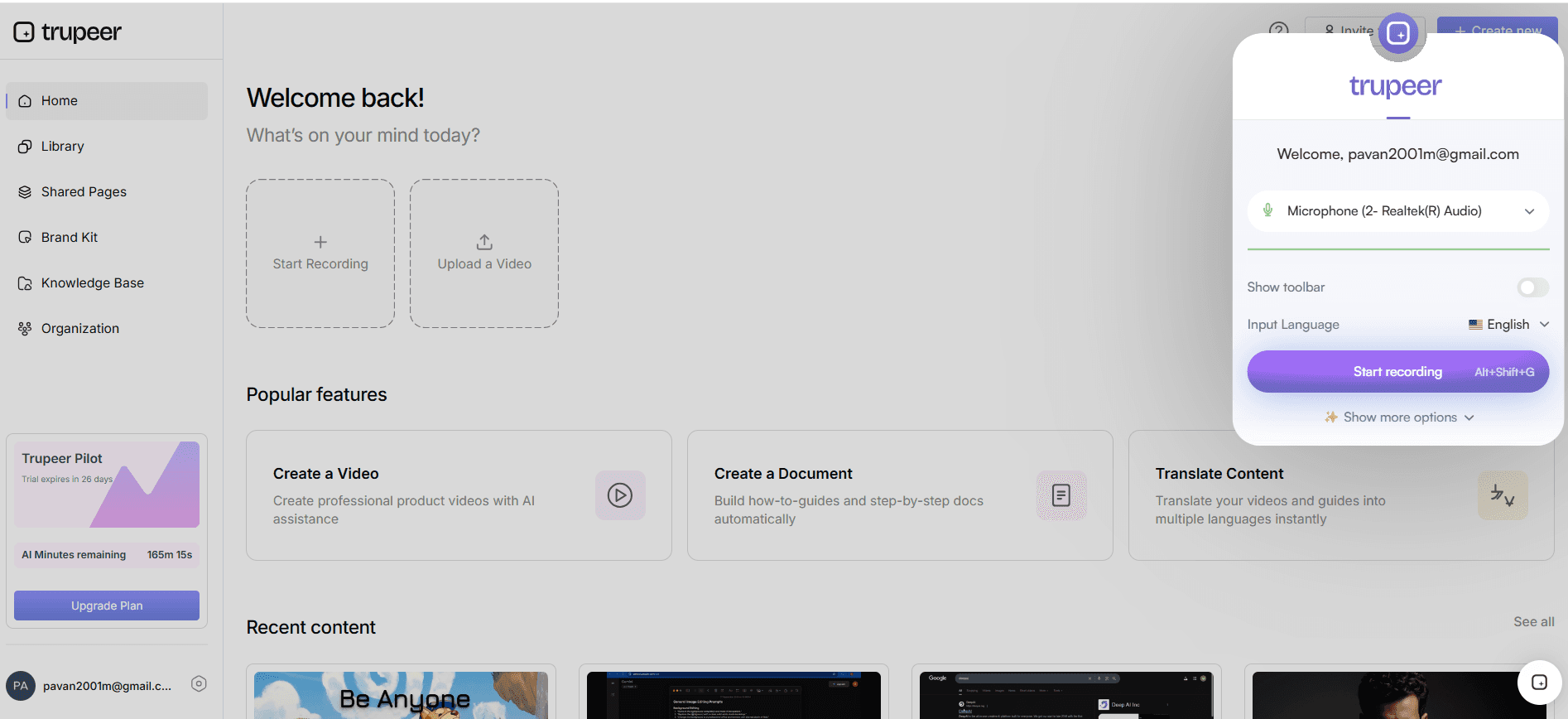
Step 2: Edit and Enhance the Recording
After capturing your workflow, use Trupeer’s editing tools to enhance the video. The platform automatically removes filler words like "um" and "ah" and cuts out long pauses, which helps in creating a professional and concise training video. Add AI-generated voiceovers in one of 65+ natural voices to narrate the workflow. You can adjust the pace and tone directly within the editor. This step, including voiceover adjustments, typically takes about 15 minutes for a 5-minute video. Ensure the final product is clear and engaging for the intended audience.
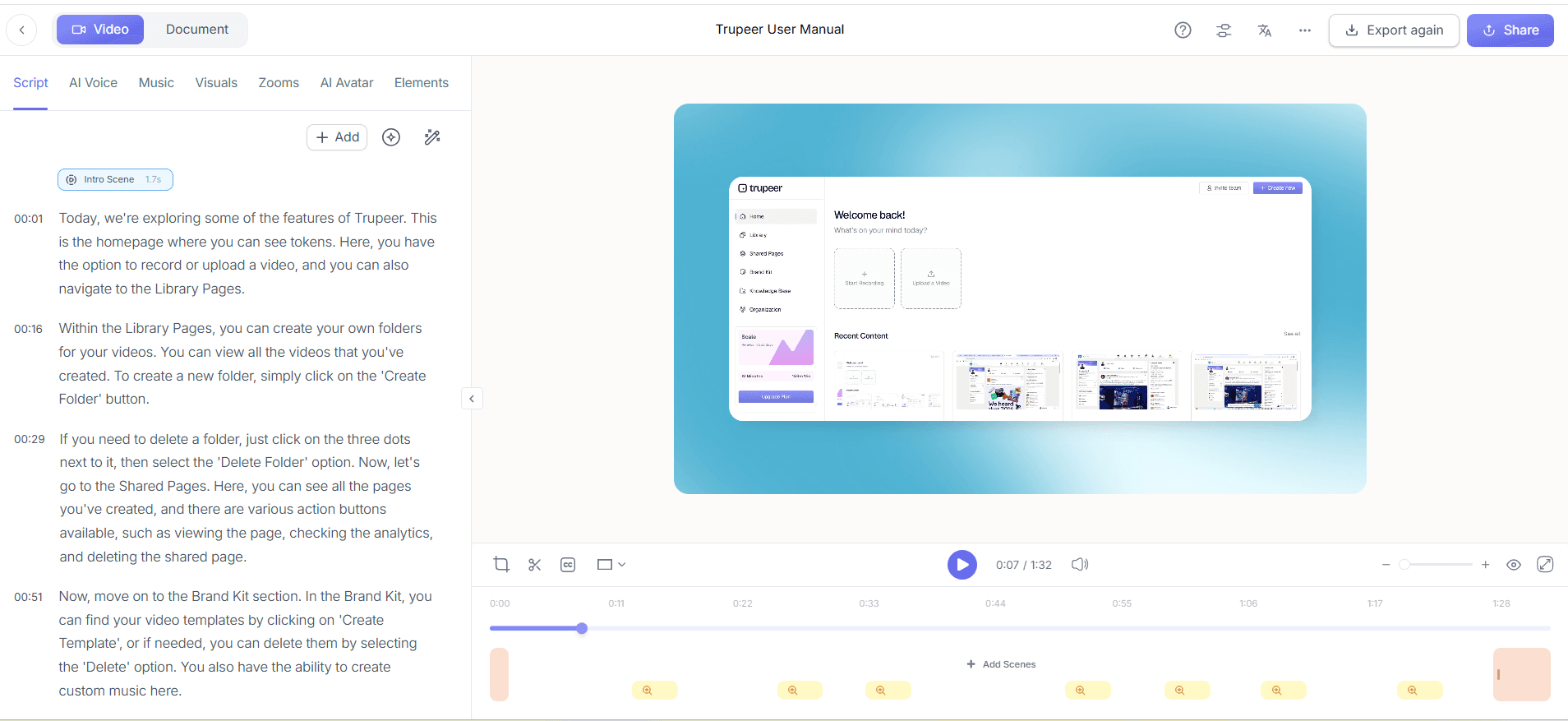
Step 3: Generate Documentation
With the recording ready, it's time to generate documentation. Trupeer excels here by creating automatic SOPs from your video. Navigate to the "Generate SOP" option and let Trupeer convert the recording into an edit-ready document. The SOP will outline every step visible in the video, and you can export it in formats like PDF or HTML. This transformation usually takes less than five minutes and ensures that your documentation is consistent with the video content.
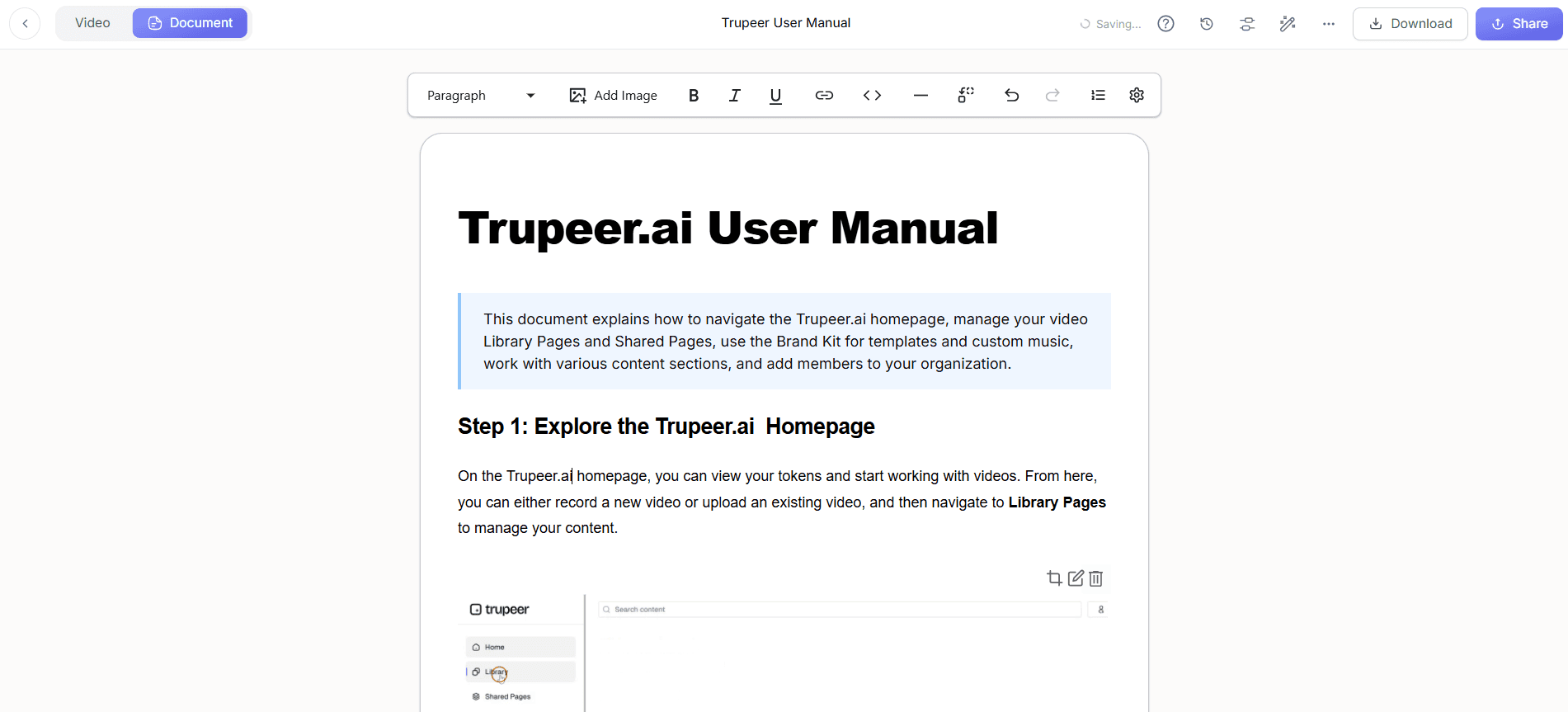
Step 4: Translate and Dub for Global Reach
To make your documentation accessible globally, use Trupeer's AI translation features. Select "AI translation" to convert your video and SOP into any of the 40+ supported languages. The platform also offers AI dubbing, which automatically syncs the translated audio with the video. This feature is invaluable for multinational teams, ensuring everyone understands the workflow regardless of language barriers. Depending on the length of your content, translation and dubbing can be completed in under 30 minutes.
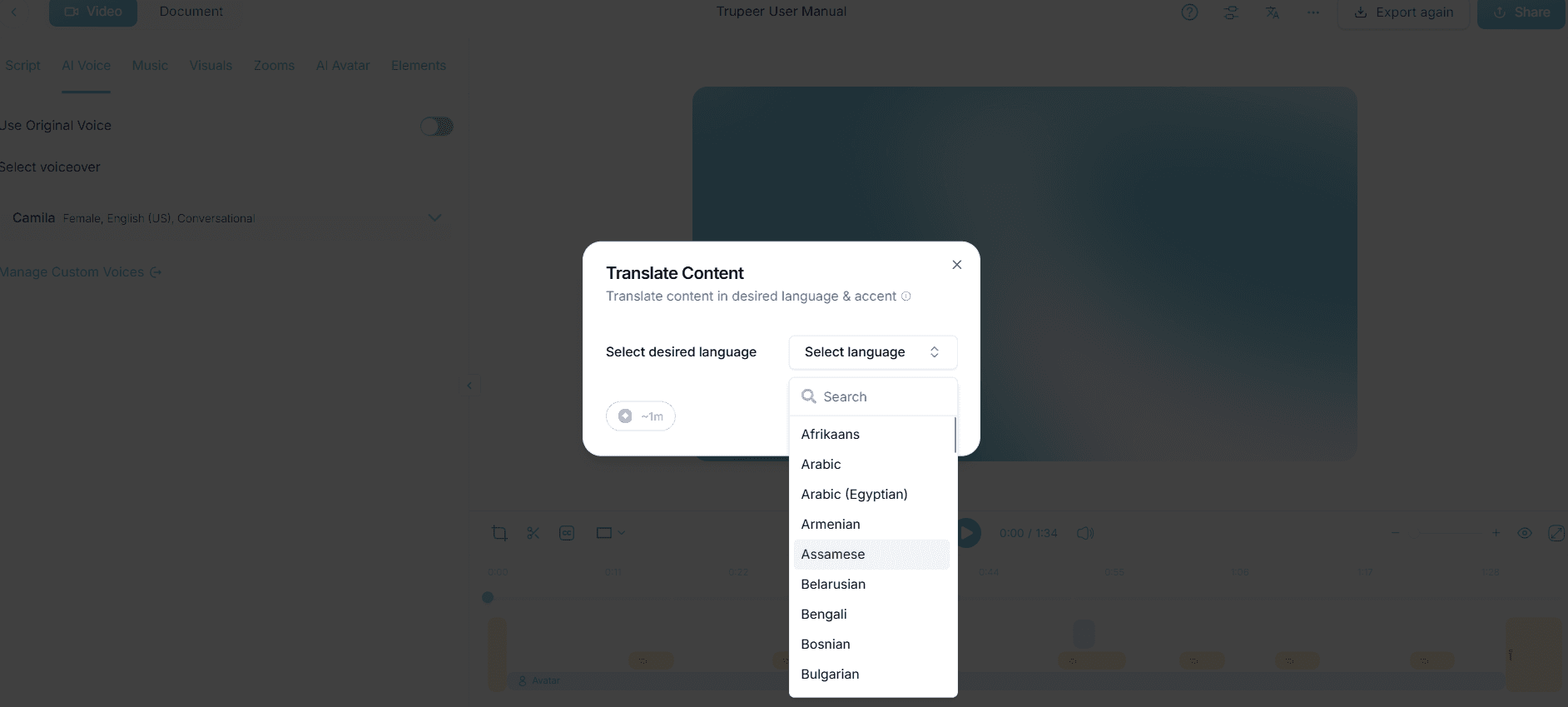
Step 5: Distribute via Knowledge Base
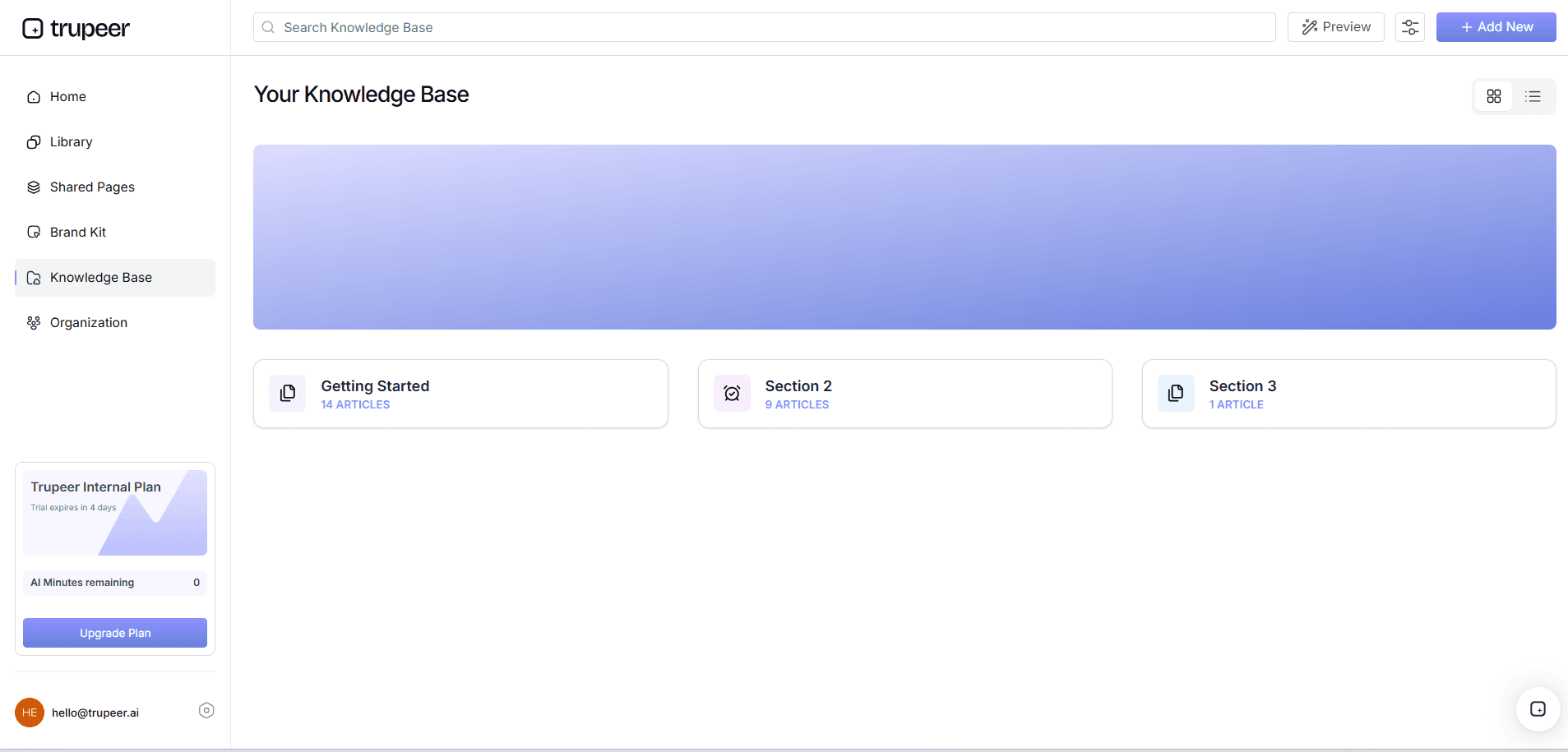
Once your documentation and videos are ready, use Trupeer's AI-searchable knowledge base for distribution. Upload the video and associated documents to this platform, which indexes them with timestamp deep-links. This allows users to search and access specific parts of the workflow quickly. The knowledge base supports custom-domain hosting and SSO, providing secure access to your materials. This setup ensures that all team members, regardless of their location, can easily access the resources they need.
Step 6: Monitor Engagement and Gather Feedback
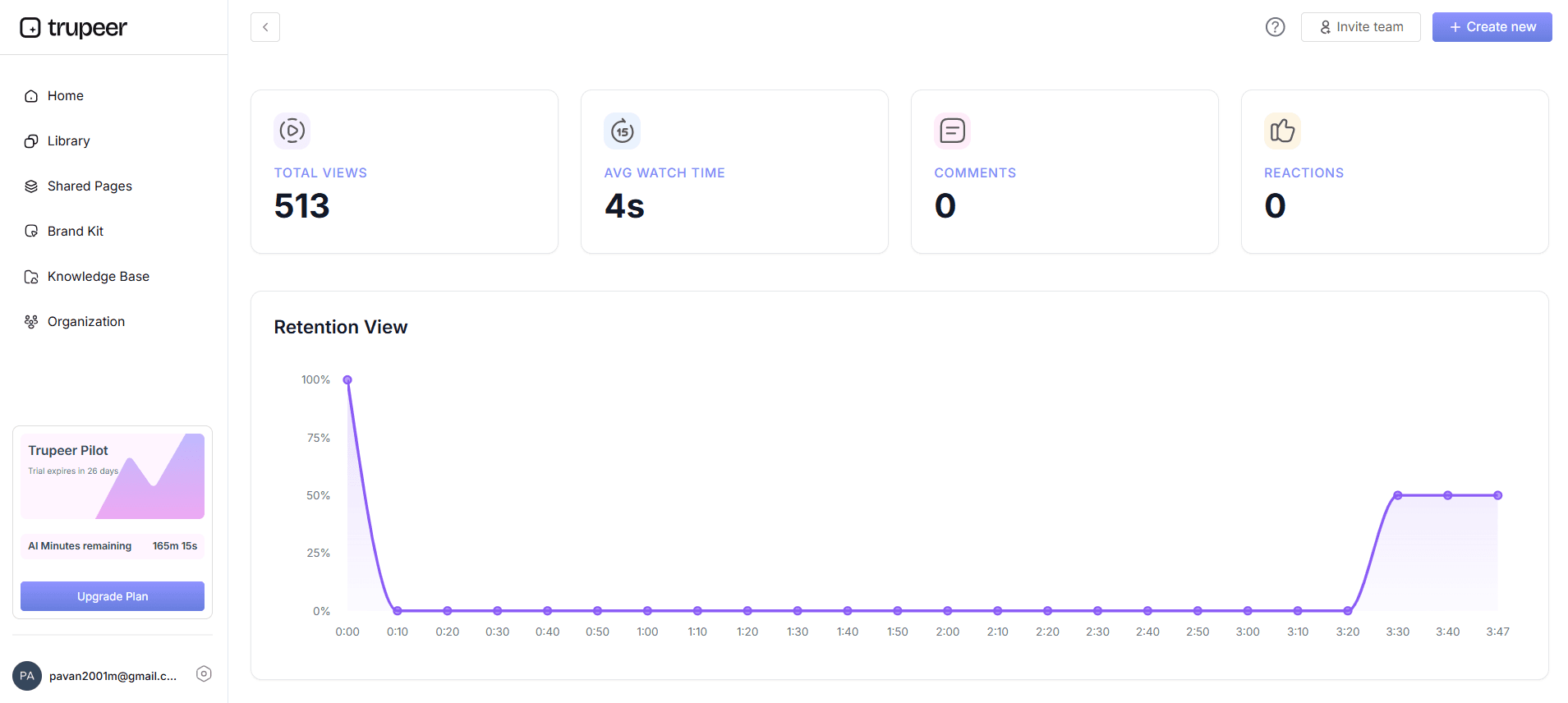
Finally, track how your documentation is being used with Trupeer's viewer engagement analytics. This tool provides insights into viewer drop-offs and heatmaps, highlighting which parts of the video are most and least engaging. Use this data to refine your future training materials. also, Trupeer supports collaborative review workflows, allowing team members to provide feedback directly on the documentation. This ongoing process helps ensure that your training assets continue to meet your team’s needs effectively.
What tips help you document AI workflows and prompts as reusable training assets?
Effectively documenting AI workflows requires strategic planning and execution. Here are some tips to help you create reusable training assets that will benefit your team and organization.
Standardize the Format. Use uniform templates and styles across all documentation to ensure consistency. This makes it easier for users to understand and follow the workflows.
Update Regularly. AI workflows evolve, so review and update your documentation frequently to reflect the latest processes and technologies.
Use Visuals Wisely. Incorporate diagrams and screenshots to complement your videos. Visual aids can significantly enhance comprehension and retention.
Engage with Video and Voiceovers. Use a training video generator to include engaging narrations that explain complex concepts clearly.
Include Real-World Examples. Contextualize your documentation with examples that users can relate to, making the abstract concepts more tangible.
Solicit Feedback. Encourage users to provide feedback on the documentation to continuously improve its effectiveness. This can be done via collaborative platforms.
use Automation Tools. use tools that automate parts of the documentation process to save time and reduce manual errors, as seen in the Scribe vs Trupeer comparison.
Frequently asked questions
How can AI workflows be documented effectively?
AI workflows can be documented effectively by using tools like Trupeer, which offers features such as AI screen recording and automatic SOP generation. Start by capturing the workflow using screen recording, then enhance it with editing tools to remove unnecessary elements. Generate SOPs from the video, ensuring that each step is clearly documented. Regularly update the documentation to reflect any changes in the workflow. Finally, distribute these materials using an AI-searchable knowledge base for easy access and utilization by team members.
What makes Trupeer suitable for documenting AI workflows?
Trupeer is particularly suitable for documenting AI workflows due to its comprehensive set of features tailored for such tasks. Its AI screen recording capability captures workflows with precision, while automatic SOP generation translates recordings into structured documents. The platform also supports AI voiceover and translation, making documentation accessible to a global audience. Trupeer's AI-searchable knowledge base ensures that documented workflows are easy to find and use, simplifying the learning and implementation process for teams.
Can Trupeer handle multilingual documentation?
Yes, Trupeer can handle multilingual documentation effectively. With its AI translation feature, you can convert video content and associated documents into over 40 languages. The platform also offers AI dubbing to synchronize translated audio with the video, ensuring that non-English speaking team members can access and understand the documentation fully. This capability is ideal for organizations with a global presence, as it allows you to maintain consistent documentation across different languages. For global audiences, adding AI video translation extends the same workflow across 40+ languages with lip-sync.
Why is it important to keep AI workflow documentation updated?
Keeping AI workflow documentation updated is crucial because AI technologies and processes are constantly evolving. Outdated documentation can lead to errors, inefficiencies, and compliance issues. Regular updates ensure that your team is working with the latest information, which is vital for maintaining process integrity and effectiveness. Updated documentation also aids in onboarding new team members more efficiently, allowing them to get up to speed with current workflows quickly and accurately.
Does Trupeer provide analytics for training video usage?
Yes, Trupeer provides analytics for training video usage. The platform offers viewer engagement analytics, which includes metrics such as drop-off rates and heatmaps. This data helps you understand how users interact with your training videos, allowing you to identify which parts are most engaging or where users lose interest. By analyzing this information, you can refine your training materials to better meet the needs of your audience. Trupeer also supports collaborative feedback, enabling continuous improvement of your documentation and training assets.

