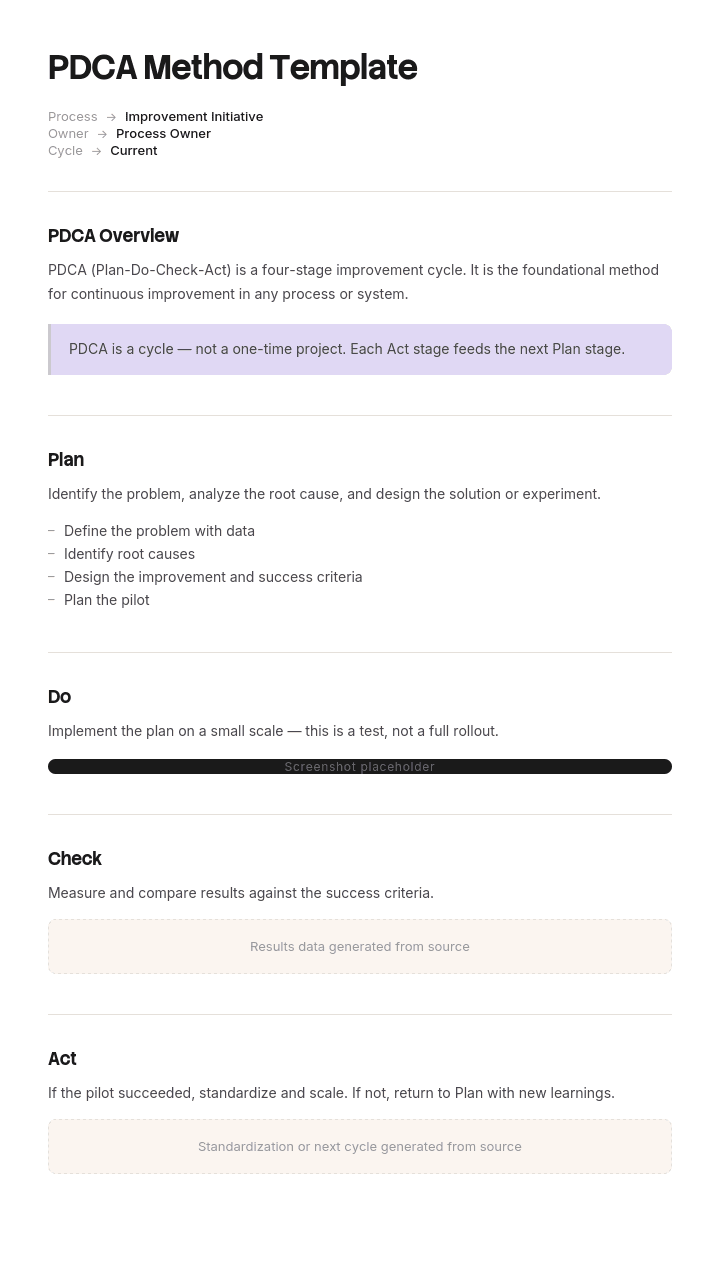
Verwenden Sie diese Vorlage
PDCA ist eines der wirkungsvollsten Frameworks für kontinuierliche Verbesserungen, die je entwickelt wurden. Mit Trupeer können Sie Stunden bei der PDCA-Dokumentation sparen, indem Sie mit einer kostenlosen PDCA-Methodenvorlage starten, sie mit Ihren Brand Guidelines anpassen und PDCA-Zyklen in Video-Updates umwandeln, die Teams hinter jeder Verbesserung ausrichten.
Was ist PDCA, und was macht eine PDCA-Vorlage?
PDCA ist ein Verbesserungszyklus in vier Phasen: Planen Sie eine Änderung, führen Sie sie in kleinem Maßstab durch, prüfen Sie, ob sie funktioniert hat, und handeln Sie auf Basis dessen, was Sie herausgefunden haben. Das Konzept stammt von Shewhart und Deming und bildet die Grundlage für die meisten modernen Qualitäts- und kontinuierlichen Verbesserungspraktiken – einschließlich der Verbesserungsanforderungen in ISO-Managementstandards.
Eine PDCA-Vorlage ist das Formular, das genau einen Zyklus abbildet. Sie gibt jeder Phase eine Box, hält die Arbeit sichtbar und ermöglicht es, auf das zurückzublicken, was ausprobiert wurde.
Die Vorlagen sind leicht zu finden und fast alle gleich: ein Kreis, der in vier Teile geteilt ist, oder eine Tabelle mit vier Spalten. Diese Form entspricht dem Modell – und genau deshalb liefern so viele PDCA-Zyklen am Ende nichts. Eine Vier-Box-Vorlage ohne Möglichkeit, festzuhalten, wie die Situation vor Ihrem Start war, kann die Phase nicht unterstützen, von der die gesamte Methode abhängt.
Warum läuft PDCA meist als Plan, Do, Plan, Do
Prüfen Sie eine Reihe abgeschlossener PDCA-Formulare in nahezu jeder Organisation – das Muster ist konsistent. Plan ist voll. Do ist voll. Check ist dünn oder leer. Act ist leer oder sagt „standardisieren“.
Die übliche Erklärung ist Disziplin: Man geht zur nächsten Sache über, bevor man die letzte abschließt. Das stimmt – und es ist nicht die Ursache, denn dieselben Personen schließen Incident-Reports ab und beenden Audits.
Die Ursache ist, dass Check in der Regel unmöglich ist. Um zu prüfen, ob sich etwas verbessert hat, brauchen Sie eine Zahl von vorher, gemessen auf die gleiche Weise – und die Vorlage fragt nie danach. Daher hat die Person, die Check ausfüllt, die Wahl zwischen einer nicht verifizierbaren Aussage, wie „Mitarbeitende berichten, es ist einfacher“, oder es leer zu lassen. Die meisten lassen es leer, und diejenigen, die es nicht tun, schreiben etwas auf, das nicht falsch sein kann – was im Grunde dasselbe ist wie nichts.
Act übernimmt dann das Problem. Ohne einen Befund, auf den man reagieren könnte, ist der einzige verfügbare Eintrag eine vage Absicht – und der Zyklus endet, ohne dass irgendjemand etwas entscheidet.
Zwei Felder beheben beide Phasen, und keines davon sitzt innerhalb der vier Boxen.
So passen Sie diese Vorlage in Trupeer an
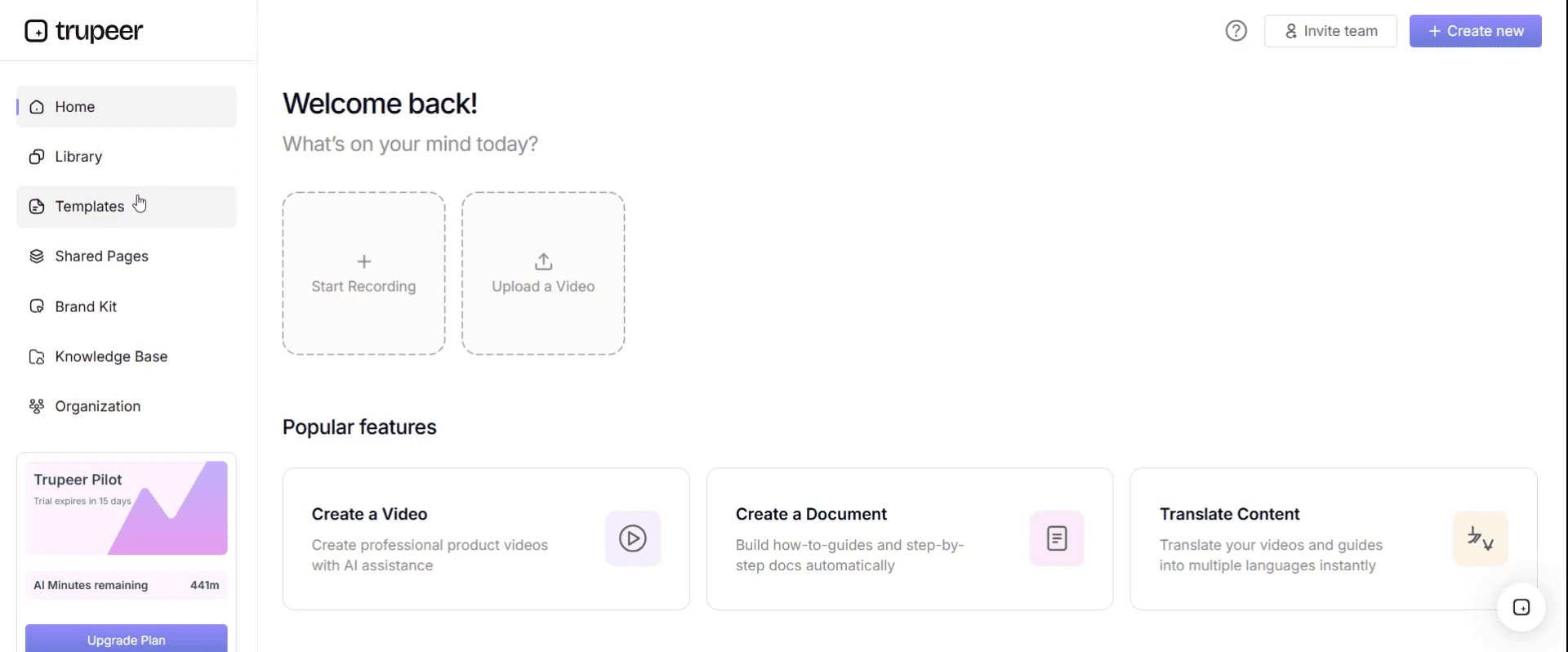
Schritt 1: Öffnen Sie den Bereich „Vorlagen“
Gehen Sie im Hauptmenü zum Bereich „Vorlagen“.
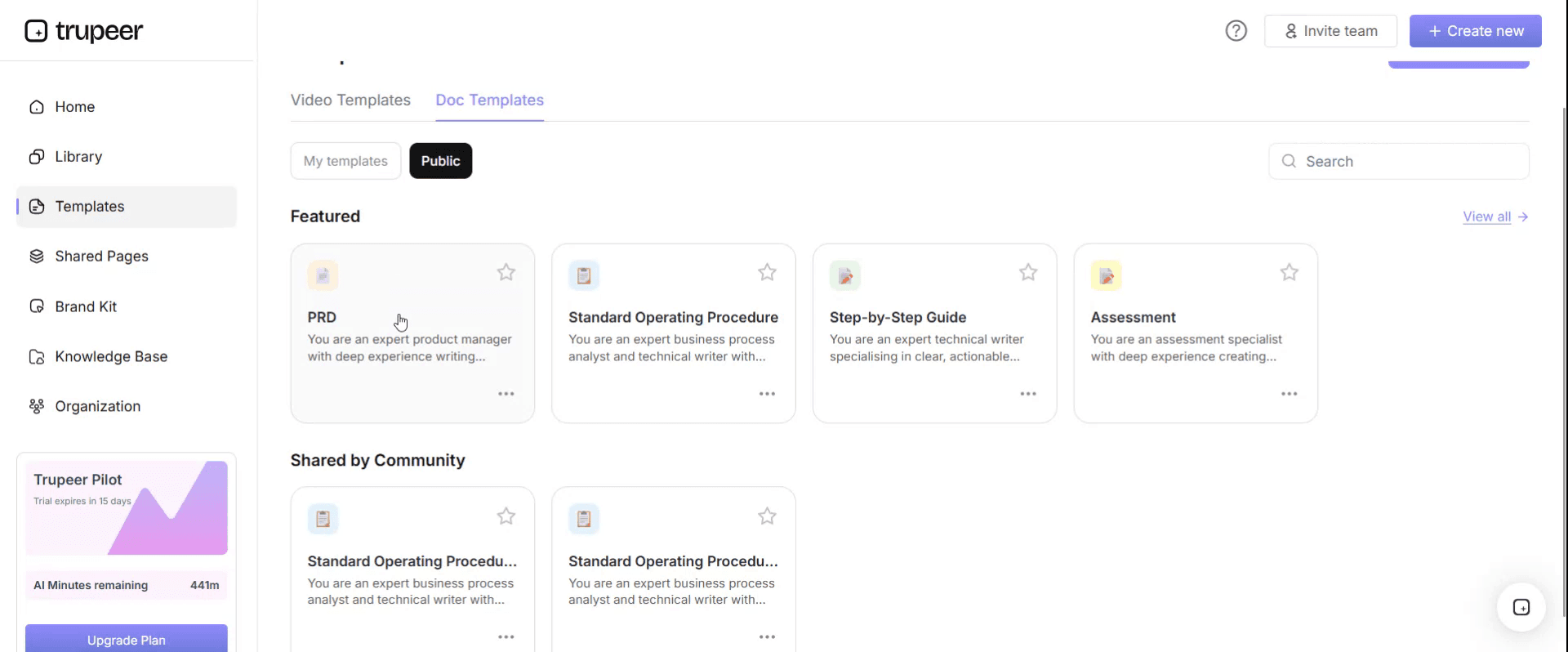
Schritt 2: Wählen und öffnen Sie eine Vorlage
Klicken Sie auf eine beliebige Vorlage, mit der Sie arbeiten möchten, um sie zu öffnen.
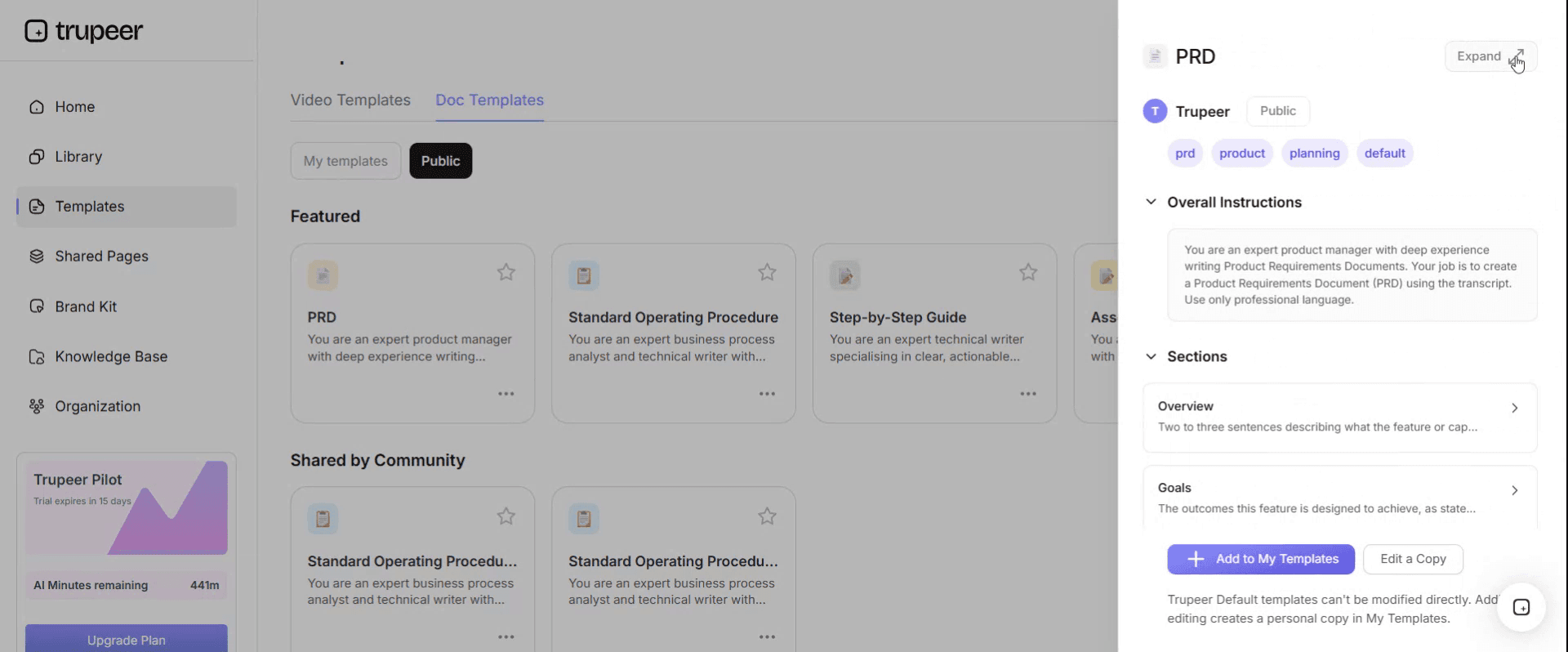
Schritt 3: Erweitern Sie die Vorlagenansicht
Falls nötig, erweitern Sie die Vorlagenansicht, um das vollständige Layout und die Details klar zu sehen.
Schritt 4: Bearbeiten Sie die Vorlage
Klicken Sie auf „Bearbeiten“, um mit der Anpassung der ausgewählten Vorlage zu beginnen.
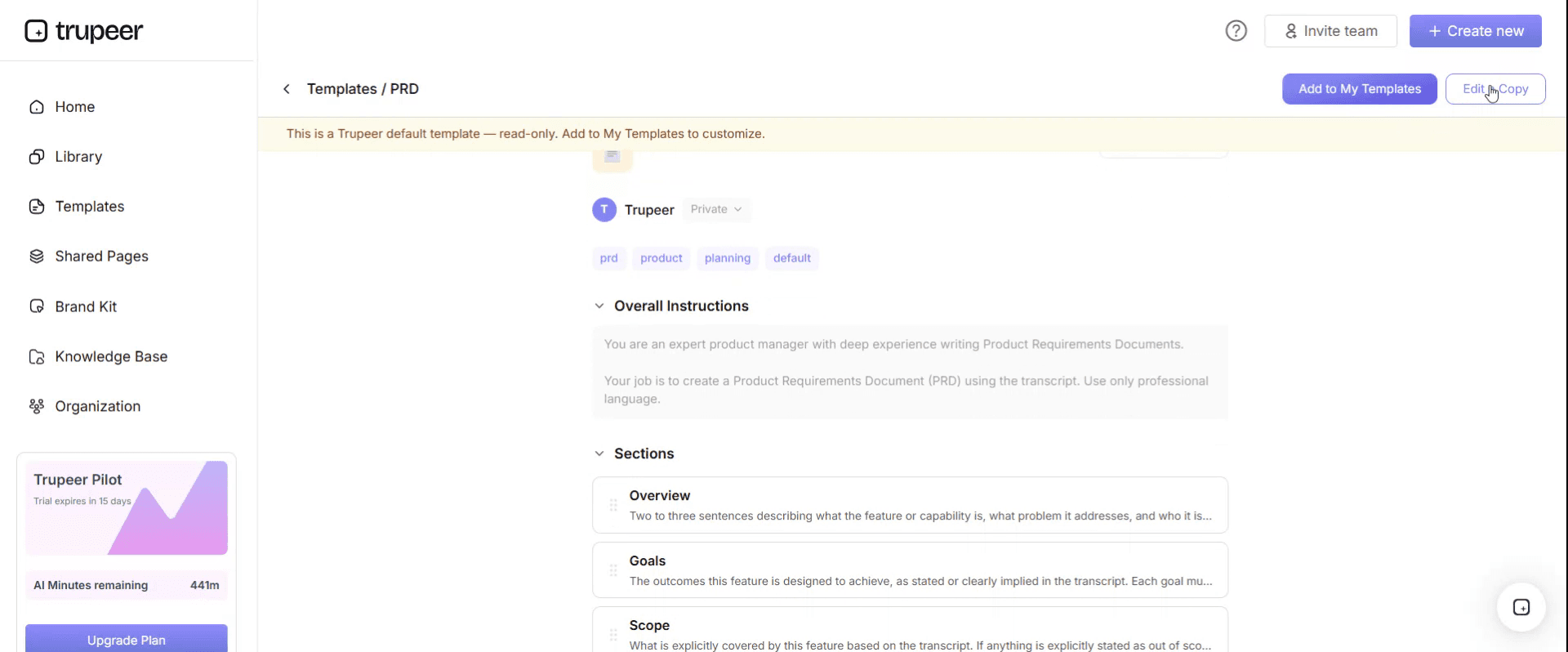
Im Editor können Sie:
Neue Abschnitte hinzufügen
Formatierungsregeln definieren oder aktualisieren
Ein Logo hinzufügen und Position sowie zugehörige Einstellungen anpassen
Schritt 5: Speichern Sie Ihre angepasste Vorlage
Nachdem Sie alle notwendigen Änderungen vorgenommen haben, klicken Sie auf „Speichern“, um die aktualisierte Vorlage als Ihre eigene zu speichern.
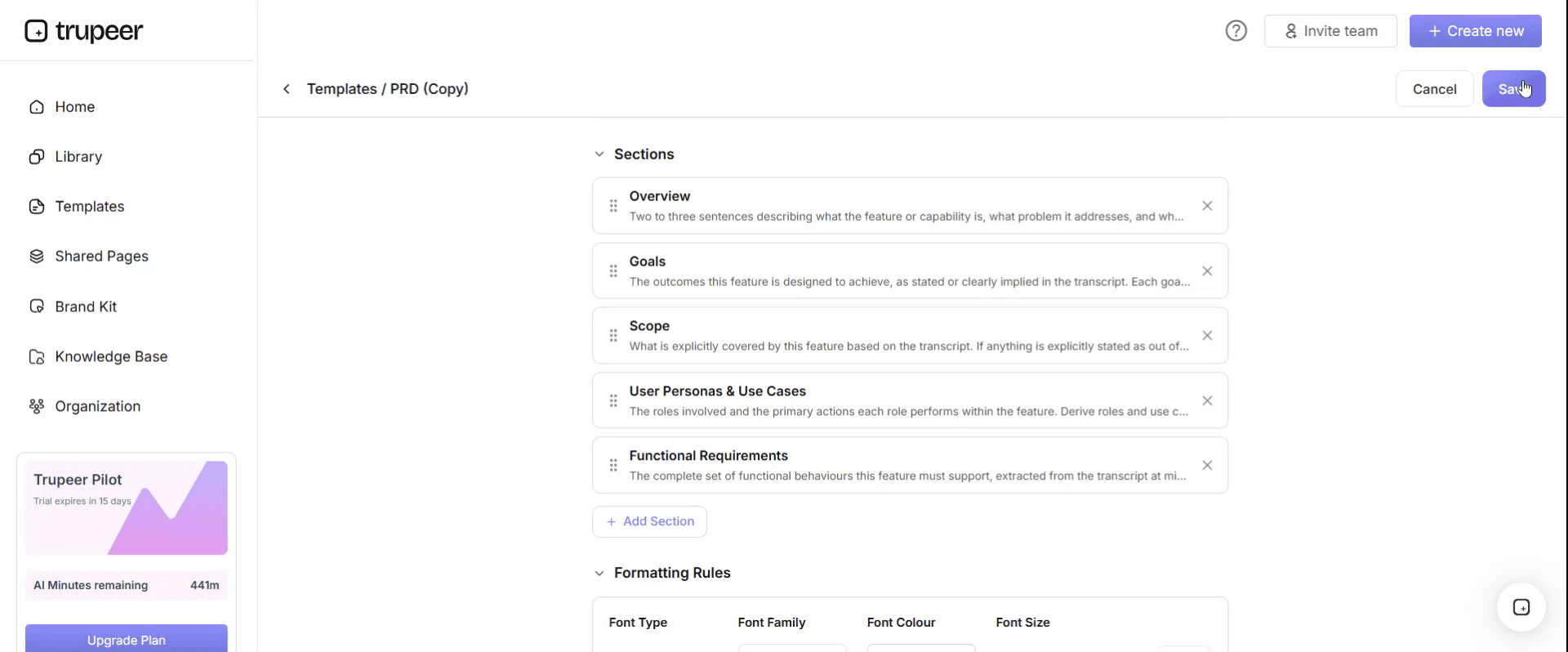
Schritt 6: Vorschau ansehen und die Vorlage feinjustieren
Wenn Sie sehen möchten, wie Ihre angepasste Vorlage aussieht, öffnen Sie die Vorschau.
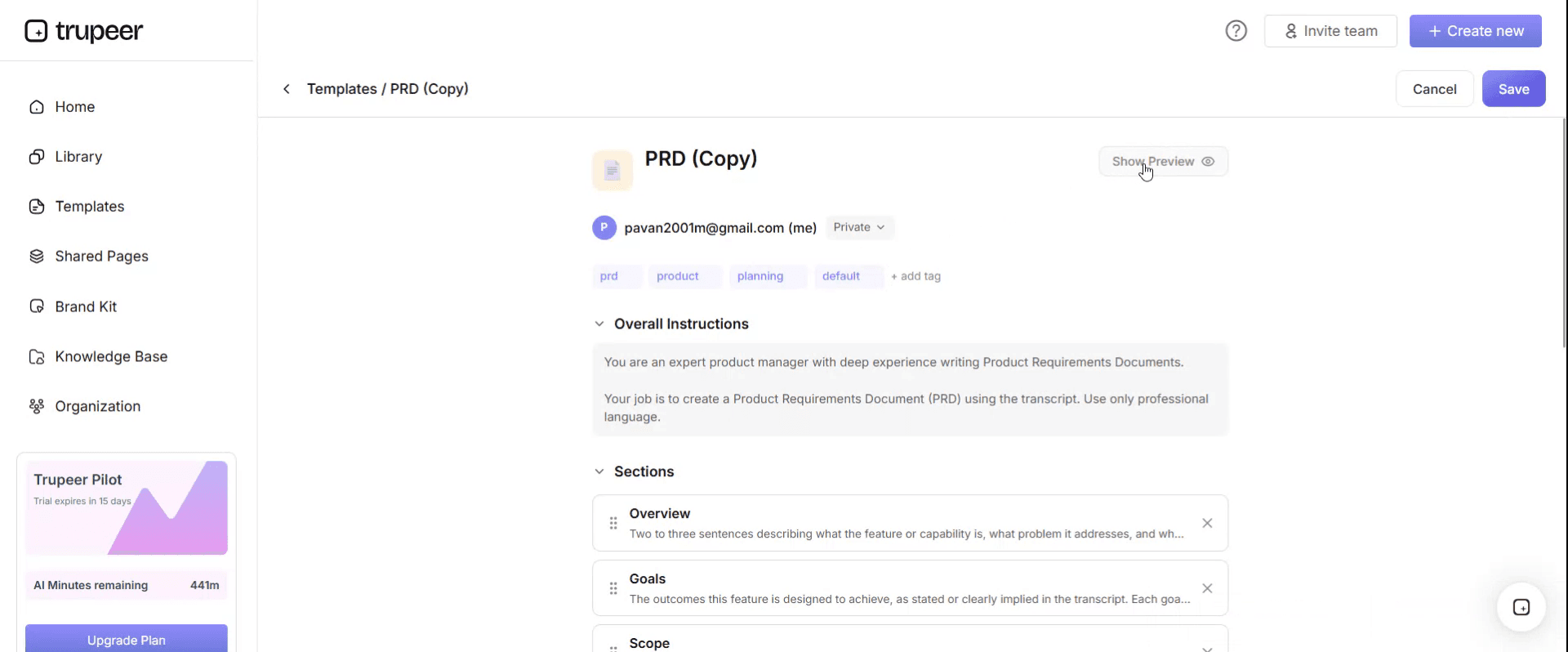
Ausgehend vom Vorschau-Bildschirm können Sie bei Bedarf direkt weiter Anpassungen vornehmen – so stellen Sie sicher, dass die Vorlage genau so erscheint, wie Sie es möchten.
Mit einer PDCA-Methodenvorlage können Sie:
Stunden bei der Planung sparen: Überspringen Sie die leere Seite mit einer Struktur, die für PDCA-Zyklen entwickelt wurde.
Kontinuierliche Verbesserung vorantreiben: Integrierte Felder stellen sicher, dass jede Phase erfasst und daraus gelernt wird.
Im Markenstil bleiben: Nutzen Sie Ihr Logo, Ihre Schriftarten und Farben mit dem Brand Kit von Trupeer.
Änderungen schneller ausrollen: Wandeln Sie PDCA-Learnings in aktualisierte SOPs und Video-Durchläufe um.
Verbesserungen standardisieren: Verwenden Sie für jeden PDCA-Zyklus dieselbe Vorlage.
Globale Teams erreichen: Übersetzen Sie PDCA-Dokumentation mit einem Klick in 65+ Sprachen.
Die Basis, die vor „Plan“ vorhanden sein muss
Der erste Akt eines PDCA-Zyklus ist keine Planung. Es ist das Messen.
Bevor irgendetwas geplant wird, halten Sie fest, wie die Situation jetzt ist: die Messgröße, ihr aktueller Wert, wie sie gemessen wird, über welchen Zeitraum, an welchem Datum und wer sie erfasst hat. Fünf Zeilen. Nichts geht weiter, bevor sie existieren.
Das klingt pedantisch – und es ist der Unterschied zwischen einem Zyklus, der zu einem Ergebnis kommen kann, und einem, der es nicht kann. Es bewirkt außerdem etwas Nützliches früher als erwartet: Eine überraschend große Anzahl vorgeschlagener Verbesserungen überlebt den Versuch, sie als Basis (Baseline) festzulegen, nicht, weil niemand sagen kann, wie hoch das aktuelle Niveau ist. Das bedeutet in der Regel auch: Niemand weiß, ob es überhaupt ein Problem gibt.
Drei Regeln halten Baselines ehrlich. Messen Sie über einen Zeitraum, der lang genug ist, um normale Schwankungen einzuschließen, denn ein Wert von nur einem Tag verändert sich von selbst. Schreiben Sie auf, wie gemessen wurde, denn „Check“ muss die identische Methode verwenden – sonst ist der Vergleich bedeutungslos. Und erfassen Sie die Baseline, bevor das Team weiß, welche Änderung kommt (wo das praktisch möglich ist), denn eine Baseline, die aufgenommen wird, nachdem allen gesagt wurde, was verbessert werden soll, ist häufig nicht repräsentativ.
Wenn es überhaupt keine Zahl gibt, ist eine Zählung besser als ein Adjektiv. Wie oft im letzten Monat, bei wie vielen Versuchen, ist fast immer auch nach einem Nachmittag verfügbar.
Act ist eine Entscheidung: übernehmen, anpassen oder verwerfen
Die Act-Phase ist der Bereich, in dem die meisten Vorlagen eine einzelne leere Box setzen – und das Wort selbst ist mehrdeutig. Im ursprünglichen Modell kann es bedeuten, die Änderung zu standardisieren, oder sie anzupassen und erneut einen Durchlauf zu starten. Das sind gegensätzliche Anweisungen – und eine Box kann beides nicht gleichzeitig abdecken.
Ersetzen Sie die Box durch drei Ergebnisse, von denen genau eines ausgewählt werden muss.
Übernehmen. Die Änderung hat funktioniert. Nennen Sie das Dokument, das als Ergebnis aktualisiert wurde: die SOP, die Arbeitsanweisung, das Job-Aid, die Umgebung. Eine Übernahme ohne benanntes Dokument wurde nicht wirklich übernommen – sie wurde lediglich genehmigt, und sie wird innerhalb von etwa sechs Wochen zurückgenommen.
Anpassen. Teilweises oder unklareres Ergebnis. Legen Sie fest, was sich konkret für den nächsten Zyklus ändert, und setzen Sie das Datum. Das ist ein legitimes Ergebnis und sollte häufig vorkommen, denn die meisten ersten Versuche liegen teilweise richtig.
Verwerfen. Es hat nicht funktioniert – oder es hat die Dinge schlimmer gemacht. Nennen Sie, was wann zurückgenommen wurde, und halten Sie fest, was gelernt wurde, damit es in achtzehn Monaten nicht von jemand anderem erneut versucht wird.
Verwerfen ist das Ergebnis, das fast keine Organisation jemals erfasst – weshalb gescheiterte Änderungen still weiterbestehen und warum dasselbe Problem zweimal mit widersprüchlichen Lösungen angegangen wird. Wenn man es als Auswahlfeld statt als Eingeständnis gestaltet, ändert sich, wie oft es verwendet wird.
Kostenlose PDCA-Methodenvorlage: die vier Phasen plus zwei Felder
Kopieren Sie von hier. Ein Zyklus pro Formular, eine Seite.
Kopfzeile. Zyklusreferenz, Titel, Verantwortliche Person, Team, Startdatum, Ziel-Schlussdatum.
Baseline, vor „Plan“. Die Messgröße. Aktueller Wert. Messmethode. Abgedeckter Zeitraum. Erfassungsdatum. Wer hat es erfasst.
Plan. Das Problem in einem Satz, als Beobachtung formuliert statt als Lösung. Der vermutete Grund. Die Änderung, die ausprobiert wird. Die Vorhersage – also was Sie erwarten, dass die Messgröße tun wird und um wie viel. Wo es getestet wird und für wie lange. Wer es durchführt.
Do. Was tatsächlich getan wurde, was vom Plan abwich, wann es begonnen und wann es beendet wurde – und alles, was während des Tests schiefgelaufen ist.
Check. Die Messgröße erneut, mit der in der Baseline genannten Methode. Der Post-Wert. Die Differenz. Ob es zur Vorhersage passte. Alle beobachteten Nebeneffekte – einschließlich Auswirkungen auf Arbeit, die nicht gemessen wurde.
Act. Eines von übernehmen, anpassen oder verwerfen – jeweils mit den erforderlichen Details wie oben. Benannte Person, datiert.
Nächster Zyklus. Referenz, falls daraus ein weiterer folgt.
Kopieren Sie bis hier. Das Feld für die Vorhersage in „Plan“ lohnt sich, gegen alle zu verteidigen, die es löschen möchten. Wenn Sie aufschreiben, was passieren soll, bevor Sie es tun, wird aus „Check“ von einer Formalität zu einer Information – denn eine Änderung, die Dinge um einen Betrag verbessert hat, den niemand erwartet hat, sagt Ihnen etwas anderes als eine, die wie vorhergesagt eingetroffen ist.
Die vier PDCA-Phasen und was jede von ihnen liefern muss
Phase | Die Frage | Was sie liefern muss | Häufiges Scheitern |
|---|---|---|---|
Baseline | Wo stehen wir jetzt? | Eine Zahl, eine Methode und ein Datum | Komplett übersprungen, sodass Check nichts zum Vergleichen hat |
Plan | Was werden wir versuchen und was erwarten wir? | Eine klar benannte Änderung und eine numerische Vorhersage | Eine Lösung ohne Ursache und ohne Vorhersage |
Do | Was ist tatsächlich passiert? | Eine Aufzeichnung dessen, was getan wurde, und was abwich | Als wiederholter Plan geschrieben, nicht als Ereignisse |
Check | Hat es funktioniert? | Die gleiche Messgröße, die gleiche Methode und die Differenz | Ein Adjektiv statt einer Zahl |
Act | Was jetzt? | Übernehmen, anpassen oder verwerfen – mit benannter Konsequenz | Leer oder nur das Wort „standardisieren“ |
Zwei Phasen tragen das Gewicht – und keine davon ist „Plan“. Teams stecken den Großteil ihrer Energie in die Planung, weil sie sich wie Denken anfühlt. Die Phasen, die Lernen erzeugen, sind „Check“ und „Act“.
Die Anlage mit 47 Zyklen und 3, die geprüft werden konnten
Ledstone Packaging betreibt eine Wellpappenverpackungsanlage mit etwa dreihundert Mitarbeitenden. PDCA war die Standardmethode für kontinuierliche Verbesserungen. Alle wurden geschult, die Boards hingen an der Wand – und über achtzehn Monate wurden siebenundvierzig Zyklen protokolliert.
Irgendjemand hat sie auditiert.
Alle siebenundvierzig hatten einen ausgefüllten Plan. Vierundvierzig hatten einen ausgefüllten Do. Zwölf hatten irgendetwas in Check. Sechs hatten irgendetwas in Act – und alle sechs sagten „standardisieren“, ohne ein Dokument zu nennen.
Von den zwölf mit etwas in Check enthielten drei eine Zahl von vorher. Die anderen neun sagten Dinge wie „verbessert“, „schneller“ oder „Mitarbeitende berichten, es ist einfacher“.
Damit konnten von siebenundvierzig Zyklen nur drei überhaupt bewertet werden.
Die Kosten zeigten sich an zwei Stellen. Zyklus 19 hatte eine Wechselreihenfolge geändert und wurde übernommen. Er erhöhte die durchschnittliche Wechselzeit um etwa sieben Minuten – und bei ungefähr vierzig Wechseln pro Woche sind das fast fünf Stunden pro Woche verlorene Laufzeit. Das wurde elf Monate später im Rahmen einer nicht zusammenhängenden Analyse der Linienleistung entdeckt – nicht durch den Zyklus, der es verursacht hatte.
Und die Zyklen acht und einunddreißig hatten beide Probleme mit Fehlzuführungen von Etikettenapplikatoren adressiert – mit widersprüchlichen Lösungen –, weil niemand festgelegt hatte, ob Zyklus acht funktioniert hatte, bevor Zyklus einunddreißig gestartet wurde.
Die vorgenommenen Änderungen waren eng gefasst. Über „Plan“ wurde ein Baseline-Block ergänzt – mit Messgröße, Wert, Methode, Zeitraum, Datum und wer es erfasst hat. Kein Zyklus konnte ohne ihn geöffnet werden. „Act“ wurde zu drei Auswahlfeldern mit einem erforderlichen Feld unter jedem.
In den folgenden zwölf Monaten protokollierten sie einunddreißig Zyklen – weniger, und zwar bewusst. Alle einunddreißig hatten Baselines. Neunundzwanzig hatten einen Check mit einem Post-Wert. Die Act-Ergebnisse waren siebzehn übernehmen, neun anpassen und fünf verwerfen.
Die fünf Verwerfungen waren die Zahl, auf die der Qualitätsmanager am stolzesten war, denn in den vorherigen achtzehn Monaten war dieses Ergebnis nie ein einziges Mal erfasst worden. Zwei davon waren Änderungen, die die Dinge verschlechtert hatten – und wurden innerhalb von drei Wochen zurückgenommen, statt nach elf Monaten.
So führen Sie einen PDCA-Zyklus richtig durch – Schritt für Schritt
Wählen Sie ein Problem, das klein genug ist, damit der Zyklus in Wochen statt in Quartalen abgeschlossen werden kann. PDCA ist keine Projektmethodik – und lange Zyklen sind der Weg, wie die Methode stirbt.
Leggen Sie zuerst die Baseline fest, bevor Sie etwas anderes tun – mit den fünf Feldern oben.
Planen Sie die Änderung mit einer benannten Ursache und einer numerischen Vorhersage. Wenn Sie nicht vorhersagen können, verstehen Sie die Ursache noch nicht gut genug, um eine Änderung zu testen. Der ehrliche nächste Schritt ist dann, eher zu beobachten als zu planen.
Führen Sie es klein durch. Eine Linie, eine Schicht, ein Team, eine Woche. Der Sinn eines Tests ist, dass das Rückgängig-Machen günstig ist.
Prüfen Sie mit derselben Messgröße und derselben Methode über einen vergleichbaren Zeitraum. Achten Sie gezielt auf Nebeneffekte, denn Änderungen verbessern häufig das gemessene Ergebnis und verschlechtern etwas daneben, das niemand beobachtet.
Handeln Sie, indem Sie eines der drei Ergebnisse auswählen und das erforderliche Feld ausfüllen. Schließen Sie dann den Zyklus sichtbar, damit alle sehen können, wenn Zyklen abgeschlossen werden.
Die Vorteile und Nachteile des PDCA-Zyklus
Die Vorteile sind real. Man kann die Methode in zwanzig Minuten so erklären, dass sie verständlich ist. Sie passt auf nahezu jede Art von Arbeit. Sie fördert kleine, rückgängig machbare Änderungen statt großer, riskanter. Und sie erzeugt eine schriftliche Dokumentation – genau das ermöglicht es einer Organisation, nicht immer wieder dieselben Fehler zu wiederholen.
Die Nachteile sind ebenso real und werden nur seltener genannt.
Er ist langsam. Ein Zyklus mit einer korrekten Baseline, einer Testphase und einem Check dauert Wochen – und passt damit schlecht zu allem, was dringend ist.
Er setzt ein messbares Ergebnis voraus. Arbeit, bei der das Ergebnis qualitativ ist oder erst nach Monaten sichtbar wird, passt nicht gut in das Modell – und wenn man es erzwingt, entsteht genau der oben beschriebene nicht überprüfbare Check.
Er wird leicht durchgeführt, statt wirklich gemacht. Boards, Formulare und Schulungen sind sichtbar; die Disziplin, zweimal zu messen, ist es nicht – und Organisationen haben häufig das Erste ohne das Zweite.
Und er sagt nichts darüber, wie man die Ursache findet. „Plan“ geht davon aus, dass Sie eine Hypothese haben. Eine gute Hypothese zu entwickeln ist der Punkt, an dem die meisten Verbesserungsarbeiten tatsächlich erfolgreich sind – oder scheitern.
Wann sollten Sie PDCA einsetzen – und wann etwas anderes?
Nutzen Sie PDCA, wenn Sie ein messbares Problem, eine plausible Ursache und die Möglichkeit haben, eine Änderung in kleinem Maßstab auszuprobieren und wieder rückgängig zu machen. Das ist ein engerer Satz an Voraussetzungen, als die Popularität der Methode vermuten lässt – und genau dort funktioniert sie besonders gut.
Nutzen Sie in drei Fällen etwas anderes.
Wenn die Verbesserung klein, offensichtlich und rückgängig machbar ist, ist ein kompletter Zyklus Overhead. Machen Sie die Änderung und dokumentieren Sie sie. Unsere Kaizen-Methodenvorlage deckt diesen leichteren Weg ab – einschließlich der Schwelle, unterhalb der niemand eine Genehmigung einholen sollte.
Wenn die Ursache wirklich unbekannt und umstritten ist, erzeugt die Plan-Phase von PDCA eine Vermutung. Strukturiertes Problemlösen wie ein A3 oder eine formale Root-Cause-Analyse kommt zuerst – und PDCA testet dann die daraus resultierende Hypothese.
Wenn das Problem Schwankungen in einem stabilen Prozess sind und Sie Daten haben, kommen DMAIC und die statistischen Werkzeuge dafür weiter als PDCA.
Und wenn die Verbesserung eher die Arbeitsplatzorganisation betrifft als die Prozessleistung, ist unsere 5S-Verbesserungsvorlage der bessere Ausgangspunkt.
Varianten der PDCA-Vorlage: A3, FOCUS PDCA und RACI
A3. Der gesamte Zyklus auf einer A3-Seite: Die linke Hälfte ist dem Verständnis des aktuellen Zustands gewidmet, die rechte Hälfte der Änderung. Es ist PDCA mit einem deutlich größeren Baseline-Bereich – genau die Betonung, für die diese Seite argumentiert.
FOCUS PDCA. Eine Gesundheitswesen-Variante mit vorgeschaltetem Teil: Finden Sie einen Prozess, den Sie verbessern möchten, Organisieren Sie ein Team, Klären Sie das aktuelle Wissen, Verstehen Sie Schwankungen, Wählen Sie die Verbesserung. Diese fünf Schritte dienen dazu, den aktuellen Zustand zu etablieren, bevor geplant wird – und das ist wieder dieselbe Korrektur.
PDCA mit RACI. Ergänzt die Verantwortungszuweisung über die Phasen hinweg. Praktisch, wenn ein Zyklus Teams überschreitet und niemand den Check besitzt – also die Phase, die am häufigsten zwischen Menschen „durchrutscht“.
Präsentations- und Diagrammformate. Kreisdiagramme für Folien. Gut, um die Methode zu erklären, aber als Arbeitsformular nutzlos – denn in einem Kreis gibt es keinen Platz, um eine Messmethode aufzuschreiben.
Das Muster bei den sinnvollen Varianten ist, dass sie alle den vorderen Teil des Zyklus erweitern. Das Muster bei den dekorativen ist, dass sie den Kreis nur hübscher machen.
Kann ich eine PDCA-Vorlage in Excel, PowerPoint oder PDF bekommen?
Excel ist das richtige Arbeitsformat – und es kommt nicht annähernd heran. Ein PDCA-Log benötigt eine Zeile pro Zyklus mit Spalten für Referenz, Titel, Verantwortliche Person, Baseline-Wert, Methode, Vorhersage, Post-Wert, Differenz, Act-Ergebnis und Abschlussdatum. Dieses Blatt macht das Audit im Beispiel überhaupt erst möglich – und beim Erstellen zeigt sich das Problem meist, bevor irgendjemand das Formular ändert.
Word oder ein gedrucktes A4-Formular eignet sich für den einzelnen Zyklus – insbesondere in einer Werkhalle, in der das Formular eher auf einem Board lebt als auf einem Bildschirm. Halten Sie es seitlich.
PowerPoint eignet sich, um PDCA Menschen zu erklären – und für nichts anderes. Ein kreisförmiges Diagramm ist ein Lehrmittel, keine Vorlage. Wenn Sie es als Arbeitsformular verwenden, stellen Sie sicher, dass die Baseline nie erfasst wird.
PDF eignet sich für den abgeschlossenen Zyklus, der als Datensatz abgelegt wird, sobald Act abgeschlossen ist.
So erfassen Sie ein Vorher und Nachher ohne eine Studie
Der Grund, warum Check oft übersprungen wird, ist häufig praktisch statt kulturell. Messen bedeutet, dass jemand die Arbeit zweimal beobachten muss – mehrere Wochen auseinander – und zwar mit derselben Methode. Das ist echte Zeit, die niemand eingeplant hat.
Für alles, was eine Person umfasst, die eine Aufgabe ausführt, ist das Erfassen günstig und vergleichbar. Eine Bildschirm- oder Prozessaufzeichnung vor der Änderung und eine weitere danach geben Ihnen zwei Artefakte, die Sie zeitlich erfassen, Schritte zählen und direkt vergleichen können – ohne dass jemand an zwei getrennten Gelegenheiten mit einer Stoppuhr danebensteht.
Trupeer AI macht aus diesen Aufzeichnungen auch schriftliche Prozeduren – und das ist wichtig in der Act-Phase: Ein Übernahme-Ergebnis erfordert ein benanntes Dokument, das aktualisiert werden muss. Wenn das Aktualisieren teuer ist, wird aus der Übernahme still eine Genehmigung, die zurückgenommen wird.
Erfassen Sie es. Machen Sie es zur Marke. Übersetzen Sie es. Trupeer it.
Der SOP-creator deckt die Prozeduren ab, die sich bei Übernahme-Ergebnissen ändern müssen. Und wenn die Änderung an einem Arbeitsplatz passiert, deckt unsere Vorlage für Fertigungsarbeitsanweisungen das Dokument ab, das es widerspiegeln muss. Die Aufzeichnungen und die daraus entstehenden Prozeduren leben in Ihrer Knowledge Base mit konsistenter Markenführung. Einrichtungsanweisungen finden Sie im document template setup guide.
Häufig gestellte Fragen
Gibt es eine kostenlose PDCA-Vorlage in Excel?
Excel ist der richtige Ort für das Zyklus-Log – es ist wertvoller als das einzelne Formular. Eine Zeile pro Zyklus mit Baseline-Wert, Methode, Vorhersage, Post-Wert und Act-Ergebnis. Fügen Sie eine Anzahl der Zyklen nach Act-Ergebnis hinzu. Wenn „Verwerfen“ über ein Jahr hinweg null ist, wird der Prozess nicht ehrlich durchgeführt – sondern eher perfekt gespielt.
Gibt es eine kostenlose PDCA-Vorlage in PowerPoint?
Nur zum Unterrichten. Die kreisförmigen PDCA-Diagramme, die die Bibliotheken von Folienvorlagen dominieren, sind erklärende Grafiken ohne Platz für eine Messmethode oder eine Vorhersage. Nutzen Sie Folien, um den Zyklus zu erklären, und ein Formular oder eine Tabelle, um ihn durchzuführen.
Gibt es eine kostenlose PDCA-Vorlage in Word?
Die Struktur oben wird direkt in Word als einseitiges Formular eingefügt – einschließlich des Baseline-Blocks und der drei Act-Ergebnisse, die Standardvorlagen auslassen. Es gibt keinen gesicherten Download und kein Formular. Drucken Sie es auf A4, wenn es auf ein Board kommt.
Gibt es eine kostenlose PDCA-Vorlage in PDF?
Exportieren Sie den abgeschlossenen Zyklus als PDF, sobald Act geschlossen ist – als Datensatz. Halten Sie das leere Formular bearbeitbar, weil die Felder für Messgröße und Methode normalerweise für jeden Bereich angepasst werden müssen. Ein festes PDF ermutigt dazu, Felder zu überspringen, die nicht offensichtlich passen.
Was ist der Unterschied zwischen PDCA und Kaizen?
Kaizen ist die allgemeinere Gewohnheit kontinuierlicher kleiner Verbesserungen. PDCA ist eine Methode, um eine konkrete Änderung innerhalb dieser Gewohnheit zu testen. In der Praxis sind die meisten Kaizen-Verbesserungen zu klein und zu leicht rückgängig zu machen, um einen vollständigen Zyklus zu rechtfertigen – und sollten einfach umgesetzt und dokumentiert werden. Reservieren Sie PDCA für Änderungen, bei denen Sie wirklich nicht wissen, ob die Idee funktionieren wird.
Was ist der Unterschied zwischen PDCA und DMAIC?
DMAIC, also define, measure, analyse, improve und control, ist das Six-Sigma-Äquivalent – und es ist schwerer. Es setzt Daten, statistische Analyse und eine geschulte Fachperson voraus. Es ist besonders stark, wenn das Problem Schwankungen in einem stabilen Prozess sind. PDCA ist leichter, schneller und besser geeignet, um eine Hypothese zu testen, die Sie bereits haben.
Wie lange sollte ein PDCA-Zyklus dauern?
Weniger als Monate, eher Wochen. Eine Baseline-Phase, eine Testphase lang genug, um normale Schwankungen einzuschließen, und ein Check. Zwei bis acht Wochen decken die meisten operativen Zyklen ab. Alles, was über ein Quartal hinausläuft, ist in der Regel zu einem Projekt geworden und sollte auch als solches gemanagt werden.
Wer sollte einen PDCA-Zyklus verantworten?
Wer auch immer die Arbeit ausführt – mit einer benannten Person, die speziell für den Check verantwortlich ist. Dieser zweite Name ist wichtig, weil der Check die Phase ist, die zwischen Menschen „liegt“, wenn ein Zyklus Teams überschreitet. Ihn separat zuzuweisen ist die günstigste Lösung, die es gibt.

