
Use this template
Operation and maintenance manuals keep machinery, facilities and systems running safely and efficiently. With Trupeer, you can save hours on writing O&M manuals by starting with a free operation and maintenance manual template, customizing it with your brand guidelines, and using our AI manual creator to turn complex procedures into clear video walkthroughs.
What is an operation and maintenance manual template?
An operation and maintenance manual, usually shortened to O&M manual, is the document handed over when something built or installed passes into the care of whoever will run it. A building, a plant room, a treatment works, a production line, or a software system going into live service.
Its job is narrow and long-lived. It tells the operator how to run the thing safely, how to maintain it, what to do when it fails, who supplied each part, and what the warranty terms are. It is consulted rarely and urgently, often years after the people who wrote it have gone.
An O&M manual template is the reusable structure for producing one: the sections, the required content, the asset data and the format. Templates are easy to find, and a complete manual built from a good template can still be unusable, which is what most of this page is about.
Why O&M manuals are accepted rather than checked
The O&M manual has a property no other document shares. It is paid for at handover and first genuinely needed somewhere between eighteen months and five years later.
That mismatch shapes everything. At practical completion the contractor wants final payment and release of retention. The client wants the building open, the line running or the system live. The manual arrives, usually in volume, at the precise moment when nobody has the time or the specialist knowledge to assess it.
So it gets checked for completeness rather than for use. Are all the volumes present, are the sections in the required order, is there a schedule for each system, are the drawings included. Those are reasonable questions and every one of them can be answered yes by a manual that will not help anybody at two in the morning in year three.
The defects surface later, when the commercial leverage has gone. By then retention has been released, the defects liability period has expired, and the people who assembled the manual are on another job.
The fix is not a better template. It is to test the manual while you still have something to hold.
How to customize this template in Trupeer
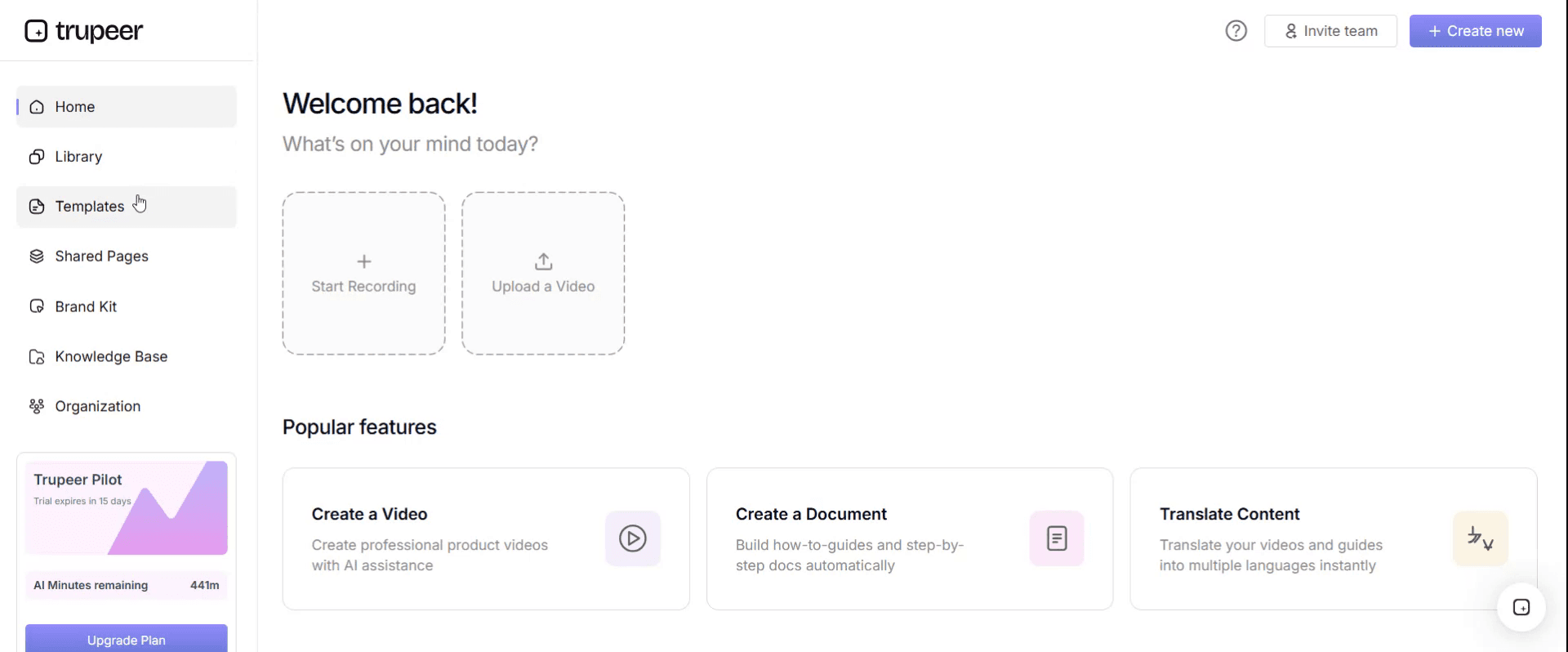
Step 1: Open the Templates Section
Go to the Templates section from the main navigation.
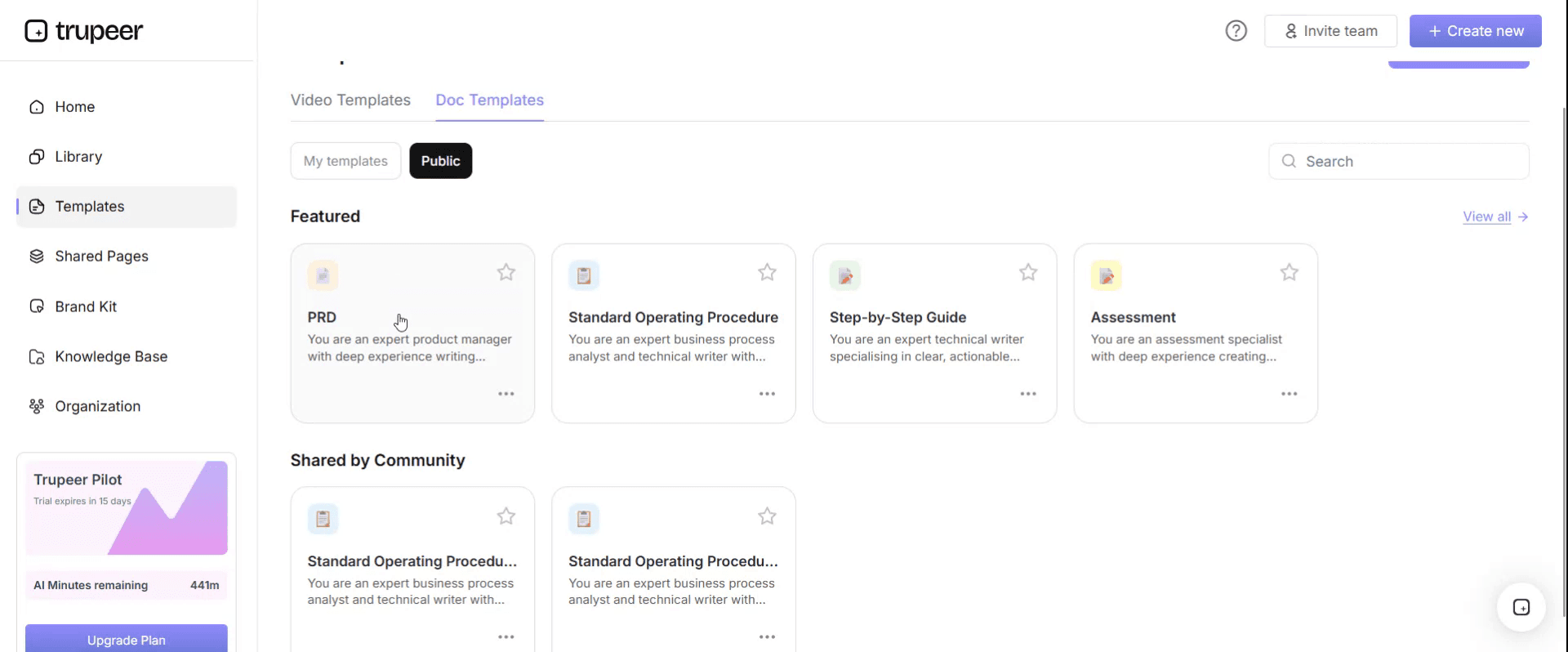
Step 2: Select and Open a Template
Click on any template you want to work with to open it.
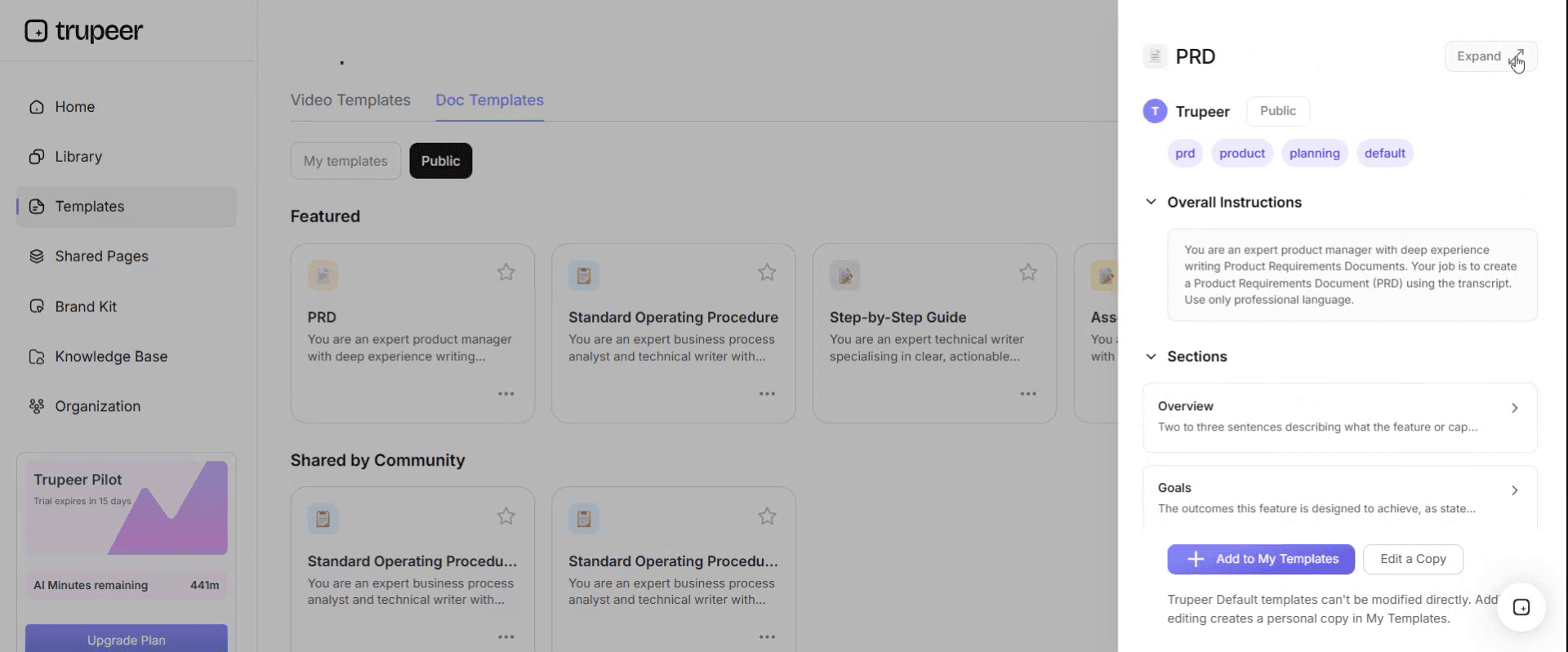
Step 3: Expand the Template View
If needed, expand the template view to see the full layout and details clearly.
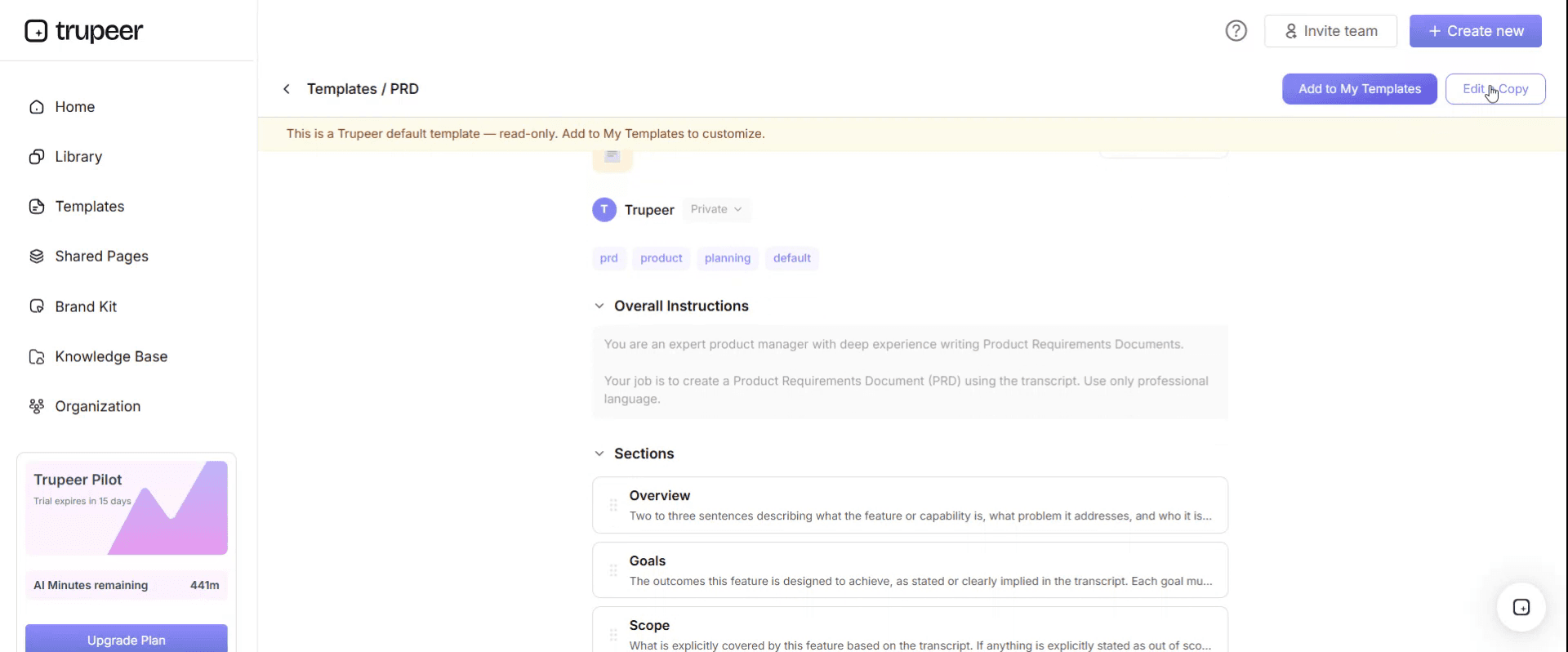
Step 4: Edit the Template
Click on Edit to start modifying the selected template.
Within the editor, you can:
Add new sections
Define or update formatting rules
Add a logo and adjust its position and related settings
Step 5: Save Your Customized Template
After making all necessary changes, click Save to store the updated template as your own.
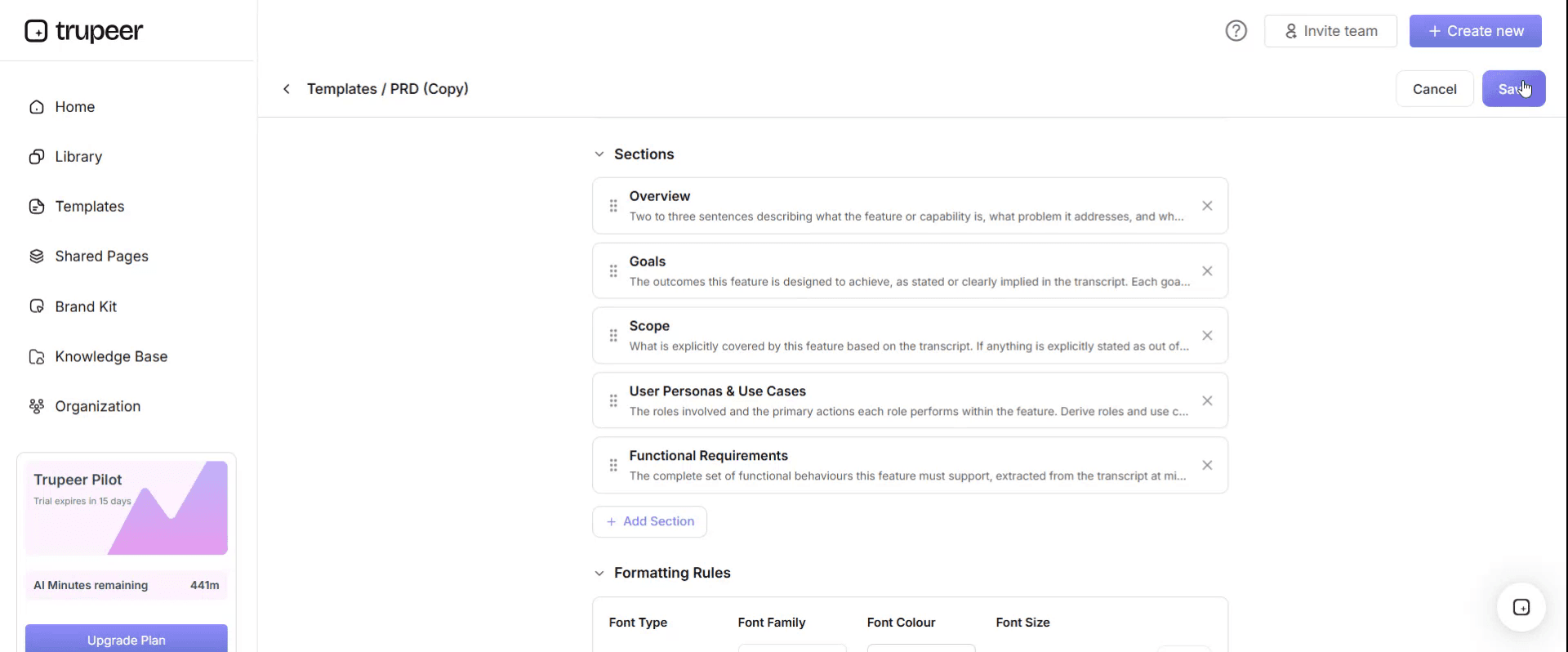
Step 6: Preview and Fine-Tune the Template
When you want to see how your customized template looks, open the Preview.
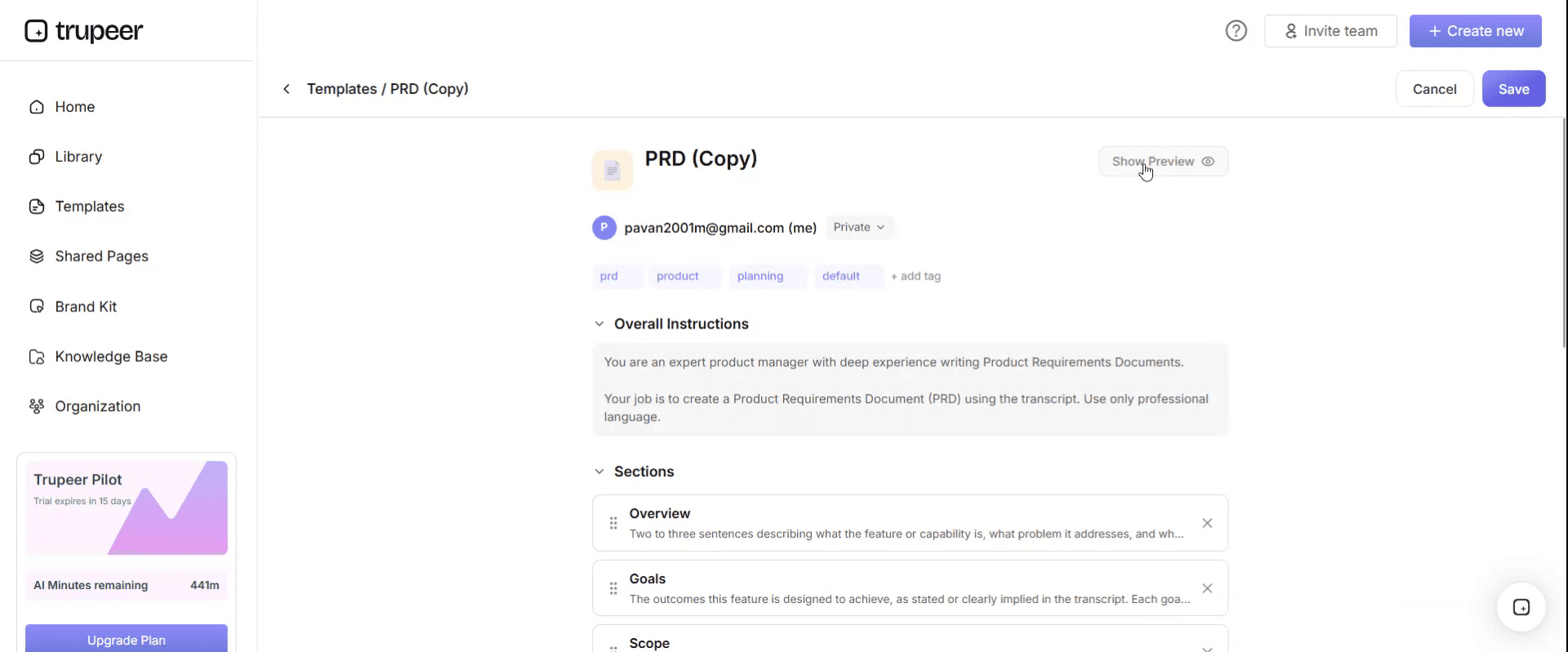
From the preview screen, you can continue to make adjustments directly if needed, ensuring the template appears exactly as you want.
With an O&M manual template you can:
Save hours on writing: Skip the blank page with a structure built for technical manuals.
Improve safety: Built-in safety sections protect operators and equipment.
Stay on-brand: Apply your logo, fonts and colors using Trupeer's brand kit.
Reduce downtime: Clear maintenance procedures prevent breakdowns and extend equipment life.
Train operators faster: Pair manuals with video walkthroughs at the equipment.
Reach global teams: Translate O&M manuals into 65+ languages with one click.
How to test an O&M manual before you sign it off
Do not read it. Use it.
Pick a small number of real tasks that the operator will actually have to perform, and have your own operator attempt each one using only the manual, with nobody helping and nobody from the contractor in the room. Time each attempt.
The tasks should include at least one routine maintenance activity, one component replacement, one out-of-hours emergency action, one location task such as finding the isolation point for a named circuit, and one administrative lookup such as the warranty terms and service contact for a specific item of plant.
Five is enough. The exercise takes a morning and it finds more than a week of desk review, because it tests the two things a completeness check cannot: whether the information is findable by somebody who does not already know the answer, and whether it matches what was actually installed rather than what was designed.
Write the test into the contract before it starts, with a stated pass condition and a portion of the contract sum retained against it. A test with no money attached becomes a conversation, and the conversation happens the week everyone wants to open.
The five scenario acceptance test, and what to retain
Scenario | What it tests | Common failure |
|---|---|---|
Perform a routine scheduled task, for example a filter change | Whether the maintenance schedule contains procedures rather than only frequencies | Schedule lists the task and no method |
Replace a named component | Whether part numbers, suppliers and access instructions are present | Manufacturer's sales brochure instead of the service instructions |
Carry out an emergency shutdown out of hours | Whether the procedure matches the labelling actually installed | Valve or panel references that do not match site labels |
Locate the isolation point for a named circuit or system | Whether as-installed drawings reflect changes made during construction | Drawings show the original design |
Find warranty terms and the service contact for one asset | Whether the asset register is complete and current | Register present, contacts missing or already out of date |
Set the pass mark before you run it, not after. A reasonable position is that all five must be completed by a competent operator within a stated time, and any failure returns the manual for correction.
Two and a half percent of the contract sum, or an agreed fixed amount, retained until the test passes is enough to change behaviour without being contentious. What matters is that the money is tied to the manual specifically rather than sitting inside general retention, because general retention is released against a hundred other things.
Free operation and maintenance manual template: the structure to copy
Copy from here. Ten sections. Adapt the terminology for IT systems, where the equivalents are noted.
1. Introduction and scope. What this manual covers, the asset or system it describes, the contract or project reference, and the version with a date.
2. Description of the installation. What was installed, how it works in plain terms, and how the parts relate. For a system, the architecture and its dependencies. Written for a competent operator rather than for the designer.
3. Asset register. Every item of plant or component with a unique reference, location, manufacturer, model, serial number, installation date, expected life, supplier and service contact. This is the section that decays fastest and matters most.
4. Operating instructions. Normal operation, start-up, shutdown, seasonal or load changes, setpoints and their tolerances, and what the operator is permitted to adjust without escalation.
5. Maintenance schedule. Task, frequency, who is competent to do it, estimated duration, and a reference to the procedure. A frequency without a procedure is not a schedule.
6. Maintenance procedures. The actual methods, one per task, with the tools, parts and isolations each requires. Where a task is complex or high consequence, a method of procedure format is the right shape.
7. Fault finding and emergency actions. Entered by symptom rather than by system, because that is how a fault presents. Include the out-of-hours actions and the point at which the operator stops and calls somebody.
8. Commissioning and test records. As-commissioned settings, test certificates, balancing data and performance results. The settings matter more than the certificates and are the thing most often omitted.
9. As-installed drawings and schematics. Reflecting changes made during construction, not the design issue. Dated and referenced.
10. Warranties, spares and contacts. Warranty terms and expiry per item, recommended spares holding, and named contacts with a review date on them.
Copy to here. Add a contents page that is genuinely usable and a single index of assets by reference number, because in practice most lookups start from a label on a piece of plant rather than from a section heading.
What an O&M manual must contain to be usable
Completeness and usability are different tests and most manuals pass the first.
Three things separate them. Findability, meaning somebody can get from a label on the wall to the right page in under a minute, which usually requires an asset index rather than a contents page. Currency, meaning the drawings and settings reflect what was installed rather than what was drawn. And procedure, meaning the maintenance section contains methods rather than a list of frequencies.
Two additions are worth making that templates rarely include. A one page emergency summary at the front, laminated separately, covering isolation points, emergency contacts and immediate actions, because in a genuine emergency nobody opens volume seven. And a named person responsible for the manual on the operator's side from day one, since a document with no owner is not maintained.
The sections most often present and useless are the manufacturer literature appendices, which are frequently sales brochures rather than service documentation. Check what has actually been supplied rather than that something has.
The leisure trust that lost nine days and £31,000
Peterfield Leisure Trust operates six centres and took handover of a new fourteen million pound pool and gym facility.
The O&M manuals arrived at practical completion: eleven lever-arch volumes and a USB drive. They were accepted that week. The opening date was booked, the contractor's final payment was tied to handover, and the check performed was a completeness review against the required contents list.
Fourteen months later the pool's UV disinfection unit failed on a Saturday afternoon.
The duty manager went to the manuals. The section for the UV unit contained the manufacturer's sales brochure rather than the service documentation, and none of the commissioning settings. The maintenance schedule listed "UV system, annual service" with no procedure and no contractor named. The emergency shutdown procedure referenced a valve labelling scheme that did not match the labels actually fitted in the plant room. And the as-installed drawings showed the original design rather than the two routing changes made during construction.
The pool closed for nine days. Lost income was around thirty one thousand pounds, and emergency call-out plus recommissioning came to roughly eighteen thousand more.
The part that hurt most was neither. When the trust approached the manufacturer under warranty, it could not evidence that the specified servicing had been carried out, because the maintenance schedule had never been transferred into its own maintenance system. Nobody had transferred it because nobody had opened the manuals between handover and the failure.
On the next project the trust wrote a use test into the contract. Five scenarios, performed by its own duty manager before practical completion, using only the manual. Two and a half percent of the contract sum retained until passed.
The first attempt failed three of the five. The contractor corrected them within three weeks and retention was released. In the two years since, there has been no equivalent incident, and the maintenance schedule went into the trust's system in the first fortnight because someone had already had to find it.
How to write an O&M manual, step by step
Start collecting during construction or build, not at the end. An O&M manual assembled in the final fortnight is assembled from whatever documentation happens to exist, which is why so many contain brochures.
Build the asset register first and keep it live. Every item added to site or to the system gets a row when it arrives. Retrofitting the register at the end is the single largest cause of missing serial numbers and wrong models.
Capture commissioning settings as they are set, by the person setting them. These are almost impossible to recover afterwards and they are what the operator needs most.
Write procedures from watching the work, not from the manufacturer's documentation, because the installed context changes how a task is actually done.
Update the drawings as changes are made rather than issuing as-designed and promising to revise.
Then run the use test on yourself, before the client does. A contractor who tests their own manual finds the same failures and fixes them without a retention argument.
O&M manuals for buildings, plant and IT systems
The structure holds across both worlds and the emphasis differs.
For buildings and infrastructure, the weight sits in the asset register, the maintenance schedule, the as-installed drawings and the statutory documentation. The manual is usually a contractual deliverable at practical completion, and it feeds the operator's maintenance system, so the register's data quality determines how much re-keying happens later.
For IT and software systems, the same document is often called an operations and maintenance manual and covers architecture, dependencies, monitoring, backup and restore, routine operational tasks, escalation and known issues. Several public sector bodies publish templates of exactly this kind. The equivalent of the as-installed drawing is the current architecture and configuration, and it goes stale faster than any building drawing ever does. Our IT documentation template covers that side in more depth.
The common failure is identical in both: the document describes what was designed rather than what exists, and nobody finds out until it matters.
Handover timing, retention and the defects liability period
Three dates decide whether an O&M manual is any good, and only one of them is usually managed.
Draft delivery, before practical completion. Ask for a draft several weeks ahead, because a manual first seen on the day of handover cannot be tested. Four weeks is a reasonable ask and it is the point at which most of this becomes possible.
Practical completion. The use test happens here, with money attached.
End of the defects liability period. A second, smaller review. By now the operator has actually used the manual, changes have been made during the defects period, and the drawings and settings may already be out of date. Retaining a small amount until this review is unusual and worth negotiating, since it is the only point at which the manual gets checked by someone with real experience of the asset.
One statutory point worth stating plainly for construction work. In the UK, the health and safety file required under the Construction Design and Management Regulations is a separate deliverable from the O&M manual, with different content and a different duty holder, and treating one as the other is a common and consequential mistake. Similar distinctions exist in other jurisdictions between operational documentation and statutory safety records.
More generally, O&M documentation may be required by building regulations, fire safety legislation, equipment regulations covering pressure, lifting or electrical systems, and by insurers. This page is not legal or compliance advice. Confirm what applies to your asset and jurisdiction with your own advisers before agreeing what the manual must contain.
O&M manual or operations manual: which do you need?
The two get used interchangeably and they are different documents.
An operations manual describes how an organisation runs: its processes, roles, policies and standard ways of working. It is about people and procedures, it applies across the business, and it is maintained continuously.
An O&M manual describes how one asset or system is operated and maintained. It is about a specific installation, it is produced at handover, and it is maintained against changes to that asset.
You can have both, and a large operator usually does. The operations manual says the pool plant is inspected daily and by whom. The O&M manual says what the correct readings are, where the isolation valves sit and what to do when the UV unit alarms.
For the broader family of manual types and how to decide how many documents you actually need, our manual templates page covers the whole set.
Can I get an O&M manual template in Word, Excel or PDF?
Word for the manual itself, because it handles numbered sections, cross-references and a generated contents page, which are the three things that become painful at this length.
Excel for the asset register and the maintenance schedule, and this is not optional in practice. Those two sections are data rather than prose, they need sorting and filtering, and they are what gets imported into a maintenance system afterwards. Keeping them as tables inside a Word document is the most common reason data has to be re-keyed later.
PDF for the issued version, with the source retained. The issued manual should be fixed and version-stamped, and every page should carry the asset or project reference so that a page found loose in a plant room can be identified.
PowerPoint is not a sensible format for this document, though a short slide summary of the emergency actions is genuinely useful next to the plant.
How to keep the O&M manual true after handover
Every O&M manual begins going out of date on the day it is accepted. Plant gets replaced, settings get retuned, contractors change, and the manual sits in a cupboard describing a building that no longer quite exists.
The realistic goal is not a fully maintained manual. It is that the sections which matter most, meaning procedures, settings and contacts, get updated when they change, and that requires updating to be cheap enough to do in the moment.
Trupeer AI is useful precisely there. The engineer who has just carried out the work records what they did once, and the output is a written procedure with the steps and images already captured, ready to slot in. A revised procedure becomes twenty minutes rather than a job for whenever there is time.
Record it. Brand it. Translate it. Trupeer it.
The manual creator covers longer operating documents and documentation keeps the asset records and the procedures together. Where the asset is handed between operators or contractors, our knowledge transfer SOP covers the handover the manual alone will not achieve, and for site work a construction site work instruction covers the task level. Setup instructions are in the document template setup guide.
Frequently Asked Questions
Is there a free O&M manual template in PDF?
Several public sector bodies publish O&M manual templates as documents, and they are a reasonable starting point for structure. Export your own to PDF for issue once the content is complete, with the project reference on every page. Keep the source editable, since the asset register and contacts will need changing within the first year.
Is there a free O&M manual template in Word?
The ten section structure above pastes straight into Word and works as a house shell. There is no gated download and no form. Use Word for sections one, two and four through ten, and keep section three, the asset register, in a spreadsheet that you reference rather than embed.
Is there a free O&M manual template in Excel?
Excel is the right home for the asset register and the maintenance schedule specifically. Columns for asset reference, description, location, manufacturer, model, serial number, install date, expected life, supplier, service contact, warranty expiry and task frequency. That sheet is what your maintenance system will import, so getting it right at handover saves considerable re-keying.
Is there a free O&M manual template in PowerPoint?
Slides are the wrong format for the manual and a reasonable format for one thing: a single emergency summary sheet showing isolation points, immediate actions and out-of-hours contacts, printed and displayed in the plant room. Build that from the manual rather than instead of it.
Where can I find an operations manual template in Word?
That is the process document rather than the asset document, covering how your organisation works rather than how one installation runs. Our manual templates page covers the different manual types and how to tell which one you need.
Who is responsible for producing the O&M manual?
Normally the contractor or supplier, as a contractual deliverable, compiled from subcontractor and manufacturer information. The client's responsibility is to specify what it must contain, when the draft is due and how it will be accepted. Specifying only that a manual will be provided is how eleven volumes of brochures arrive.
When should the O&M manual be delivered?
A draft four weeks before practical completion, and the final version at handover. The draft date is the one that matters, because it is the only point at which testing the manual can change anything without delaying the project.
How long should an O&M manual be kept?
For the life of the asset, plus whatever period your statutory, insurance and contractual obligations require afterwards, which for building work can be many years. Keep the issued version unchanged as a record and maintain a live working copy alongside it, since conflating the two makes it impossible to prove what was handed over.


