
Use this template
A clear SLA is the foundation of every successful service relationship - whether internal or external. With Trupeer, you can save hours on SLA writing by starting with a free service level agreement template, customizing it with your brand guidelines, and turning the SLA into a video walkthrough that helps customers and teams understand expectations clearly.
What is a free service level agreement template?
A free service level agreement template is a reusable structure for the document that states what level of service a provider will deliver, how that level is measured, and what happens when it is not met.
An important note before anything else. A service level agreement is a contract or part of one, and this page describes document structure rather than providing legal advice. Nothing here is a substitute for review by a qualified lawyer in your jurisdiction, and no template found online, including any described here, should be signed without that review. The consequences of an SLA fall on whoever signed it, not on whoever published the template.
With that said, most published SLA templates share a specific weakness, and knowing it is worth more than the template.
They supply targets. Ninety nine point nine percent availability. Four hour response for priority one. Ninety five percent of tickets resolved within two working days. These read as commitments and they are not, because a target is only a commitment once three further things are stated: how it is measured, what is excluded from the measurement, and what happens when it is missed.
Most free templates state none of the three. What you are given is a set of aspirations formatted as an agreement.
Format follows use. A free service level agreement template Word file is where these are drafted and negotiated, since both sides mark up the text, and a free service level agreement template Word doc or free service level agreement template doc file is the same thing under an older extension. A free service level agreement template PDF is the executed version, which is why most publishers offer a Service Level Agreement template Word PDF pairing: one to edit, one to sign. A free service level agreement template Excel version suits the service level table and the ongoing reporting against it.
A target with no remedy is not an agreement
Read any SLA you currently hold, find the availability commitment, and then look for what happens if it is missed.
In a large proportion of documents, the answer is nothing. There is a number, there is a paragraph about the provider's commitment to service quality, and there is no consequence anywhere. Some say the provider will investigate and report. That is a description of competence, not a remedy.
A target with no consequence is an internal performance indicator that has been printed in a contract. It may still be useful, because it creates an expectation and gives you something to point at. It is not an agreement in the sense the name implies, and treating it as one leads organisations to feel protected when they are not.
The remedy is what converts the number into an obligation. Usually service credits, sometimes escalation rights, occasionally termination rights after repeated failure. What matters is less which mechanism than that one exists and that it is proportionate to the harm, because a credit worth two percent of a monthly fee against an outage that cost you a day of trading is not a remedy, it is an apology with an invoice attached.
How to customize this template in Trupeer
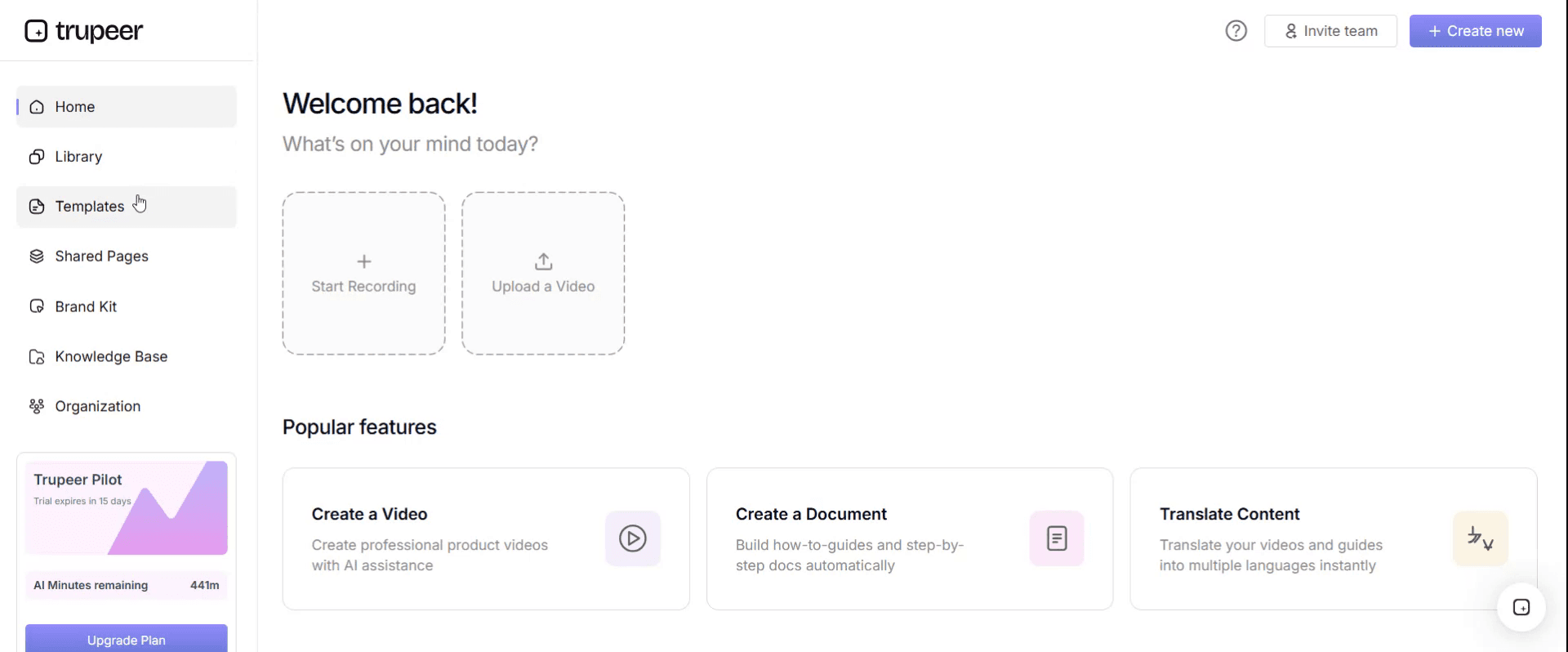
Step 1: Open the Templates Section
Go to the Templates section from the main navigation.
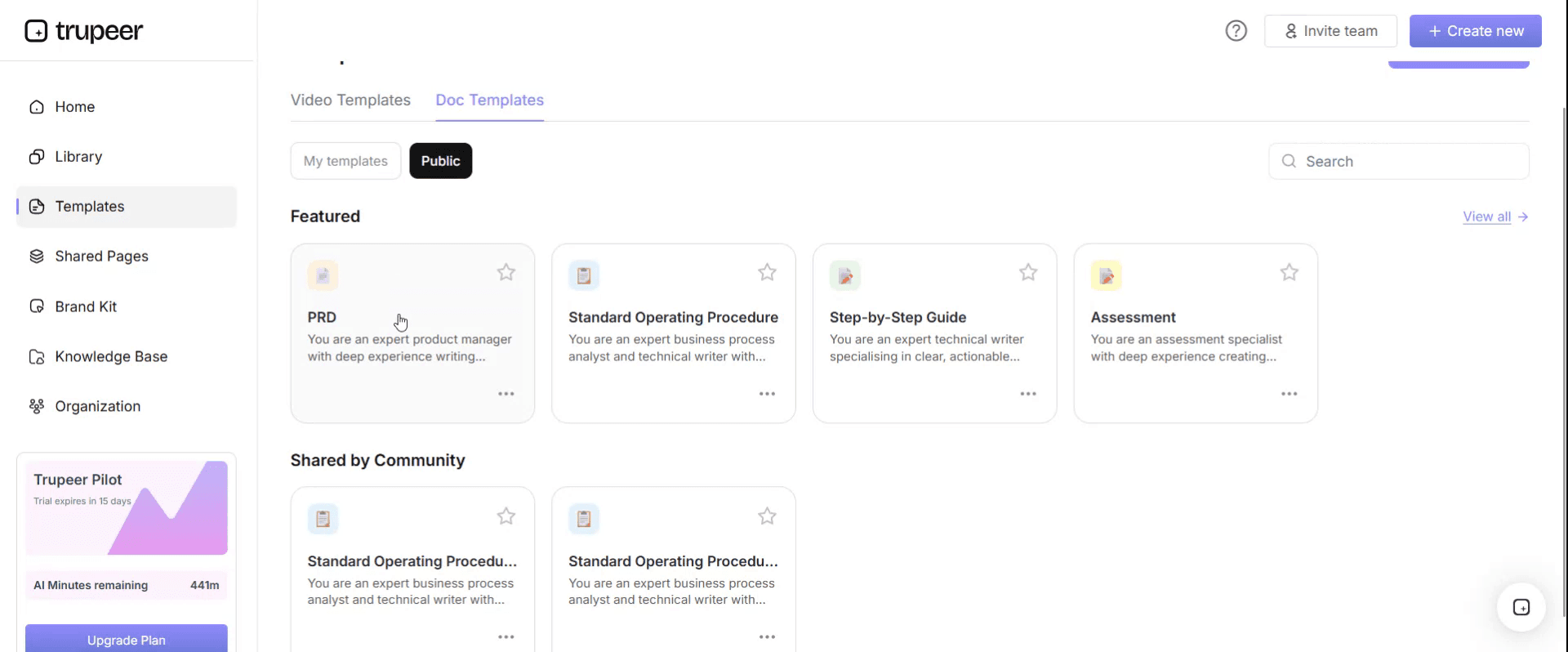
Step 2: Select and Open a Template
Click on any template you want to work with to open it.
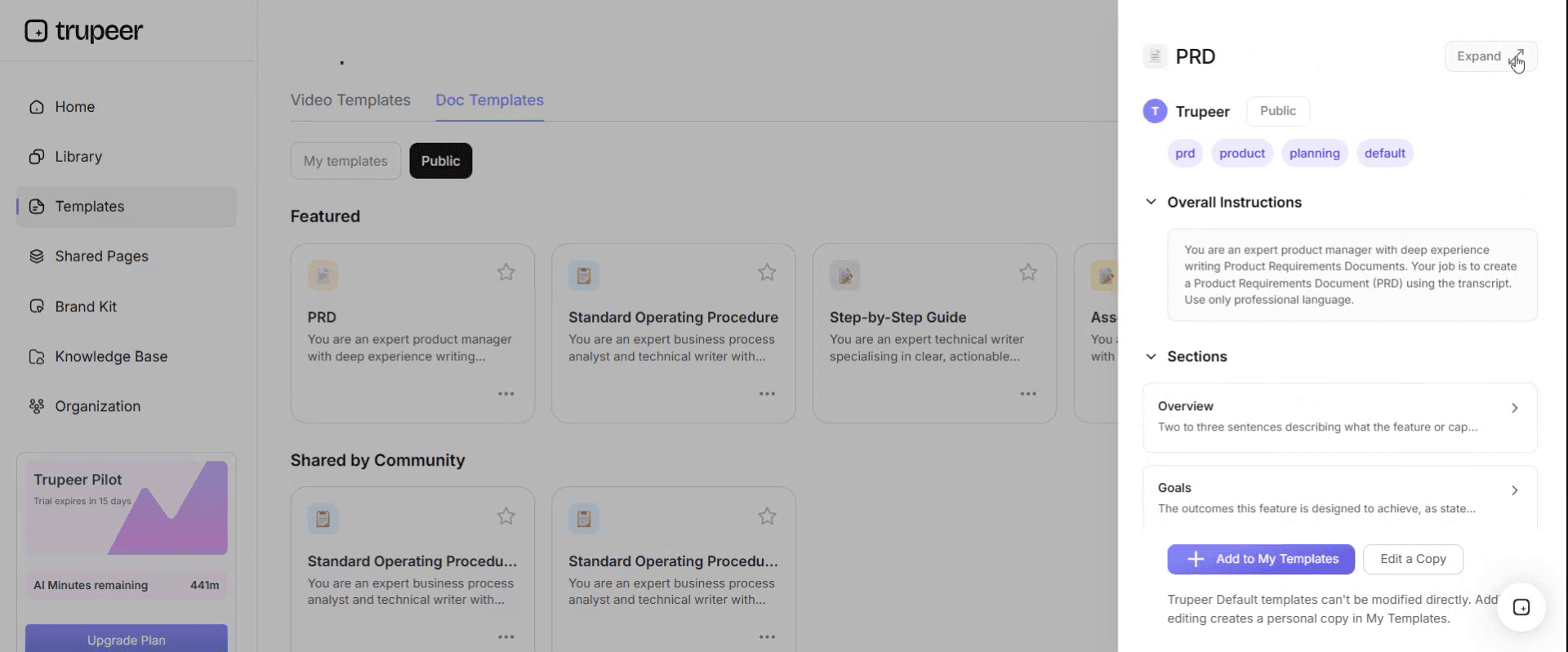
Step 3: Expand the Template View
If needed, expand the template view to see the full layout and details clearly.
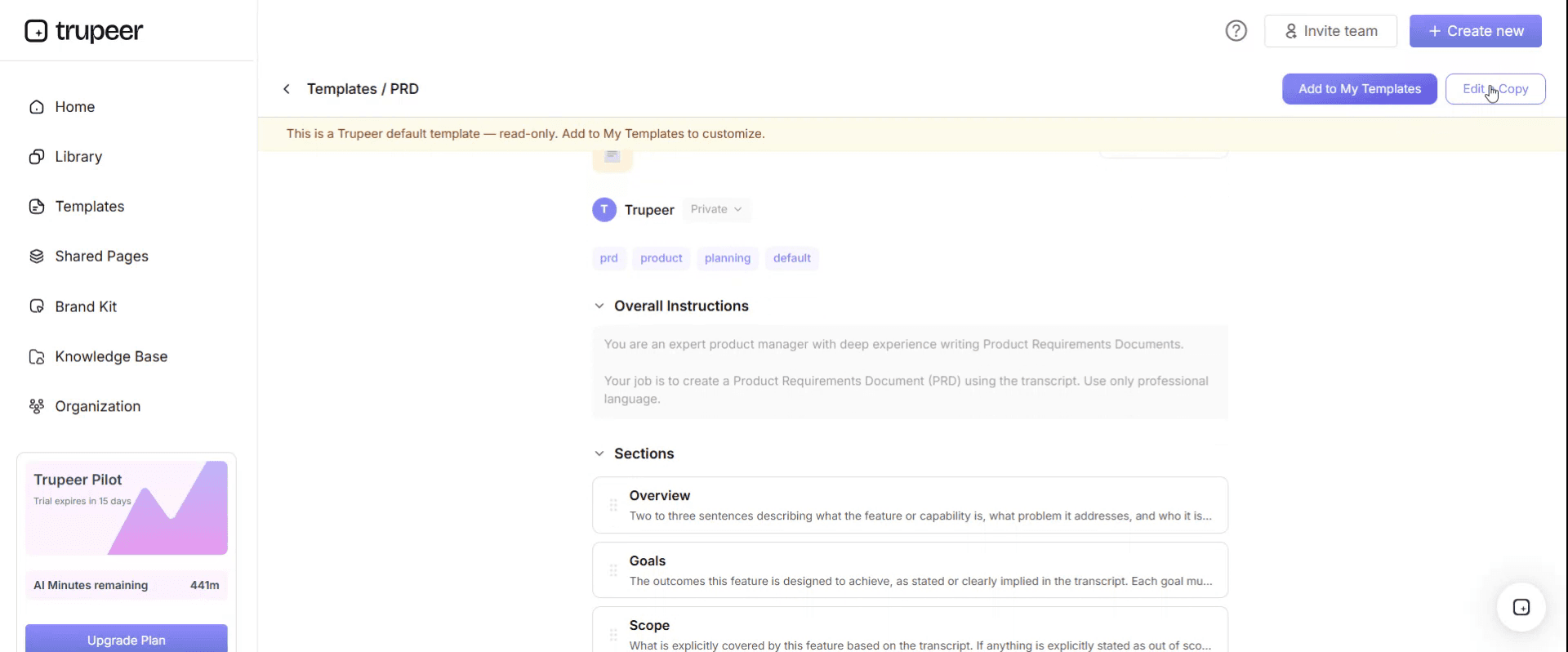
Step 4: Edit the Template
Click on Edit to start modifying the selected template.
Within the editor, you can:
Add new sections
Define or update formatting rules
Add a logo and adjust its position and related settings
Step 5: Save Your Customized Template
After making all necessary changes, click Save to store the updated template as your own.
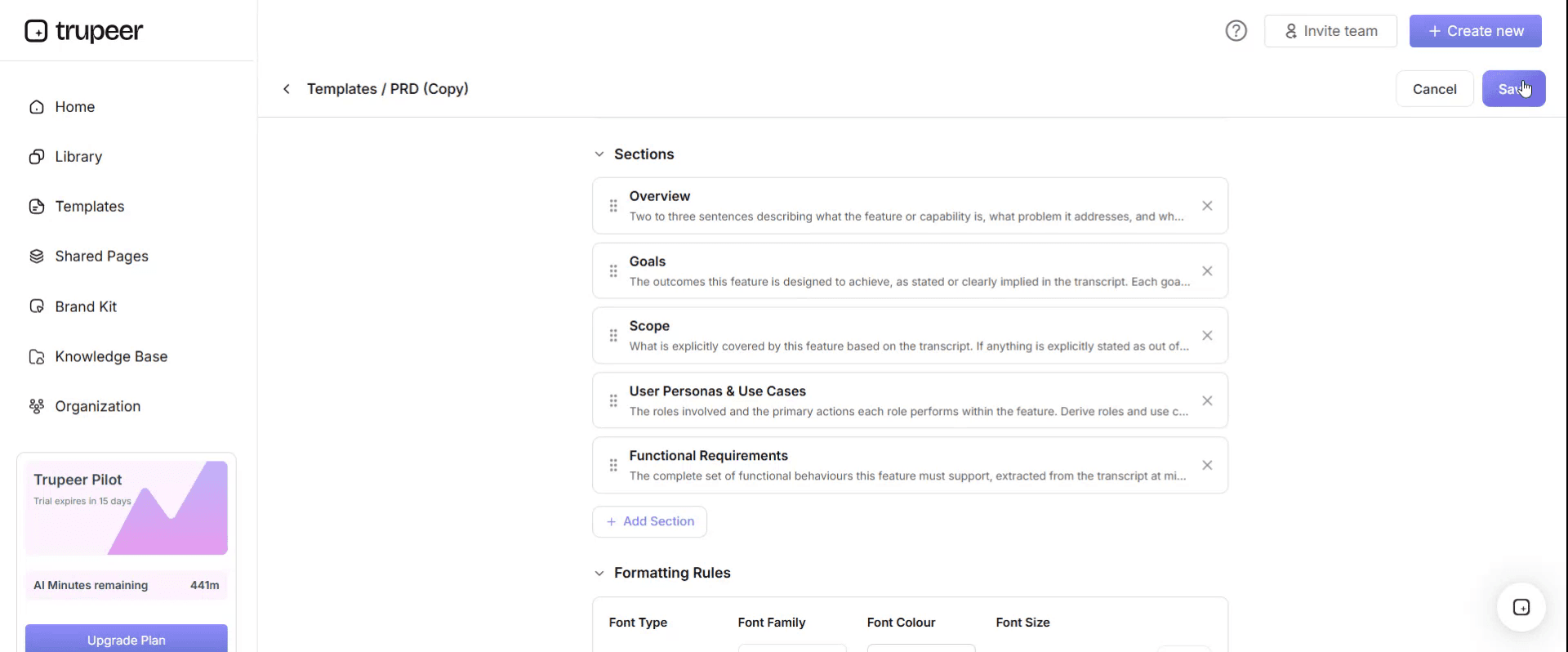
Step 6: Preview and Fine-Tune the Template
When you want to see how your customized template looks, open the Preview.
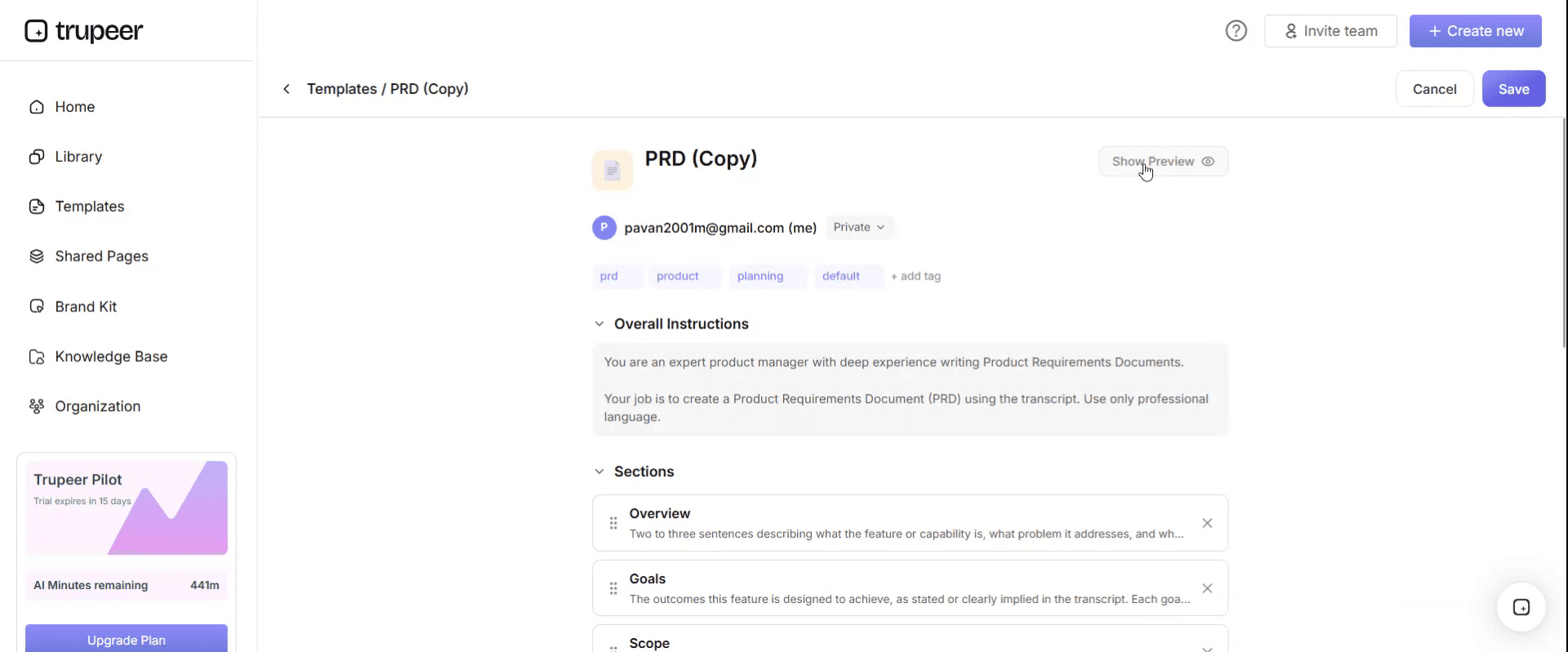
From the preview screen, you can continue to make adjustments directly if needed, ensuring the template appears exactly as you want.
With a service level agreement template you can:
Save hours on writing: Skip the blank page with a structure used by service providers.
Set clear expectations: Built-in sections for metrics, response times and exclusions.
Stay on-brand: Apply your logo, fonts and colors using Trupeer's brand kit.
Reduce disputes: Clear SLAs prevent misunderstandings about what's covered and when.
Standardize across customers: Use the same SLA template for every relationship.
Reach global customers: Translate SLAs into 65+ languages with one click.
The window, the exclusions and the remedy
Three questions turn a target into something enforceable, and templates supply the number without any of them.
Over what period is it measured? This is the question that changes the meaning of the number most dramatically, and almost nobody asks it.
Availability | Allowed downtime per month | Allowed downtime per year |
|---|---|---|
99.5% | About 3 hours 40 minutes | About 1 day 20 hours |
99.9% | About 43 minutes | About 8 hours 45 minutes |
99.95% | About 22 minutes | About 4 hours 20 minutes |
99.99% | About 4 minutes 20 seconds | About 53 minutes |
Ninety nine point nine percent measured monthly allows forty three minutes of downtime in any month. The same figure measured annually allows almost nine hours, and permits every one of those hours to fall on a single day in your busiest week while the provider remains fully compliant. Same number, entirely different agreement.
What is excluded? Every SLA excludes something and the list is where the commitment is really decided. Scheduled maintenance is reasonable and should be bounded: within a stated window, with stated notice, capped at a stated number of hours per month. Unbounded maintenance exclusions make the availability figure meaningless. Third party failures are the exclusion to read hardest, because a cloud hosted provider whose contract excludes their own hosting provider's failures has excluded the most likely cause of any outage you will experience.
What happens when it is missed? The remedy. Whether it is automatic or must be claimed, within what period, calculated how, capped at what, and whether repeated failure gives you any right beyond credits.
A template that gives you a number and leaves all three blank has given you the easy part.
What a service level agreement template must contain
Ten components. The service level table carries the substance.
Component | What it does |
|---|---|
Parties and term | Who is bound, from when, for how long, and how it renews or ends. |
Services covered | Precisely what is in scope, and explicitly what is not. |
Definitions | What available means, what an incident is, what each priority means. Ambiguity here undoes everything below. |
Service level table | Each commitment with its target, measurement method, measurement window and remedy. |
Priority definitions | How severity is assigned, and who assigns it. Covered below, because this is where most disputes start. |
Exclusions | Maintenance, third party dependencies, customer caused issues, force majeure. Bounded rather than open ended. |
Measurement and reporting | Who measures, using what, reported how often, and whether the customer can verify it. |
Remedies | Credits or other consequences, how claimed, within what period, capped how. |
Review and change | How service levels are revisited, and what happens if the service changes materially. |
Governance | Who meets, how often, and how a dispute escalates before it becomes a legal matter. |
The priority definitions row deserves emphasis. Most SLA disputes are not about whether a response happened within four hours. They are about whether the incident was priority one or priority two, because that determines which clock applied. If the provider assigns priority unilaterally, the response time commitment is softer than it appears.
Free service level agreement template: the structure to copy
Filled with a real example rather than placeholders. This is a support and availability SLA for a business software service. It is illustrative and is not legal drafting.
Copy from here.
Parties and term. Provider, customer, effective date, initial term, renewal mechanism, notice period.
Services covered. The hosted application, its standard integrations, and support. Not covered: customer's own network and devices, customer configured integrations, third party applications, and any custom development.
Definitions. Available means the application responds to a login request and returns a page within ten seconds, tested from two independent external locations at one minute intervals. Degraded performance is not unavailability unless response exceeds thirty seconds for more than fifteen consecutive minutes.
Service level table.
Service level | Target | Measured | Window | Remedy if missed |
|---|---|---|---|---|
Availability | 99.9% | External monitoring from two locations, one minute intervals, log available to customer | Calendar month | 5% of monthly fee per 0.1% below target, to a cap of 30% |
Priority one response | 30 minutes | Ticket system timestamps, acknowledgement by a named engineer | Calendar month, 95% of tickets | 5% of monthly fee if below 95% |
Priority one resolution or workaround | 4 hours | Ticket system timestamps | Calendar month, 90% of tickets | 5% of monthly fee if below 90% |
Priority two response | 4 working hours | Ticket system timestamps | Calendar month, 95% of tickets | Escalation, no credit |
Data restore from backup | 4 hours from request | Restore completion timestamp | Per incident | 10% of monthly fee per failure |
Priority definitions. Priority one: the service is unavailable to all users, or a core function is unusable with no workaround. Priority two: a core function is impaired with a workaround available. Priority three: everything else. Priority is proposed by the customer and may be changed only by agreement, with disagreements escalated to the governance forum within one working day and the higher priority applying until resolved.
Exclusions. Scheduled maintenance within the window of 22:00 to 02:00 on Sundays, with five working days notice, capped at four hours per calendar month. Emergency maintenance with as much notice as circumstances allow, capped at two hours per month before it counts against availability. Failures caused by the customer's network or configuration. Force majeure. Note that failures of the provider's own hosting infrastructure are not excluded and do count against availability.
Measurement and reporting. Provider measures using named external monitoring. The raw log is available to the customer on request at any time. A monthly report is issued within five working days of month end showing performance against each service level.
Remedies. Credits are applied automatically to the next invoice without the customer needing to claim. Total credits in any month are capped at 30% of the monthly fee. Where availability falls below target in three consecutive months, the customer may terminate on thirty days notice without penalty.
Review. Service levels reviewed annually, or within thirty days of any material change to the service.
Governance. Monthly service review with named attendees from both sides. Disputes escalate to named executives within ten working days before any formal process begins.
Copy to here.
Two features of that document are unusual and both are deliberate. Credits are automatic rather than claimable, which removes the common situation where a customer is entitled to a remedy and never claims it. And repeated failure creates a termination right, which is the only remedy providers genuinely fear.
Service level agreement example: six hours in November
Ballinger Wholesale, a food wholesaler of about four hundred staff, ran its warehouse operation on a hosted software service under a three year contract.
The SLA committed to ninety nine point nine percent availability and a four hour response for priority one incidents. Both figures had been checked during procurement and found acceptable.
Four things had not been checked. Availability was measured annually rather than monthly. Scheduled maintenance was excluded with no cap on hours. Failures attributable to third party infrastructure were excluded, which covered the provider's own cloud host. And response meant acknowledgement rather than resolution, with no resolution commitment anywhere in the document.
On a Tuesday in November the service was unavailable for six hours, caused by a failure at the provider's cloud region.
Pickers could not pick. Around a hundred and eighty thousand pounds of orders went unfulfilled that day, and two retail customers applied late delivery penalties under their own contracts with Ballinger.
Ballinger received a response within four hours, correctly. They received no credit, because the outage was excluded as third party infrastructure. Even had it not been excluded, six hours sits comfortably within the eight and three quarter hours that ninety nine point nine percent permits across a year, so the provider would still have been compliant.
The provider had not behaved badly. They met every commitment in the document, which was the problem.
The procurement review afterwards looked at fourteen supplier SLAs the business held. Eleven contained no remedy of any kind beyond a commitment to investigate. Three had credits, of which two were claimable only in writing within a short window, and neither had ever been claimed by anyone at Ballinger.
At renewal they asked for three changes. Monthly measurement. Exclusions bounded, with hosting failures explicitly included. And credits applied automatically with a termination right after three consecutive breach months.
The provider accepted the first two and refused the third, offering an extended notice period instead. That is a normal outcome and it was still a considerably better contract than the one it replaced.
The cheapest lesson in the whole episode is that all three changes were available for the asking, and nobody had asked at the original negotiation because the number at the top of the page had looked reassuring.
Types of service level agreement
Three types are commonly distinguished, and the distinction affects how the document is structured.
Customer based SLA. One agreement covering all services provided to a single customer. Common where a provider delivers several things to one client and simplest to manage.
Service based SLA. One agreement covering one service across all customers who take it. Standard for software and hosted services, and typically non negotiable below a certain contract value.
Multi level SLA. Layered, with a corporate level covering terms common to everyone, a customer level, and a service level. Used by larger providers to avoid maintaining hundreds of bespoke documents.
Two related documents sit alongside these. An operational level agreement is internal, between teams inside the same organisation, supporting the external commitment. If you have promised a customer a four hour resolution and your infrastructure team has no corresponding internal commitment, the external SLA rests on goodwill. An underpinning contract is the equivalent with a third party supplier, and any external commitment that depends on a supplier must be supported by one, or you have promised something you do not control.
How to write a service level agreement in six steps
Define the terms before the numbers. What available means, what each priority means, what response means. Numbers attached to undefined terms are unenforceable in practice even where they are enforceable in law.
Set the measurement window first. It changes the meaning of every figure that follows.
Choose targets you can currently meet. Look at twelve months of actual performance. An SLA promising better than your historical performance without an operational change behind it is a commitment to fail.
Bound every exclusion. Capped hours, stated windows, stated notice. An exclusion without a limit swallows the commitment.
Attach a remedy to every target. Automatic where possible, and proportionate to the harm rather than to the fee.
Have it reviewed by a lawyer. This is a contract with financial consequences, and the review costs a fraction of a single dispute.
Step three deserves a note for providers. There is a persistent temptation to offer a service level slightly better than the competition rather than slightly better than your actual performance. That gap becomes credits, and eventually becomes a customer with a termination right.
Exclusions and remedies
These two sections determine the value of the entire document, and both tend to be skimmed.
Exclusions to look at hardest. Scheduled maintenance, which should be bounded by window, notice and monthly hours. Third party and infrastructure failures, which should be explicitly included where the provider chose the third party. Customer caused issues, which are reasonable and should be defined rather than left as a general escape. Force majeure, which is standard and should still be specific about what qualifies.
A Service Level Agreement example PDF published by a public sector buyer is the best place to see both handled properly, since those documents were negotiated by parties with something at stake.
Remedies worth negotiating. Automatic credits rather than claimable ones, because claimable credits go unclaimed at a remarkable rate. Credits that scale with severity rather than a flat percentage. A cap that is high enough to matter. And an escalating consequence for repeated failure, since a provider who can absorb the credit indefinitely has no incentive to fix anything.
The point to be realistic about is that service credits rarely compensate for actual loss and are not designed to. They exist to create an incentive and to give the customer something concrete to point at. Where the potential loss is genuinely large, credits are not the right mechanism and the conversation needs to be about liability, insurance and termination rights, all of which require legal advice rather than a template.
What a free service level agreement template cannot fix
A service that cannot meet the number. Signing a commitment you have never achieved does not improve the service. It converts an operational problem into a contractual one.
Undefined priorities. If severity is assigned by whoever is arguing, every response time in the document is soft.
Nobody measuring. An SLA with no reporting is unenforced by default, because the customer only ever discovers a breach during an incident, when they are busy.
Legal risk. No free service level agreement template Word free download is written for your jurisdiction, your liability position or your existing contract terms. The structure transfers. The drafting does not, and this is the document where that distinction is most expensive.
Meeting the commitment, not just writing it
The document is the easy half. Meeting a four hour resolution commitment repeatedly, across a support team of varying experience, is the harder one, and it is where credits are actually earned or lost.
The variable that moves resolution time most is whether the person picking up the ticket knows the procedure for that class of problem. Written procedures address this poorly, because the reader has to reconstruct a sequence of screens from prose, gives up, and asks a colleague, which converts one person's four hours into two people's four hours.
Trupeer AI closes that gap. Somebody resolves the issue once while recording, and the output is a written step by step walkthrough with screenshots already captured and placed, alongside a video, in your own branding. The next person to see that problem follows it rather than asking.
Record it. Brand it. Translate it. Trupeer it.
Two things follow that matter for service commitments. Where support operates across regions or languages, the same recording produces the same procedure in each, so the resolution time commitment does not depend on which team the ticket landed with. And when the product changes, re-recording is faster than editing, which keeps the procedures current rather than quietly wrong.
The material sits in your knowledge base and doubles as training for new support staff. Task level detail belongs in the work instructions underneath. Consistency with your other documents is a matter of setting the brand kit once, and setup is covered in the document template setup guide.
Frequently Asked Questions
Is there a free service level agreement template Word version?
Word is where SLAs are drafted, because both sides mark up the text and negotiate specific clauses. A free service level agreement template Word file with tracked changes is the normal working format.
Structure it with the service level table as its own section rather than distributed through the prose, since that table is what both sides will return to. And have the finished document reviewed by a lawyer before signing, because the template supplies structure rather than enforceable drafting.
Is there a free service level agreement template Word doc or doc version?
Yes, and they are the same thing under different file extensions. A free service level agreement template Word doc file and a free service level agreement template doc file both give you an editable document, with the older extension simply indicating an older format.
What matters far more than the extension is whether the template includes a measurement window, bounded exclusions and a remedy against each target. Most do not, and those three additions are the difference between a document that binds and one that describes.
Is there a free service level agreement template Word free download?
There are many, and the caution is worth stating plainly. A free service level agreement template Word free download is drafted for no particular jurisdiction and no particular commercial relationship.
Use it to structure your thinking and to make sure you have not forgotten a section. Do not use it as the document you sign. The cost of legal review on an SLA is small relative to a single disputed outage, and this is the document type where that comparison is clearest.
Is there a Service Level Agreement template Word PDF?
Most published templates offer both, and each format has its moment. A Service Level Agreement template Word PDF pairing typically means the Word file is for editing and negotiation, and the PDF is what gets signed and filed.
Keep the editable source after signature. SLAs get reviewed at renewal, amended when services change, and referenced during disputes, and reconstructing the document from a PDF is avoidable work.
Is there a free service level agreement template PDF?
PDF is the executed version. Once both parties have agreed the terms, a free service level agreement template PDF signed and dated is the reference copy, and its value comes from the fact that it cannot quietly change.
Make sure the version and date appear on the document itself rather than only in the file name, and that any subsequent amendment is a numbered variation attached to it rather than a replacement PDF with the same name.
Where can I find a Service Level Agreement example PDF?
Government and public sector procurement sites publish real ones, and a Service Level Agreement example PDF from a public contract is more instructive than a commercial template, because it was negotiated by parties with something at stake.
Read them for the exclusions and the remedies rather than for the targets. The targets are specific to that service and will not transfer. How a serious buyer bounded maintenance windows and what consequence they attached to repeated failure will.
Is there a free service level agreement template Excel version?
Excel is poor for the agreement and good for what surrounds it. A free service level agreement template Excel file works well for the service level table itself, and better still for the monthly tracking of actual performance against each commitment.
Keep the agreement in a document. The definitions, exclusions, remedies and governance provisions are legal text, and legal text in spreadsheet cells gets truncated, reformatted and eventually misread.
What is the difference between an SLA and a KPI?
A key performance indicator is something you measure. A service level agreement is something you are bound to, with a defined measurement method and a consequence for missing it.
The practical test is what happens on a bad month. If the answer is a conversation, you have a KPI. If the answer is a credit, an escalation or a termination right, you have an agreement. A great many documents titled SLA contain only KPIs, which is worth knowing before you rely on one.


