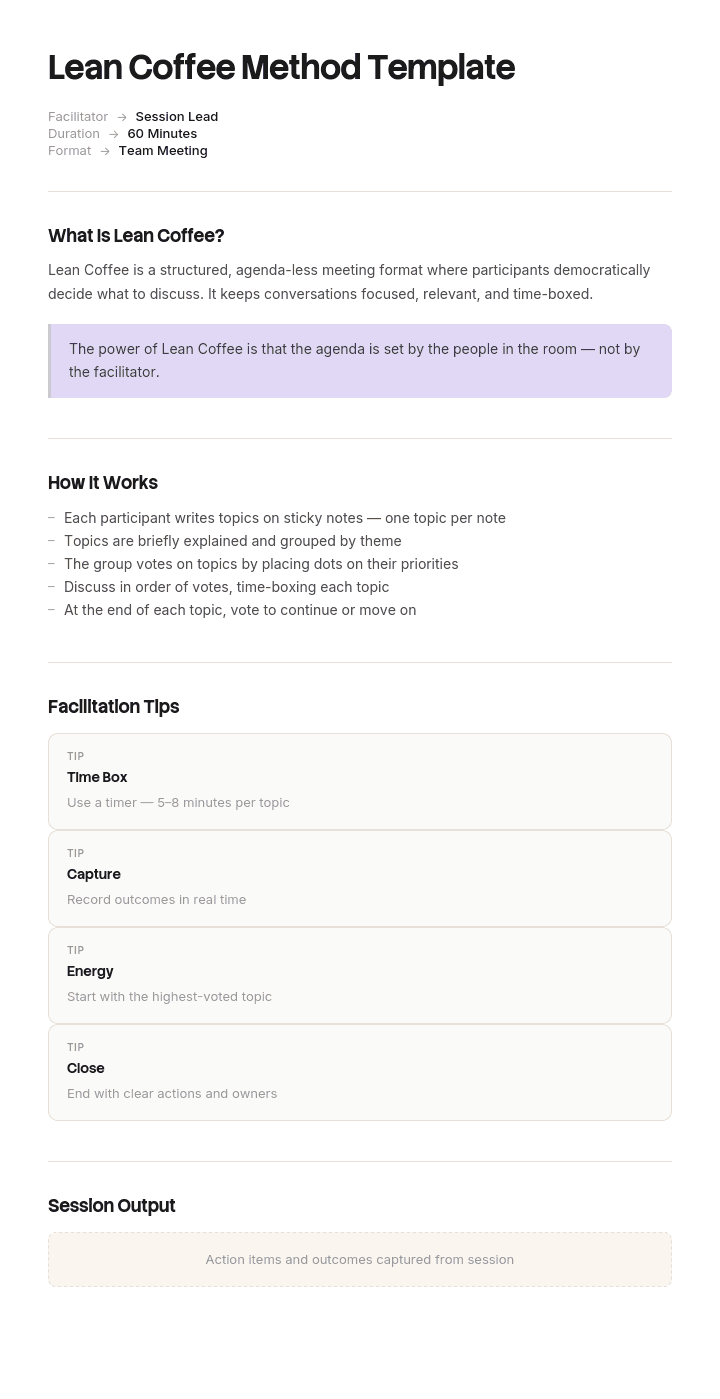
Use this template
Lean Coffee turns meetings from one-way broadcasts into focused, participant-driven conversations. With Trupeer, you can save hours on facilitation prep by starting with a free Lean Coffee method template, customizing it with your brand guidelines, and turning session outcomes into video summaries the team can revisit.
What is the Lean Coffee method, and what is the template for?
Lean Coffee is a meeting format with no agenda set in advance. The people who turn up propose the topics, vote on them, and discuss them in short timed blocks, with the group deciding after each block whether to keep going. It was created by Jim Benson and Jeremy Lightsmith in Seattle in 2009 and spread through agile teams from there.
A Lean Coffee template is the board and the rules: three columns, a card format, a voting allocation and a timebox. The board can be a wall, a whiteboard or a shared canvas, and it matters far less than the rules attached to it.
The format suits any recurring meeting where the right topics are not knowable a week ahead. Team retrospectives, community of practice sessions, skip-level conversations, and the standing meeting that has quietly become a status update. It does not suit meetings with a decision that must be made by a deadline, for reasons covered further down.
Lean Coffee removes the agenda-setter, not the agenda
Almost every guide describes Lean Coffee as an agenda-less meeting. That is accurate and it hides what is actually happening.
A Lean Coffee meeting has an agenda. It is built in the first five minutes, in the room, by everyone. What has been removed is the role of the person who used to build it beforehand, and that role is where the power in most meetings sits. Whoever sets the agenda decides what gets air, in what order, and what quietly never appears.
This is why the format produces such different results in different teams with identical tooling. It is a redistribution of control dressed as a facilitation technique. Teams where control was already fairly evenly held barely notice. Teams where one person set every agenda find it either liberating or threatening, and which of those it is decides whether the format survives.
It also tells you what to protect. Every rule below exists to stop the agenda-setter reappearing, whether that is through who proposes, who votes first, or who speaks first on each topic.
How to customize this template in Trupeer
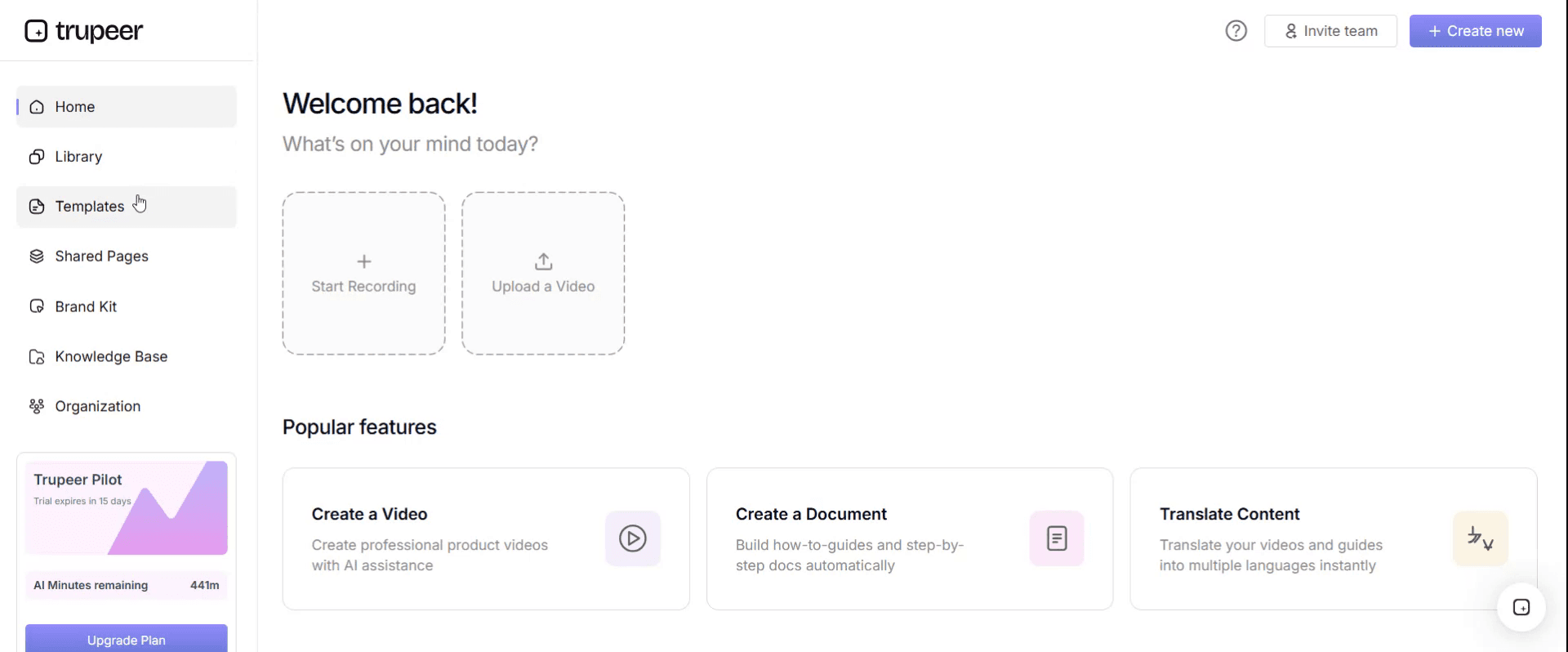
Step 1: Open the Templates Section
Go to the Templates section from the main navigation.
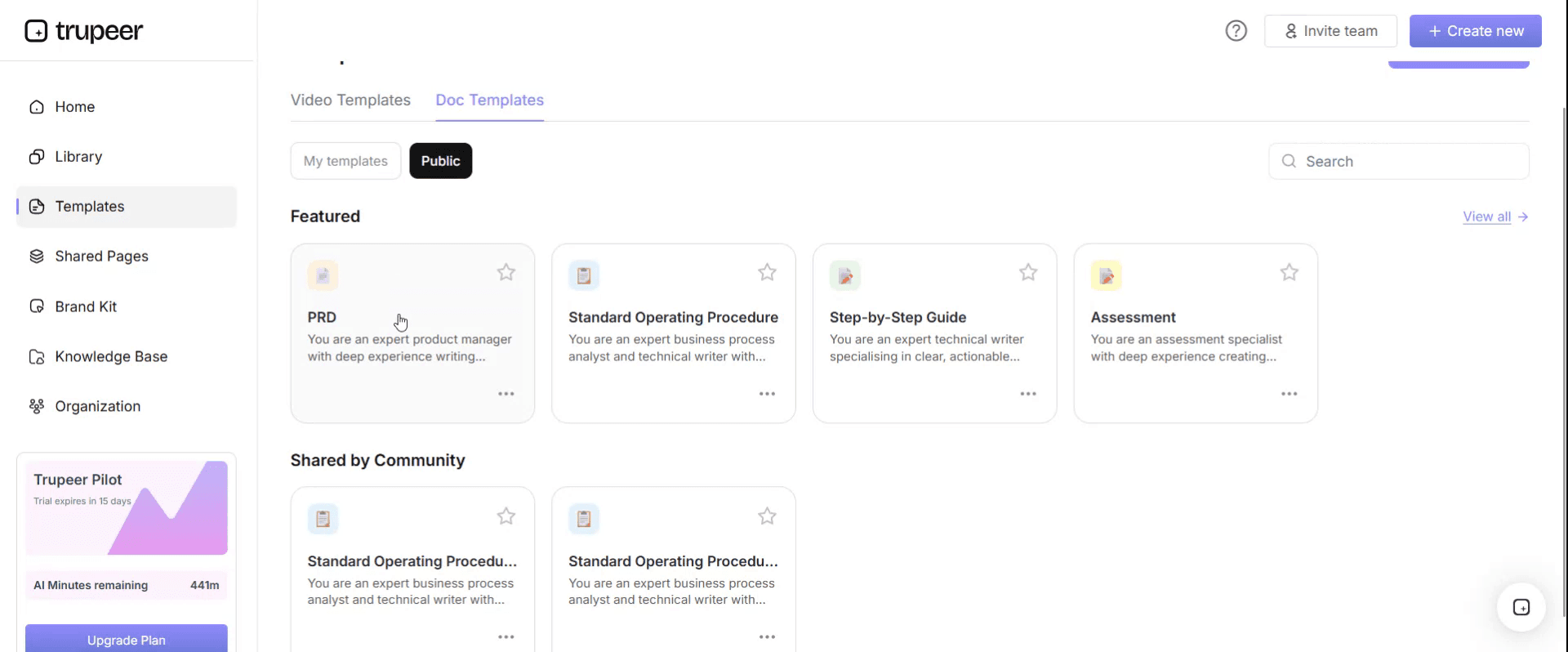
Step 2: Select and Open a Template
Click on any template you want to work with to open it.
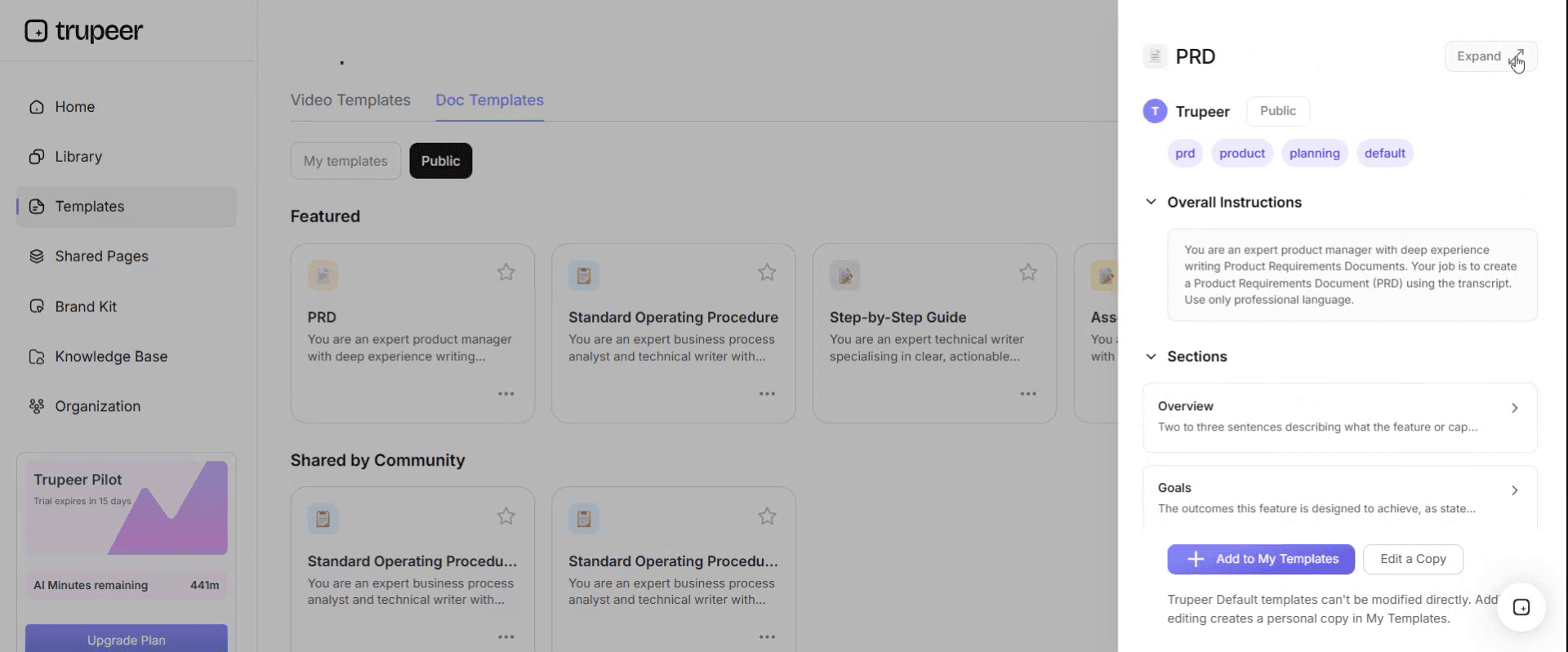
Step 3: Expand the Template View
If needed, expand the template view to see the full layout and details clearly.
Step 4: Edit the Template
Click on Edit to start modifying the selected template.
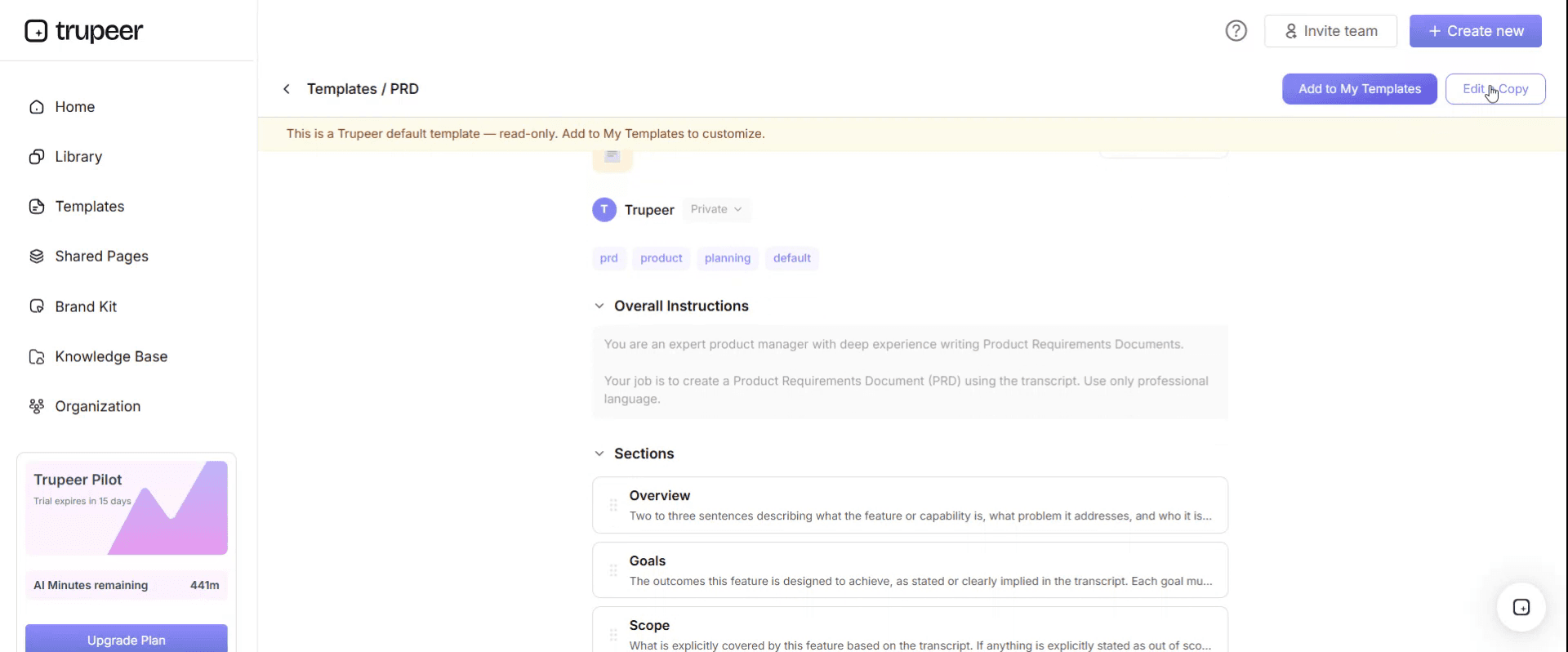
Within the editor, you can:
Add new sections
Define or update formatting rules
Add a logo and adjust its position and related settings
Step 5: Save Your Customized Template
After making all necessary changes, click Save to store the updated template as your own.
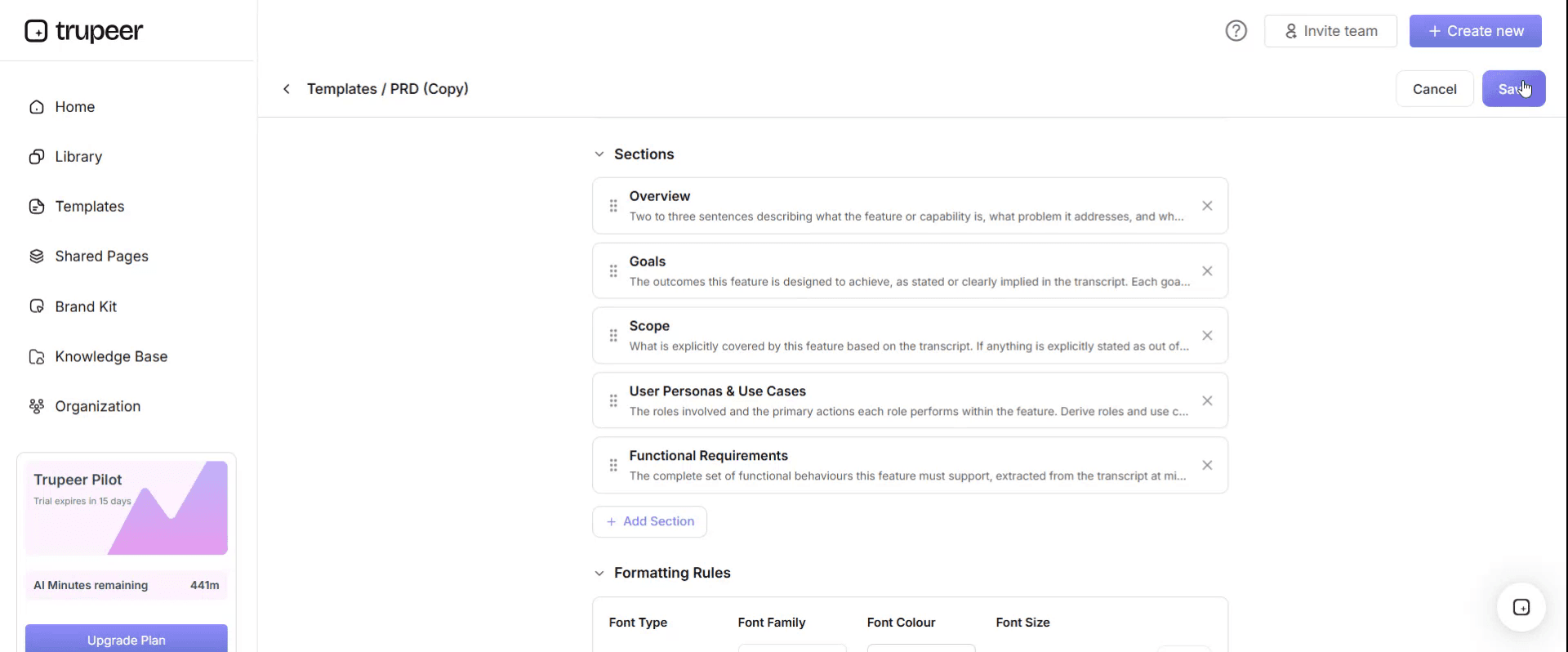
Step 6: Preview and Fine-Tune the Template
When you want to see how your customized template looks, open the Preview.
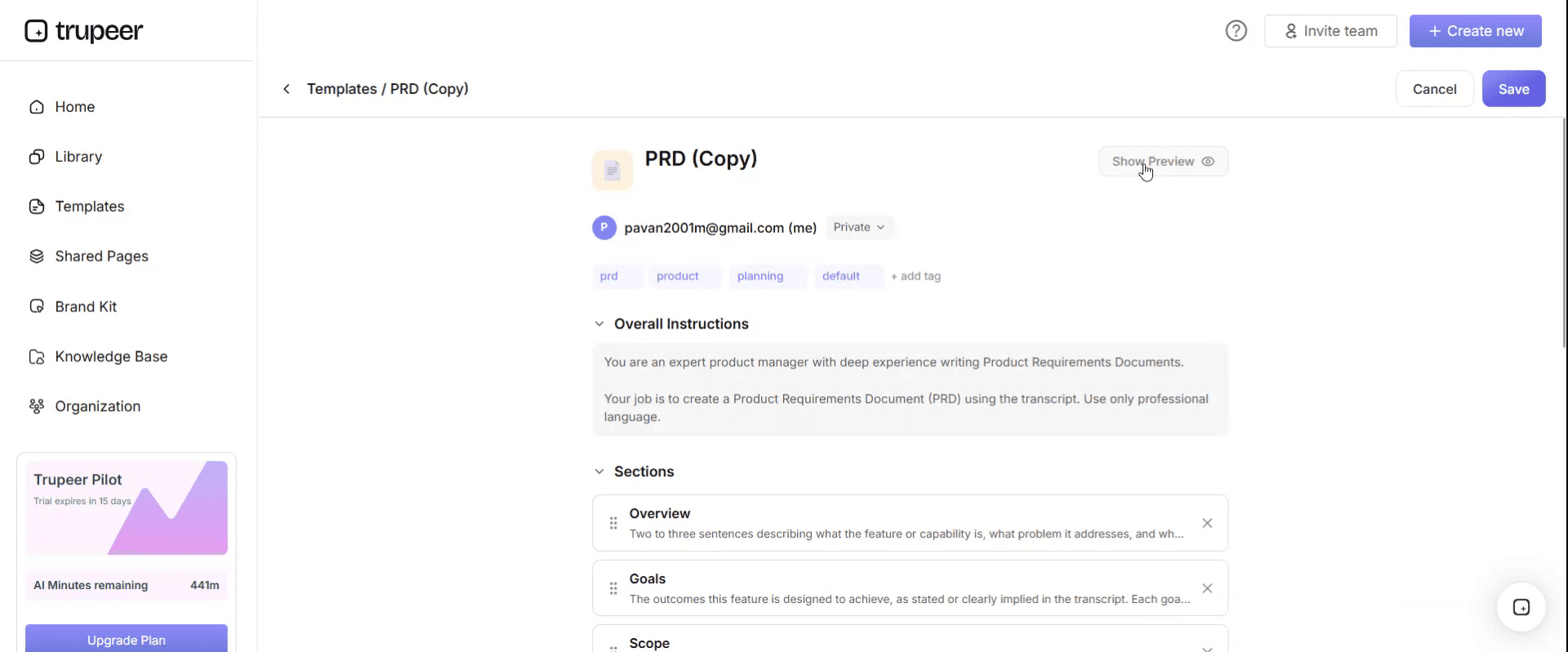
From the preview screen, you can continue to make adjustments directly if needed, ensuring the template appears exactly as you want.
With a Lean Coffee method template you can:
Save hours on facilitation: Skip the blank page with a proven Lean Coffee structure.
Drive engaged discussion: Built-in voting and time-boxing keep sessions focused.
Stay on-brand: Apply your logo, fonts and colors using Trupeer's brand kit.
Capture insights: Convert session outcomes into video summaries for absent stakeholders.
Standardize across teams: Use the same template for every Lean Coffee session.
Reach global teams: Translate session summaries into 65+ languages with one click.
How to run a Lean Coffee meeting, step by step
Set up three columns: To discuss, Discussing, Discussed. Physical or digital, it makes no difference.
Give everyone three or four minutes to write topics, one per card, in silence. Silence is load-bearing. The moment people start proposing out loud, the confident and the senior fill the board.
Read the cards out without attribution. Whoever is facilitating reads them, not the author, which keeps a topic from being weighted by who suggested it.
Give each person two or three votes and have everyone vote at the same time. Dots, marks, whatever the board supports. Simultaneous matters as much as silence did.
Order by votes, move the top card to Discussing, and set a timer for five minutes. Discuss.
When the timer goes, take a thumb vote. Thumbs up means continue, thumbs down means move on, sideways is neutral. Majority wins. If it continues, add three minutes and repeat.
When a topic ends, move the card to Discussed and take the next one. Stop at the meeting's end time regardless of what is left on the board, and leave the unfinished cards where they are.
Free Lean Coffee method template: the board and the cards
Copy from here.
Board. Three columns. To discuss, Discussing, Discussed. Nothing else. A fourth column for actions is the most common addition and it is covered below.
Card fields. Topic in one line, phrased as a question or a statement rather than a subject heading, so "should we stop doing the Friday deploy freeze" rather than "deploy freeze". Optionally a single word for the kind of card: question, problem, idea or decision. Leave the author off.
Rules block, agreed once and visible every session. Topics are written in silence, three minutes. Cards are read out by the facilitator, unattributed. Everyone gets [3] votes, cast simultaneously. First timebox is [5] minutes, extensions are [3] minutes. Thumb vote on a count of three, no discussion before it. The most senior person in the room votes last, or does not vote. The meeting ends at its end time whatever is left on the board.
Session record. Date, who attended, topics that made the board, topics that did not, and any actions. Keep these, for reasons in the section on what to carry between sessions.
Copy to here. The rules block is the template. The three columns are just where the cards go.
Why the thumb vote is the whole Lean Coffee method
Dot voting is not distinctive. Every workshop format in existence uses it, and a meeting that dot-votes an agenda and then works through it is a well-prioritised normal meeting.
The thumb vote is the actual mechanism. Every five minutes the group is asked, without discussion, whether this topic still deserves the room's time. That is continuous consent, and it does something no agenda can do: it lets a topic that turned out to be more important than it looked run for twenty minutes, and kills one that looked promising after five.
It is also the rule teams water down first. The most common corruption is the facilitator asking out loud, "shall we carry on with this one?" That is not a thumb vote. It is an open question, and the person most comfortable speaking answers it, which hands the agenda straight back to whoever it was taken from.
Do it silently, simultaneously, on a count of three. If your team finds that awkward for the first two sessions, that is normal and it passes.
How seniority quietly kills a Lean Coffee meeting
The format has one real failure mode and it is not tooling.
If the most senior person in the room proposes topics out loud, votes first, or speaks first on each card, the meeting reverts. Not dramatically. Everyone still writes cards and everyone still votes. But the cards that reach the board start to be the ones that person would have put on an agenda anyway, and within about four sessions people stop proposing things that will not get votes.
The signal is measurable and worth measuring. Count how many distinct people proposed the topics that made the board over five sessions. If a third of the room is generating most of the board, the format has stopped working regardless of how well the meeting feels.
Three rules fix it and cost nothing. Topics written silently. Votes cast simultaneously. The most senior person votes last or abstains. That last one is usually the hardest to introduce and the most effective, and it works best when the senior person proposes it themselves.
A Lean Coffee example: worked in one team, died in three
Aldercroft, a software company of around a hundred and eighty people, had run fortnightly Lean Coffee in engineering for a year. It was well liked and leadership rolled it out to six more teams.
Four months later engineering was still running it. Three of the six had quietly stopped. Two had turned it into a status update with a voting ritual at the front.
The review expected to find a facilitation or tooling problem and found neither. Every team had the same board, the same timer and the same one page of rules.
What differed was the first three minutes. In the teams where it died, topics were proposed out loud rather than written in silence, and the most senior person in the room voted first, visibly.
They counted it. In customer success, across five sessions, thirty one of the thirty four topics that reached the board had come from three of the eleven attendees. In engineering over the same period, forty seven topics had come from nine of twelve.
The thumb vote had degraded the same way. The failing teams had a facilitator asking aloud whether to continue. Engineering did it silently on three.
The fixes were the three rules above, introduced in customer success by the team's director, who volunteered to stop voting. Over the next five sessions, eight of eleven people proposed topics that reached the board.
Nothing about the template changed. The board was identical throughout.
What are the common pitfalls in Lean Coffee?
Pitfall | What it looks like | Fix |
|---|---|---|
Topics proposed out loud | The board fills with the loudest three people's concerns | Silent writing, three minutes, no exceptions |
Sequential voting | People see the senior vote and follow it | Vote simultaneously, senior person last or abstaining |
Thumb vote asked as a question | Facilitator says "shall we continue?" | Silent thumbs on a count of three |
Timebox not enforced | First topic eats the meeting | Timer visible to everyone, not held by the facilitator |
No actions captured | Good discussions evaporate by Thursday | Action card rule, covered below |
Used for a real decision | The deadline arrives and nothing is decided | Use a normal meeting with a named decision maker |
Same topics every session | Nobody notices the pattern | Keep the session record and read it quarterly |
The last two are worth separating from the rest. Lean Coffee is a poor format for making a decision that has to be made by Friday, because nothing guarantees the topic reaches the board. Use it to surface what needs deciding, then hold a different meeting to decide it.
How to capture actions without breaking the format
The gap in the standard format is real. Topics get discussed, everyone leaves feeling it was a good conversation, and nothing changes. Several template libraries now offer a Lean Coffee with actions variant for exactly this reason.
The lightest fix that works: when a topic ends, before the card moves to Discussed, the facilitator asks one question. Does anything happen because of this? If yes, write a card with a name and a date on it. If no, say so out loud and move on.
That question takes about fifteen seconds and it is the only addition to the format worth making. Resist a full action review at the end, which turns the meeting back into a managed agenda.
Read the previous session's action cards aloud at the start of the next one, before topic writing begins. Nothing more than reading them. That thirty seconds does more for follow-through than any tracker.
What to keep between sessions, and what it tells you
Most teams wipe the board at the end. That throws away the most interesting output the format produces.
The board is a record of what your team actually wants to talk about, generated without anyone filtering it. Kept over a quarter, it answers questions no survey will.
Which topics get voted up repeatedly and never resolved. That is usually something outside the team's control that nobody has escalated, and it is worth escalating.
Which topics get proposed and never get votes. Sometimes that is one person's hobby horse. Sometimes it is the thing everyone is avoiding.
How many distinct people propose topics. The participation number from the example above, tracked over time.
And which topics are procedural, meaning somebody wanting to know how something is done. A cluster of those is not a discussion problem. It is a documentation gap wearing a meeting costume.
Can I get a Lean Coffee template in PPT or Excel?
PowerPoint suits the rules slide and the facilitator's script rather than the board. One slide with the seven rules, shown at the start of every session, does more for consistency than anything else you can put on a screen, particularly when facilitation rotates.
Excel suits the session record: date, attendees, topics proposed, topics that made the board, who proposed each one, and actions with owners. That sheet is what makes the participation count and the repeated-topic analysis possible, and it takes about ten minutes to set up.
Neither is right for the board itself during the meeting. The board needs to be something everyone can reach at the same time, which means a wall, a whiteboard or a shared canvas. A board only the facilitator can edit reintroduces the agenda-setter through the back door.
When the same topic keeps coming back, write it down
Once you keep the session record, one pattern shows up in almost every team. A handful of topics recur, and when you look at them closely they are not debates at all. They are people asking how something works, or how it is meant to be done, and the discussion is a group act of remembering.
Those topics do not need another five minutes. They need writing down once.
Trupeer AI makes that cheap enough to do on the day. Whoever knew the answer in the meeting records themselves doing the thing, and the result is a formatted guide with the steps already written, plus a video and a document for your knowledge base in your own branding. A topic that has taken fifteen minutes of a team meeting three times over a quarter is worth ten minutes of recording.
Record it. Brand it. Translate it. Trupeer it.
Where the recurring topic is a process rather than a question, the SOP creator covers it, and the structures for writing it up sit in our knowledge base article templates. Setup instructions are in the document template setup guide.
Frequently Asked Questions
Is there a free Lean Coffee method template in PPT?
Use slides for the rules and the facilitator script, not the board. One slide listing the seven rules, one showing the timebox, and one with the previous session's actions is enough. Keeping it to three slides matters, because a facilitator deck longer than that stops being opened.
Is there a free Lean Coffee method template in Excel?
Excel is the right home for the session record rather than the meeting. Columns for date, attendee count, topic, who proposed it, votes received, whether it was discussed, and any action with an owner. Two derived numbers are worth adding: distinct proposers per session, and topics appearing for the second or third time.
What is the best free Lean Coffee method template?
The one that includes the voting rules rather than just the three columns. Most free templates give you a board layout, which is the part you could draw on a whiteboard in ten seconds. The rules about silence, simultaneous voting and the thumb vote are what actually distinguish the method, and a template without them will produce an ordinary meeting with sticky notes on it.
How long should a Lean Coffee meeting be?
Between thirty and sixty minutes. Under thirty and you get through one topic. Over sixty and attendance decays, because the format's appeal is that it is short and finishes on time. Whatever you choose, end at the stated time with cards still on the board, since that is what teaches people their votes were real.
How many votes should each person get?
Two or three. Fewer forces harder choices and surfaces the genuinely pressing topic. More flattens the ordering until everything has two votes and the sequence becomes arbitrary. Three is the common default and works for most group sizes.
Can you run Lean Coffee remotely?
Yes, and the rules matter more rather than less. Use a shared canvas everyone can edit, have people write topics in silence with cameras on, and use simultaneous voting the tool supports rather than asking people to speak up. For the thumb vote, a count of three with everyone on camera works, and reaction emoji sent at the same moment works nearly as well.
Is Lean Coffee the same as a retrospective?
No, though it is often used to run one. A retrospective has a defined scope, meaning a period of work you are reflecting on, and usually a structure that moves from what happened to what changes. Lean Coffee has no scope and no arc. It is a way of choosing what to discuss, which makes it a good container for a retrospective and a poor substitute for one when the team needs to reach agreed actions.


